MR8740、MR8741_user_manual_eng_20191016H.pdf - 第336页
15.2 Performing Remote Operations on the Instrument (Use an Internet Browser) 324 Use any of the following operating proced ures to acquire the data. • Use the FTP function • Use communication commands Acquiring dat a by…
15.2 Performing Remote Operations on the Instrument (Use an Internet Browser)
323
12
Chapter 15 Connection to a Computer
14
15
The instrument can be controlled from a remote location. (This remote operation is mainly intended for
monitoring the screen. If you want more nimble remote operation, use Model 9333 LAN Communicator.)
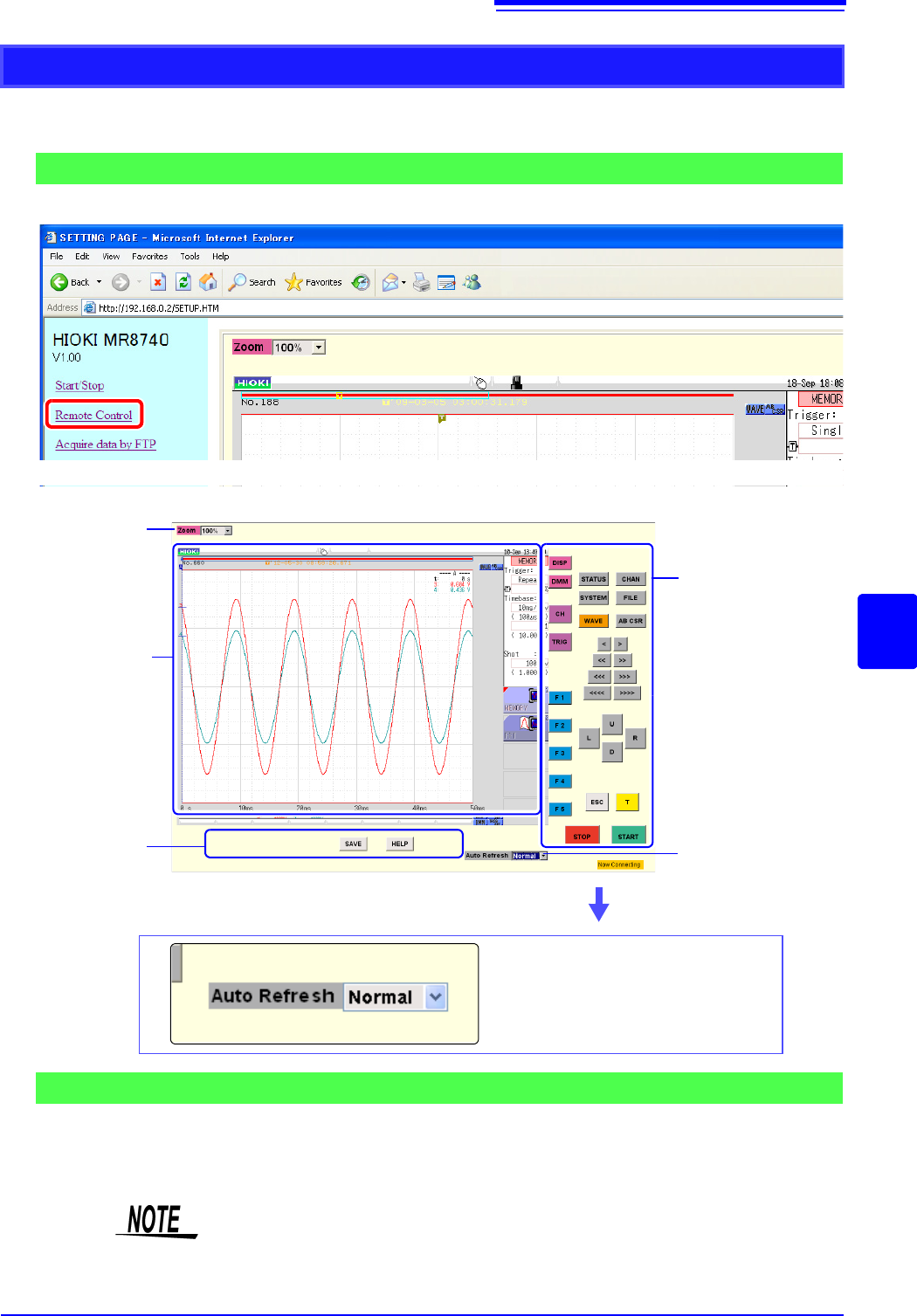
To open the screen: Click [Remote Control] on list of operations.
The remote control screen is divided into the instrument display section and operation panel.
When you click a button on the operation panel, MR8740/MR8741 Memory
HiCorder performs the same action is if the corresponding key on the unit was
pressed. However, simultaneously activating more than one button is not possible.
The keys and controls on the instrument are active also during remote operation.
Remote Operation
Remote Control Screen
Operation panel
Instrument display
screen
Operation panel
Update screen
Zoom in or out
Set display update speed.
Available settings:
Normal / Slow / Very Slow
When Auto Update is enabled, screen information is sent from the instrument to the
PC in regular intervals to keep the display updated.
Basic Operations
Remote control may not be possible when JRE has not been installed. ( p.320)
If you will be using key operation, we recommend setting the refresh speed to
[Slow] or [Very Slow].
15.2 Performing Remote Operations on the Instrument (Use an Internet Browser)
324
Use any of the following operating procedures to acquire the data.
• Use the FTP function
• Use communication commands
Acquiring data by FTP __________________________________________
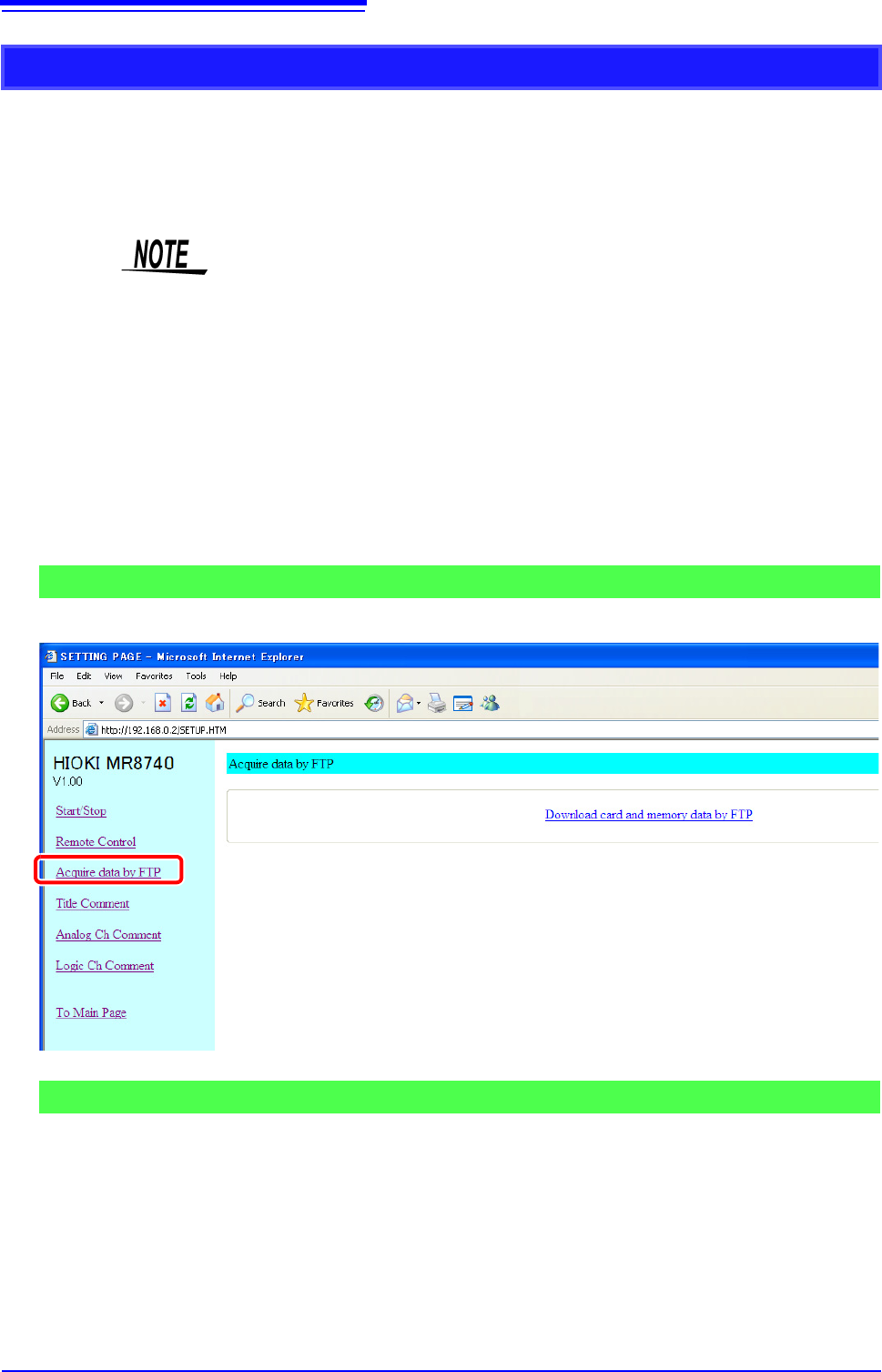
To open the screen: Click [Acquire data by FTP] in the list of operations.
Click [Download card and memory data by FTP].
A list of folders is displayed.
For details on how to perform file operations, see "15.3.3 Using FTP for File
Operations" (p.330).
Acquiring Instrument Memory Data from a Computer
For details on each of the commands, refer to the Instrument Communication
Command Instruction Manual on the application CD.
1
Save the data you want to acquire to a USB memory stick.
See: "4.2 Saving Data" (p.87)
2
Use the FTP function to move the saved data to a computer.
Screen for Acquiring Data by FTP
Procedure
15.2 Performing Remote Operations on the Instrument (Use an Internet Browser)
325
12
Chapter 15 Connection to a Computer
14
15
Acquiring data by communication commands ______________________
Transferring storage data (measurement values)
Use :MEMory:VDTA? A.
Transferring storage data in binary format
Use :MEMory:BDATA? A.
Procedure
1
:MEMory:MAXPoint?
The number of data samples stored in the memory of the instrument is acquired.
Check that storage data exists.
2.
:MEMory:POINt CH$,A
The output point of the storage data is specified.
(If you want to acquire the data from the beginning, change the value of A to 0.)
3.
:MEMory:VDATA? A
Just the number of data samples of the storage data (measurement values) specified with A is transferred
from the instrument to the computer. The output point is also incremented by the number of data samples.
• From 1 to 80 values can be acquired at one time with the VDATA command. If
you want to acquire more values than that, send the command in step
3
repeatedly.
• The maximum number of data samples that can be acquired is the value
acquired with the MAXPoint command.
Procedure
1
:MEMory:MAXPoint?
The number of data samples stored in the memory of the instrument is acquired.
Check that storage data exists.
2.
:MEMory:POINt CH$,A
The output point of the storage data is specified.
(If you want to acquire the data from the beginning, change the value of A to 0.)
3.
:MEMory: BDATA? A
Just the number of data samples of the storage data (binary) specified with A is transferred from the instru-
ment to the computer. The output point is also incremented by the number of data samples.
• From 1 to 400 values can be acquired at one time with the BDATA command.If
you want to acquire more values than that, send the command in step
3
repeatedly.
• The maximum number of data samples that can be acquired is the value
acquired with the MAXPoint command.
• #0 (indicates binary format) is added to the beginning of the output data.
• After #0, the storage data is transmitted two bytes at a time.