MR8740、MR8741_user_manual_eng_20191016H.pdf - 第416页
Appendix 4 FFT Definitions A 20 T ot al harmonic distortion (T HD) ________________ __________________ Total harmonic distortion ( THD) indicate s the pr oportion of the higher harm onics to the fundame ntal harmonic Thi…
Appendix 4 FFT Definitions
A19
Appendix
Averaging_____________________________________________________
With the FFT function, averaging is performed according to the following analyti-
cal expressions. Averaging in the time domain produces meaningless data if per-
formed with inconsistent trigger criteria.
1. Simple Averaging (Time and Frequency Domains)
Sequences of acquired data are summed and divided by the number of acquisi-
tions.
n: count of measurements to average
A
n
: averaging results of n counts
Z
n
: measurement data of n counts
2. Exponential Averaging (Time and Frequency Domains)
Before averaging, newer data is given exponentially greater significance than
older data.
N: Specified number of counts to average
n: count of measurements to average
A
n
: averaging results of n counts
Z
n
: measurement data of n counts
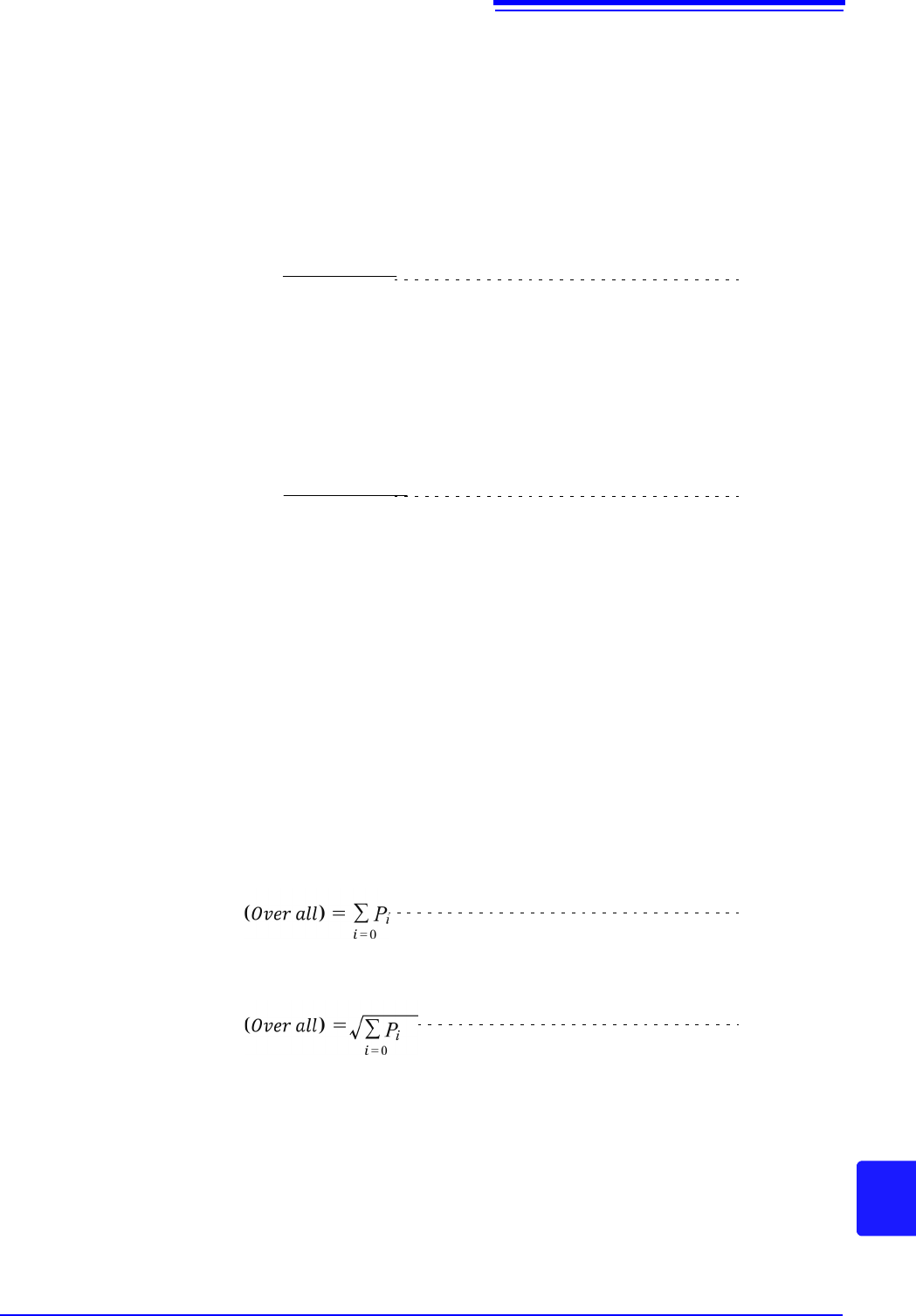
Overall Value __________________________________________________
The overall value is the sum of the power spectrum at each frequency. This
value is equal to the positive sum of the squares of the (RMS) input signals,
except when frequency averaging is performed. The FFT function of this instru-
ment calculates and displays the RMS values for stored waveforms and the
overall value from the sum of the power spectrum for the frequency domain. Any
FFT analysis modes other than the power spectrum, however, take the root
square of the overall value to match the unit.
P
i
: power spectrum of value i
(11)
n
ZAn
A
nn
n
1
)1(
(12)
N
ZAN
A
nn
n
1
)1(
(13-1)
With the FFT analysis mode set to the power spectrum
With the FFT analysis mode set to the histogram, linear spectrum, RMS spec-
trum, impulse response, 1/1 octave analysis, or 1/3 octave analysis
(13-2)

Appendix 4 FFT Definitions
A20
Total harmonic distortion (THD) __________________________________
Total harmonic distortion (THD) indicates the proportion of the higher harmonics
to the fundamental harmonic
This means that the larger the value, the more distorted the waveform.
THD
f
n
2
f
0
2
---------------
100=
f
0
= fundamental wave
f
n
= n next higher harmonic
[%]
(14)
Appendix 4 FFT Definitions
A21
Appendix
Window Function ______________________________________________
The Fourier transform of a continuous system is defined by the integral Calculus
in expression (15) for the time range from minus infinity to plus infinity.
However, because expression (15) cannot be calculated with actual measure-
ments, the Analysis is performed on a segment between finite limits. Processing
the waveform segment within these limits is called window processing. For FFT
analysis, the waveform segment within these limits is assumed to repeat period-
ically (as shown below).
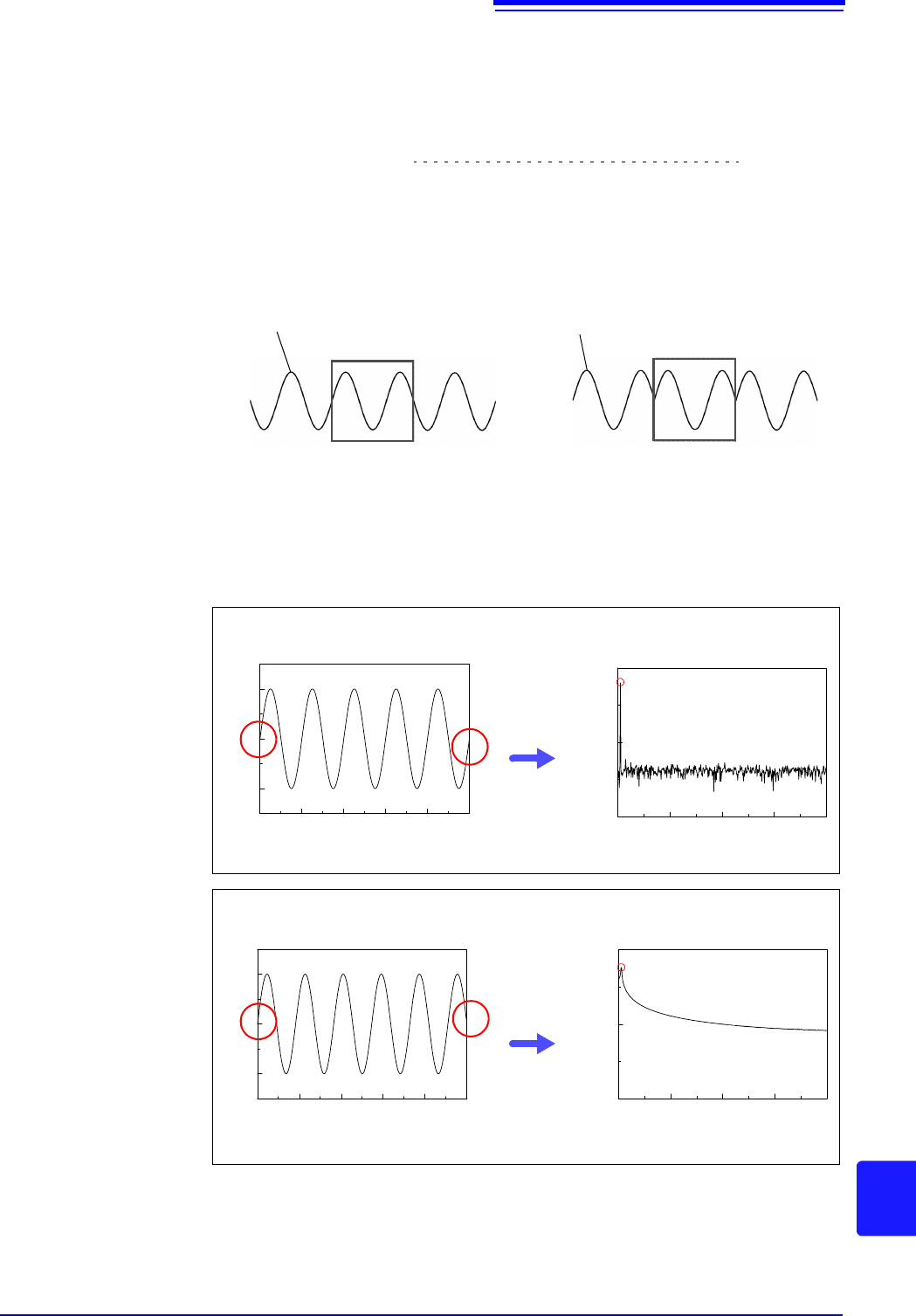
When the number of points for FFT analysis is an integer multiple of the input
signal frequency, a single-line spectrum is obtained. However, if it is not an inte-
ger multiple of the frequency (when the waveform assumed with FFT includes
discontinuous points), the spectrum is scattered, and a line spectrum cannot be
obtained. This phenomena is called leakage error (as shown below).
The window function was created to suppress such leakage errors. The window
function smoothly connects each end of the time-domain waveform where it is
cut off.
(15)
dttxfX
ft
2
)()(
Original Time-Domain Waveform
Waveform to be assumed with FFT
Time-Domain Waveform
Number of Points setting
Time-Domain Waveform
Number of Points setting
Time-domain waveform when the number of analysis points is an integer
multiple of the input frequency
Spectrum
0 0.002 0.004 0.006 0.008 0.01
-0.1
0
0.1
Time [sec]
Amplitude [V]
0 10 20 30 40
-200
-100
0
Frequency [kHz]
Magnitude [dB]
Time-Domain Waveform
Time-domain waveform when the number of analysis points is not an
integer multiple of the input frequency
Spectrum
0 0.002 0.004 0.006 0.008 0.01
-0.1
0
0.1
Time [sec]
Amplitude [V]
0 10 20 30 40
-200
-100
0
Frequency [kHz]
Magnitude [dB]
Time-Domain Waveform