KJ-01.02.Instruction Manual.REV.02.pdf - 第186页
5 − 90 3) Duplicate] The line on which the curs or is located is insert ed (copied) t o the next line. The paramet ers that are copied are the “ Component name” and “ Packag e”, with the remainders init ialized. 4) Find …
5 − 89
1) Copy
Use [1/ Copy] and [5/ Duplicate] when one type of component is supplied
from two or more feeders or trays.
The line on which the cursor is located is inserted (copied) to the line next to
the cursor line as many times as specified. The “component name” and
“package” on the cursor line are copied, while other parameters are
initialized.
The ESC key can be used to cancel the command any time. After the copy
operation, the cursor moves to the beginning of the copied line.
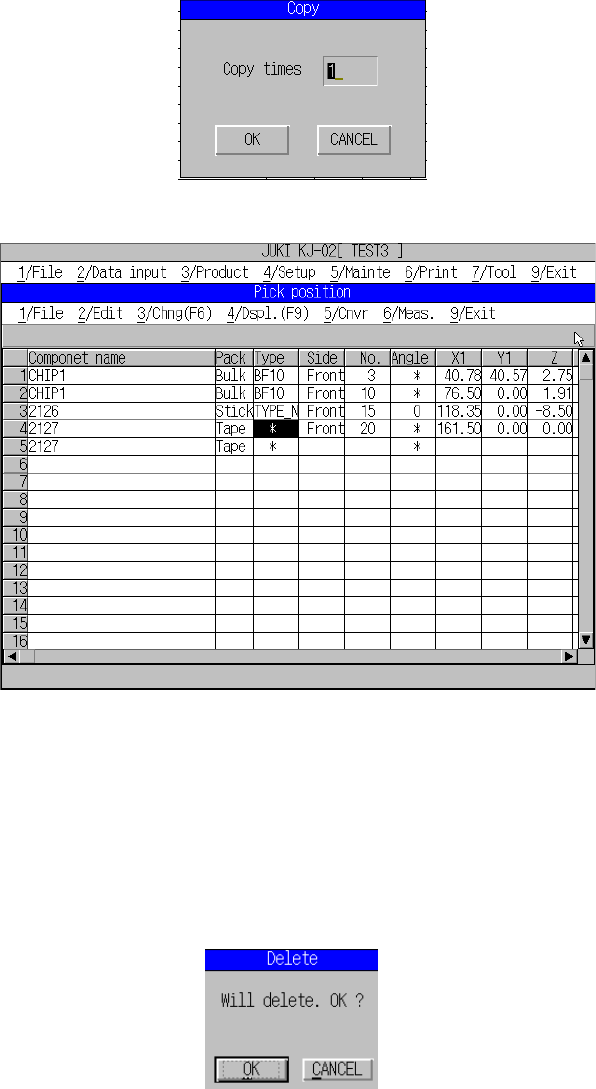
After [1/ Copy] has been selected, a dialog box appears to prompt you to
specify the number of copies.
Figure 5.6.6.2 Dialog box prompting entry of no. of copies
Figure 5.6.6.3 Result of copy operation
2) Delete
This command deletes the line on which the cursor is located.
The line cannot be deleted if only a set of pick data (line) is available with a
component type. The entire line on the cursor is deleted if multiple sets of
pick data (lines) are available with a component type.
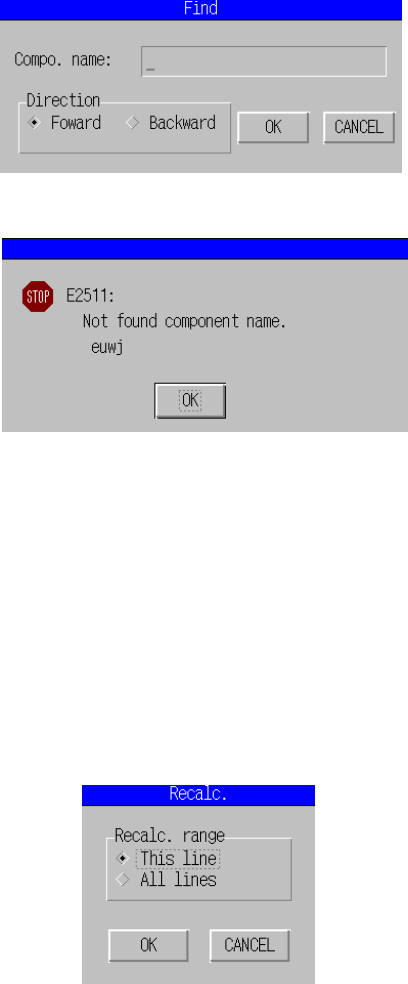
When you select the [2/Delete] command, the “Delete” confirmation dialog
box appears.
Figure 5.6.6.4 Dialog box confirming deletion
5 − 90
3) Duplicate]
The line on which the cursor is located is inserted (copied) to the next line.
The parameters that are copied are the “Component name” and “Package”,
with the remainders initialized.
4) Find
This command searches a component name through Pick data. When you
select the [7/Find] command, the “Find” dialog box appears on the screen as
shown in Figure 5.6.6.5. If the machine does not find a name you entered,
the error dialog box appears on the screen.
Figure 5.6.6.5 Pick data finding dialog box
Figure 5.6.6.6 Find error dialog box
5) Pick point recalc
This command displays the following dialog box to ask you whether the
pick-up coordinates of the line the cursor is located should be calculated
again or those of all lines should be calculated again.
The machine recalculates the pick-up coordinates of the current line or all
lines according to your selection.
If you have not entered the component pick-up coordinates (X1, Y1) on a
tray holder, the machine will not recalculate the pick-up coordinates of the
line(s) since the machine calculates that of the line(s) based on the
component pick-up position (X1, Y1).
Figure 5.6.6.7 Pick-up point recalculation dialog box
6) Mark database
This command deletes/modifies data registered onto the mark database.
See Section 6.4 “Mark Database Management” for details
5 − 91
(3) Chng
See the description of “Chng” on the PWB data screen for how to operate this
command.
(4) Dspl.
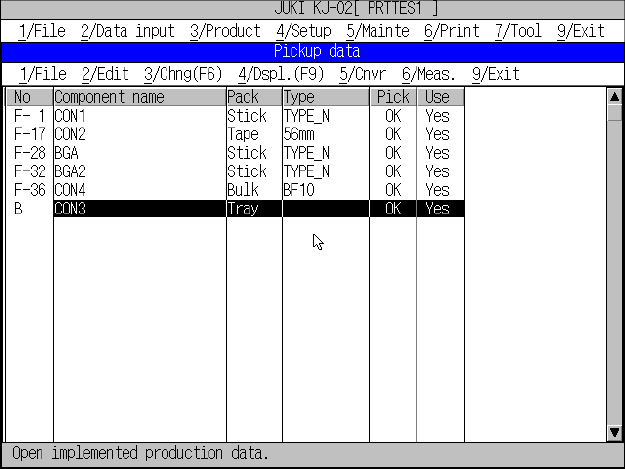
This command switches the screens between the Pick data displayed in input
order and that in feeder order.
On the screen displaying Pick data in feeder order, you can see the data only,
and cannot edit any data.
Figure 5.6.6.8 shows the screen displaying Pick data in feeder order.
Figure 5.6.6.8 Displaying Pick data in feeder order
The cursor moves up or down with pressing the ↑ or ↑ key. When you press the
↑ key on the top line or ↑ key on the bottom line, the screen is scrolled.
The PageUp or PageDown key scrolls the screen by one page.
When you press the Enter key, the machine switches the current screen to the
screen that allows you to enter data on the line the cursor is located.
(5) Cnvr (Conveyor) menu
The operation is the same as that for [5/ Cnvr] of PWB data.
(6) Meas. (Measurement) menu
Not available with the placement data.
(7) Exit menu
The same as the end of [Exit].