KJ-01.02.Instruction Manual.REV.02.pdf - 第99页
5 − 3 Director y list: – Allows you to change the curr ent drive and director y . File type: – Selects t he file t ypes to be read. – Y ou can select a f ile type: KJ-01 (*. J1 1), KJ-02 (*. J12), KE750 ( *.G3C) and KE76…
5 − 2
The table below shows the messages displayed on the message line during file
command selection.
No. Command Display on the message line
1 Open Reading the production program already stored.
2 Save Saving the current program.
3 New Creating a new production program.
4 Save as Saving the current program by renaming it.
5 File maintenance Copying, deleting, or renaming the file, or formatting the disk.
6 Exit Exiting from the program.
7 About program Showing the version number of the program.
5.1.1 Open
(1) Operation
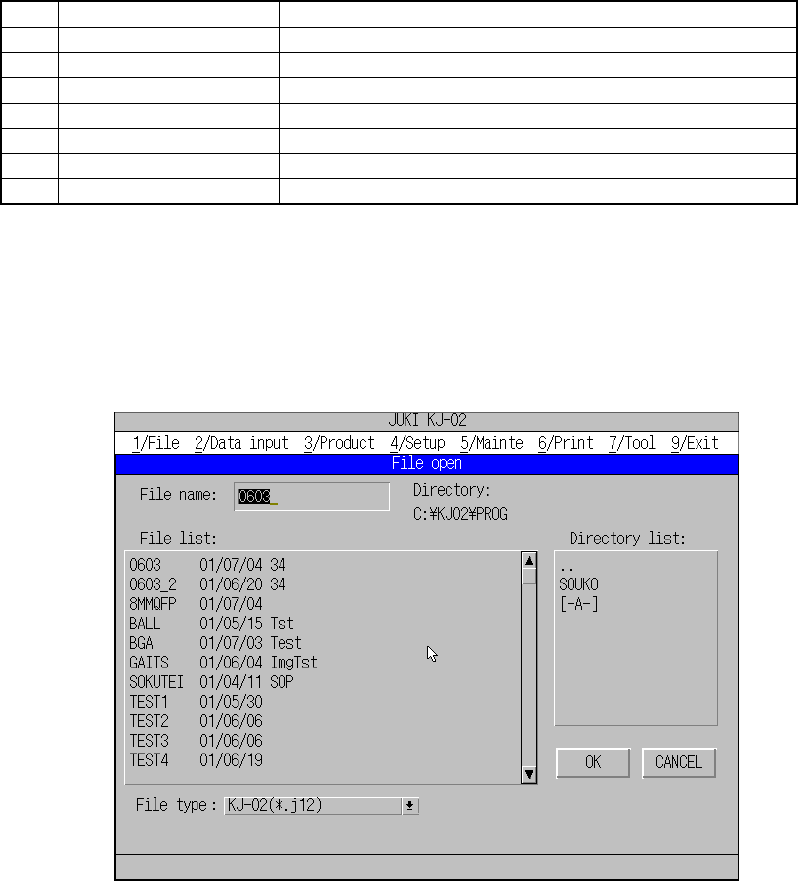
A screen appears as shown in Figure 5.1.1.1 when [Open] is selected from the
File menu.
Figure 5.1.1.1 File Open dialog box
① Description of each display item
File:
– Enter the file name directly in the edit box for “File Name”. Or, use the field
selection key to move to the “File list” and use a cursor key to select the
desired file. The file name highlighted at this time is set in the file name edit
box.
– The read (load) operation is executed when the ENTER key is pressed or
“OK” button is selected with the file name specified.
– An error dialog appears to prompt the operator’s confirmation if the file name
directly entered in the edit box does not exist.
File list:
– Lists the file name, date last modified, and PWB ID for all files. A cursor key is
used to select the desired file.
5 − 3
Directory list:
– Allows you to change the current drive and directory.
File type:
– Selects the file types to be read.
– You can select a file type: KJ-01 (*.J11), KJ-02 (*.J12), KE750 (*.G3C) and
KE760 (*.G3G).
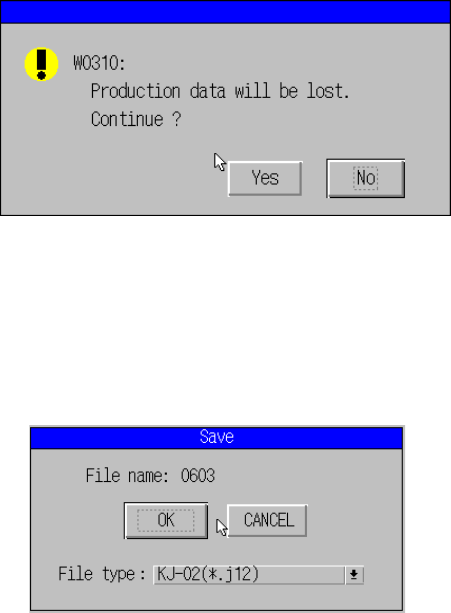
② Dialog box
– A dialog when the data created will be lost
A dialog box as shown in Figure 5.1.1.1 appears as a cautionary window to
confirm you whether the data being created may be lost or not.
5.1.2 Save
(1) Operation
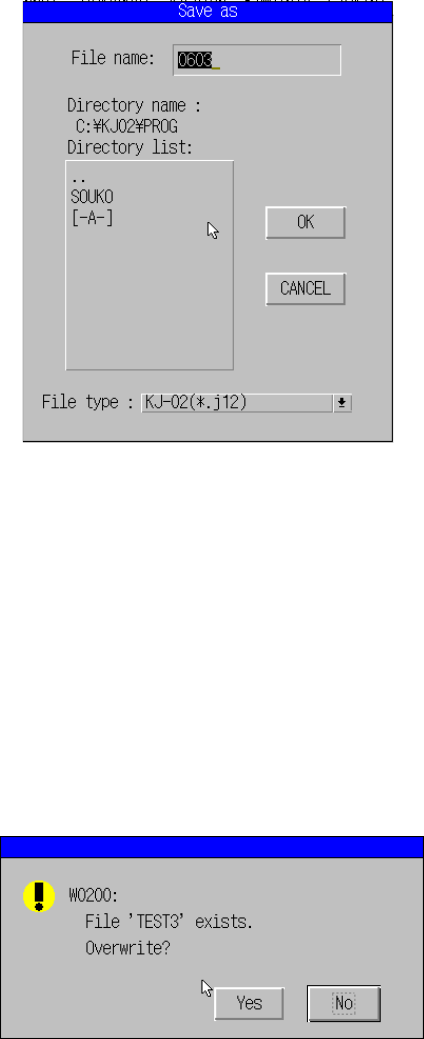
A screen appears as shown in Figure 5.1.2.1 “Save dialog box” when [Save] is
selected from the File menu.
Figure 5.1.2.1 Save dialog box
After checking the file name and type, the machine saves a file in the machine format
selected from the combo box: KJ-01 (*.J11) or KJ-02 (*.J12). If you have not
specified the file name, the following “Save as” dialog box appears on the screen.
5.1.3 New
(1) Operation
When you select the [3/New] command, the PWB data screen, which is
described under Section 5.2 “Data Input”, appears.
If the current data has been edited and your initialization causes that data to be
lost, the confirmation dialog box appears on the screen.
(See the description of the dialog box that appears if the current data is to be
lost.)
5 − 4
5.1.4 Save as
(1) Processing
When the command is selected, the machine renames the current data file and
saves it. Once the data file is saved, the file name for the current data file
becomes the one set by this command.
(2) Operation
A screen appears as shown in Figure 5.1.4.1 “Save as dialog box” when [Save
as] is selected from the File menu.
Figure 5.1.4.1 Save as dialog box
The machine displays the original file name and waits for your entry of a new file
name.
When you press the ENTER key or filed selection key to confirm the entered new
file name, the current file is saved with the new file name. Note that an error
message appears if saving of the file exceeds the number of storable programs
or capacity of the disk memory space.
① Dialog box
When the new file name already exists: