Hanwha SM481 PLUS Series Administrator’s Guide Eng.pdf.pdf - 第228页
7-70 Fast Flexible Placer SM481(L) PLUS Administ r ator’s Guide Memo Normally , the typ e of the time graph becomes dif f erent by parts. For e xample, in the case of the general r e ctangular chips greater than 1608, t …
7-69
Part Registration
<Vac Off> edit box
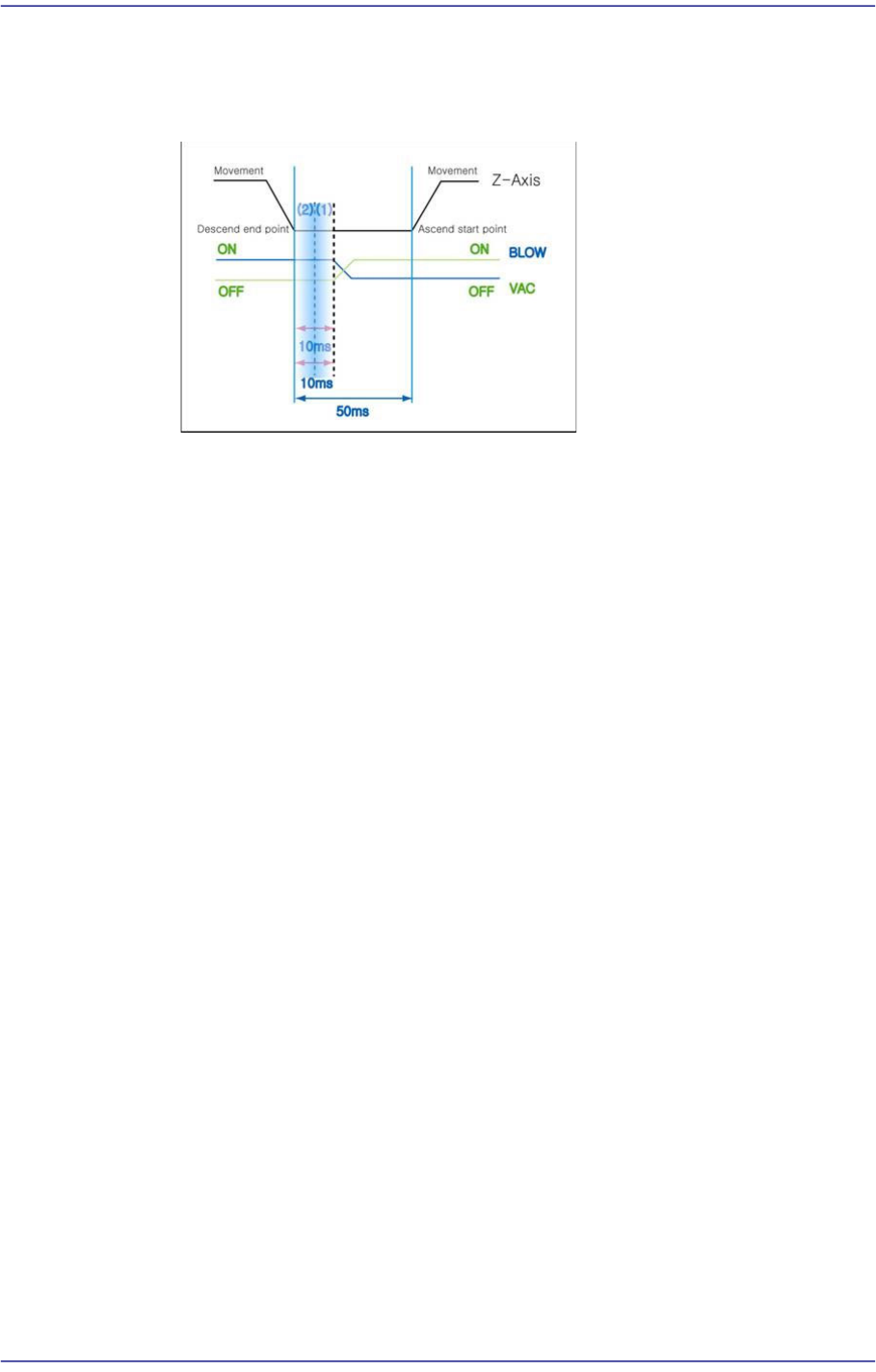
During component placement, the delay time after the head spindle has come
down until vacuum is off.
For example, if the ‘Place’, ‘Vac OFF’ and ‘Blow ON’ are set to 50, 10 and 10
respectively,
The time required is 50ms from the time the Z axis finishes moving down for
placement until the Z axis begins to move up after all processes are completed.
The ‘Vac off’ 10 means that the vacuum will be turned off in 10ms after the Z
axis finishes moving down for placement.
The ‘Blow ON’ 10 refers to the delay time from the time the Z axis finishes
moving down to the time the Blow On is performed.
7-70
Fast Flexible Placer SM481(L) PLUS Administrator’s Guide
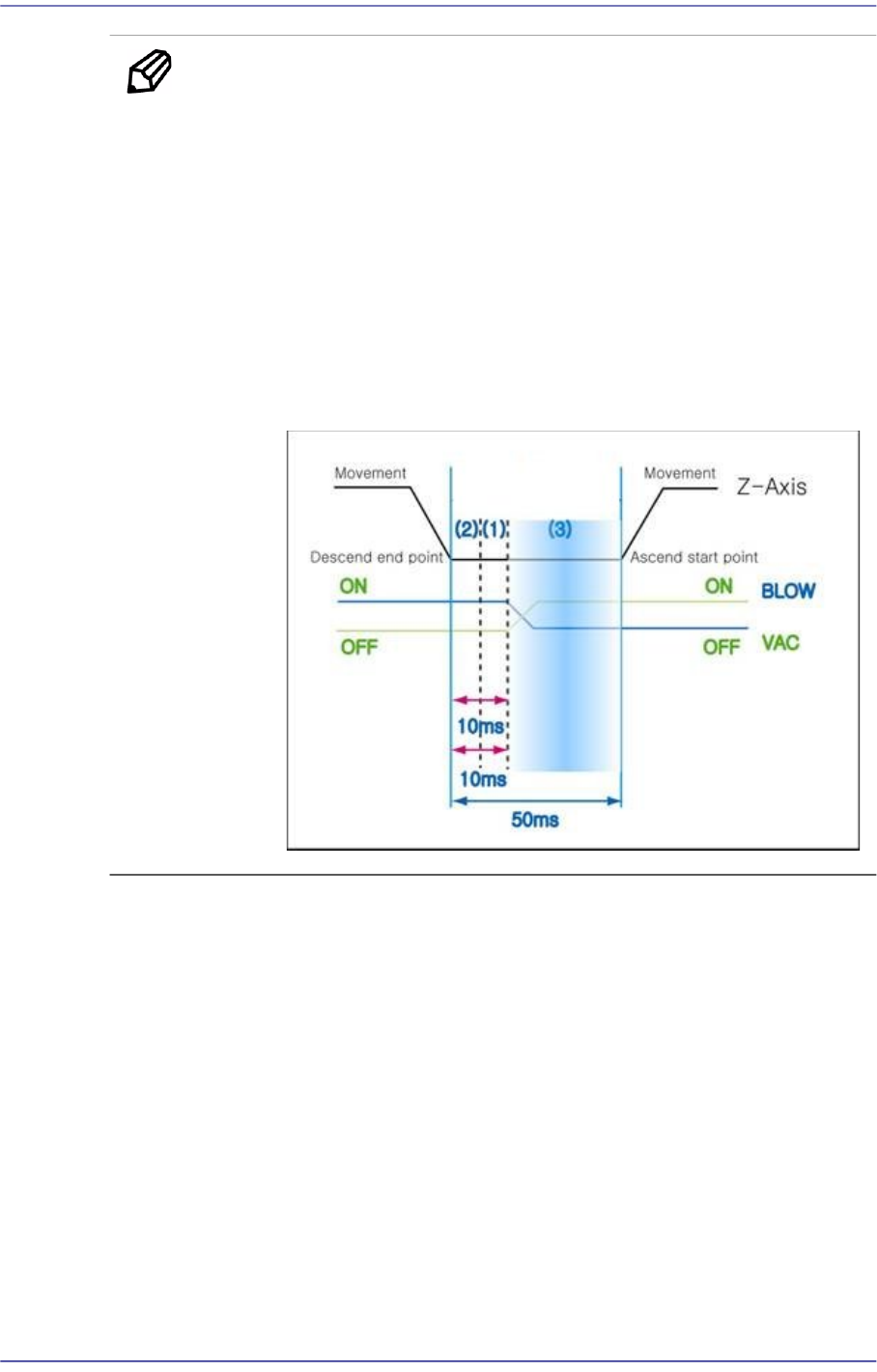
Memo Normally, the type of the time graph becomes different by parts.
For example, in the case of the general rectangular chips greater
than 1608, the parts are very light. Therefore, if the Z-axis moves
up before the vacuum disappears completely, the part may fall to
the PCB when the vacuum disappears while it moves up along
with the head.
In other words, item (3) in the following figure may act as the most
important factor for general rectangular chips.
From many test and experiment results, it was known that the
required time in item (3) was at least 0ms up to 20ms. Since this is
very important, the user must have this in mind.
7-71
Part Registration
Memo In the case of the QFP for fine pitch parts, when the Z-axis moves
down at high speed to place the part, it may physically collide with
the PCB.
In addition, such impact may shake the PCB slightly and cause the
solder paste to be mashed. Therefore, placing the parts in this manner
may cause the reduction of placement accuracy.
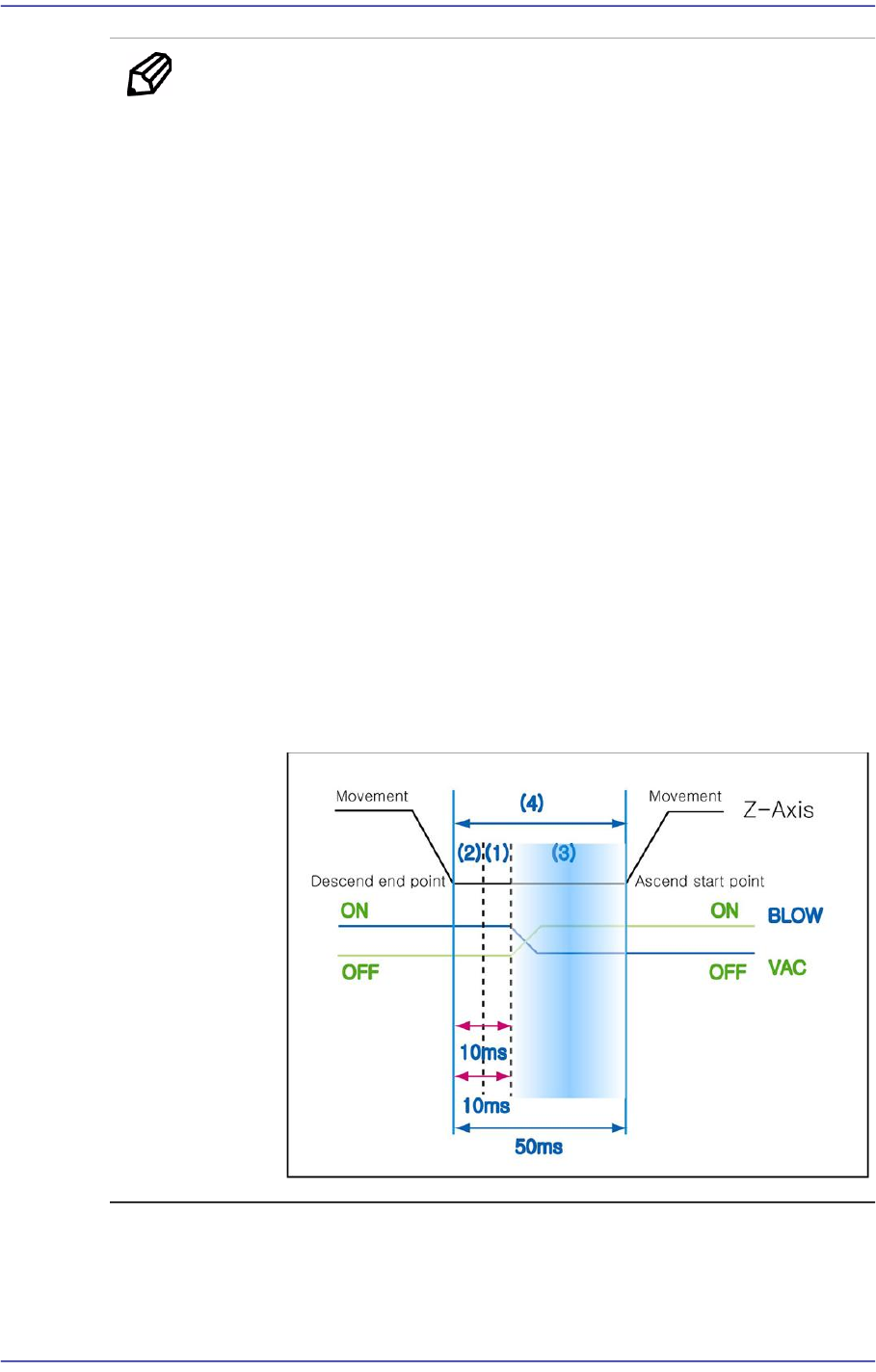
Such situation can be prevented by controlling the Vac off delay time.
That is, the part is held by a vacuum until various external factors are
stabilized, after which the vacuum is turned off after the external
factors disappear to prevent the problem.
The Vac off delay time corresponds to item (1) of the following
figure.
In the case of parts with general pitch, even though the time in the
above item (1) is not considered, it does not have great influence on
the placement accuracy.
However, in the case of parts with fine pitch or those that may cause
the above problem, it may be beneficial to set the time in item (1)
short.
Generally, the Vac off delay time is set to 20~30% of the total delay
time in item (4). Since this is very important, the user must have
this in mind.
<Blow On> edit box
During component placement, The time from vacuum off till blown on once the
head stops upon completion of descent