IPC-TM-650 EN 2022 试验方法.pdf - 第101页
1.0 Scope This method is designed to determine dimen- sional conformance to specification of production-cut panels of laminate or prepreg for length, width, and perpendicularity. 2.0 Applicable Documents IPC-PC-90 3.0 Te…
1.0
Scope
This
test method is designed to determine the
minimum and maximum thickness of the base material of
metallic clad laminates by microsectioning and optical mea-
surement.
2.0
Applicable Documents
IPC-TM-650
Method
2.1.1, Microsectioning
IPC-TM-650
Method
2.2.18, Determination of Thickness of
Laminates, by Mechanical Measurement
3.0
Test Specimens
3.1 Size
Unless
otherwise specified, a specimen measuring
25.4 X 12.7 mm [1.0 X 0.5 in] shall be taken from the laminate
sample.
3.2
Quantity and Sampling
Unless
otherwise specified,
two samples shall be taken from the lot that represent the
centermost area and the edges, but no closer than 25.4 mm
[1.0 in] from the edge, of the as- manufactured sheet.
4.0
Apparatus or Material
4.1
Any
optical inspection measuring device with a capabil-
ity of 100X and 200X with an accuracy to 0.0025 mm [0.0001 in].
4.2
A
microsectioning system capable of preparing speci-
men mounts that can be used for this procedure.
5.0
Procedure
5.1 Preparation of Specimens
Each
specimen to be
measured shall be microsectioned in accordance with IPC-
TM-650, Method 2.1.1. The long dimension of the specimen
shall be in the plane of examination. Specimens may be
ganged in accordance with the sampling procedure.
5.2
Evaluation
Examine
the entire length of the specimen.
Determine and record the minimum and maximum thickness
of each specimen to the nearest 0.0025 mm [0.0001 in] using
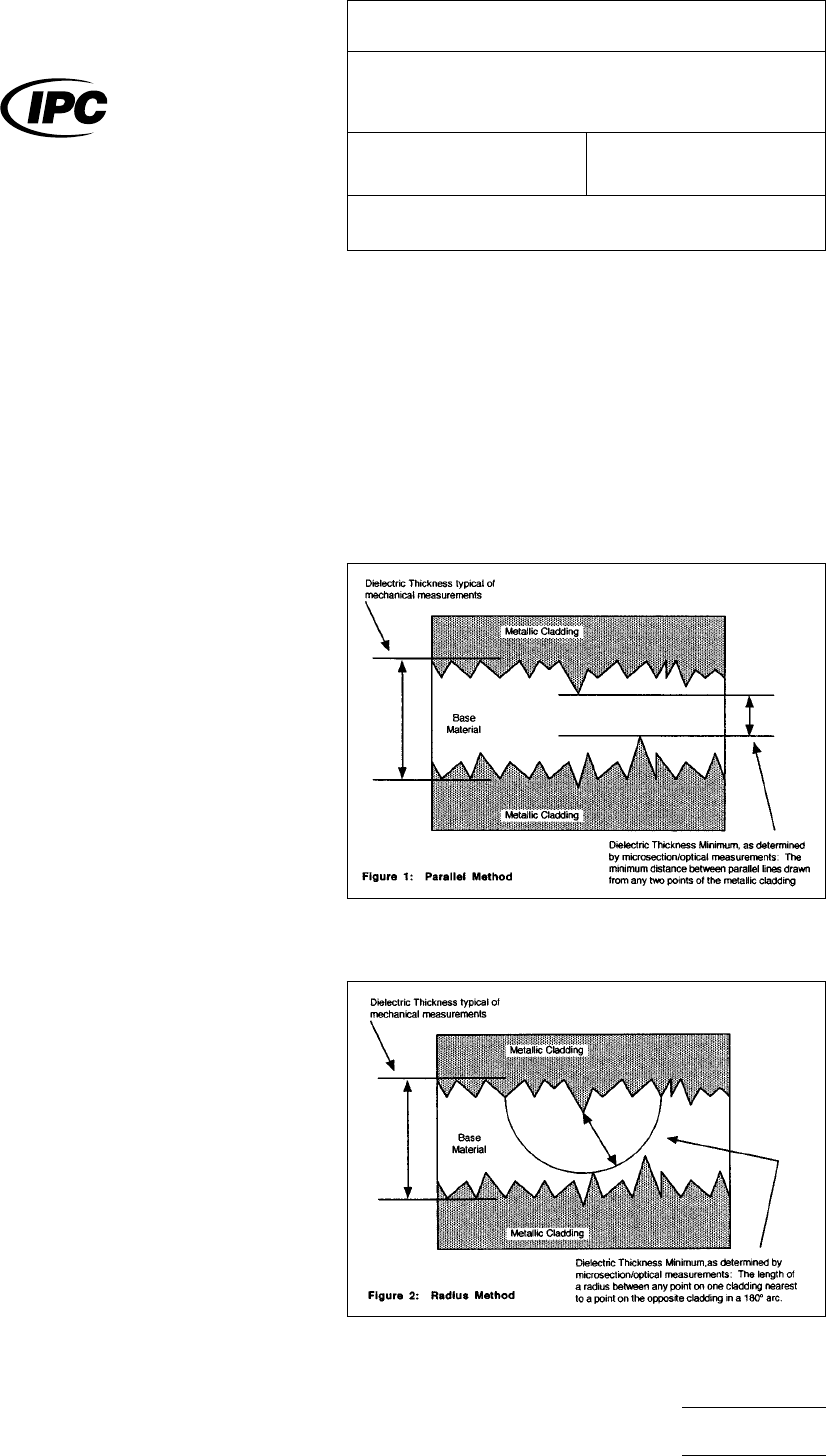
100X magnification and in accordance with Figures 1 or 2, in
accordance with the applicable specification. Unless other-
wise specified, Figure 2 shall be used. Any referee measure-
ments shall be made at 200X magnifications.
5.3
Report
Report
the minimum and maximum readings
found from each specimen inspected, and whether the Paral-
lel (Figure 1) or Radius (Figure 2) Method was used.
6.0
Notes
Cross-sectional
thickness relates to the effective
electrical insulation thickness and will usually be less than that
found by mechanical means (see IPC-TM-650, method
2.2.18). For determination of the laminate’s contribution to
overall board thickness, the mechanical approach is preferred
(when measuring thin cores for multilayer applications).
The
Institute for Interconnecting and Packaging Electronic Circuits
2215 Sanders Road • Northbrook, IL 60062
IPC-TM-650
TEST
METHODS MANUAL
Number
2.2.18.1
Subject
Determination
of Thickness of Metallic Clad
Laminates, Cross-sectional
Date
12/94
Revision
Originating Task Group
MIL-P-13949 Test Methods Task Group (7-11b)
Material
in this Test Methods Manual was voluntarily established by Technical Committees of the IPC. This material is advisory only
and its use or adaptation is entirely voluntary. IPC disclaims all liability of any kind as to the use, application, or adaptation of this
material. Users are also wholly responsible for protecting themselves against all claims or liabilities for patent infringement.
Equipment referenced is for the convenience of the user and does not imply endorsement by the IPC.
P
age1of1
电子技术应用 www.ChinaAET.com

1.0
Scope
This
method is designed to determine dimen-
sional conformance to specification of production-cut panels
of laminate or prepreg for length, width, and perpendicularity.
2.0 Applicable Documents
IPC-PC-90
3.0
Test Specimens
3.1 Size
Production
cut panels in the dimensions intended
for shipment shall be used.
3.2
Sampling
Sampling
rates shall be in accordance with
the applicable specification. (Also see 6.1.)
4.0
Apparatus or Material
Unless
otherwise specified,
precision of measurement apparatus shall be in accordance
with the applicable specification.
4.1
Vernier
calipers capable of measuring up to 914 ± 6.4
mm [36.0 ± 0.25 in] or equivalent.
4.2
Tape
measure capable of measuring up to 1829 mm
[72.0 in]
4.3
Carpenters
square, or equivalent
4.4
Pin
gauges, dial indicators or equivalent
5.0
Procedure
5.1 Length
Measure
the length of the edges of the panel
that are parallel to the grain direction using a vernier caliper.
5.2
Width
Measure
the length of the edges of the panel
that are perpendicular to the grain direction using a vernier
caliper.
5.3
Perpendicularity
5.3.1 Method A: by diagonals
5.3.1.1
Measure
the diagonals of the panel using vernier
caliper or tape measure.
5.3.1.2
Calculate
perpendicularity as follows:
D = D1–D2 (Maximum allowable difference in diagonals)
Where:
D1
=
√
(L + T)
2
+ W
2
D2
=
√
(L − T)
2
+ W
2
L
= Nominal length of panel [ins]
W = Nominal width of panel [ins]
Tii = Tolerance in inches per inch for perpendicularity
shown in the procurement document.
T = Tii x W (Tolerance in inches)
5.3.1.3
Calculate
the actual difference in the diagonals from
the measurements taken.
5.3.1.4 Compare
the actual difference to the allowable
maximum.
5.3.2
Method B: By carpenters square (‘‘Right Angle’’
Square)
5.3.2.1
Place
the panel in the carpenters square, contacting
the square by at least two corners.
5.3.2.2
Using
suitable means (see 4.4) measure the dis-
tance of the panel’s corner that does not contact the square.
5.3.2.3
Calculate
the perpendicularity by dividing the dis-
tance by the length of the longest dimension of the panel.
5.4
Evaluation
Compare
the measurements with dimen-
sional requirements of the applicable specification. Record the
number of panels that do not comply. Record the number of
noncomplying panels for each dimension—length, width, and
perpendicularity.
5.5
Report
the number of panels, specifying which dimen-
sion, that do not comply with the applicable specification.
6.0 Notes
6.1
Sampling
may also be determined by IPC-PC-90 on
materials produced by continuous processing.
The
Institute for Interconnecting and Packaging Electronic Circuits
2215 Sanders Road • Northbrook, IL 60062
IPC-TM-650
TEST
METHODS MANUAL
Number
2.2.19.1
Subject
Length,
Width and Perpendicularity of Laminate
and Prepreg Panels
Date
12/94
Revision
Originating Task Group
MIL-P-13949 Test Methods Task Group (7-11b)
Material
in this Test Methods Manual was voluntarily established by Technical Committees of the IPC. This material is advisory only
and its use or adaptation is entirely voluntary. IPC disclaims all liability of any kind as to the use, application, or adaptation of this
material. Users are also wholly responsible for protecting themselves against all claims or liabilities for patent infringement.
Equipment referenced is for the convenience of the user and does not imply endorsement by the IPC.
P
age1of1
电子技术应用 www.ChinaAET.com

1.0
Scope
This
procedure determines the percent metal
content for solder paste.
2.0
Applicable Documents
None
3.0
Test Specimen
50
grams of solder paste
4.0
Equipment/Apparatus
Balance
Crucible
or Beaker
Heat Source
Flux Solvent
5.0
Procedure
5.1 Preparation
5.1.1
Weigh
10 to 50 grams (to the nearest 0.01 gram) of
solder paste into a tared vessel suitable for melting the solder
paste.
5.2
Test
5.2.1
Melt
the solder at approximately 25°C above liquidus
of the alloy, remove from heat and allow solder to solidify.
5.2.2
Extract
melt from residual flux with a suitable solvent,
dry and weigh metal to within 0.01 grams to determine %
metal content.
5.3
Evaluation
Weight
of extracted metal
Weight
of original sample
x 100 = % Metal
Enter the results in Table 1 ‘‘Test Report on Solder Paste.’’
The
Institute for Interconnecting and Packaging Electronic Circuits
2215 Sanders Road • Northbrook, IL 60062
IPC-TM-650
TEST
METHODS MANUAL
Number
2.2.20
Subject
Solder
Paste Metal Content by Weight
Date
1/95
Revision
Originating Task Group
Solder Paste Task Group (5-24b)
Material
in this Test Methods Manual was voluntarily established by Technical Committees of the IPC. This material is advisory only
and its use or adaptation is entirely voluntary. IPC disclaims all liability of any kind as to the use, application, or adaptation of this
material. Users are also wholly responsible for protecting themselves against all claims or liabilities for patent infringement.
Equipment referenced is for the convenience of the user and does not imply endorsement by the IPC.
P
age1of2
电子技术应用 www.ChinaAET.com