IPC-TM-650 EN 2022 试验方法.pdf - 第294页
only this length is used in the calculation, otherwise the dis- tance between the grips is used as the initial gauge length. The result is expressed in percent and reported to two signifi- cant figures. percent elongatio…

4.7
Extension Indicators (optional)
Extension
indicators
(e.g., extensometers) must be designed as to minimize stress
on the specimen at the contact points of the specimen and
the indicator. Clip type extensometers are not recommended
for this reason. Laser extensometers can be used if the
method of marking the specimen does not induce any stress
or strain into the specimen (e.g., scratching the specimen) or
change the specimen in any fashion (e.g., heating the
specimen).
4.8
Calibration
The
thickness gauge should be calibrated
every six months using standard gauge blocks. The blades on
the film cutter should be resharpened or replaced at least
once a year. The load cell on the tensile tester should be cali-
brated at least once a week following the manufacturer s rec-
ommended procedure. Also, the stops which control the ini-
tial grip separation should be checked once a week.
5.0
Procedure
5.1 Operating Conditions
The
tests should be conducted
at 23 ± 2°C and 50 ± 5% relative humidity.
5.2
Preparation of Test Specimens
5.2.1
The
test specimens should be conditioned at 23 ±
2°C and 50 ± 5% relative humidity for not less than 24 hours
prior to testing. Refer to ASTM D 618.
5.2.2
The
free films are placed between two cover sheets of
clear film (MylarT* or equivalent) to facilitate handling of the
specimens.
5.2.3
Cut
at least 10 specimens 76.20 mm long and 12.70
mm wide. No specimen shall vary by more than 2% in width
along its entire length. The utmost care must be exercised in
cutting specimens to prevent nicks and tears along the edges
of the specimen that are likely to cause premature failure. If
the properties in the plane of the film are not isotropic (e.g.,
the films were not prepared by spin coating), then ten films
must be cut in both the machine direction (MD) and transverse
direction (TD).
5.4
Testing
5.4.1
Measure
and record the thickness of the test speci-
men to an accuracy of 0.1 µm at no fewer than five different
places within the gauge length area. Refer to ASTM D 1005
and AST D 2370.
5.4.2
Set
the initial gauge length (grip separation) at 25.4
mm and the rate of grip separation at 5.08 mm/min.
5.4.3
Place
the specimen in the grips of the testing
machine, taking care to align the long axis of the specimen
with an imaginary line joining the points of attachment of the
grips to the machine. The specimen should be aligned as per-
fectly as possible with the direction of pull so that no rotary
motion that may induce slippage will occur in the grips.
Tighten the grips evenly and firmly to the degree necessary to
minimize slipping of the specimen during testing. The use of
air activated grips facilitates the mounting of the specimen in
the grips.
5.4.4
Start
the test and record the load versus extension.
5.4.5
Repeat
steps 5.4.1 - 5.4.4 for each series of ten
specimens.
5.5
Calculations
5.5.1
For
each series of ten specimens, the arithmetic mean
and standard deviation of each property for the specimens
with the five highest tensile strengths shall be calculated to the
proper number of significant figures. This is done on the basis
that the expected errors (nicks or flaws in the specimen,
breaks within the grips, specimen slippage, etc.) would all
tend to produce lower results. The standard deviation is cal-
culated as follows and reported to two significant figures:
S
x
=
√
N
Σ
N
i = 1
X
i
2
−
(
Σ
N
i = 1
X
i
)
2
N(N−1)
where
Xi is the value of a single observation (i = 1 through N),
N is the number of observations, and s
x
is
the estimated stan-
dard deviation.
5.5.2
Tensile Strength
Tensile
strength is calculated by
dividing the load at break by the original minimum cross-
sectional area. The result is expressed in megapascals (MPa)
and reported to three significant figures.
tensile strength =
(load at break)
(original
width)(original thickness
5.5.3
Percent Elongation
Percent
elongation is calculated
by dividing the elongation at the moment of rupture by the ini-
tial gauge length and multiplying by 100. When gauge marks
or extensometers are used to define a specific test section,
IPC-TM-650
Number
2.4.18.3
Subject
Tensile
Strength, Elongation, and Modulus
Date
7/95
Revision
P
age2of3
电子技术应用 www.ChinaAET.com
only
this length is used in the calculation, otherwise the dis-
tance between the grips is used as the initial gauge length.
The result is expressed in percent and reported to two signifi-
cant figures.
percent elongation =
(elongation at rupture) x 100
(initial
gage length)
5.5.4
Young’s Modulus
Young’s
modulus is calculated by
drawing a tangent to the initial linear portion of the stress-
strain curve, selecting any point on this tangent, and dividing
the tensile stress by the corresponding strain. For purposes of
this calculation, the tensile stress shall be calculated by divid-
ing the load by the average original cross section of the test
specimen. The result is expressed in gigapascals (GPa) and
reported to three significant figures.
Young’s modululus =
(load at point on tangent)
(original
width)(original thickness)
(elongation at point on tangent)
(initial
gage length
5.5.5
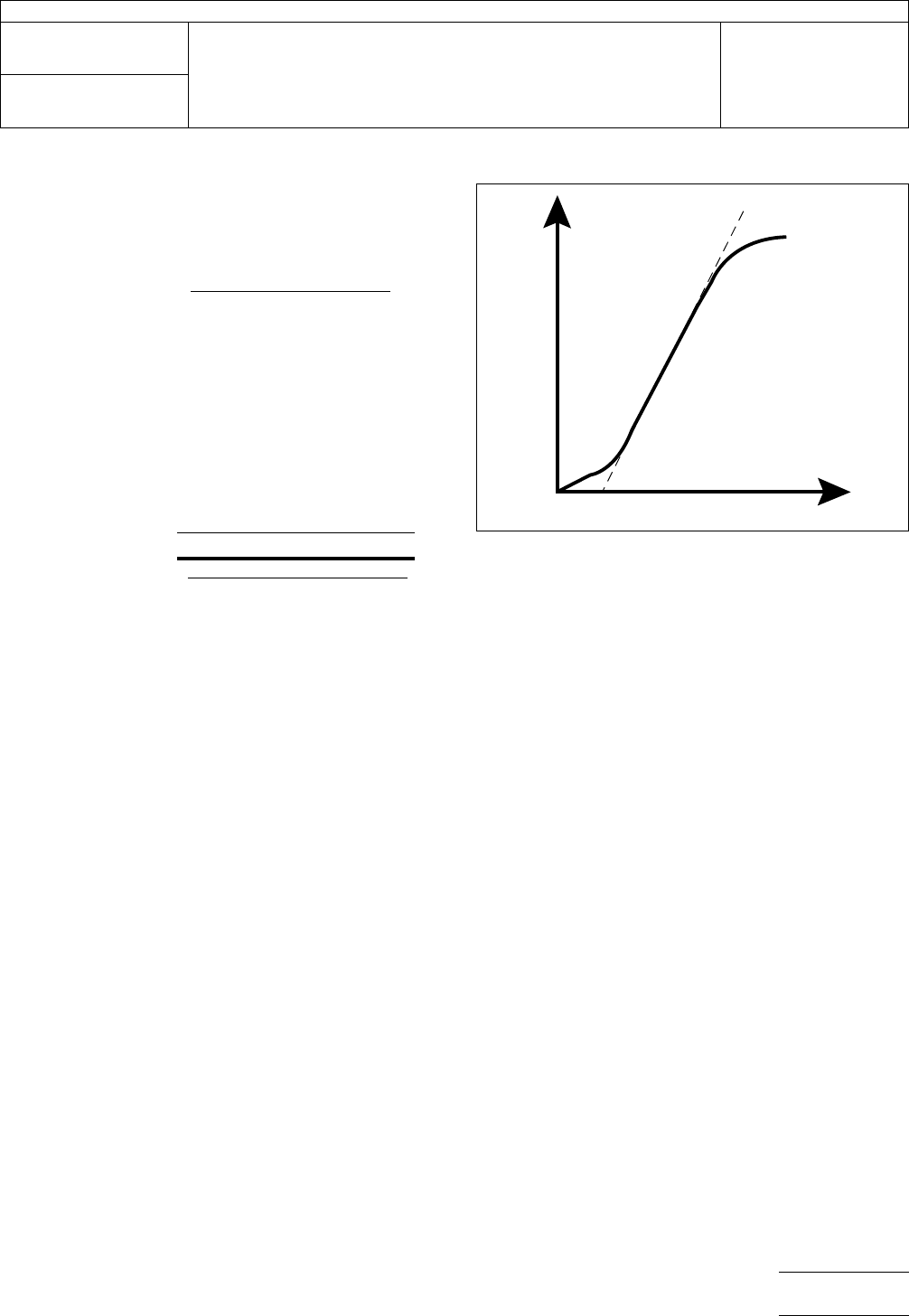
Toe Compensation
(from
ASTM D 882) In a typical
stress-strain curve (see below), there is a toe region, AC,
which does not represent a property of the material. It is an
artifact caused by a take-up of slack, and alignment or seat-
ing of the specimen. In order to obtain correct values of such
parameters as modulus, strain, and yield point, this artifact
must be compensated for to give the corrected zero point on
the strain or extension axis. In the case of a material exhibiting
a region of Hookean (linear) behavior as shown below, a con-
tinuation of the linear (CD) region of the curve is constructed
through the zero-stress axis. The intersection (B) is the cor-
rected zero-strain point from which all extensions or strains
must be measured, including the yield point, if applicable. The
elastic modulus can be determined by dividing the stress at
any point along line CD (or its extension) by the strain at the
same point (measured from point B, defined as zero-strain).
6.0
Notes
The
tensile properties determined using this test
method will vary with method of specimen preparation, speci-
men thickness, specimen width, rate of grip separation, initial
gauge length, type of grips used, and method of measuring
extension. The tensile strength and elongation are sensitive to
the specimen dimensions and any flaws in the specimen.
Young’s modulus is an index of the stiffness of the specimen
and is sensitive to the rate of grip separation. Note that mate-
rials that fail by tearing give anomalous data that cannot be
compared with those from normal failure (rupture). A tear fail-
ure is a tensile failure characterized by fracture initiating at one
edge of the specimen and progressing across the specimen
at a rate slow enough to produce an anomalous stress-strain
curve. Results obtained using different specimen dimensions
or at different rates of grip separation are not comparable;
consequently, when trying to make quantitative comparisons
between specimens or between laboratories, these factors
must be carefully controlled.
2.4.18.3-01
Figure
1
Strain
Stress
AB
C
D
IPC-TM-650
Number
2.4.18.3
Subject
Tensile
Strength, Elongation, and Modulus
Date
7/95
Revision
P
age3of3
电子技术应用 www.ChinaAET.com

1
Scope
This
test is to determine the tensile strength and
elongation on specimens exposed to mechanical loads.
2
Applicable Documents
None
3
Test Specimen
The
test specimen shall consist of a strip
of flexible material 152.4 mm long x 12.7 mm wide. A mini-
mum of 10 specimens, five from the machine direction, and
five from the transverse direction, shall be prepared.
4
Apparatus
4.1 Equipment
Tinius-Olson
Super L Tester or equivalent
(with appropriate load cell). The machine used for tension test-
ing shall be in current calibration. The loads used in determin-
ing tensile strength shall be within the loading range of the
testing machine.
4.2
Gripping Devices
Various
types of gripping devices
may be used to transmit the measured load applied by the
testing machine to the test specimens. To ensure axial tensile
stress within the gauge length, the axis of the test specimen
should coincide with the centerline of the heads of the testing
machine.
4.3
Sample Cutter
Thwing
Albert Sample Cutter, Model
No. JDC-50, or equivalent.
4.4
Etcher
4.5
Sander
4.6
Micrometer
with 0.0025 mm resolution
4.7
Conditioning
chamber or work area 23°C ± 2°C, 50% ±
5% RH
5
Procedure
5.1 Preparation of Specimens
5.1.1
Condition
specimens for 24 hours at 23°C ± 2°C and
50% ± 5% relative humidity (RH). Stabilization time may be
reduced if statistically sound evidence has been generated on
the specific product line to support shorter conditioning times
to reach equilibrium.
5.1.2
Cut
at least 10 specimens, 152.4 mm long by 12.7
mm wide, using a precision sample cutter, which produces
smooth and undistorted edges. Specimens may be sanded
on the edges with 400-600 grit emery paper to further smooth
the edges and improve the repeatability of the test.
5.2
Test
5.2.1
Measure
and record the width and thickness of the
specimen at several points along its length. Calculate the mini-
mum cross-sectional area using the measured width. For
coated materials, ignore the thickness of the coating,
assumed to contribute nothing to the tensile properties of the
composite, and use the nominal substrate thickness for the
cross-sectional area calculation.
5.2.2
Set
the grip separation to 101.6 mm and the rate of
grip separation to 50.8 mm per minute.
5.2.3
Place
the test specimen in the grips of the testing
machine, taking care to align it with the centerline of the grips.
There should be no slack in the specimen.
5.2.4
Start
the machine and record load versus extension
(grip separation).
5.3
Evaluation
5.3.1
Tensile
strength shall be calculated by dividing the
load at break by the original cross-sectional area of the speci-
men. Average the five values obtained for the machine direc-
tion samples and report the average. Average the five values
obtained for the transverse direction samples and report the
average.
2215
Sanders Road
Northbrook, IL 60062-6135
IPC-TM-650
TEST
METHODS MANUAL
Number
2.4.19
Subject
Tensile
Strength and Elongation, Flexible Printed
Wiring Materials
Date
5/98
Revision
C
Originating Task Group
Flex Peel Strength Test Methods Task
Group (D-13A)
Material
in this Test Methods Manual was voluntarily established by Technical Committees of the IPC. This material is advisory only
and its use or adaptation is entirely voluntary. IPC disclaims all liability of any kind as to the use, application, or adaptation of this
material. Users are also wholly responsible for protecting themselves against all claims or liabilities for patent infringement.
Equipment referenced is for the convenience of the user and does not imply endorsement by the IPC.
P
age1of2
ASSOCIA
TION CONNECTING
ELECTRONICS INDUSTRIES
®
电子技术应用 www.ChinaAET.com