IPC-TM-650 EN 2022 试验方法.pdf - 第368页
where: L o = specimen length ( ∆ L L o ) t = certified expansion of the reference material. ( ∆ L/L o ) m = the measured expansion of the reference mate- rial. ( ∆ L L o ) s = the expansion of the vitreous silica parts o…
5.2.2
Condition
E-1/110.
5.2.3
Condition
C
1
-40/23/50.
5.3
Calibration
5.3.1
The
transducer shall be calibrated by imposing a
series of known displacements with a precision screw
micrometer or set of end gage blocks.
5.3.2
The
temperature sensor shall be calibrated according
to an appropriate ASTM method (E-220) or procedure recom-
mended by the National Bureau of Standards.
5.3.3
The
dilatometer, as a total system, shall be calibrated
by measuring two reference materials of known thermal
expansion. One of the materials should have an expansion
close to the sample specimen, and the other close to that of
the dilatometer.
5.3.4
Recommended standard reference materials:
•
NBS Fused Silica – SRM 739; CTE ∼ .55 PPM/°C (for cali-
bration of dilatometer)
• NBS Single Crystal Sapphire - SRM 732; CTE ∼ 5.5 PPM/°C
(for use with ‘‘low expansion’’ materials)
• OFHC Copper; CTE ∼ 17.3 PPM/°C (for use with ‘‘high
expansion’’ materials)
5.3.5
The
expansion of the dilatometer system, (∆L/L
o
)
s
,
and
the calibration constant, for corrections of lead lag, tem-
peratures, etc., are determined at 20°C intervals using the fol-
lowing equations:
(∆L/L
o
)
s
=(∆L/L
o
)
t
–(∆L/L
o
)
m
A =
(
∆L
L
o
)
t
–
(
∆L
L
o
)
s
(
∆L
L
o
)
m
IPC-24411-1
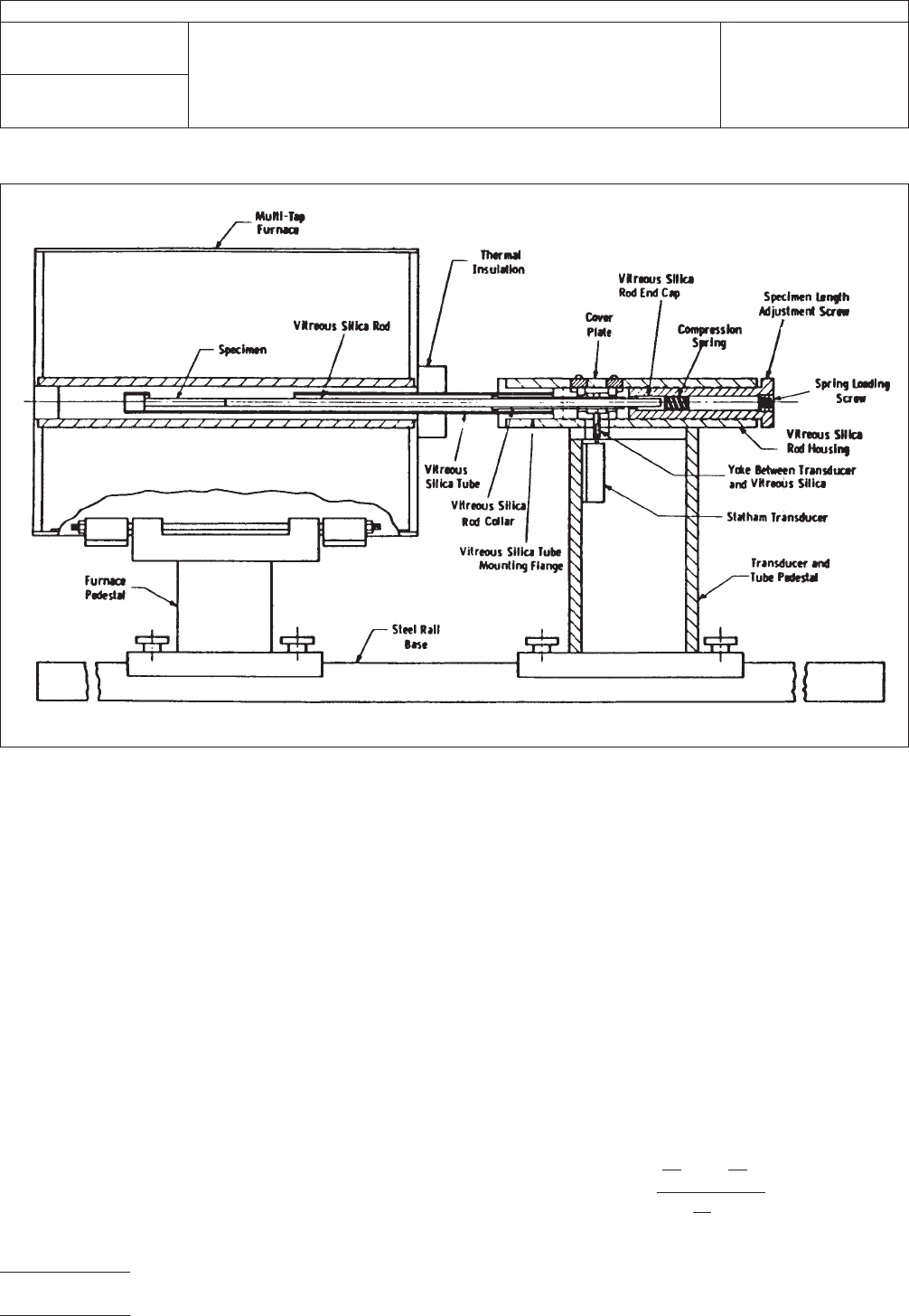
Figure
1 Cutaway view of vitreous silica tube dilatometer
IPC-TM-650
Number
2.4.41.1
Subject
Coefficient
of Thermal Expansion by the Vitreous Silica (Quartz)
Dilatometer Method
Date
8/97
Revision
A
P
age2of3
电子技术应用 www.ChinaAET.com

where:
L
o
=
specimen length
(
∆L
L
o
)
t = certified
expansion of the reference material.
(∆L/L
o
)
m
=
the measured expansion of the reference mate-
rial.
(
∆L
L
o
)
s = the
expansion of the vitreous silica parts of the dila-
tometer.
5.4
Test Procedure
Following
the conditioning steps per
5.2, two thermal cycles shall be conducted per test. The first
is to normalize the specimen and the second to generate data
for the calculation of CTE.
5.4.1
Measure
the initial length of the specimen, using the
micrometer to ± .001 inch.
5.4.2
Place
the specimen in the dilatometer after making
certain that all contacting surfaces are free of foreign material.
Specimens with thickness 0.125 inch shall be supported with
side plates. Care must be taken to assure good seating of the
specimen against the bottom of the tube bottom and the push
rod.
5.4.3
Place
the thermocouple sensor in intimate contact
with the specimen at midlength.
5:4.4 Mount
the transducer to provide a stable contact with
the probe. The sample loading force shall be the minimum
necessary for proper contact between the rod and specimen,
and the bottom of the tube and specimen. Set the transducer
at a nominal initial reading.
5.4.5
Place
the assembled dilatometer into the chamber
and allow the temperature of the specimen to come to equi-
librium.
5.4.6
Record
the initial readings of the thermocouple and
the transducer.
5.4.7
Heat
and cool at a constant rate of 2°C/min.
5.4.8
Record
length changes as a function of temperature.
5.4.9 Remove
the specimen from the fixture and repeat the
procedure per 5.4.1-5.4.8, following the first cycle. Remea-
surement of the specimen length must not be omitted prior to
start of the second cycle.
5.4.10
Test
a total of four specimens, two prepared with the
length in the machine direction of the laminate reinforcement
and two cut in the transverse direction. This quantity is
intended to represent the expansion characteristics of a 18
inch x 24 inch panel size.
6.0
Calculations
6.1
Linear
thermal expansion (LTE), the change in length per
unit length resulting from a temperature change is represented
by:
∆L
L
o
= A
(
∆L
L
o
)
a
+
(
∆L
L
o
)
s
where:
(
∆L
L
o
)
a
is
the expansion as indicated by the transducer, ∆Listhe
observed change in length (∆L=L
2
–L
1
).
LTE is often
expressed in µm/m (parts per million).
6.2
Mean
coefficient of linear thermal expansion – the linear
thermal expansion per change in temperature. Represented
by:
∝ m =
∆L/L
o
∆T
=
(L
2
–L
1
)
L
o
(T
2
–T
1
)
where
L
1
and
L
2
are
the lengths of the specimen at the test
temperatures T
1
and
T
2
.
6.3
Instantaneous
coefficient of linear thermal expansion –
the slope of the linear thermal expansion curve at temperature
T. Represented by:
∝ T =
1
L
o
dL
dT,
6.4
Plots
of the following are commonly used as required:
∆L
L
o
vs.
T; ∝ m vs. T
When reporting the mean coefficient of thermal expansion, the
temperature ranges must be specified.
IPC-TM-650
Number
2.4.41.1
Subject
Coefficient
of Thermal Expansion by the Vitreous Silica (Quartz)
Dilatometer Method
Date
8/97
Revision
A
P
age3of3
电子技术应用 www.ChinaAET.com

1
Scope
To
describe the strain gage method for determin-
ing linear thermal expansion of laminated materials within the
temperature range of –55 °C to +130 °C and inorganic sub-
strates (nonlaminated) with a range of –55 °C to +150 °C.
1.1
Care
should be taken if the higher temperatures are
used. The adhesive shown is rated by the manufacturer from
less than –200 °C to greater than +300 °C; however, for
higher temperature pretesting with the Titanium Silicate Stan-
dard or materials of known thermal expansion characteristics
is recommended.
2
Applicable Documents
None
3
Test Specimens
3.1
Specimens
are normally flat pieces of laminate or printed
wiring boards/assemblies that are to be tested nondestruc-
tively. Dimensions are to be 50.0 mm x 50.0 mm [2.0 in X
2.0 in] minimum by 1.5 mm [0.060 in] minimum thick.
Plated-through holes in the specimen are not desirable, but
can be tolerated to a certain extent. If possible, the strain
gages are to be located as far from the PTHs as possible and
centered with regard to surrounding PTHs. Mounting strain
gages over PTHs will result in measurements that may not be
representative of the sample material.
For each material or lot tested, a minimum of three determi-
nations shall be made in each of the x and y directions.
4
Apparatus
4.1
Silicon
carbide paper, 220, 320 and 400 grit
4.2
Cotton
tipped applicator
4.3
Tweezers,
stainless steel, Style 3C
4.4
Scissors,
stainless steel, 2 to 4 inch blades
4.5
Tape,
Mylar, transparent, 1/2 inch wide
4.6 Tape,
Mylar, transparent 1 inch
4.7 Tape,
PFTE, 1 inch wide, no adhesive
4.8 Binder
clips, No. 100, large
4.9
Binder
clips, No. 20, small
4.10
Silicone
gum pad (2.5 mm [0.0984 in] thick) with metal
backup plate
4.11
Test
plate constructed of 1.25 mm [0.050 in] thick
Alloy 42 plated with 0.025 mm [0.001 in] of copper
4.12
M-Prep
Conditioner A or equivalent
4.13
M-Bond
610 Adhesive or equivalent (M-Bond 600 for
lower cure temperatures, if applicable)
4.14
M-Prep
Neutralizer 5 or equivalent
4.15
M-Coat
B, Nitrile rubber coating
4.16
Cleaning
solvent, Isopropan OL or equivalent
4.17
Strain
gages, Type WK-06-250BG, Measurements
Group Inc. (Other strain gages may be selected for customiz-
ing for a specific material or temperature range.)
4.18
Alloy
42 Holding Fixture (∝30-400 °C) = 4.5-5.0
ppm/°C
4.19
Solder
terminals, Type CEG-63S, Measurements
Group Inc. (Terminal may be integral when using WK series
strain gage with option W.)
4.20 Select
a solder that will maintain a connection at test
temperature;
Solder Sn-63/Pb-37 Liquidus = 183 °C [361 °F]
Solder Sn-96.5/Ag-3.5 Liquidus = 221 °C [430 °F]
Solder Pb-97.5/Ag-1.5/Sn-1 Liquidus = 309 °C [588 °F]
4.21
Solder
Flux, Type RMA or equivalent
4.22
Soldering
Iron, 15 to 25 watt
4.23
M-line
Rosin Solvent, Measurements Group Inc.
4.24
Oven
for Curing M-Bond Adhesive with heat rise of
3 °C to 11 °C/min [5 °F to 20 °F/min].
4.25 Gauze
Sponge
2215
Sanders Road
Northbrook, IL 60062-6135
IPC-TM-650
TEST
METHODS MANUAL
Number
2.4.41.2
Subject
Coefficient
of Thermal Expansion—Strain Gage
Method
Date
05/04
Revision
A
Originating Task Group
Rigid Printed Board Performance Task Group
(D-33a)
Material
in this Test Methods Manual was voluntarily established by Technical Committees of IPC. This material is advisory only
and its use or adaptation is entirely voluntary. IPC disclaims all liability of any kind as to the use, application, or adaptation of this
material. Users are also wholly responsible for protecting themselves against all claims or liabilities for patent infringement.
Equipment referenced is for the convenience of the user and does not imply endorsement by IPC.
P
age1of4
ASSOCIA
TION CONNECTING
ELECTRONICS INDUSTRIES
®
电子技术应用 www.ChinaAET.com