IPC-TM-650 EN 2022 试验方法.pdf - 第587页
1 Scope This test method is used to determine the resistiv- ity of copper foil. 2 Applicable Documents ASTM-B-193 Resistivity of Conductive Materials 3 Test Specimen 3.1 Three samples should be selected at equal distance…
1
Scope
This
test method determines electrical resistance
of multilayer PWBs.
2
Applicable Documents
None
3
Test Specimen
3.1
Test
coupon ‘‘G’’
4
Equipment/Apparatus
4.1
A
four-terminal Kelvin Bridge or equivalent
5
Procedure
5.1 Test
5.1.1
Measure
the resistance between any two adjacent
holes in row A or E of Specimen G, except holes A5 & 6, E3,
4, 11, and 12 (see Figure 1).
5.1.2
Solder
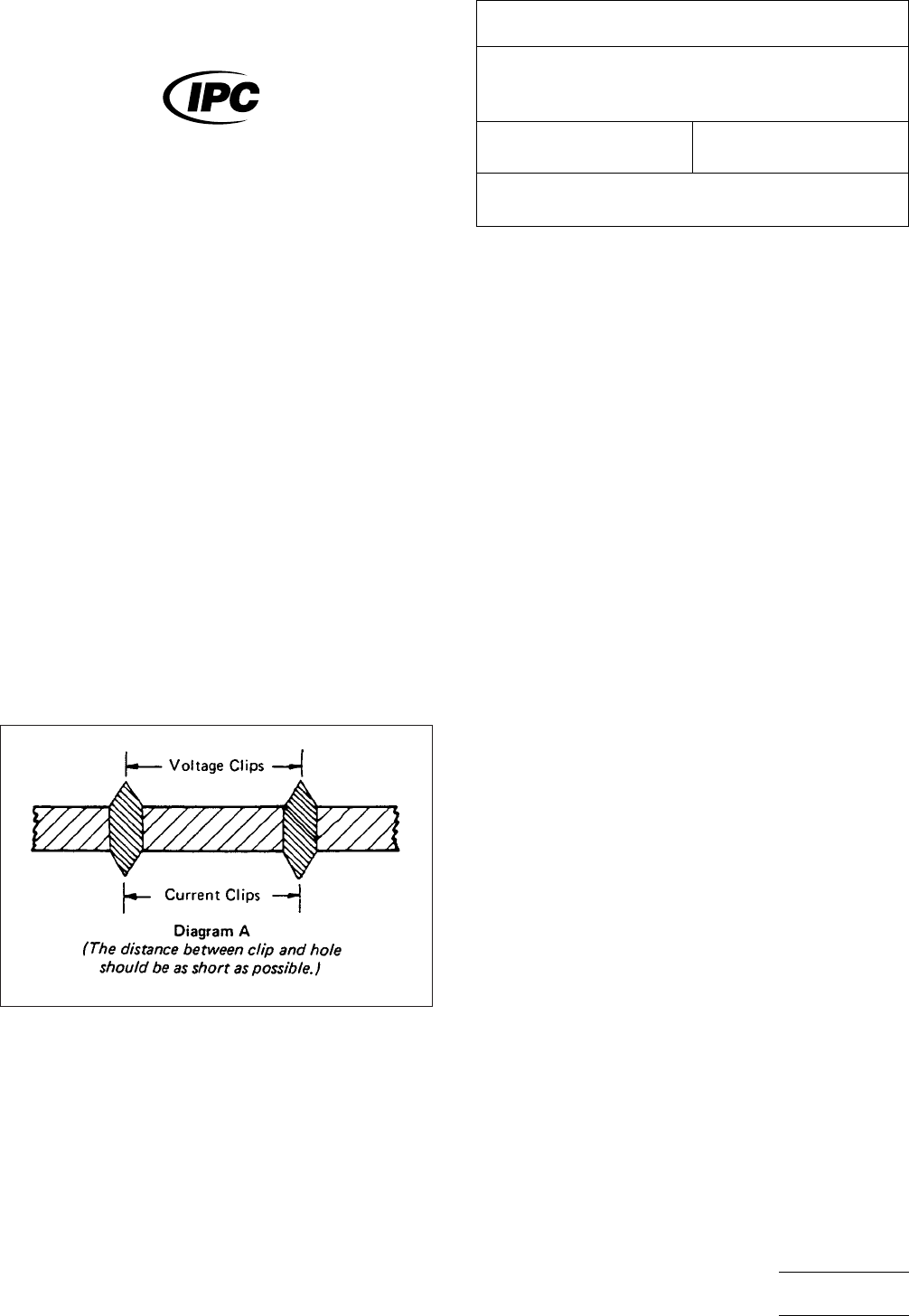
leads in the selected holes for proper connec-
tion to the four terminals of the test instrument according to
diagram A.
5.1.3 Repeat
this test for each of the five pairs of holes.
5.2
Evaluation
Record
and report all electrical resistance
values.
IPC-2-5-12-1
Figure
1 Distance from Clips
The
Institute for Interconnecting and Packaging Electronic Circuits
2215 Sanders Road • Northbrook, IL 60062
IPC-TM-650
TEST
METHODS MANUAL
Number
2.5.12
Subject
Interconnection
Resistance, Multilayer Printed
Wiring
Date
4/73
Revision
Originating Task Group
N/A
Material
in this Test Methods Manual was voluntarily established by Technical Committees of the IPC. This material is advisory only
and its use or adaptation is entirely voluntary. IPC disclaims all liability of any kind as to the use, application, or adaptation of this
material. Users are also wholly responsible for protecting themselves against all claims or liabilities for patent infringement.
Equipment referenced is for the convenience of the user and does not imply endorsement by the IPC.
P
age1of1
电子技术应用 www.ChinaAET.com

1
Scope
This
test method is used to determine the resistiv-
ity of copper foil.
2
Applicable Documents
ASTM-B-193
Resistivity
of Conductive Materials
3
Test Specimen
3.1
Three
samples should be selected at equal distances
across the width of the material from each lot and the width
and gauge length measured to the nearest 0.025 mm.
4
Equipment/Apparatus
4.1 Tester
The
resistance of the samples shall be mea-
sured with instruments of suitable sensitivity (see ASTM-B-
193).
5
Procedure
5.1 Test
5.1.1 Resistance Determination
Three
samples shall be
selected at equal distances across the width of the material
from each lot and the width and gauge length measured to
the nearest 0.025 mm. The resistance of the samples shall be
measured with instruments of suitable sensitivity, in accor-
dance with ASTM-B-193.
5.1.2
For
convenience, the distance between test points
may be 15 cm, and the weight of the 2.5 cm wide sample
being measured is determined by weighing a 2.5 cm x 15 cm
strip from the test specimen.
5.2
Evaluation
5.2.1
Calculate the resistance using the formula:
R
T
=
R
t
1 +αT (t − T)
where:
T
= reference temperature (20°C)
t = temperature at which measurement is made (°C)
αT = temperature coefficient of resistance (0.00388)
R
T
=
resistance at reference temperature (20°C)
R
t
=
measured resistance
5.2.2
Calculate
weight resistivity in ohms - gram/meter
2
using
the formula:
P
w
=
W
L
1
L
2
R
T
where:
W
= weight of test specimen (grams)
L
1
=
gauge length (meters)
L
2
=
length of test specimen (meters)
R
T
=
resistance at reference temperature (20°C)
Note: If the procedure described in 5.1.2 is used, then:
L
1
L
2
Therefore
is (0.1524 meters)
2
or:
P
W
=
weight
of 0.040 mm x 0.235 mm specimen
0.02323
R
T
The
Institute for Interconnecting and Packaging Electronic Circuits
2215 Sanders Road • Northbrook, IL 60062
IPC-TM-650
TEST
METHODS MANUAL
Number
2.5.13
Subject
Resistance
of Copper Foil
Date
3/76
Revision
A
Originating Task Group
N/A
Material
in this Test Methods Manual was voluntarily established by Technical Committees of the IPC. This material is advisory only
and its use or adaptation is entirely voluntary. IPC disclaims all liability of any kind as to the use, application, or adaptation of this
material. Users are also wholly responsible for protecting themselves against all claims or liabilities for patent infringement.
Equipment referenced is for the convenience of the user and does not imply endorsement by the IPC.
P
age1of1
电子技术应用 www.ChinaAET.com
1.0
Scope
1.1 Purpose
This
test method covers procedures for deter-
mining the electrical resistivity of copper foil. It provides for an
accuracy of ± 0.30 percent of test specimens having a resis-
tance of 0.00001 ohm (10 microhms) or more.
1.2
Definition
Resistivity
is the electrical resistance of a
body of unit length and unit cross-sectional area or unit
weight. Volume resistivity is commonly expressed in ohms for
a theoretical conductor of unit length and cross-sectional
area; in English units in ohm–circular mil/ft and in metric units
in ohm–mm
2
/meter.
It may be calculated by the following for-
mula:
p. =
A
L
R
where:
p.
= volume resistivity in ohm–circular mil/ft or ohm–mm
2
/meter,
A
= cross-sectional area in circular mils, or sq mm,
L = gauge length, used to determine R, in ft, or m, and
R = measured resistance in ohms.
Weight resistivity is commonly expressed in ohms for a theo-
retical conductor of unit length and weight. The method for
calculating weight resistivity, based on resistance, length, and
weight measurements, of a test specimen is given in Note 2.
2.0
Applicable Documents
None
3.0
Test Specimen
The
test specimen must have the fol-
lowing characteristics:
1. A resistance of at least 0.00001 ohm (10 microhms) in
the test length between potential contacts,
2. A test length of at least 1 ft or 30 cm,
3. A thickness, width or other dimension suitable to the limi-
tations of the resistance measuring instrument,
4. No surface cracks or defects visible to the unaided nor-
mal eye, and substantially free from surface oxide, dirt
and grease,
5. No joints or splices.
4.0
Apparatus
4.1 Tester
4.1.1
A
Kelvin-type double bridge or a potentiometer, if the
resistance of the specimen is below 1 ohm,
4.1.2
If
1 ohm or more, a Wheatstone bridge may be used.
4.1.3 Where
applicable, a Hoopes conductivity bridge may
be used.
4.2
Conditions
When
the measurement is made at any
other than a reference temperature, the resistance may be
corrected for moderate temperature differences to what it
would be at the reference temperatures as follows:
R
T
=
R
t
1 +γT
(t−T)
where:
R
T
=
resistance at reference temperature T,
R
t
=
resistance as measured at temperature t,
γT = known or given temperature coefficient of resistance
of the specimen being measured at reference tempera-
ture T,
T = reference temperature, and
t = temperature at which measurement is made.
NOTE:
The
parameter T, in the above equation, varies with
conductivity and temperature. For copper of 100 percent con-
ductivity and a reference temperature of 20°C, its value is
0.00393. Table 2 lists temperature coefficients for copper.
5.0
Procedure
5.1 Preparation
5.1.1
All
determinations of the dimensions and weight of the
test specimen must be accurate within 0.05%.
2215
Sanders Road
Northbrook, IL 60062-6135
IPC-TM-650
TEST
METHODS MANUAL
Number
2.5.14
Subject
Resistivity
of Copper Foil
Date
8/76
Revision
A
Originating Task Group
N/A
Material
in this Test Methods Manual was voluntarily established by Technical Committees of the IPC. This material is advisory only
and its use or adaptation is entirely voluntary. IPC disclaims all liability of any kind as to the use, application, or adaptation of this
material. Users are also wholly responsible for protecting themselves against all claims or liabilities for patent infringement.
Equipment referenced is for the convenience of the user and does not imply endorsement by the IPC.
P
age1of3
ASSOCIA
TION CONNECTING
ELECTRONICS INDUSTRIES
电子技术应用 www.ChinaAET.com