IPC-TM-650 EN 2022 试验方法.pdf - 第569页
6.1 The dielectric breakdown of the material may be adversely affected if the drilling process used to produce the holes is inadequate. Use of a sharp high speed drill is recom- mended to prevent burning the material or …

5.2
Test Condition
The
test shall be performed at ambient
temperature (23°C ± 5°C). Relative humidity is not significant
as the tests are performed under oil.
5.3
Equipment Set Up
5.3.1
Adjust
the transformer on the high voltage tester
(manually for most models) to the position which will allow for
the necessary voltage to be achieved with adequate current
capacity for breakdown.
5.3.2
Set
the machine for testing using a 500 volt per sec-
ond rate of rise.
5.4
Test
5.4.1
Remove
a preconditioned specimen from the ambient
temperature water and wipe dry with a lint free paper towel.
5.4.2 Insert
the first specimen into the fixture (inserting the
tapered pins from opposite sides) and immerse in the oil bath.
5.4.3
Attach
leads (if not permanently wired) so that one
high voltage lead is connected to one tapered pin electrode
and the ground lead is connected to the other tapered pin
electrode.
5.4.4
Operate
the tester such that the voltage is applied with
a 500 volts per second rate of rise and observe the specimen
until an electrical breakdown occurs.
5.4.5
Record
the voltage at which breakdown occurs, using
the meter memory device if available.
Note:
If
the breakdown
appears to be in the oil and no specimen damage is obvious
it is recommended that the same sample be retested. If the
specimen still will not breakdown due to breakdown of the oil,
the oil should be filtered or replaced.
5.4.6
Determine
the starting voltage and steps for the
remaining specimens from the same sample from Table 1.
5.4.7
Change
the high voltage tester to manual (or pro-
grammed stepped) operation, remove a specimen from the
water bath, wipe dry, and insert the second specimen.
5.4.8
Set
the voltage to the 50% value (plus or minus the
value of one step) and apply the voltage for 60 seconds.
5.4.9 If
no breakdown occurs increase the voltage in steps
per Table 1 until the material breaks down or the breakdown
capacity of the machine or oil is reached. Record the break-
down voltage to the nearest kilovolt or record ‘‘N. B.’’ if there
is no breakdown of the material.
Note:
If
the minimum value
required by the material specification is not exceeded, but
material breakdown does not occur, it is necessary to replace
or filter the oil.
5.4.10
Repeat
steps 5.4.7-5.4.9 for the remaining speci-
mens from the sample.
5.5
Calculation
5.5.1
Average
the values for the three specimens tested
using the stepped technique and round to the nearest kilovolt.
Even if some specimens do not break down, the maximum
individual voltages will be used to calculate an average.
Note:
If
the accuracy of the meter on the machine is not within 5%
for all values in the range, apply a correction obtained from the
last machine calibration to each reading to determine the
actual value for the dielectric breakdown.
5.6
Report
5.6.1
Report
the average value of the dielectric breakdown
(if all specimens actually breakdown), e.g., 85KV average.
5.6.2
Report
the average with a plus after the value if one or
two specimens do not break down, e.g., 82 + KV average
2NB.
5.6.3
Report
the minimum value at which the oil broke
down, if no actual specimen breakdowns are obtained, e.g.,
75 + KV N.B.
5.6.4
Report
any anomalies in the test or any variations from
prescribed procedures or tolerances.
6.0 Notes
T
able 1 Voltage increments for Step by Step Test
Breakdown
Voltage (KV) Increment KV
less than 12.5 0.5
over 12.5 to 25 1.0
over 25 to 50 2.5
over 50 to 100 5
over 100 10
IPC-TM-650
Number
2.5.6
Subject
Dielectric
Breakdown of Rigid Printed Wiring Material
Date
5/86
Revision
B
P
age2of3
电子技术应用 www.ChinaAET.com

6.1
The
dielectric breakdown of the material may be
adversely affected if the drilling process used to produce the
holes is inadequate. Use of a sharp high speed drill is recom-
mended to prevent burning the material or producing rough
holes.
6.2 This test requires voltages which are life threatening. The
High Voltage Tester must be installed and operated in accor-
dance with the manufacturer’s instructions. If the test cham-
ber is not totally enclosed, with a safety interlock, extreme
care must be exercised in performance of the test.
IPC-TM-650
Number
2.5.6
Subject
Dielectric
Breakdown of Rigid Printed Wiring Material
Date
5/86
Revision
B
P
age3of3
电子技术应用 www.ChinaAET.com
1 Scope The dielectric strength test (also called high-
potential [Hi-Pot], over potential, or voltage breakdown) con-
sists of the application of a test voltage for a specific time
between mutually insulated portions of a printed board or
between insulated portions and ground. This is used to prove
that the printed board can operate safely at its rated voltage
and withstand momentary overpotentials due to switching,
surges, and other similar phenomena.
2 Applicable Documents
ASTM D 149
Standard Test Method for Dielectric Break-
down Voltage and Dielectric Strength of Solid Electrical Insu-
lation Materials at Commercial Power Frequencies
3 Test Specimen Three 102 mm x 102 mm [4.016 in x
4.016 in] squares of glass epoxy laminate materials having
1 ounce (0.0343 mm [0.00135 in] nominal) copper foil lami-
nates on one side, and having the test specimen polymer film
applied to the copper surface (see specimen preparation).
4 Apparatus
4.1
Any high voltage potential test equipment capable of
providing voltage increases of 500 VDC per second, up to at
least 10,000 VDC (see Section 6).
4.2 A standard Type 1 electrode per ASTM D 149, with a 51
mm [2.0 in] diameter, 25 mm [1.0 in] thick, with edges
rounded to 6.4 mm [0.25 in.] radius to cover the test surface.
5 Procedure
5.1 Preparation of Test Specimen
5.1.1
Cut the laminate specimen to 102 mm x 102 mm
[4.016 in x 4.016 in] and sand the edges lightly.
5.1.2 If double clad material is used, etch off all copper foil
on one side.
5.1.3 Clean the copper foil surface thoroughly, per the poly-
mer manufacturer’s recommendations, prior to applying poly-
mer coating.
5.1.4 Apply a film of the polymer test material on an area of
76.2 mm x 76.2 mm [3.0 in x 3.0 in] at the center of the cop-
per clad surface. A pinhole free film is essential.
5.1.5 Cure the polymer coating per manufacturer’s recom-
mendations.
5.2 Test
5.2.1
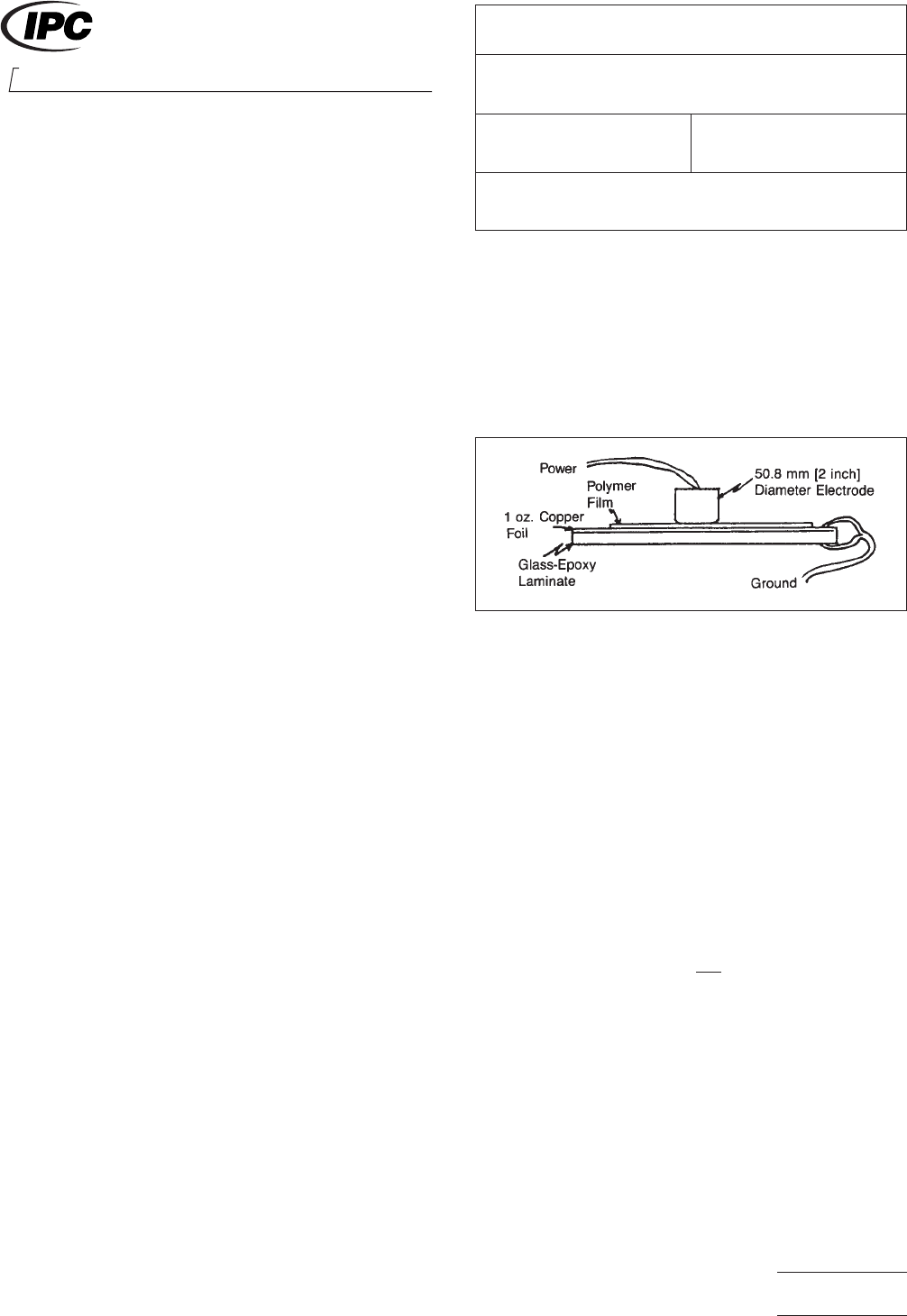
Clip the ground terminal of the tester over the thick-
ness of the copper foil and substrate, being careful not to let
the clip extend inward to the polymer coating (see Figure 1).
5.2.2 Place the positive electrode on top of test panel at the
center. Make certain the electrode and clip are electrically iso-
lated by the test polymer film.
5.2.3 Set up the potential voltage tester. Increase the volt-
age 500 VDC per second, until specimen exceeds require-
ment or breakdown occurs.
5.2.4 Measure the coating thickness of each of the test
specimens to the nearest 0.0025 mm [0.0001 in] in at least
four locations. Compute the average coating thickness and
standard deviation.
5.3 Evaluation Determine the dielectric strength, E
D
, using:
E
D
=
V
BD
t
where t is the thickness of the specimen, to the nearest
0.0025 mm [0.0001 in], measured in 5.2.4 and V
BD
is
the breakdown voltage measured in 5.2.3. Record results as
‘‘V/mm’’ or ‘‘V/in.’’
6 Notes
6.1
Suggested source for tester: Hipotronics Model HD-140
from Hipotronics, Inc. Brewster, NY 10509, or equivalent.
6.2 Safety must be exercised because of the potential dan-
ger of electrical shock.
IPC-2561-1
Figure 1
3000 Lakeside Drive, Suite 309S
Bannockburn, IL 60015-1249
IPC-TM-650
TEST METHODS MANUAL
Number
2.5.6.1
Subject
Solder Mask - Dielectric Strength
Date
03/07
Revision
B
Originating Task Group
Solder Mask Performance Task Group (5-33b)
Material in this Test Methods Manual was voluntarily established by Technical Committees of IPC. This material is advisory only
and its use or adaptation is entirely voluntary. IPC disclaims all liability of any kind as to the use, application, or adaptation of this
material. Users are also wholly responsible for protecting themselves against all claims or liabilities for patent infringement.
Equipment referenced is for the convenience of the user and does not imply endorsement by IPC.
Page1of1
ASSOCIATION CONNECTING
ELECTRONICS INDUSTRIES
®