IPC-TM-650 EN 2022 试验方法.pdf - 第730页
IPC-2616-3 CONDITION 3 IPC-2616-4 CONDITION 4 IPC-2616-5 CONDITION 5 IPC-TM-650 Number 2.6.16 Subject Pressure Vessel Method for Glass Epoxy Laminate Integrity Date 7/85 Revision P a g e3o f3 电子技术应用 www.ChinaAET.com
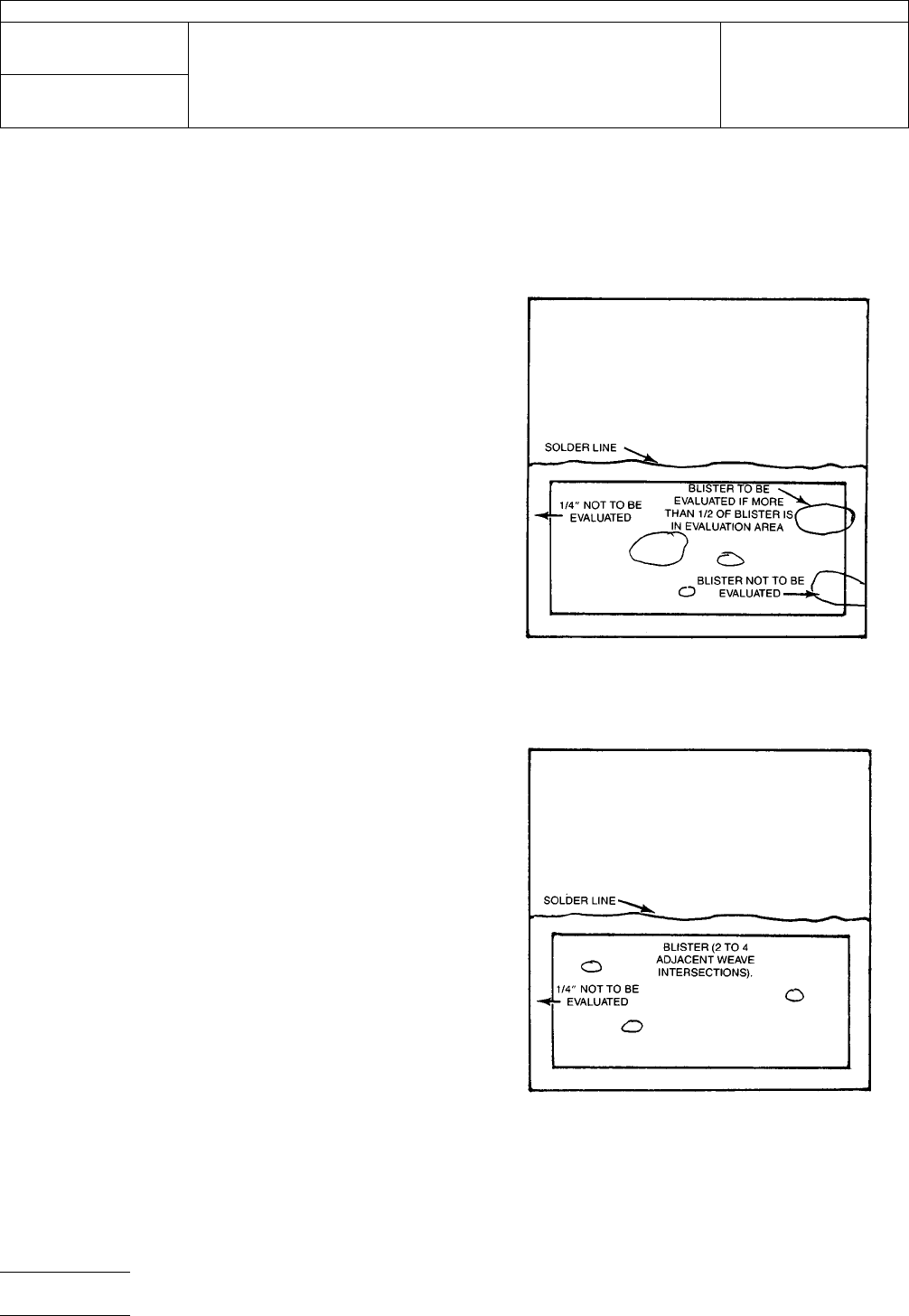
seconds.
Immersion and withdrawal rates should not exceed
2 seconds. Do not allow test coupons to touch bottom of sol-
der bath.
Note:
Other
solder bath temperatures maybe agreed upon by
user and vendor.
6.3 Evaluation
6.3.1
Do
not evaluate areas within 1/8 inch from all edges,
including solder line.
6.3.2
Grading
Grade
specimens on the evaluation scale of
5 through 1 (below) according to degree of severity of the
attack. In order for the grading to be more meaningful, the
tester should also provide comments on the overall specimen
appearance. For additional description and illustrations of
measles, blisters, weave texture, delamination, etc., refer to
IPC-A-600, Acceptability Guidelines for Printed Wiring.
V
alue Condition
5
The samples have no measles, blisters, or sur-
face erosion.
4 Occasional minute (1/32 inch or less) measles.
3 Minute measles scattered across the speci-
men.
2 Occasional minor blisters (two to four adjacent
weave intersections).
1 Large blisters, delamination, or convolution.
If five test coupons are evaluated, the test may use a total
performance points-rating (e.g.,5x5=25).
7.0 Notes
7.1
This
test method is developed for 1/16 inch thick mate-
rial. Different results are to be expected for other thicknesses.
Therefore, the time of exposure and grading values may
change for different thicknesses and must be agreed upon
between user and vendor.
7.2
Warning
Pressure
vessel must always be opened with
extreme caution to be certain pressure has been released.
7.3
Warning
Samples
could retain some moisture. There-
fore, care should be taken in immersing the sample in the sol-
der bath. It is recommended that the operator work behind a
suitable protective screen and use a glove to protect the hand
holding the sample. The wet specimens will react violently
during the immersion into the solder pot, splaying and sput-
tering bits of molten solder about the fume hood. Proper pre-
cautionary measures must be taken.
IPC-2616-1
CONDITION
1
IPC-2616-2
CONDITION
2
IPC-TM-650
Number
2.6.16
Subject
Pressure
Vessel Method for Glass Epoxy Laminate Integrity
Date
7/85
Revision
P
age2of3
电子技术应用 www.ChinaAET.com
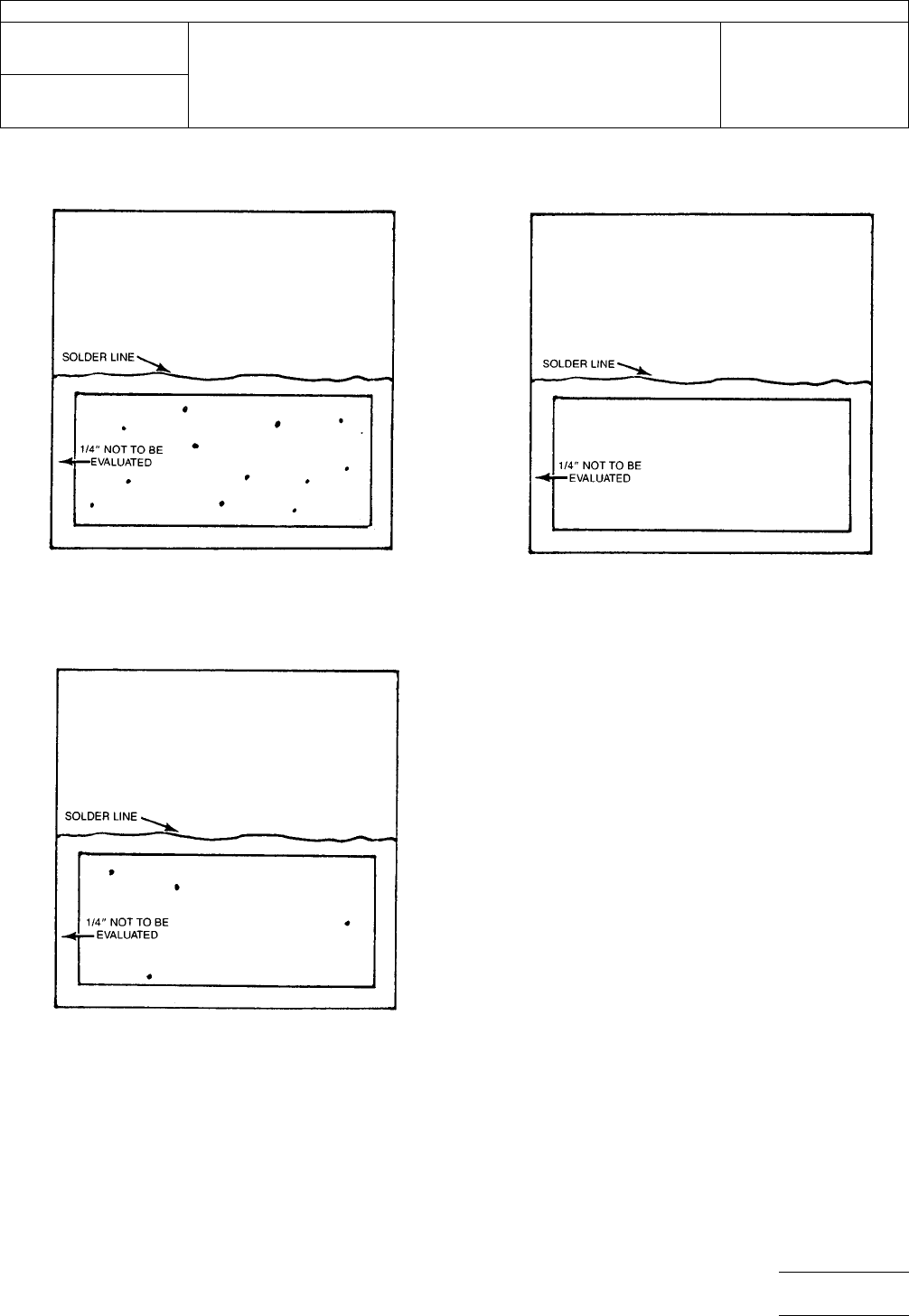
IPC-2616-3
CONDITION
3
IPC-2616-4
CONDITION
4
IPC-2616-5
CONDITION
5
IPC-TM-650
Number
2.6.16
Subject
Pressure
Vessel Method for Glass Epoxy Laminate Integrity
Date
7/85
Revision
P
age3of3
电子技术应用 www.ChinaAET.com

1
Scope
This
test method is designed to determine the
capability of HDI materials and other dielectrics to withstand
moisture induced stress as applied by extended time in a
pressure vessel. For laminated constructions, the results may
be affected by the process conditions.
2
Applicable Documents
IPC-A-600
Acceptability
of Printed Boards
IPC-TM-650
Test Methods Manual
2.1.1
Microsectioning
2.1.1.2 Microsectioning—Semi or Automatic Technique
Microsection Equipment (Alternate)
2.3.6 Etching, Ammonium Persulfate Method
2.3.7 Etching, Ferric Chloride Method
2.3.7.1 Cupric Chloride Etching Method
2.3.7.2 Alkaline Etching Method
3
Test Specimen
3.1
Samples
shall be prepared as appropriate for the type of
material. All samples shall be 10 cm x 10 cm ± 0.5 cm, with
the thickness determined by the type of material (see 3.1.1 to
3.1.3). Three samples shall be prepared. Control samples are
required for all samples where the dielectric layer is applied to
an etched laminate. One control sample of the etched lami-
nate (with no added dielectric) is required for samples pre-
pared according to 3.1.2.2 or 3.1.3.
3.1.1
Copper-Clad Laminate
The
laminate shall have all
copper removed in accordance with IPC-TM-650, Method
2.3.6, 2.3.7, 2.3.7.1 or 2.3.7.2, then cut to dimensions of 10
cm x 10 cm ± 0.65 cm.
3.1.2
Semi-Cured Prepreg
The
prepreg shall be lami-
nated to a cured sheet configuration, with 35 micron copper
foil, using the supplier’s recommended lamination cycle. The
laminate shall be etched of all copper, then cut to dimensions
of 10 cm x 10 cm ± 0.65 cm.
3.1.2.1
Semi-Cured Prepreg or Dielectric Material,
Method A
Sufficient
plies of prepreg shall be used to result
in a composite base thickness of 0.4 mm ± 0.1 mm. If the
prepreg is of a nature that does not allow for lamination of a
single sample of the thickness specified, then a thinner
sample shall be laminated, noting the thickness as part of the
report, see 5.5.
3.1.2.2
Semi-Cured Prepreg or Dielectric Material,
Alternate Method B
The
prepreg or dielectric layer shall be
laminated to both sides of an etched laminate that has a thick-
ness of 0.4 mm ± 0.1 mm. The prepreg or dielectric layer shall
be applied, laminated and cured according to the manufactur-
er’s recommendations. Unless otherwise specified, the result-
ing prepreg or dielectric layer thickness shall be a nominal of
0.05 mm on each side of the core laminate. Optionally, the
actual thickness may be measured by mechanical or cross-
sectional methods and reported, see 5.5. Control samples
shall be the etched laminate core with no prepreg or dielectric
layer.
3.1.3
Coated Dielectrics
The
coated dielectrics (i.e., res-
ins, adhesives, dry films) shall be applied to both sides of an
etched laminate that has a thickness of 0.4 mm ± 0.1 mm.
The coated dielectrics shall be applied and cured according to
the manufacturer’s recommendations. Unless otherwise
specified, the resulting coated dielectric thickness shall be a
nominal of 0.05 mm on each side of the core laminate.
Optionally, the actual thickness may be measured by
mechanical or cross-sectional methods and reported, see 5.5.
Control samples shall be the etched laminate core with no
coated dielectric.
4
Test Equipment
4.1
Pressure
vessel capable of maintaining a constant pres-
sure of 2 ATM (14 psig), and a temperature of 121°C ± 2°C,
with water content maintained for a minimum of six hours
before needing replenishment.
4.2
Oven,
air circulating, capable of holding a temperature of
105°C ± 2°C
4.3
Microsectioning
equipment, including slug cutter,
mounting, grinding, and polishing equipment (see IPC-TM-
650, Method 2.1.1 or 2.1.1.2)
4.4 Microscope
capable of 200X magnification, with optional
photographic equipment
2215
Sanders Road
Northbrook, IL 60062-6135
IPC-TM-650
TEST
METHODS MANUAL
Number
2.6.16.1
Subject
Moisture
Resistance of High Density
Interconnection (HDI) Materials Under High
Temperature and Pressure (Pressure Vessel)
Date
8/98
Revision
Originating Task Group
HDI Test Methods Task Group (D-42A)
Material
in this Test Methods Manual was voluntarily established by Technical Committees of the IPC. This material is advisory only
and its use or adaptation is entirely voluntary. IPC disclaims all liability of any kind as to the use, application, or adaptation of this
material. Users are also wholly responsible for protecting themselves against all claims or liabilities for patent infringement.
Equipment referenced is for the convenience of the user and does not imply endorsement by the IPC.
P
age1of2
ASSOCIA
TION CONNECTING
ELECTRONICS INDUSTRIES
电子技术应用 www.ChinaAET.com