IPC-TM-650 EN 2022 试验方法.pdf - 第465页
An alternate method for trimming the copper strip is to use a sharp scalpel. However, this can smear the copper across that the specimen end surface, especially with thin speci- mens, and may introduce end fringing error…
This
method is best suited for measurements at ambient tem-
peratures in a controlled laboratory atmosphere. It may be
possible to adapt it for measurements at other temperatures.
6.1.1
The
steel clamping bars, copper clamping plates, and
the specimen assembly with copper foil are stacked with the
help of a jig (Figure 5) to assure the following:
a) One side surface or edge of each steel bar, copper plate,
specimen card, and ground plane copper foil lie in a
common plane.
b) The end surfaces of the steel bars lie in a common plane
within a 0.1 mm tolerance.
c) The ends of the copper plates extend beyond the steel
bars equally on both ends within a 0.1 mm tolerance.
d) The ends of copper plates, specimen cards, and copper
foil ground planes lie in a vertical plane within a 0.1 mm
tolerance.
e) In the case of specimen type A, the center conductor,
whose length extends enough beyond both ends of the
specimen cards to be gripped in tension and positioned,
is centered across the width of the specimen cards.
6.1.2
The
stack formed in 6.1.1 is clamped with a specified
total force. For a selected specimen length of 153 mm or less,
the force is applied through a force gage in a line centered on
the outer faces of the steel bars. For greater lengths, the force
should be distributed through force gages at two or more
positions not further than 153 mm apart along the length to
get uniformity of force per unit length along the specimen
length with minimal deflection of the steel bars. Thus, for a
304.8 mm length, apply equal forces at the 76.2 mm and
228.6 mm positions. If a 381 mm was used, apply force at the
63.5 mm, 190.5 mm, and 317.5 mm positions.
6.1.3
Remove
the alignment jig used in 6.1.1.
6.1.4
For
type A specimens, the center copper strip will still
be extending beyond the plane formed by the surfaces of the
copper plates, ground foil, and specimen end. This is clipped
off cleanly flush with that plane. One preferred method for
doing this is to use a lever-action toe nail clipper with a con-
vex shaped cutting pattern modified by grinding so that the
metal extending beyond the cutting edges is removed so that
the cutting edges are able to reach to the specimen edge for
cutting the copper strip.
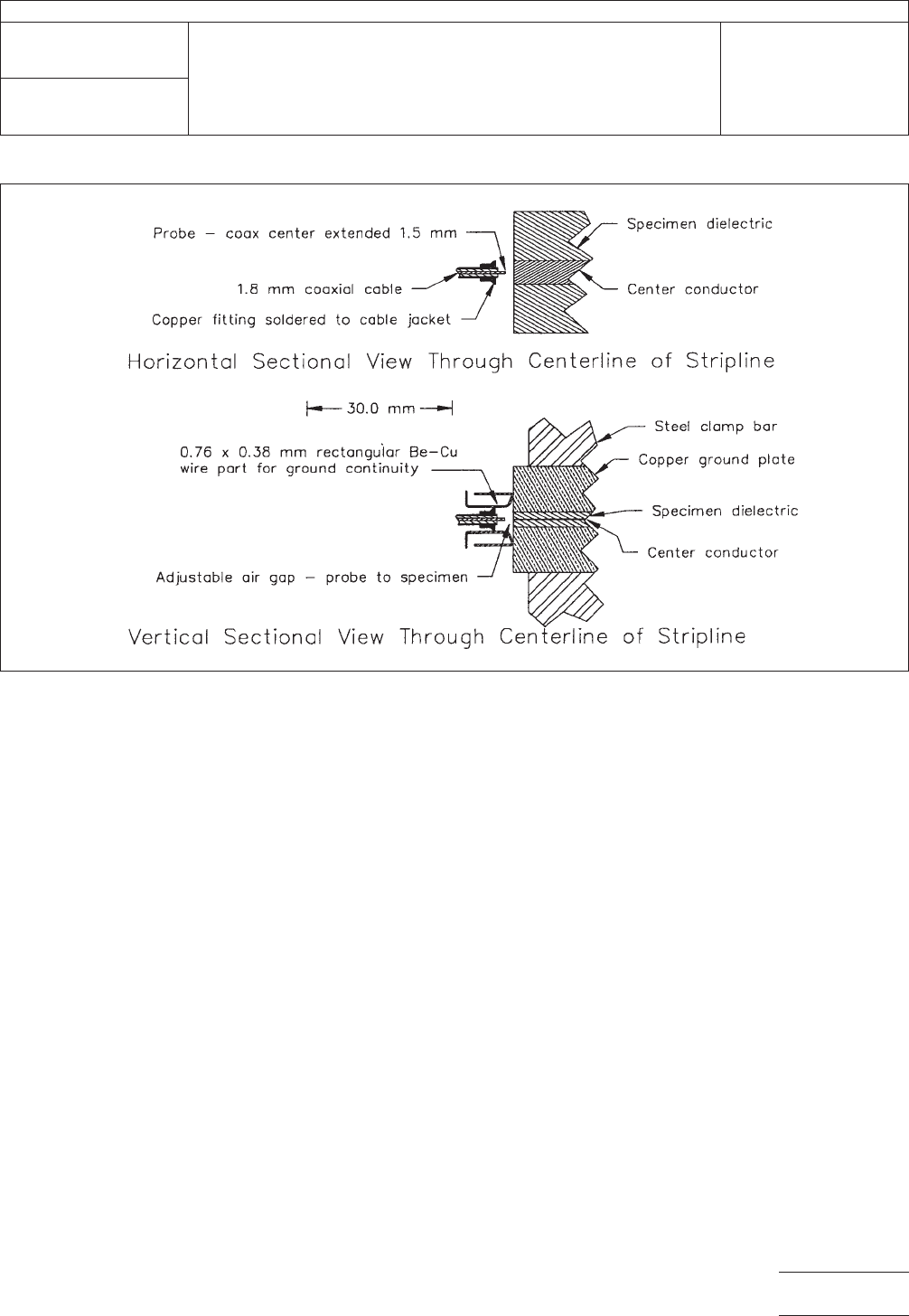
IPC-25551-9
Figure
9 Probe Assembly Position (See 6.1.5) for One End of the Clamped Stack
Note: This figure shows coaxial probe with fitting and Be-Cu alloy wire for ground continuity without showing supporting mechanical
structures and adjustments.
IPC-TM-650
Number
2.5.5.5.1
Subject
Stripline
Test for Complex Relative Permittivity of Circuit Board
Materials to 14 GHz
Date
3/98
Revision
P
age7of11
电子技术应用 www.ChinaAET.com

An
alternate method for trimming the copper strip is to use a
sharp scalpel. However, this can smear the copper across
that the specimen end surface, especially with thin speci-
mens, and may introduce end fringing errors on short L val-
ues.
6.1.5
Fasten
the probe assemblies to the clamped stack at
both ends so that the coaxial cable probe end is centered on
the stripline resonator center line. Adjust the assembly so the
contact areas on the soldered copper fitting make firm electri-
cal contact by the wires to both top and bottom copper
plates. Figure 9 shows by vertical and horizontal sectional
views through the stripline resonator centerline this relation-
ship among:
• the copper ground plates (see 5.1.2).
• the specimen with conductors (see 3.0).
• the coaxial cable with extended center conductor end (see
5.2.1).
• the copper fitting (see 5.2.2) soldered to the coaxial cable.
• the wire connection (see 5.2.3).
For the purpose of this method horizontal orientation is paral-
lel to the plane of the specimen surface in the fixture. See
three requirements under 5.2.4.
6.1.6
Adjust
the position of the coaxial cable probe ends so
the air gaps they form with the stripline resonator element are
equal. This may be done with the help of a network analyzer
set for lowest frequency by adjusting the gaps smaller until
each causes a sudden shift in reflected or transmitted power,
then adjusting them back to a small gap value, equal on both
ends.
6.1.7
With
the probe’s longitudinal position set to a small air
gap such as 0.05 mm, use an appropriate means with the
electronic instrumentation to identify the approximate location
of the lowest resonant frequency (the fundamental where the
resonator length is half the wavelength in the material being
tested) and a series of resonances (harmonics) up to the high-
est frequency of interest. Ideally harmonic resonances occur
at each integer multiple of the fundamental resonance. The
integer multiples are the values of n in formula 1 of section
7.1. Select which of these resonances will be measured as
discussed in section 6.3, 6.4, or 6.5.
6.2
Adjustment of Air Gap for Each Resonance
Before
the
measurement at each resonance, adjust the air gaps at
each probe an equal amount to get the dB insertion loss at
the maximum transmission to a recommended value between
49.5 and 51.5 dB. As resonant frequency is increased from
resonance to resonance for a given specimen, the gap
required for a nominal 50 dB insertion loss at resonance tends
to increase. A high value dB minimizes the correction for
unloaded Q and makes this correction less sensitive to poor
data on the baseline dB of the instrumentation. Too high a dB
value will put the measurements down in the noise region of
the instrumentation, making results less certain and less
reproducible.
6.3
Manual Measurement of the Specimen
The
follow-
ing procedure is most applicable where only equipment as
described in 4.1 is available. The equipment of 4.2 could also
be operated manually.
6.3.1
The
resonant frequency shall be found by scanning
frequency over the expected transmission range of the test
resonator. The frequency shall be precisely adjusted to get a
maximum reading of power in dB.
6.3.2
Determine
half power points by adjusting frequency to
give three dB readings both above and below the maximum
transmission frequency. Measure each frequency with the fre-
quency meter and record the results:
•f1-3dBdown, below the maximum transmission fre-
quency.
•f2-3dBdown, above the maximum transmission fre-
quency.
6.4
Automated Measurement of the Specimen
For
an
automated system to be used in performing the measure-
ment, computer software is needed that will collect paired
values of frequency and transmitted power. From this data,
the frequency for maximum power transmission and the fre-
quencies of the half power points are determined. The com-
puter program may optionally include computation of permit-
tivity and loss tangent as described in section 7.0. Results and
collected data may be displayed on the screen, stored in a
disk file, sent to a printer, or any combination of these.
In one possible mode of operation, with the equipment
described in 4.2, the sequence of steps described in 6.4.1
through 6.4.4 is performed as many times as necessary to get
enough data to complete the test procedure. The computer is
designated as the controller on the GPIB.
IPC-TM-650
Number
2.5.5.5.1
Subject
Stripline
Test for Complex Relative Permittivity of Circuit Board
Materials to 14 GHz
Date
3/98
Revision
P
age8of11
电子技术应用 www.ChinaAET.com

6.4.1
The
computer sets the sweeper to a selected carrier
wave frequency without an AM or FM audio signal and to a
desired output power level, such as 10 dBm.
6.4.2 The same frequency is given to the synchronizer with
instructions to lock the frequency of the sweeper to the speci-
fied value.
6.4.3
The
computer checks the synchronizer for status until
the status value indicates the frequency is locked.
6.4.4
The
power meter reading is obtained by the computer.
Since it takes a finite amount of time for the power sensor to
stabilize, either a delay is used or the reading may be taken
repeatedly until consecutive readings meet a given require-
ment for stability.
6.5
Use of the Network Analyzer for Measurement of
the Specimen
An
automated network analyzer may be
used either by operating the front panel controls manually or
under computer control with suitable specialized software.
The fixture with the specimen is connected by test cables and
adapters as a device under test. Set up the instrument so the
Cartesian screen display shows the S21 parameter, the
transmission/incident power ratio, in negative dB vertical scale
units versus frequency on the horizontal scale. Select the start
and stop frequency range to sweep across the resonance
peak and at least 3 dB below the peak. Adjust the start and
stop frequency values as narrowly as possible, but still include
the resonant peak and the portions of the response curve on
both sides of it that extend 3 dB downward.
6.5.1 The
first option is to get the three points (f
r
,f
1
and
f
2
)
as
described in 6.3 or 6.4. Determine the resonant dB
r
and
frequency
f
r
values
for the highest point (maximum) on the
response curve. With manual operation, instrument program
features may be available to do this very quickly. On the
response curve to the left and right of f
r
,
locate the f
1
,d
B
1
and
f
2
,d
B
2
points
as near as possible to 3 dB below dB
r
.
These
may then be used in the calculations shown in 7.2.
6.5.2
A
second option requires a computer external to the
instrument. Collect from the network analyzer all of the f, dB
data points represented by the response curve between f
1
,
dB
1
and
f
2
,d
B
2
and
apply non-linear regression analysis tech-
niques to determine statistically values for Q
loaded
,f
r
and
dB
r
that
best fit the f
i
,d
B
i
paired
data points to the formula.
dB
i
=d
B
r
-1
0log
e
(10)
log
e
(
1+4Q
loaded
2
(f
i
/f
r
-1
)
2
)
[1]
where 10 log
e
(10)
is the constant for converting from log
e
to
dB.
This formula may be derived from formula 5 with the rea-
sonable assumption that f
r
-f
1
equals
f
2
-f
r
.
The statistically
derived values for f
r
and
Q would then be used in formulas 2
of section 7.1, formula 3 of section 7.2, and formula 6 of sec-
tion 7.3 respectively.
This has been found to fit the collected data points very well
at all regions across the entire f
1
to
f
2
range.
It is a simplified
version of the non-linear regression method for complex S21
parameters described by Vanzura
4
.
7.0
Calculations
7.1 Stripline Permittivity
Use
special care to assign the
correct n value for each resonance measured.
At resonance, the electrical length of the resonator circuit is an
integral number of half wavelengths. The effective stripline
permittivity, ε
r
,
can be calculated from the frequency of maxi-
mum transmission as follows:
ε
r
=[
nC/(2f
r
(L
+ ∆L))]
2
[2]
where
n is the number of half wavelengths along the resonant
strip of length L in mm, ∆L is the total effective increase in
length of the resonant strip due to the fringing field at the ends
of the resonant strip, C (the speed of light) is 2.9978z10
11
mm/s,
and f
r
in
Hz (or cycles/s) is the measured resonant
(maximum transmission) frequency.
The resonator ends coincide with the end edges of both the
dielectric and the ground planes. The relative fringing field at
the ends becomes extremely small. It has been the practice
with this method to ignore this fringing field and consider the
∆L value to be zero in the calculation of stripline permittivity.
7.2
Calculation of Effective Dielectric Loss Tangent
tan δ =
1/Q
unloaded
-
1/Q
c
[3]
where:
1/Q
c
is
the loss factor of the conductor
1/Q
unloaded
is
the total loss factor of the unloaded resonator
due only to the dielectric, copper, and copper-dielectric inter-
face, and does not include loss due to coupling of the probes.
7.2.1
The resonator loss factor
The
measurement of the
resonance gives a value for the loss factor of the resonator
with loading due to probe coupling (1/Q
loaded
).
IPC-TM-650
Number
2.5.5.5.1
Subject
Stripline
Test for Complex Relative Permittivity of Circuit Board
Materials to 14 GHz
Date
3/98
Revision
P
age9of11
电子技术应用 www.ChinaAET.com