IPC-TM-650 EN 2022 试验方法.pdf - 第578页
5.2 Test (see 6.6) 5.2.1 Raise the test voltage from zero to one of the follow- ing specified test condition values (see 6.2) as uniformly as possible, at a rate of approximately 100 volts DC per second. If the test cond…

1
Scope
The
dielectric withstanding voltage test (also
called high-potential, over potential, voltage breakdown, or
dielectric strength test) consists of the application of a voltage
higher than rated voltage for a specific time between mutually
isolated portions of a PCB or between isolated portions and
ground. This is used to prove that the PCB can operate safely
at its rated voltage and withstand momentary over potentials
due to switching, surges, and other similar phenomena.
Although this test is often called a voltage breakdown or
dielectric strength test, it is not intended that this test cause
insulation breakdown or that it be used for detecting corona,
rather it serves to determine whether insulating materials
and/or conductor spacings are adequate.
2
Applicable Documents
None
3
Test Specimen
The
test specimen shall be comprised of
a minimum of two conductor lines per conductive layer, suffi-
cient to allow a voltage to be applied between adjacent con-
ductor patterns both between conductive layers and on the
same conductive layer (see 6.1).
4
Apparatus or Material
4.1
A high voltage source capable of supplying the specified
voltage with a tolerance of ± 5% (see 6.2).
4.2
A
voltage measuring device with an accuracy of 5%. If
leakage current measuring capability is required, the device
shall be capable of detecting the leakage current to within 5%
of the requirement.
4.3
Soft
bristle brush
4.4 Deionized
or distilled water (2 megohm-cm minimum
resistivity recommended)
4.5
Isopropyl
alcohol
4.6
Drying
oven
5
Procedure
5.1 Specimen Preparation
(see
6.3)
5.1.1
Positive,
permanent, and noncontaminating identifica-
tion of test specimen is of paramount importance.
5.1.2 Visually
inspect the test specimens for any obvious
defects, as described in the applicable performance specifica-
tion. If there is any doubt about the overall quality of any test
specimen, the test specimen should be replaced and this
replacement noted.
5.1.3
Solder
single stranded (to simulate discrete compo-
nent axial leads) polytetrafluroethylene (PTFE) insulated wires
in each of the connection points of the test specimens. These
wires will be used to connect the test patterns of the test
specimens to the high voltage source.
5.1.4
Wet
test lead terminals with deionized or distilled
water and scrub with a soft bristle brush for a minimum of 30
seconds. During the remainder of the test specimen prepara-
tion, handle test specimens by the edges only (see 6.4).
5.1.5
Spray
rinse thoroughly with deionized or distilled
water. Hold test specimen at an approximate 30° angle and
spray from top to bottom.
5.1.6
Wet
test lead terminals with clean isopropyl alcohol
and agitate for a minimum of 30 seconds. Scrub with a soft
bristle brush to remove flux residue.
5.1.7
Rinse
cleaned area thoroughly with fresh isopropyl
alcohol.
5.1.8
Dry
test specimens in a drying oven for a minimum of
three hours at an oven temperature of between 49 °C to
60 °C (120 °F to 140 °F).
5.1.9
Allow
the test specimens to cool to room temperature.
(see 6.5)
2215
Sanders Road
Northbrook, IL 60062-6135
IPC-TM-650
TEST
METHODS MANUAL
Number
2.5.7
Subject
Dielectric
Withstanding Voltage, PCB
Date
05/04
Revision
D
Originating Task Group
Rigid Printed Board Performance Task Group
(D-33a)
Material
in this Test Methods Manual was voluntarily established by Technical Committees of IPC. This material is advisory only
and its use or adaptation is entirely voluntary. IPC disclaims all liability of any kind as to the use, application, or adaptation of this
material. Users are also wholly responsible for protecting themselves against all claims or liabilities for patent infringement.
Equipment referenced is for the convenience of the user and does not imply endorsement by IPC.
P
age1of2
ASSOCIA
TION CONNECTING
ELECTRONICS INDUSTRIES
®
电子技术应用 www.ChinaAET.com

5.2
Test
(see
6.6)
5.2.1
Raise
the test voltage from zero to one of the follow-
ing specified test condition values (see 6.2) as uniformly as
possible, at a rate of approximately 100 volts DC per second.
If the test condition is not specified Condition A shall be the
default.
Condition A: 500+15/-0 volts DC
Condition B: 1000+25/-0 volts DC
5.2.2
Maintain
the test voltage at the specified value for a
period of 30+3/-0 seconds.
5.2.3
Upon
completion of the test, the test voltage shall be
gradually reduced to avoid surges.
5.3
Evaluation
Examine
the test specimens and note any
evidence of inadequate insulating materials and/or conductor
spacing (i.e., visually inspect for flashover, sparkover or break-
down between conductor patterns or between conductor pat-
terns and mounting hardware).
6 Notes
6.1
Recommended
test specimens include ‘‘Y’’ test pat-
terns (also referred to as ‘‘E’’ test coupons) or ‘‘comb pat-
terns.’’ Production printed boards may also be used as test
specimens.
6.2
Performance
specifications should specify the high volt-
age test condition and any deviations to this test method. If no
test condition is specified, use test condition A.
6.3
This test method may be performed on test specimens
which have previously been prepared and tested for moisture
and insulation resistance.
6.4
Alternative cleaning procedures may be implemented if
there is a concern that scrubbing will adversely affect test
results, e.g., when the test specimens have very fine spacing
and/or are plated with soft metals (tin/lead, gold, etc.).
6.5
Insulating
compound (conformal coating) may be
applied to the test specimens following soldering and clean-
ing. Any coating application and cure shall be as specified by
the coating supplier.
6.6
The
testing process outlined in 5.2 should be used for
qualification testing. For in-plant quality conformance testing,
the following testing modifications may be chosen:
6.6.1
At
the option of the customer, reduced time with a
possible correlated higher test voltage may be used.
6.6.2
At
the option of the customer, an AC test voltage may
be applied.
6.6.3
At
the option of the customer, the test voltage may be
applied instantaneously.
IPC-TM-650
Number
2.5.7
Subject
Dielectric
Withstanding Voltage, PCB
Date
05/04
Revision
D
P
age2of2
电子技术应用 www.ChinaAET.com
1
Scope
The
dielectric withstanding voltage test (also
called high-potential, over potential or voltage breakdown test)
consists of the application of a voltage higher than rated volt-
age for a specific time between mutually isolated portions of a
PWB or between isolated portions and ground. This is used to
prove that the PWB can operate safely at its rated voltage and
withstand momentary over potentials due to switching,
surges, and other similar phenomena. Although this test is
often called a voltage breakdown test, it is not intended that
this test cause insulation breakdown or to be used for detect-
ing corona. Rather, it serves to determine whether insulating
materials and/or conductor spacings are adequate.
2
Applicable Documents
IPC-CC-830
Qualification
and Performance of Electrical Insu-
lating Compound for Printed Board Assemblies
IPC-A-600
Acceptability
of Printed Wiring Boards
MIL-STD-202
Method
301
J-STD-004
Requirements
for Soldering Fluxes
3
Test Specimens
3.1 Qualification Testing, Classes 1-3
Five
IPC-B-25A
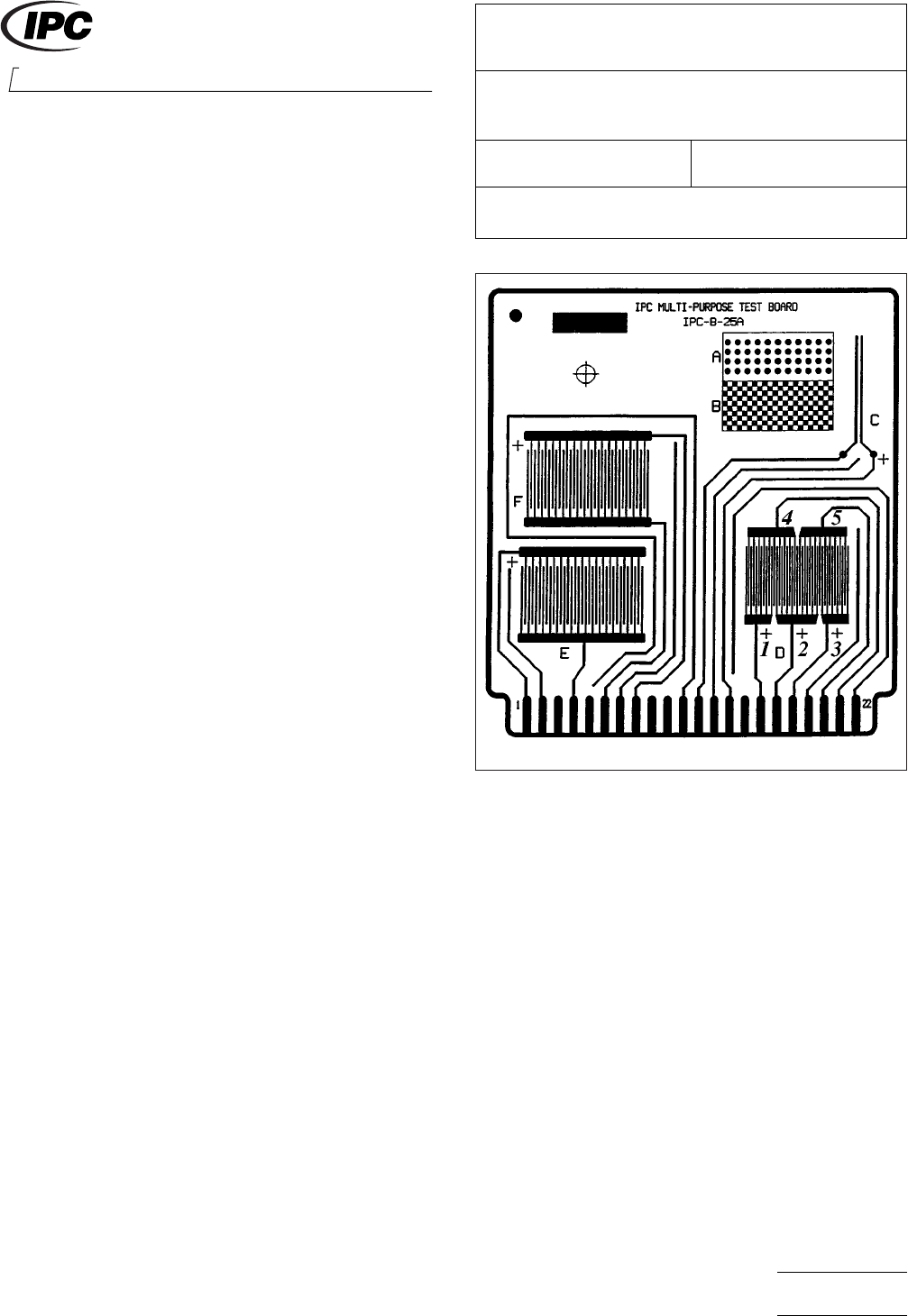
boards (see Figure 1) using the D comb pattern (one uncoated
and four coated) with conformal coating according to the
coating suppliers recommendations.
3.2
Conformance Testing
Five
IPC-B-25A Boards (See
Figure 1) containing the C pattern (‘‘Y’’ shape pattern) with
0.635 mm lines/0.635 mm spacing [25.00 mil lines/25.00 mil
spacing] or minimum spacing on the production board,
whichever is smaller, coated with conformal coating according
to the coating supplier’s recommendations.
4
Apparatus
4.1 Soldering Iron
4.2 Flux
Water
white rosin (R or RMA) with halide content
less than 0.5%, i.e., type Symbol A and B or ROL0 and ROL1
according to J-STD-004.
4.3
Hi-Pot Tester
Capable
of supplying a test voltage of
1,500 VAC at 50-60 hertz (Hz) and able to record a leakage
rate.
4.4
Timer
4.5 Oven
Capable
of maintaining 60°C [140°F].
4.6
Desiccator
5 Test Specimens Preparation Prior to Testing
5.1
Solder
wires to the finger tabs on the ‘‘D’’ comb pattern
using R or RMA flux.
5.1.1
Clean
the specimens using a soft bristle brush while
rinsing with deionized water for 30 seconds.
IPC-2571-1
Figure
1 IPC-B-25A Test Board (Leads on D Pattern Are
Identified)
2215
Sanders Road
Northbrook, IL 60062-6135
IPC-TM-650
TEST
METHODS MANUAL
Number
2.5.7.1
(Supersedes
2.5.7C for Conformal Coating Test)
Subject
Dielectric Withstanding Voltage - Polymeric
Conformal Coating
Date
07/00
Revision
Originating Task Group
Conformal Coating Task Group (5-33a)
Material
in this Test Methods Manual was voluntarily established by Technical Committees of IPC. This material is advisory only
and its use or adaptation is entirely voluntary. IPC disclaims all liability of any kind as to the use, application, or adaptation of this
material. Users are also wholly responsible for protecting themselves against all claims or liabilities for patent infringement.
Equipment referenced is for the convenience of the user and does not imply endorsement by IPC.
P
age1of2
ASSOCIA
TION CONNECTING
ELECTRONICS INDUSTRIES
电子技术应用 www.ChinaAET.com