IPC-TM-650 EN 2022 试验方法.pdf - 第317页
1.0 Scope This test method establishes a procedure for determining the glass transition temperature of organic films using thermal mechanical analysis (TMA). 2.0 Applicable Documents ASTM D 618 Standard Practice for Cond…

6.3
In
general, DMA is more sensitive that DSC or TMA. This
is especially important for high temperature polymers with
weak transitions.
6.4
If
the polymer decomposes before the glass transition is
reached, report the decomposition temperature and indicate
that it is a decomposition temperature and not a glass transi-
tion temperature.
IPC-TM-650
Number
2.4.24.2
Subject
Glass
Transition Temperature of Organic Films − DMA Method
Date
7/95
Revision
P
age2of2
电子技术应用 www.ChinaAET.com
1.0
Scope
This
test method establishes a procedure for
determining the glass transition temperature of organic films
using thermal mechanical analysis (TMA).
2.0
Applicable Documents
ASTM D 618
Standard
Practice for Conditioning Plastics and
Electrical Insulating Materials for Testing
3.0
Test Specimen
The
test specimen shall consist of a
strip 15-20 mm long and 2 mm wide with a minimum thick-
ness of 10 µm.
4.0
Apparatus or Material
Perkin-Elmer
TMA-7 with a film
fixture in extension mode or equivalent equipment capable of
handling films less than 25 µm thick.
5.0
Procedure
5.1
The
test specimens should be conditioned at 23 ± 2°C
and 50 ± 5% relative humidity for not less than 24 hours prior
to testing. Refer to ASTM D 618.
5.2
Follow
the manufacturer’s recommendations for equip-
ment startup and calibration.
5.2
Mount
the test specimen in the film holder. The sample
length (between the grips) should be between 11-13 mm.
5.3
Set
the force at 30 mN.
5.4
Perform
a prescan by heating at a rate of 20°C/min
under inert atmosphere from ambient to 50°C beyond the
apparent completion of the thermal activity to erase previous
thermal history.
5.5
Hold
the temperature for 10 min.
5.6
Cool
to 50°C below the transition temperature observed
in the prescan.
5.7
Hold
the temperature for 10 min.
5.8
Reheat
the specimen at a rate of 5°C/min until all
desired transitions have been completed.
5.9
The
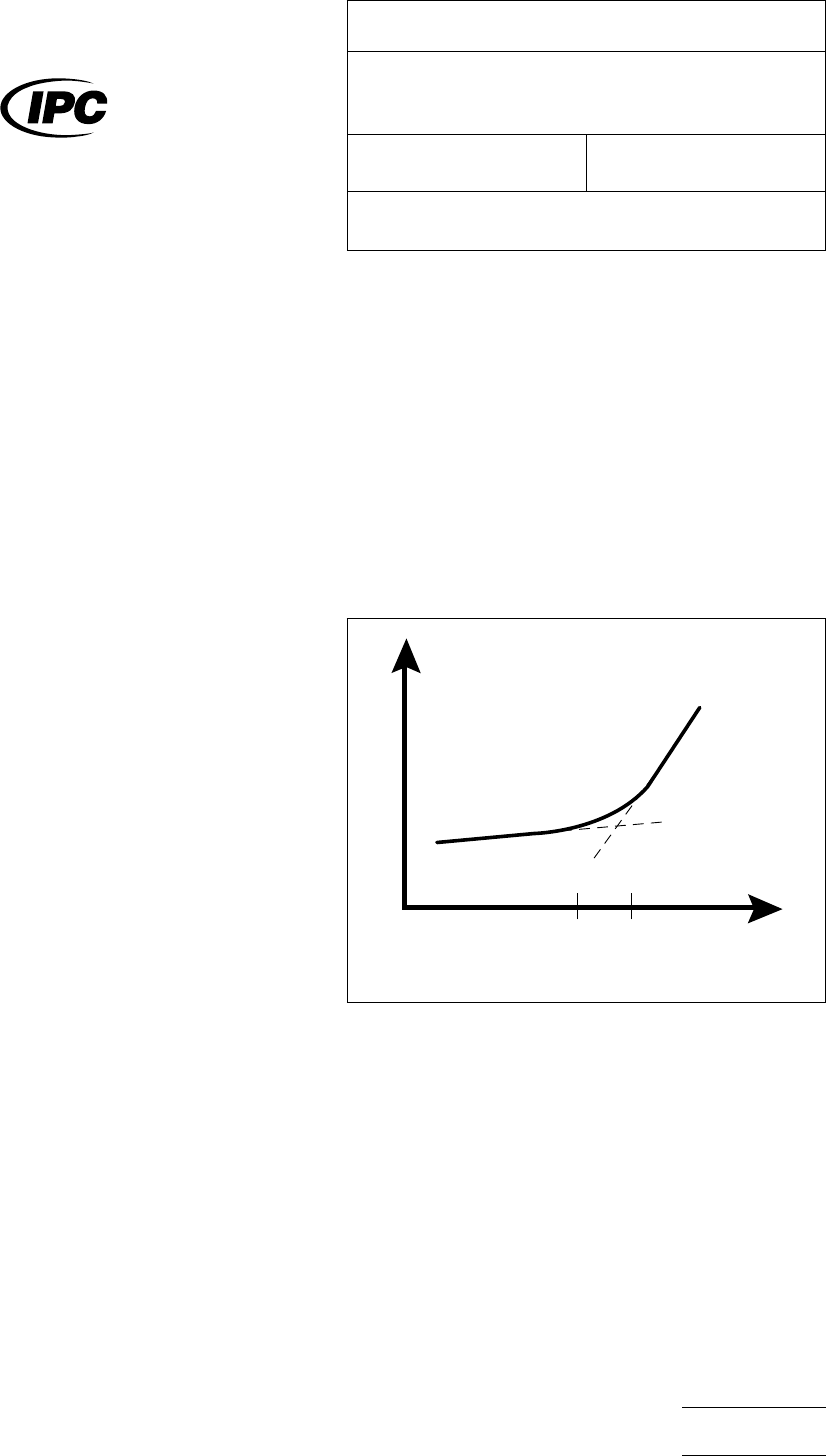
glass transition is determined by a construction pro-
cedure on the transition region of the extension versus tem-
perature curve (Figure 1).
5.10
Construct
a tangent line to the curve above and below
the transition.
5.11
The
temperature at which the tangents intersect is the
glass transition temperature.
5.12
Report
both the glass transition (intersection of tan-
gents), e.g., 200°C (TMA-5°C/min), and the temperatures at
the beginning of tangent A (T
A
)
and tangent B (T
B
)
(i.e., the
transition range), e.g., transition range: 160-205°C.
6.0
Notes
2.4.24.3-01
Figure
1
T
emperature
Tangent A
Tangent B
T
A
T
B
Extension
The
Institute for Interconnecting and Packaging Electronic Circuits
2215 Sanders Road • Northbrook, IL 60062-6135
IPC-TM-650
TEST
METHODS MANUAL
Number
2.4.24.3
Subject
Glass
Transition Temperature of Organic Films −
TMA Method
Date
7/95
Revision
Originating Task Group
Deposited Dielectric Task Group (C-13a)
Material
in this Test Methods Manual was voluntarily established by Technical Committees of the IPC. This material is advisory only
and its use or adaptation is entirely voluntary. IPC disclaims all liability of any kind as to the use, application, or adaptation of this
material. Users are also wholly responsible for protecting themselves against all claims or liabilities for patent infringement.
Equipment referenced is for the convenience of the user and does not imply endorsement by the IPC.
P
age1of2
电子技术应用 www.ChinaAET.com

6.1
Calibration
of the instrument must be carried out
according to the manufacturer’s recommendations. Two cali-
brations are required, one to establish the baseline and the
other to calibrate the TMA relative to a standard.
6.2
A
quartz specimen of 11-13 mm in length (between the
grips) is run at 5°C/min under inert gas purge (He) from −20
to 400°C to establish a baseline. The baseline is used to elimi-
nate the effects of grip expansion on extension measure-
ments. The coefficient of linear thermal expansion of quartz is
0.57 x 10
-6
/°C
(16-500°C)
1
.
6.3 After
the baseline is established, the TMA must be cali-
brated with at least one standard being 99.9999% pure alu-
minum which has a linear CTE of 24.9 x 10
-6
/°C
from
0-250°C. An aluminum specimen is run between -10 and
200°C and the coefficient of linear thermal expansion is calcu-
lated. If the measured value differs from the literature value,
the specimen size is adjusted to correspond to the measured
value, and the specimen is rerun. Once the measured and lit-
erature values are in agreement, this constant factor is used
on subsequent specimen sizes.
6.4
The
glass transition temperature for a given material will
be significantly different depending on the method of analysis
(i.e., DMA, DSC, or TMA). The glass transition determined by
DMA is frequency dependent and increases with increasing
frequency. The glass transition determined by DSC or TMA
will depend on the heating rate. The test method used along
with the frequency (DMA) or heating rate (DSC or TMA) should
be noted beside the glass transition value, e.g., 135°C
(DMA-10 Hz) or 141°C (DSC-5°C/min).
6.5
In
general, DMA is more sensitive that DSC or TMA. This
is especially important for high temperature polymers with
weak transitions.
1.
Lange’s Handbook of Chemistry, 12th edition, J. A. Dean, ed., McGraw-Hill, New York (1979).
IPC-TM-650
Number
2.4.24.3
Subject
Glass
Transition Temperature of Organic Films − TMA Method
Date
7/95
Revision
P
age2of2
电子技术应用 www.ChinaAET.com