IPC-TM-650 EN 2022 试验方法.pdf - 第696页
1 Scope This test method is to determine the physical endurance of applied polymer solder mask to sudden changes of high and low temperature excursions to cause physical fatigue. 2 Applicable Documents IPC-CC-830 Qualifi…

7 Notes
7.1
The design of the thermal cycling system must be flex-
ible enough to allow for an extremely high rate of temperature
change and for the rate of temperature change to be deter-
mined. Some issues to consider are as follows:
• Thermal mass compensation capability (energy vs. time)
• Environmental control capability (heating and cooling)
• Reproducibility of parameters
• Transfer speed (if applicable)
• Heating ramp rate
• Cool down rate
• Programming capability
• Profile memory
7.2 Suggested Drawing Note As this method addresses
assembly issues with printed boards, it is recommended that
the user of the printed board establish a drawing note in the
procurement documentation to provide the printed board fab-
ricators with guidance relative to the intended reflow process
of the printed board. An example of such a drawing note is
provided as follows:
XX. IPC D COUPON TESTING
A. COUPONS SHALL INCLUDE COMPONENT (A), VIA (B)
AND ALL PROPAGATED B STRUCTURES IAW IPC-
2221B APPENDIX A. 2 OF EACH COUPON DESIGN
SHALL BE TESTED PER MANUFACTURING PANEL.
B. THE IPC D COUPONS SHALL BE SUBJECTED TO 6
REFLOW SIMULATIONS IAW IPC-TM-650, METHOD
2.6.27 USING THE [230 °C, OR 245 °C, OR 260 °C]
PROFILE. ACCEPTANCE CRITERIA SHALL BE<5%
CHANGE IN RESISTANCE.
C. AFTER REFLOW SIMULATION TESTING, THE IPC D
COUPONS SHALL BE SUBJECTED TO 100 THERMAL
SHOCKS IAW IPC-TM-650, METHOD 2.6.7.2 FROM
-55C TO [MINIMUM OF (LAMINATE T
G
–10°C), OR
(REFLOW PEAK TEMPERATURE – 25 °C), OR
210 °C]. ACCEPTANCE CRITERIA SHALL BE<5%
CHANGE IN RESISTANCE.
Note: Parameters in bold should be tailored to each
application.
IPC-TM-650
Number
2.6.7.2
Subject
Thermal Shock, Thermal Cycle and Continuity
Date
3/2020
Revision
C
Page5of5
1
Scope
This
test method is to determine the physical
endurance of applied polymer solder mask to sudden
changes of high and low temperature excursions to cause
physical fatigue.
2
Applicable Documents
IPC-CC-830
Qualification
and Performance of Electrical
Insulating Compounds for Printed Board Assemblies
IPC-SM-840
Qualification
and Performance of Permanent
Coating (Solder Mask) for Printed Boards
3
Test Specimens
3.1 Qualification Testing
Six
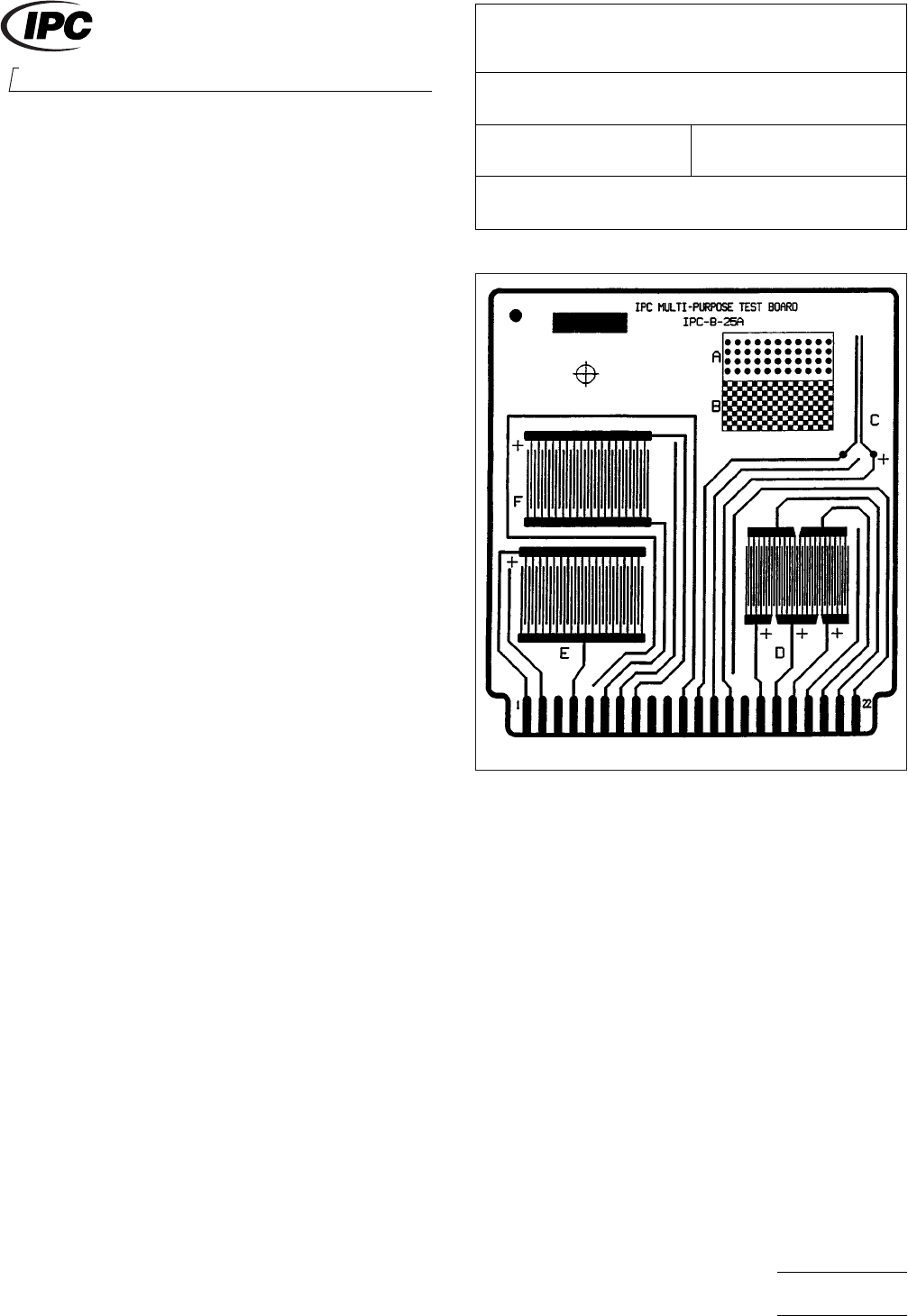
IPC-B-25A test boards (see
Figure 1) coated with solder mask and cured in accordance
with solder mask supplier’s recommendations.
3.2
Conformance Testing
Six
IPC-B-25A boards (see Fig-
ure 1) containing the C pattern (‘‘Y’’ pattern) with 0.635 mm
lines/0.635 mm spacing [25.00 mil lines/25.00 mil spacing] or
minimum spacing on the production board, whichever is
smaller, coated with solder mask according to the coating
supplier’s recommendations.
4
Apparatus
4.1 Chamber
Automatically
controlled dual temperature
environmental test equipment or two separate chambers
capable of maintaining -65° ± 5°C [-85° ± 9°F] and +125° ±
5°C [+257° ± 9°F].
5
Procedure
5.1 Specimen Preparation
In
order to test the compatibil-
ity of solder mask with conformal coating, conformal coat
three of the above test specimens with a coating in accor-
dance with IPC-CC-830 and cure in accordance with the
coating supplier’s recommendations
5.2
Test
5.2.1
Place
the test specimens into the test chamber, so that
they do not touch one another, and set the parameters as fol-
lows:
a. Temperature Extremes: as specified in IPC-SM-840 ± 5°C
[± 9°F].
b. Dwell Time at Temperature Extremes: 15 minutes
c. Transfer Time: Less than two minutes
d. Number of Cycles: 100
5.2.2
Activate
the test chamber and begin testing.
5.2.3
One
thermal cycle consists of the following:
a. Expose the specimens to the high temperature for 15 min-
utes.
b. Transfer the specimens to the low temperature in less than
two minutes.
c. Expose the specimens to the low temperature for 15 min-
utes.
d. Transfer the specimens to the high temperature in less
than two minutes.
IPC-2673-1
Figure
1 IPC-B-25A Test Board
2215
Sanders Road
Northbrook, IL 60062-6135
IPC-TM-650
TEST
METHODS MANUAL
Number
2.6.7.3
(Supersedes
2.6.7.1 for Solder Mask Test)
Subject
Thermal Shock - Solder Mask
Date
07/00
Revision
Originating Task Group
Solder Mask Performance Task Group (5-33b)
Material
in this Test Methods Manual was voluntarily established by Technical Committees of IPC. This material is advisory only
and its use or adaptation is entirely voluntary. IPC disclaims all liability of any kind as to the use, application, or adaptation of this
material. Users are also wholly responsible for protecting themselves against all claims or liabilities for patent infringement.
Equipment referenced is for the convenience of the user and does not imply endorsement by IPC.
P
age1of2
ASSOCIA
TION CONNECTING
ELECTRONICS INDUSTRIES
电子技术应用 www.ChinaAET.com

5.2.4
Repeat
the above cycle to 100 cycles without interrup-
tion.
5.2.5
Remove the specimens and allow them to reach labo-
ratory conditions as specified in IPC-SM-840.
5.2.6
Evaluation
Examine the specimens, on both sides,
for all visual requirements of IPC-SM-840 using 10X magnifi-
cations (Referee of 30X magnifications).
Note: The presence of cracks in solder mask is not a suffi-
cient reason for rejection unless the conformal coating has
also cracked. Report findings and support results with the
photographs, if appropriate.
IPC-TM-650
Number
2.6.7.3
Subject
Thermal
Shock - Solder Mask
Date
07/00
Revision
P
age2of2
电子技术应用 www.ChinaAET.com