IPC-TM-650 EN 2022 试验方法.pdf - 第498页
7.2). The diameter of the dielectric should be equal to the diameter of the bottom electrode. 4.1.1 Preparation of the Test Specimen from Metal Clad Laminates The metal cladding should be removed from the dielectric, unl…

1
Scope
This
test method describes procedure for measur-
ing dielectric permittivity and loss tangent of embedded pas-
sive materials. The measurements are made in an APC-7
coaxial configuration where the test specimen represents a
load terminating an air-filled coaxial transmission line. The
method is suitable for testing high dielectric constant (high-k)
polymer-composite materials having nominal thickness of
1 µm to 300 µm at frequencies of 100 MHz to 12 GHz. With
proper use and computation the frequency range can be
extended to 18 GHz. Existing measurement methods (see
Section 2) assume quasi-static conditions in the thin film
specimen, whereas this test method produces meaningful
results at frequencies greater than hundreds of megahertz
and where high-dielectric constant, thin film materials are to
be measured.
This test method is for qualification of filled and unfilled, dis-
tributed capacitance, thin film materials where the permittivity
in the frequency range of 100 MHz to 12 GHz is a critical
functional parameter. The method is also applicable to poly-
mer resist materials for embedded passive devices. This
method fills a test method gap within the IPC-TM-650 Test
Methods Manual for thin film, high-k dielectrics.
2
Applicable Documents
IPC-TM-650
Test
Method Manual
2.5.5.1 Permittivity (Dielectric Constant) and Loss Tangent
(Dissipation Factor) of Insulating Material at 1 MHz
(Contacting Electrode Systems)
2.5.5.4 Dielectric Constant and Dissipation Factor of Printed
Wiring Board Material-Micrometer Method
2.5.5.9 Permittivity and Loss Tangent, Parallel Plate, 1 MHz
to 1.5 GHz
ASTM
D 150
Standard
Test Methods for AC Loss Charac-
teristics & Permittivity (Dielectric Constant) of Solid Electrical
Insulating Materials
3
Terminology
3.1
Complex
Permittivity, ε*, ε*=ε
0
(ε’ - jε’’)
where ε
0
=
8.85419
10
-12
F/m
is the dielectric permittivity of air [1], ε’ is
the relative dielectric constant and ε’’ is the relative imaginary
dielectric constant (the dielectric loss).
3.2
Relative
Permittivity, ε
r
*,
is a dimensionless ratio of com-
plex permittivity to the permittivity of air, ε
r
*=ε*/ε
0
= ε’ - jε’’.
3.3
Dielectric
Constant is the real part of the relative permit-
tivity. The symbol used in this document is ε’. Other symbols
such as K, k, K’,k’, ε
r
and ε
r
’ are
exchangeable symbols used
in the technical literature.
3.4
Dielectric
Loss Tangent, tan (δ), is a dimensionless ratio
of the dielectric loss to the dielectric constant, tan (δ)=ε’’/ε’.
3.5 APC-7,
Amphenol 7 mm 50 Ω Coaxial Connector; APC-
3.5 Amphenol 3.5 mm Precision 50 Ω Coaxial Connector.
3.6 Scattering
Coefficient, S
11
,
is a ratio of incoming and
outgoing power waves measured by a network analyzer
through Port 1. S
11
is
complex entity consisting of magnitude,
|S
11
|,
and phase, φ. In this document the circuit parameters
that are complex numbers are in bold font.
3.7
Input
Impedance, Z
in
,
a complex entity consisting of
magnitude and phase.
Z
in
= Z
0
(1 + S
11
)/(1 − S
11
)
(1)
where
Z
0
is
characteristic impedance of the APC-7 air-filled
coaxial line, Z
0
=5
0Ω.
4
Test Specimen
The
test specimen consists of a circular
disk capacitor having the nominal diameter, a, of 3.0 mm with
metal electrodes on both sides. The dielectric thickness, d,
may be in the range of 1 µm to 300 µm (1 µm = 1 micro-
meter).
4.1
Preparation
Conducting
metal electrodes, thickness of
0.1 µm to 0.5 µm, shall be coated on both sides of the dielec-
tric. Sputtered copper or gold is recommended. To avoid
electrical shorting, the diameter of the top electrode, which
faces the Section B of the test fixture (Figure 1), may be
2.85 mm to 3.0 mm. The diameter of the bottom electrode
that faces the Section A (Figure 1), shall be within 3.0 mm to
3.05 mm, matching the diameter of the center conductor pin
(Figure 1). This is the diameter a of the specimen that along
with the specimen dielectric thickness, d, determines the
specimen geometrical capacitance, C
p
(see
Equation (3) in
3000
Lakeside Drive, Suite 309S
Bannockburn, IL 60015-1219
IPC-TM-650
TEST
METHODS MANUAL
Number
2.5.5.10
Subject
High
Frequency Testing to Determine Permittivity
and Loss Tangent of Embedded Passive Materials
Date
07/05
Revision
Originating Task Group
Embedded Devices Test Methods Subcommittee
(D-54)
Material
in this Test Methods Manual was voluntarily established by Technical Committees of IPC. This material is advisory only
and its use or adaptation is entirely voluntary. IPC disclaims all liability of any kind as to the use, application, or adaptation of this
material. Users are also wholly responsible for protecting themselves against all claims or liabilities for patent infringement.
Equipment referenced is for the convenience of the user and does not imply endorsement by IPC.
P
age1of8
ASSOCIA
TION CONNECTING
ELECTRONICS INDUSTRIES
®
电子技术应用 www.ChinaAET.com
7.2).
The diameter of the dielectric should be equal to the
diameter of the bottom electrode.
4.1.1
Preparation of the Test Specimen from Metal Clad
Laminates
The
metal cladding should be removed from the
dielectric, unless the thickness of the conductor is already
within the recommended range of 0.1 µm to 0.5 µm. The sur-
faces of the bare dielectric should be cleaned from conduct-
ing contaminants such as traces of ions to avoid possible
corrosion of sputtered thin film metals, by rinsing in deionized
water, drying, and then remetalizing by sputtering with copper
or gold (see 4.1).
4.1.2
Thin Dielectric Films that are Not Free-Standing
and Require Support
The
supporting conductor can be
used as the bottom electrode of the specimen. The topside
conductor should be removed and then the top surface of the
dielectric should be recoated to make the top electrode (see
4.1). The thickness of the bottom conductor can be compen-
sated during measurements by adding an equivalent electrical
delay (see 6.3.1).
5
Test Fixture
The
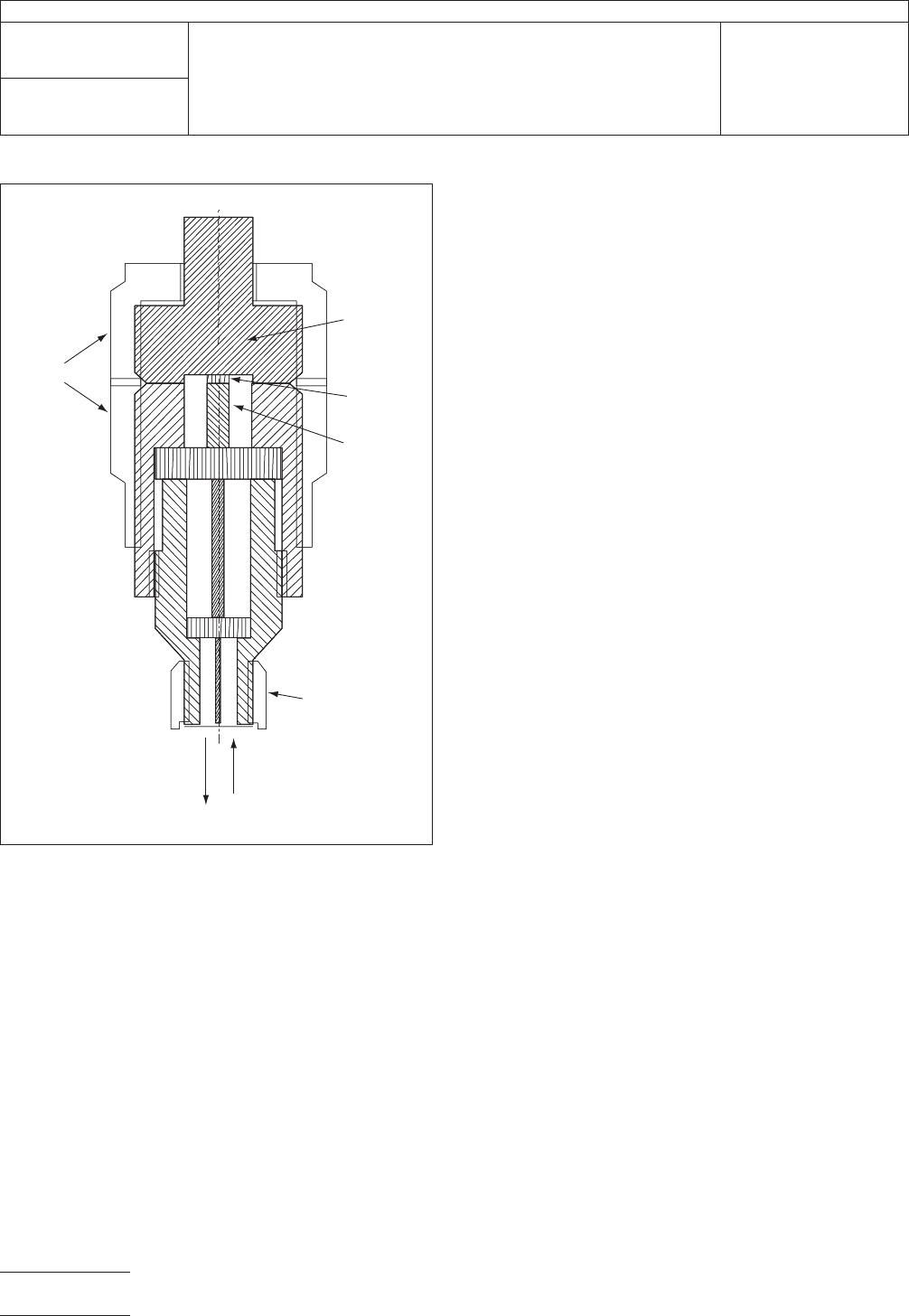
test fixture consists of two Sections A
and B, where the specimen is placed in between, as shown in
Figure 1. The detailed drawings are given in Section 11. Sec-
tion A is an APC-7 to an APC-3.5 microwave adapter with
characteristic impedance of 50 Ω (Agilent 1250-1746). Sec-
tion B is an altered APC-7 short termination (Agilent 04191-
85300 or equivalent may be used), with a custom-machined
gap to accommodate a specimen of particular thickness.
When Sections A and B are assembled, the depth, d,ofthe
gap is equal to the specimen thickness. Specimens with dif-
ferent thickness will require separate Sections B. In the case
of a specimen thinner than 10 µm, the center conductor of the
APC-7 Section A may be replaced with a fixed 3.05 mm diam-
eter pin, machined precisely to achieve a flat and parallel con-
tact between the film specimen and the terminating Section B.
The diameter of the outer conductor, b, of Section A is
7.0 mm (see drawing in Section 11).
6
Measurement Procedure
6.1 Apparatus
The
measurement requires an automatic
vector network analyzer operating in the frequency range of
100 MHz to 18 GHz, for example an Agilent 8720D or equiva-
lent. The instrument should be equipped with a IEEE 488.2
I/O interface for transferring data between the network ana-
lyzer and a computing unit, e.g., a personal computer (PC)
with a General Purpose Input/Output Board (GPIB).
Connection between the test fixture (APC 3.5 adapter of Sec-
tion A) and the network analyzer shall be made using a phase
preserving coaxial cable, for example an Agilent 85131-60013
or equivalent.
6.2
Calibration Procedure
Set
the measurements range
to be between 100 MHz and 12 GHz. The number of data
points should be in the range of 800. The power level should
be set to 0 dBm with a dynamic range of at least - 40 dBm
(desirably to - 60 dBm ). Select the one Port S
11
measuring
mode
and Smith-Chart format. Connect the phase preserving
cable to the Port-1 of the network analyzer and to Section A
of the test fixture. Attach a calibration standard to Section A
of the test fixture. Perform an APC-7 Open, Load, Short cali-
bration using suitable calibration standards (Agilent 85050B
IPC-25510-1
Figure
1 Test fixture with a test specimen between
Sections A and B
SECTION B
APC-7
Mount
SECTION A
APC-3.5 Port
to Network Analyzer, S
11
Short
Standard
with a Gap
Test
Specimen
Center
Conductor
Pin
IPC-TM-650
Number
2.5.5.10
Subject
High
Frequency Testing to Determine Permittivity and Loss
Tangent of Embedded Passive Materials
Date
07/05
Revision
P
age2of8
电子技术应用 www.ChinaAET.com
7
mm calibration kit or equivalent) in accordance with the
manufacturer specification for the network analyzer. After cali-
bration verify the following:
• The Open Standard produces an ‘open trace’ on the Smith
Chart.
• The Broad Band 50 Ω Standard Load produces a dot trace
located in the middle of the Smith Chart at 50 Ω, with phase
angle equal to zero degree.
• The Short Standard produces a dot trace at 0 Ω, with a
phase angle of 180°.
6.3
Measurements
Determine
the specimen dielectric
thickness, d. The thickness of the sputtered conductor may
be neglected. However, if the specimen was made on a con-
ducting support (see 4.1.2) thicker than 0.5 µm, the thickness
of the bottom conductor should be compensated by adding
an equivalent electrical delay (see 6.3.1.). Verify that the diam-
eter of both electrodes satisfies the required values (see 4.1).
Ensure that the diameter of the bottom electrode facing the
center conductor of Section A is in the range of 3.0 mm to
3.05 mm. Place the test specimen at the center conductor of
Section A. Attach Section B of the test fixture.
Measure the complex scattering coefficient, S
11
.
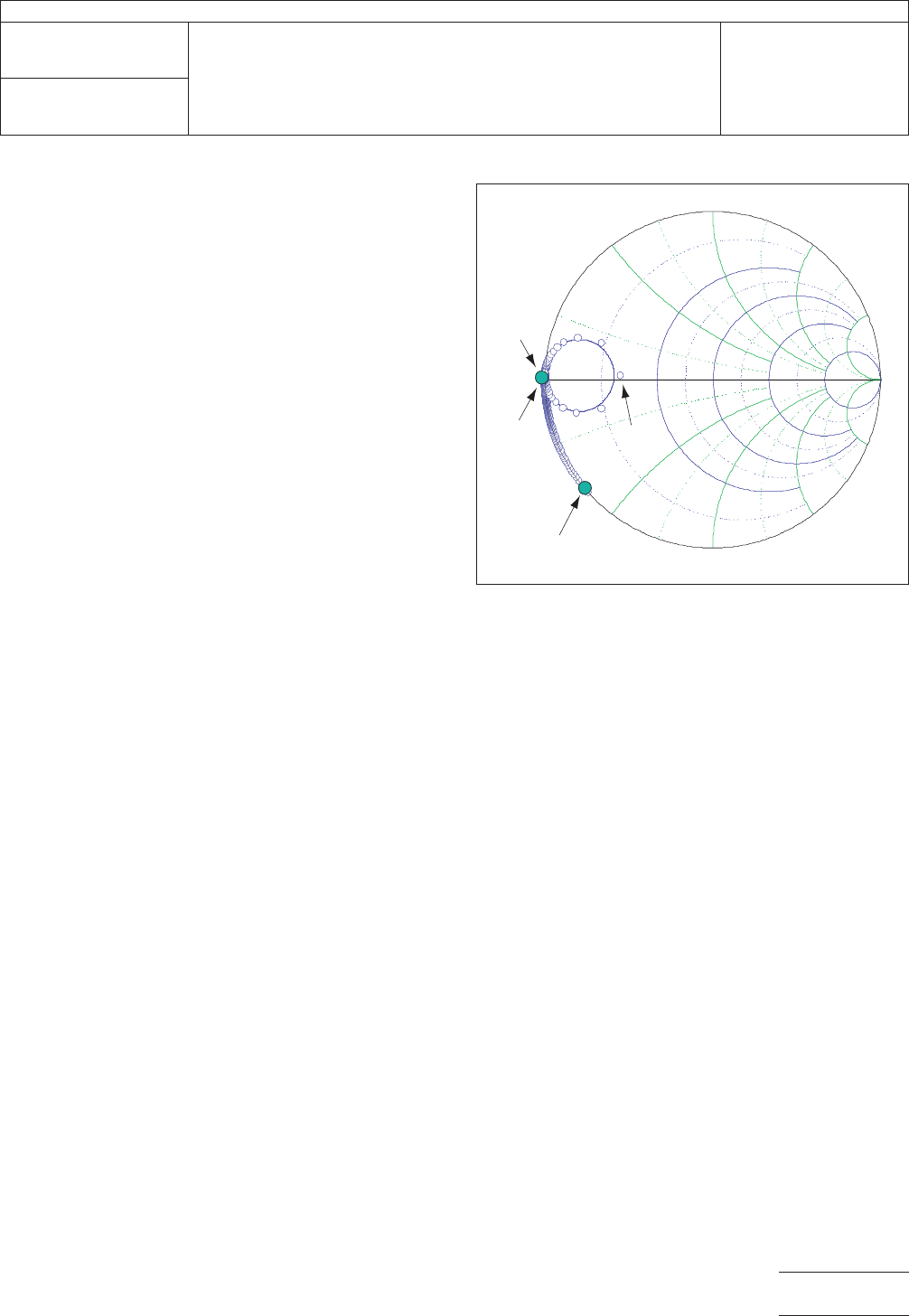
For a capaci-
tive load (a dielectric specimen), the trace should represent a
semicircle on the lower half portion of the Smith Chart (Figure
2), going from a high impedance region at lowest frequencies
towards a low impedance region as the frequency increases.
The radius of the semicircle represents the reflection coeffi-
cient, which for a loss-less dielectric approaches the value of
one. In the case of an inductive specimen, the trace should
represent a semicircle on the higher half portion of the Smith
Chart, going from a low impedance region, Z ≈ 0 at lowest
frequencies, towards a high impedance region as the fre-
quency increases.
Example measurements obtained for a specimen having the
dielectric thickness of 80 µm, dielectric constant of 69 and the
dielectric loss tangent of 0.0023 are shown in Figure 2. The
trace crosses the zero impedance point at the series reso-
nance frequency, ƒ
LC
,
of 5.1 GHz, beyond which the load
character changes from capacitive to inductive. A local loop
on the chart indicates the first cavity resonance at ƒ
cav
of
14.65
GHz.
After the frequency scan is completed, transfer the entire digi-
tized trace spectrum containing the S
11
amplitude
and S
11
phase
at each measured frequency to a PC via a GPIB link.
6.3.1
Compensation for a Finite Thickness of the Speci-
men Bottom Conductor
Adding
an electrical delay to the
test structure can compensate thickness of the bottom elec-
trode conductor. This procedure moves the reference plane
established during calibration (see drawings of the test fixture
in Section 11), to a new position located at the interface
between the bottom conductor and the dielectric. The plane
should be moved away from the generator a distance equal to
the actual thickness of the bottom conductor. The electrical
delay procedure should be conducted in accordance to the
operating manual for the network analyzer before transferring
the data to a PC.
7
Calculations
7.1 Impedance
Determine
the experimental complex
impedance, Z
in
,
of the specimen at each frequency point, ƒ,
according to Equation (1) presented in 3.7. Example results
obtained for a 25 µm thick dielectric with (ε’ =10andtan (δ)
of 0.01 are shown in Figure 3.
7.2
Specimen Permittivity
At
frequencies where the
specimen may be treated as a lumped capacitance, where |Z|
is larger than 5 Ω (see Figure 3, References [2,3]), the input
impedance is given by Equation (2a) and the real (ε’) and
imaginary (ε’’) component of the dielectric permittivity can be
IPC-25510-2
Figure
2 Example measurements plotted in a Smith chart
Format for an 80 µm thick specimen with permittivity of 69
- j0.16.
0.8
1.5 3.0 7.5
-0.8j
0.8j
-1.5j
1.5j
-3.0j
3.0j
-7.5j
7.5j
100 MHz
5.1 GHz
14.65 GHz
Z
in
~
0
~
IPC-TM-650
Number
2.5.5.10
Subject
High
Frequency Testing to Determine Permittivity and Loss
Tangent of Embedded Passive Materials
Date
07/05
Revision
P
age3of8
电子技术应用 www.ChinaAET.com