IPC-TM-650 EN 2022 试验方法.pdf - 第362页
1 Scope This method is used to determine the inner layer bond strength of either a metal conductor or an individual dielectric. 2 Applicable Documents None 3 Test Specimen Laminate dielectric with or without cop- per foi…
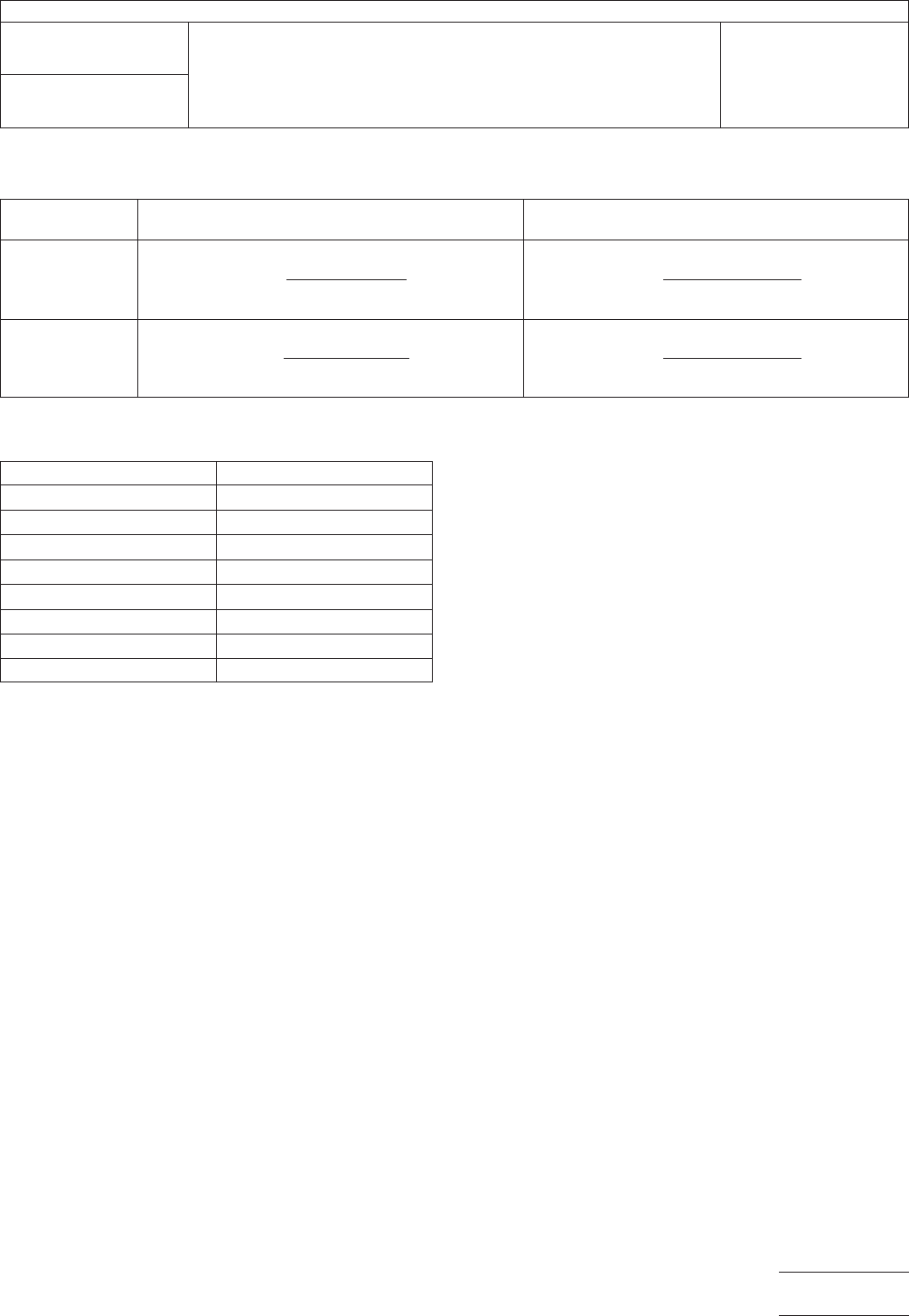
CHECKLIST
1. Is the specimen size 300 mm x 280 mm
[12 in x 11 in]?......................................................... ____
2. Is the warp direction properly identified? ................. ____
3. Were the four location points prepared by either
drilling or scribing?................................................... ____
4. Were the measured points located approximately
12 mm [0.5 in] from each edge of the fill direction
and approximately 25 mm [1.0 in] from each edge
of the warp direction?.............................................. ____
5. Were the measurements taken from the same
feature location, i.e., edge of the hole, center,
scribe mark, etc?..................................................... ____
6. Were specimens processed without mechanical
or chemical pre-cleaning?........................................ ____
7. Was cupric chloride etching with spray used to
remove the copper? ................................................ ____
8. Was the temperature of the etching less than
50°C? ...................................................................... ____
9. The specimens were not exposed to resist
stripping solution?.................................................... ____
10. Were specimens racked after removal from
etching cycle?.......................................................... ____
11. Is the oven used for baking capable of ± 2°C
control and has a recovery time of less than
15 minutes?............................................................. ____
12. Were specimens subjected to the bake cycle
within 4 hours after etching?.................................... ____
13. Were the specimens baked at 105°C ± 5°C for
4 hours and vertically racked? ................................. ____
14. Was the stabilization chamber capable of
maintaining 20% RH maximum at 21 ± 2°C? .......... ____
15. Was each specimen removed from stabilization
after 1 hour + 1/2 hour -0 hours and were all
measurements taken within 5 minutes?................... ____
16. Were samples stored in stabilization chamber
between after bake and after thermal stress
measurements if immediate processing not
feasible?................................................................... ____
17. Were specimens thermal stressed at 150°C
± 5°C for two hours and vertically racked?.............. ____
18. Was each specimen removed from stabilization
after 1 hour + 1/2 hour -0 hours and were all
measurements taken within 5 minutes?................... ____
Note:
When
using the above checklist, all answers should be
affirmative. The technician performing the test should sign the
report, record the date and times of all actions taken, and
report any deviations on the procedure.
T
able 1 Calculation Procedure
Subgroup
Size
If
Apparent Outlier
is Largest Value
If Apparent Outlier
is Smallest Value
n
= 3-7
D =
Largest Value −
2nd Largest Value
Largest
Value −
Smallest Value
D =
2nd Smallest Value −
Smallest Value
Largest
Value −
Smallest Value
n = 8-10
D =
Largest Value −
2nd Largest Value
Largest
Value −
2nd Smallest Value
D =
2nd Smallest Value −
Smallest Value
2nd
Largest Value −
Smallest Value
Table 2 Extreme Value Table
n
D (Confidence Level 95%)
3
0.941
4 0.765
5 0.642
6 0.560
7 0.507
8 0.554
9 0.512
10 0.433
IPC-TM-650
Number
2.4.39
Subject
Dimensional
Stability, Glass Reinforced Thin Laminates
Date
2/86
Revision
A
P
age3of3
电子技术应用 www.ChinaAET.com
1
Scope
This
method is used to determine the inner layer
bond strength of either a metal conductor or an individual
dielectric.
2
Applicable Documents
None
3
Test Specimen
Laminate
dielectric with or without cop-
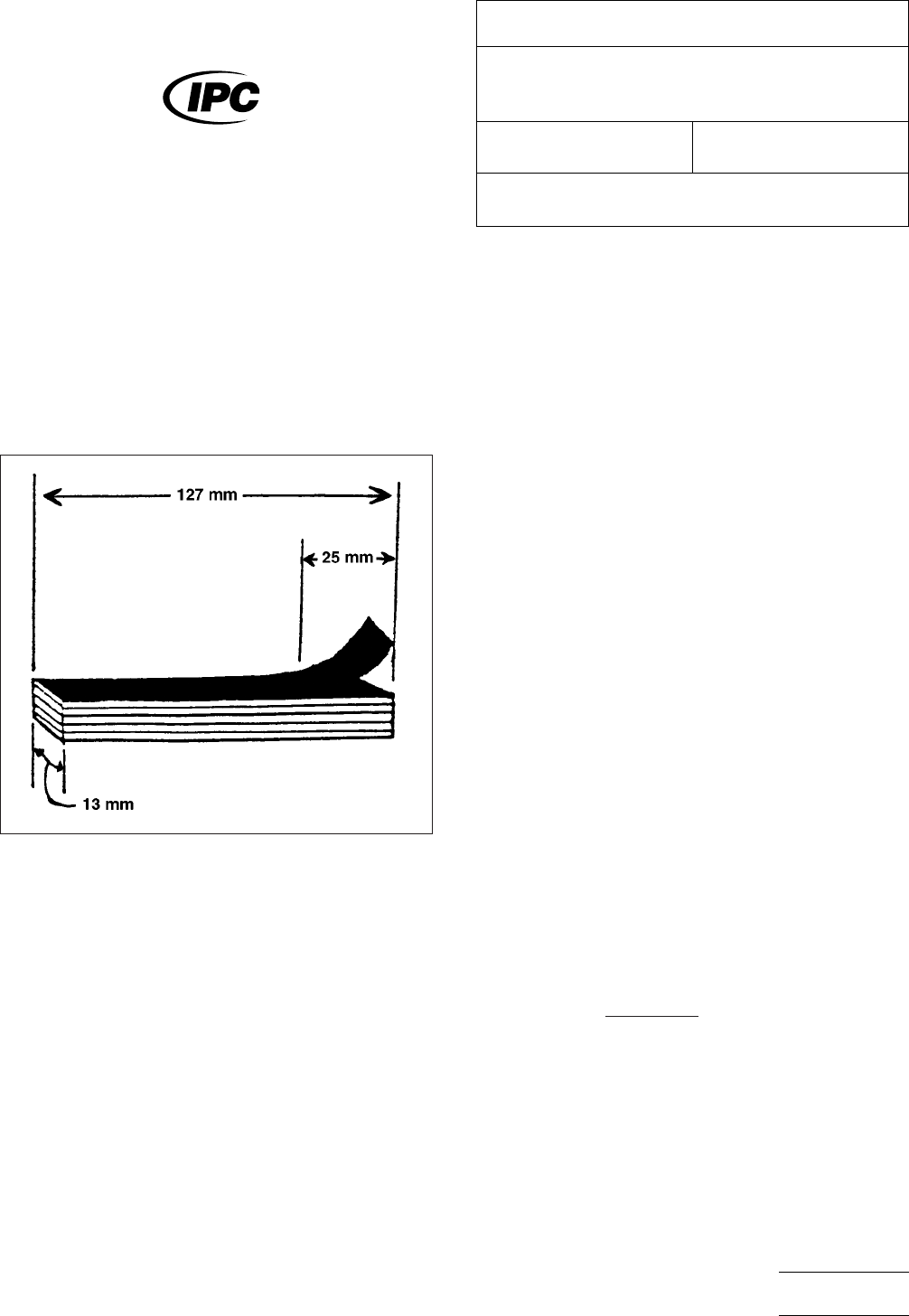
per foil, prepared in accordance with Figure 1.
4
Equipment/Apparatus
4.1
Unite-O-Matic
tensile tester Model #FM 10 or equivalent
4.2
Scalpel
5
Procedure
5.1 Preparation for Testing
During
layup of the test
specimen panel, place ‘‘TEDLAR’’ (or other suitable material)
release sheets that will disallow lamination at one end of each
specimen, providing a 13 mm x 25 mm non-bonded tab. The
tabs can then be used as gripping areas to perform bond
strength testing. One can then evaluate the laminate-to-
laminate bonds and the laminate-to-copper foil bond through-
out the finished panel thickness.
5.1.1
Place
an equal number of release sheets on the outer
surface of the layup, covering all surfaces, except where inter-
nal release sheets have been placed. This is essential to pro-
vide proper and uniform lamination pressure.
5.1.2
After
lamination and cure, cut the panel into 25 mm
strips, as shown in Figure 1, and remove internal release
sheets.
5.1.3
If
steps 5.1.1 and 5.1.2 are not used, it will be neces-
sary to chemically or thermally remove resins from the outer
25 mm, in order to provide a tab to initiate testing.
5.2
After
cutting the samples to the designated size and lift-
ing the 25 mm strip for testing, the layer to be tested shall be
fastened into the clamping device of the tensile tester, allow-
ing the wire connecting the clamp to the tensile tester to pull
the specimen vertically within ± 5° angle.
5.3
The
tester is then started. A force is applied in the verti-
cal direction at a rate of 51 mm per minute until delamination
(bond strength) is completed or the inner layer tears.
The minimum load is then recorded using the following for-
mula:
Bond strength of the conductor width =
25mm
sample
width
x total load
IPC-2-4-40-1
Figure
1 Laminate Dielectric
The
Institute for Interconnecting and Packaging Electronic Circuits
2215 Sanders Road • Northbrook, IL 60062-6135
IPC-TM-650
TEST
METHODS MANUAL
Number
2.4.40
Subject
Inner
Layer Bond Strength of Multilayer Printed
Circuit Boards
Date
10/87
Revision
Originating Task Group
N/A
Material
in this Test Methods Manual was voluntarily established by Technical Committees of the IPC. This material is advisory only
and its use or adaptation is entirely voluntary. IPC disclaims all liability of any kind as to the use, application, or adaptation of this
material. Users are also wholly responsible for protecting themselves against all claims or liabilities for patent infringement.
Equipment referenced is for the convenience of the user and does not imply endorsement by the IPC.
P
age1of1
电子技术应用 www.ChinaAET.com

1.0
Scope
1.1
This
method covers determination of the coefficient of
linear thermal expansion of electrical insulating materials
1
by
use
of a thermomechanical analyzer.
1.2
This
method is applicable to materials that are solid over
the entire range of temperature used, and that retain sufficient
hardness and rigidity over the temperature range so that irre-
versible indentation of the specimen by the sensing probe
does not occur.
1.3
Transition
temperatures also may be obtained by this
method.
2.0
Applicable Documents
ASTM D-618
Conditioning
Plastics and Electrical Insulating
Materials for Testing
2
ASTM-D-696
Test
for Coefficient of Linear Thermal Expan-
sion of Plastics
3
3.0
Summary of Method
3.1
This
method used a thermomechanical analyzer with an
X-Y recorder to graph the change of dimension as a function
of temperature of a small specimen of a solid electrical insu-
lating material. Coefficients of linear thermal expansion can be
calculated from the graph. Other thermal observations may
also be made.
Note
1—
-Other
rapid thermal analysis methods are being
studied by ASTM Subcommittees D09.17 and D20.30.
4.0
Significance
4.1
Measurements
of coefficient of linear thermal expansion
are useful in evaluating the suitability of solid insulating mate-
rials for use in combination with other materials where
mechanical stresses may develop as a result of differences in
coefficients.
4.2
This
method may be compared with Method D-696, but
tests made with this method use much smaller specimens.
This eliminates the need for large liquid baths and greatly
reduces the time required to reach temperature equilibrium.
As a result, the time required for making a test is less than for
Method D-696, and the method can conveniently be used
over a wider temperature range than for Method D-696.
5.0
Apparatus
5.1
The
thermomechanical analyzer shall include:
5.1.1
A
specimen holder and probe, into which the speci-
men can be placed. Changes in height of the specimen are
sensed by movement of the probe. The shape and size of the
probe shall be such that for the material tested the load
applied to the specimen by the probe shall not cause inden-
tation of the specimen within the range of temperatures of
interest.
5.1.2
Means
for sensing movement of the probe resulting
from changes in height of the specimen and for translating
these movements into a signal suitable for input to the
recorder. The sensing element should be capable of produc-
ing a movement of the recorder pen of at least 1000 times the
change in height of the test specimen, with provisions for less
sensitive ranges when needed.
5.1.3
Means
for uniformly heating the specimen holder at a
predetermined rate over the range of temperatures of interest.
This will consist of a furnace and temperature controller with
provisions for precooking the furnace and specimen holder
when measurements at subambient temperatures are to be
made.
5.1.4 Means
for measuring temperature in immediate prox-
imity to the test specimen.
5.1.5
An
X-Y recorder for recording changes in specimen
height as a function of specimen temperature.
1. This method is under the jurisdiction of ASTM Committee D-9 on Electrical Insulating Materials and is the direct responsibility of Subcommittee D09.01 on Electri-
cal Insulating Varnishes, Powders, and Encapsulating Compounds.
2. Annual Book of ASTM Standards, Part 39.
3. Annual Book of ASTM Standards, Part 35.
The
Institute for Interconnecting and Packaging Electronic Circuits
2215 Sanders Road • Northbrook, IL 60062-6135
IPC-TM-650
TEST
METHODS MANUAL
Number
2.4.41
Subject
Coefficient
of Linear Thermal Expansion of
Electrical Insulating Materials
1
Date
3/86
Revision
Originating
Task Group
N/A
Material
in this Test Methods Manual was voluntarily established by Technical Committees of the IPC. This material is advisory only
and its use or adaptation is entirely voluntary. IPC disclaims all liability of any kind as to the use, application, or adaptation of this
material. Users are also wholly responsible for protecting themselves against all claims or liabilities for patent infringement.
Equipment referenced is for the convenience of the user and does not imply endorsement by the IPC.
P
age1of3
电子技术应用 www.ChinaAET.com