IPC-TM-650 EN 2022 试验方法.pdf - 第393页
1.0 Purpose To determine dispersion of glass microbeads in Self Shimming Thermally Conductive Adhesives, thus ensuring the proper self-induced gap. It is important for the beads to be well dispersed throughout the batch,…
1.0
Scope
This
test method defines the procedure for
determining the Thermal Conductivity of polymer coatings on
inorganic substrates, such as polyimide on a silicon wafer.
2.0
Applicable Documents
ASTM D 2766
Standard
Test Method for Specific Heat of
Liquid and Solids
3.0
Test Specimen
See
Sample Preparation 5.1.
4.0
Apparatus
4.1
CO
2
Laser
capable of 5 Joules per pulse.
4.2
Mercury/Cadmium/Tellurium
(MCT) Infrared Detector or
equivalent.
5.0
Procedure
5.1 Sample Preparation
Samples
are prepared by form-
ing a structure on a silicon wafer consisting of 2 µm of sput-
tered carbon, 2 µm of sputtered Al metal, 25 µm of polymer
dielectric, and 2 µm of sputtered Al on wafer according to
manufacturer’s recommendations.
5.2
Test Procedure
Sample
is placed between the laser
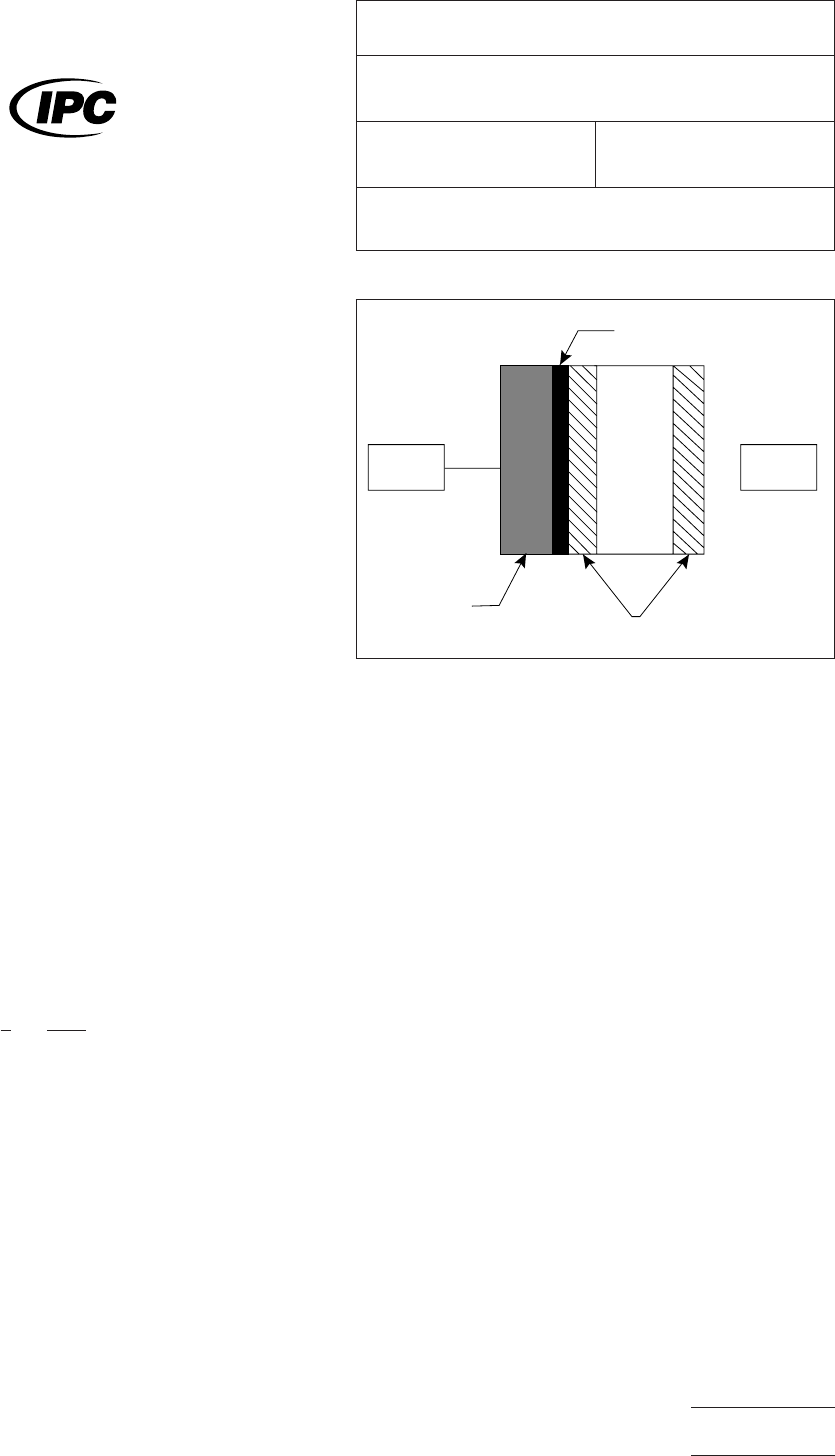
and the detector according to Figure 1.
5.3
Test Analysis
Heat
rise is fit to the equation:
T = 1 −
4
π
Σ
α
n = 0
(−1)
n
2n+1
e
−{(2n+1)
2
π
2
Lt/4}
where
T is the normalized temperature rise and t is the time in
seconds and L is the fitting parameter. The thermal divusivity
k is given by:
k = (L)(l)
2
where
l is the sample thickness. The thermal condutivity, K, is
given by the equation:
K=kC
p
P
where
C
p
is
the heat capacity (as determined by ASTM D
2766) and p is the density.
2.4.50-01
Figure
1 Laser is flashed and the heat rise is measured
on the back Al by the detector
Sputtered Al
Sputtered Carbon
Polymer
Dielectri
c
Silicon
DetectorLaser
The
Institute for Interconnecting and Packaging Electronic Circuits
2215 Sanders Road • Northbrook, IL 60062-6135
IPC-TM-650
TEST
METHODS MANUAL
Number
2.4.50
Subject
Thermal
Conductivity, Polymer Films
Date
7/95
Revision
Originating Task Group
Deposited Dielectric Task Group (C-13a)
Material
in this Test Methods Manual was voluntarily established by Technical Committees of the IPC. This material is advisory only
and its use or adaptation is entirely voluntary. IPC disclaims all liability of any kind as to the use, application, or adaptation of this
material. Users are also wholly responsible for protecting themselves against all claims or liabilities for patent infringement.
Equipment referenced is for the convenience of the user and does not imply endorsement by the IPC.
P
age1of1
电子技术应用 www.ChinaAET.com
1.0
Purpose
To
determine dispersion of glass microbeads
in Self Shimming Thermally Conductive Adhesives, thus
ensuring the proper self-induced gap.
It is important for the beads to be well dispersed throughout
the batch, since this adhesive is designed for bonding of elec-
trical components to printed circuit boards where electrical
isolation, provided by a consistent gap, is required. The test-
ing is performed by measuring the gap induced by the adhe-
sive placed between two flat metal surfaces.
2.0
Applicable Documents
None
3.0
Test Specimen
Two
steel blocks; one with dimensions 1″x1″x
5
⁄
16
″,
the sec-
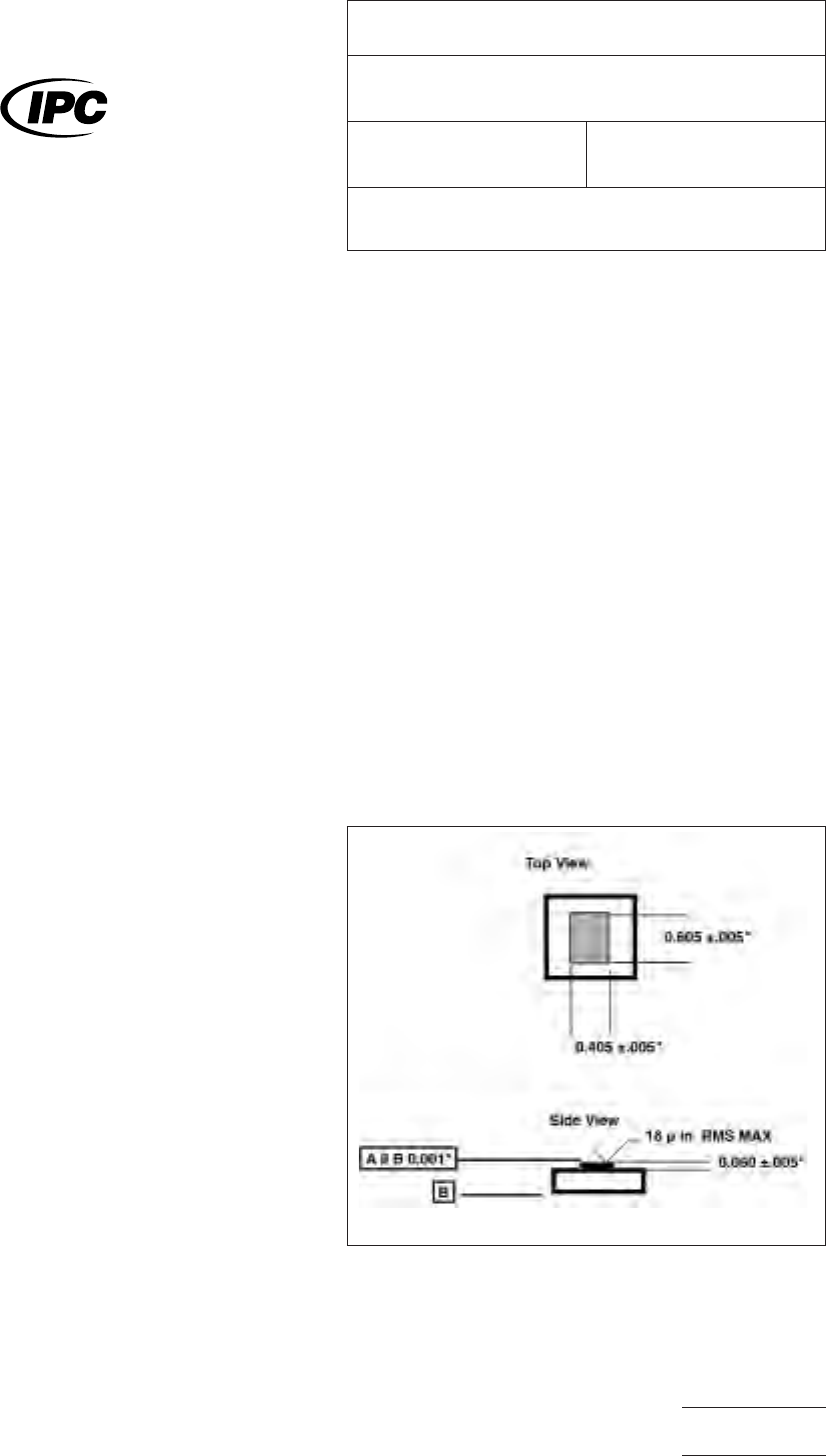
ond must be machined to equal the area of a TO-220 transis-
tor (.605″x.405″x0.060″) on the center top of the block
4.0
Apparatus and Reagents
4.1 Apparatus
4.1.1
Two
steel blocks; one with dimensions 1″x1″x
5
⁄
16
″,
the
second must be machined to equal the area of a TO-220
transistor (.605″x.405″x0.060″) on the center top of the block.
Both surfaces contacting the adhesive during the test must be
highly polished. (See Figure 1).
4.1.2
Micrometer,
accurate to the nearest 0.001″
4.1.3
Spatula
4.1.4
Clamp,
Hargrave #1
5.0
Test Procedure
5.1 Preparation
5.1.1
Accurately
measure to the nearest 0.001″ the thick-
ness of the two sandwiched steel blocks. Record.
5.1.2
Apply
sufficient adhesive to ensure coverage of the
T0-220 machines area.
5.1.3
Assemble
blocks without twisting.
5.2 Test
5.2.1
Clamp
blocks to induce vertical force.
5.2.2 Wipe
off excess adhesive, if any.
5.2.3 Remove
clamp.
5.2.4
Measure
thickness of the sandwiched blocks with the
adhesive in between. Record.
5.3
Evaluation
5.3.1
Gap
Induced = Thickness measured in 5.2.4 − thick-
ness measured in 5.1.1.
5.3.2
Report
the average of three determinations.
Note: A hargrave #1 clamp produces approximately 20 lbs of
clamping force.
IPC-2.4.51-001
Figure
1
The
Institute for Interconnecting and Packaging Electronic Circuits
2215 Sanders Road • Northbrook, IL 60062-6135
IPC-TM-650
TEST
METHODS MANUAL
Number
2.4.51
Subject
Self
Shimming Thermally Conductive Adhesives
Date
1/95
Revision
Originating Task Group
SMT Mounting Adhesives Task Group (5-11c)
Material
in this Test Methods Manual was voluntarily established by Technical Committees of the IPC. This material is advisory only
and its use or adaptation is entirely voluntary. IPC disclaims all liability of any kind as to the use, application, or adaptation of this
material. Users are also wholly responsible for protecting themselves against all claims or liabilities for patent infringement.
Equipment referenced is for the convenience of the user and does not imply endorsement by the IPC.
P
age1of1
电子技术应用 www.ChinaAET.com

1 Scope This test method establishes a procedure for
characterizing the toughness of the resin system materials
used in making laminates for the fabrication of printed wiring
boards. The single-edge-notch bending (SENB) geometry is
used to determine the critical-stress-intensity factor, K
1c
, and
the energy per unit area of crack surface or critical strain
energy release rate, G
1c
, at fracture initiation. This method
assumes linear elastic behavior of the cracked specimen, so
there are corresponding restrictions on the linearity of the
load-displacement diagram. Use of this test method for
printed wiring board laminate materials or other composites
may not yield comparative results.
2 Applicable Documents
2.1 ASTM Standards
D638
Test Method for Tensile Properties of Plastics
D4000 Classification Systems for Specifying Plastic Materials
D5045 Standard Test Methods for Plane-Strain Fracture
Toughness and Strain Energy Release Rate of Plastic
Materials
E399 Test Method for Linear-Elastic Plane-Strain Fracture
Toughness K
1c
of Metallic Materials
E691 Practice for Conducting an Inter-Laboratory Study to
Determine the Precision of a Test Method
3 Terminology
3.1 Terms and Definitions (reference ASTM E399)
3.1.1 Compact Tension
Specimen geometry consisting of
single-edge notched plate loaded in tension.
3.1.2 Critical Strain Energy Release Rate (G
1c
) Tough-
ness parameter based on energy required to fracture.
3.1.3 Plane-Strain Fracture Toughness (K
1c
) Toughness
parameter indicative of material fracture resistance.
3.1.4 Single-Edge Notched Bend Specimen geometry
consisting of center-notched beam.
3.1.5 Yield Stress The stress at fracture (slope of stress-
strain curve is not required to be zero).
4 Test Samples
4.1 Sample Construction
The preferred finished sample is
a block of pure resin, free of contaminants and fully cured (not
partially cured, not over-cured). Note: DSC may be used to
evaluate a received sample’s degree of cure. TGA may be
used to check for the presence of residual solvents or other
contaminants.
A heated hydraulic press may be required to prepare the
sample. Attachment A is a method for making compression
molded thermoset neat resin castings. Size and occurrence of
voids within the sample should be kept to an absolute
minimum (maximum void dimension 25 µm [0.001 in]; maxi-
mum 5 voids/cc). Specimen block may be ground down to
the desired dimensions, and a mold shall not be used.
Default specimen dimensions should be 3.50 mm ± 0.05 mm
thick, 12.7 mm wide (in general, the nominal width can be
between 2X to 4X the thickness, but should be consistent)
and 55.88 mm long (length should be 4.4 times the width).
However the absolute minimum thickness is 2.5 times the
square of the conditional or trial K
1c
(K
Q
) divided by the yield
stress (σ
y
) of the material for the temperature and loading rate
of the test.
The above should ensure that the sample is wide enough to
ensure plane strain and sufficiently thick to avoid excessive
plasticity in the ligament. If non-linearity in loading still occurs,
the width can be increased up to 4 times the thickness of the
specimen. Polishing the sample (minimum 600 grit) is recom-
mended to promote yielding in the tensile test, rather than
brittle fracture. Each of the thickness and width dimensions of
the specimen should be measured in at least 3 locations to an
accuracy of 0.1% and both dimensions shall be accurate to
within 1% of nominal. The average of these measurements will
be used in the calculations. At least 10 samples of each mate-
rial are recommended for testing, allowing up to 5 samples for
developing sufficient skill in initiating consistent cracks and
subsequently at least 5 samples meeting Section 4.2 criteria
for acceptable fracture toughness measurements.
3000 Lakeside Drive, Suite 309S
Bannockburn, IL 60015-1249
IPC-TM-650
TEST METHODS MANUAL
Number
2.4.52
Subject
Fracture Toughness of Resin Systems for Base
Materials
Date
07/13
Revision
Originating Task Group
IPC 3-11
Material in this Test Methods Manual was voluntarily established by Technical Committees of IPC. This material is advisory only
and its use or adaptation is entirely voluntary. IPC disclaims all liability of any kind as to the use, application, or adaptation of this
material. Users are also wholly responsible for protecting themselves against all claims or liabilities for patent infringement.
Equipment referenced is for the convenience of the user and does not imply endorsement by IPC.
Page1of8