IPC-TM-650 EN 2022 试验方法.pdf - 第483页
Step 3 – Calculate the reflection coefficient of the transmis- sion line under test relative to the air line. If the TDR system already provides reflection coefficient values, go directly to Step 4. The reflection coeffi…
directly
to Step 5. The reflection coefficient, ρ
TL
for
the trans-
mission line is given by:
ρ
TL
=
V
r,0
V
i,0
Step
5 –
Calculate
the characteristic impedance, Z
C,X
, of
the
transmission line using:
Z
C,x
= Z
std
1 +ρ
TL
1 −ρ
TL
The Z
C,x
, therefore,
corresponds to the average, minimum, or
maximum characteristic impedance value of the transmission
line under test.
5.2.3
Stored Reference Waveform Method
The
stored
reference method requires a fewer number of measurements
than the transfer standard method (see 5.2.1) because the
reference waveform is stored and subsequent waveforms
compared to it. However, it is important in this method that
the amplitude offset of the TDR unit does not drift.
5.2.3.1
Measurement Calibration Procedure
The
instru-
ment setting must be the same for Steps 1 and 2. This pro-
cedure will determine the characteristic impedance of the
transfer standard from which characteristic impedance of the
transmission line under test will be determined (see 5.2.1.2).
Step
1 –
Hold
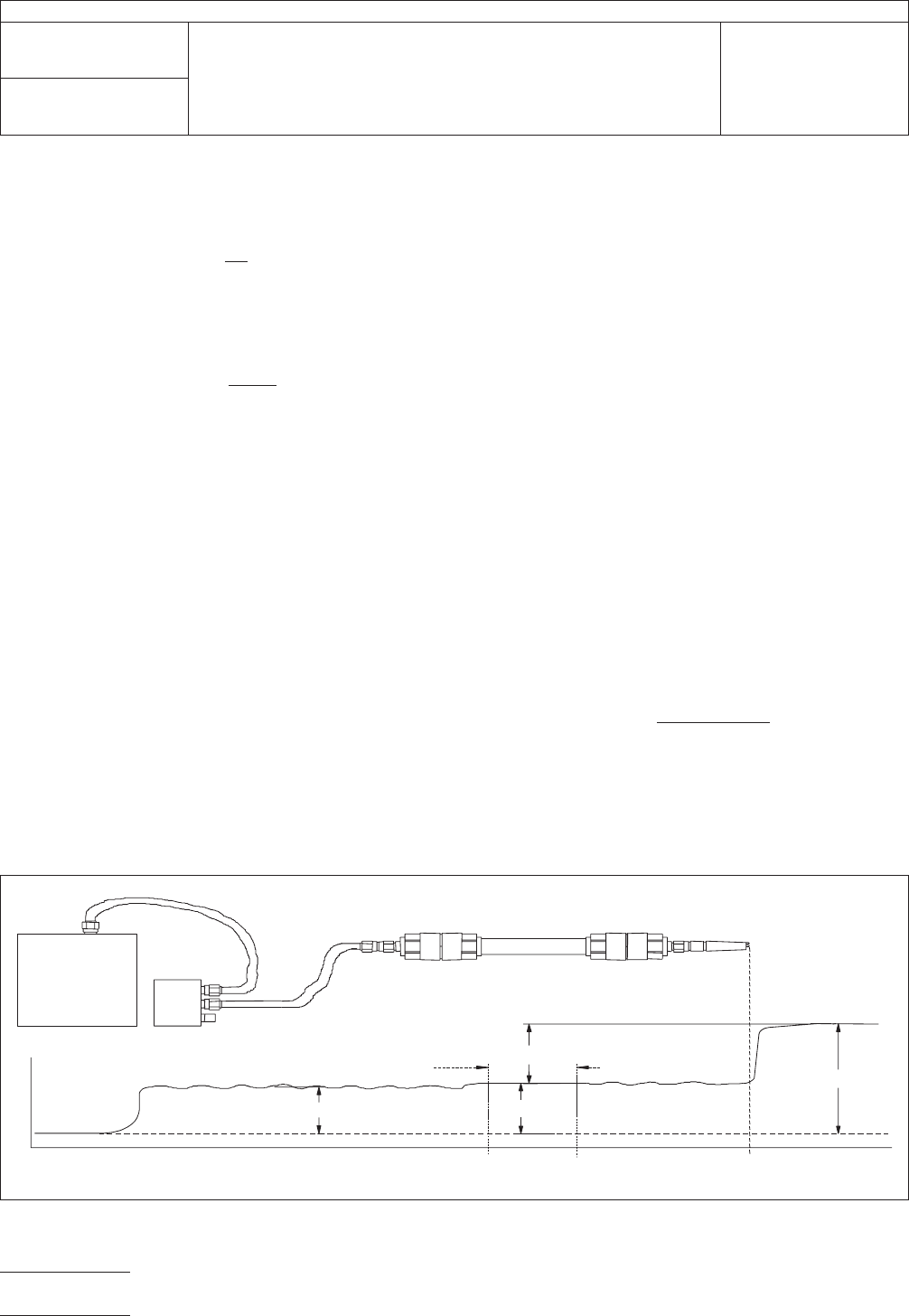
the probe in air (see Figure 5-11) and measure
the average voltage levels for each of those parts of the TDR
waveform corresponding to the open step, V
open
, and
to the
reference standard, V
std,0
.
Calculate the amplitude, V
i,0
,o
fthe
incident voltage step using:
V
i,0
= V
open
− V
std,0
Step
2 –
Record
the voltage, V
check,0
, in
the TDR waveform
corresponding to the precision RF cable.
5.2.3.2
Measurement Process
The
instrument setting
must be the same for Steps 1 and 2. This procedure will
determine the characteristic impedance of the transmission
line under test. This process should be done after the mea-
sure zone has been defined (see 5.1.3).
Step
1 –
Probe
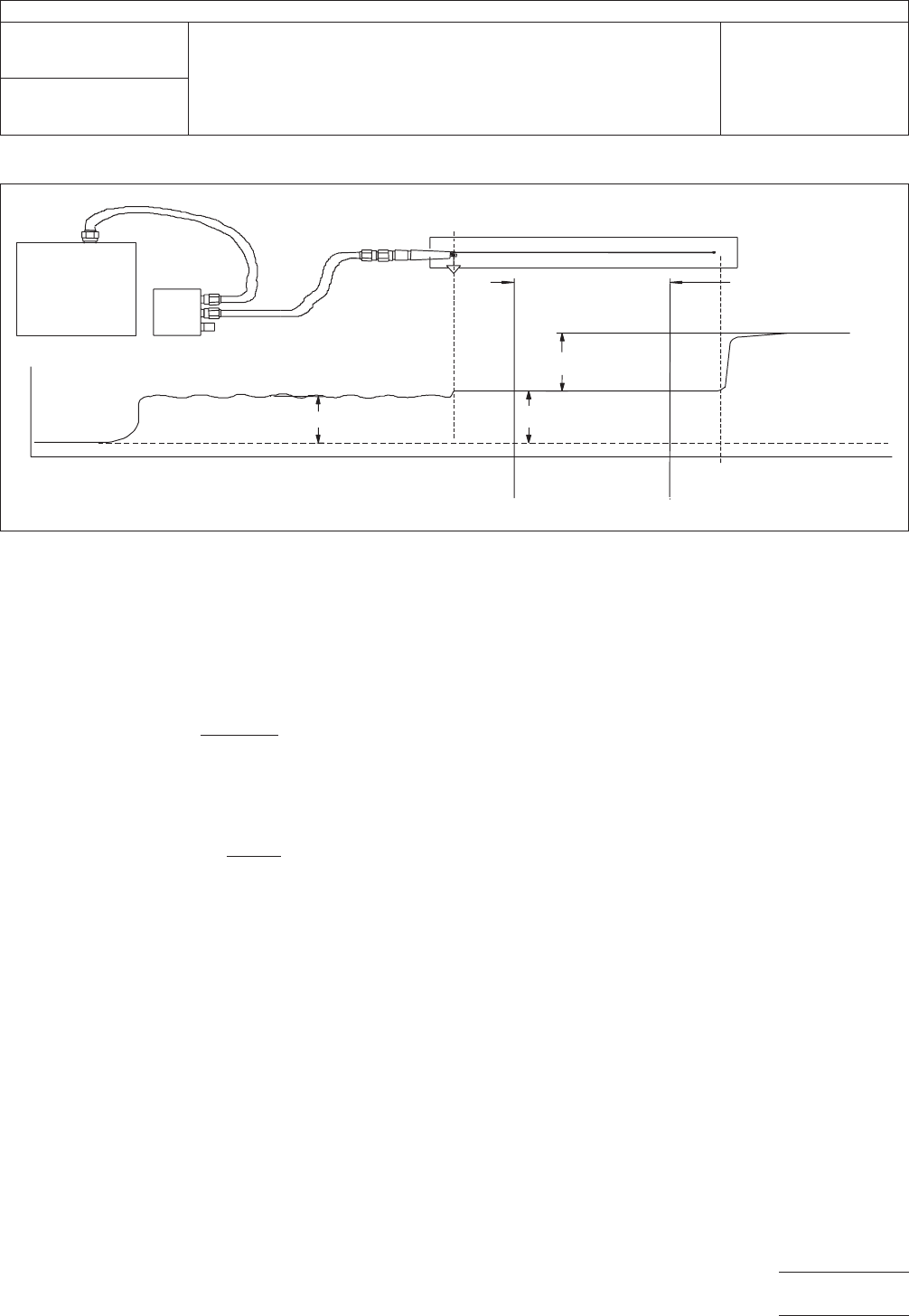
the transmission line (see Figure 5-12) and
measure the mean, minimum, and maximum voltage values,
V
C,ave
,V
C,min
, and V
C,max
, of
that part of the TDR waveform
corresponding to the measurement zone of the transmission
line.
Step
2 –
Record
the voltage, V
check,1
,
in the TDR waveform
corresponding to the precision RF cable and compute the fol-
lowing:
V
diff
=
?
V
check,0
− V
check,1
V
i,0
?
If V
diff
is
greater than 0.002, then the TDR system must be
recalibrated (see 5.2.3.1).
IPC-2257a-5-11
Figure
5-11 Calibration for Stored Reference Method
AIRLINE
PROBE
SPD
TDR
INSTRUMENT
V
std,0
V
open
PRECISION
RF CABLE
V
check,0
t
f,std
t
i,std
MEASUREMENT ZONE
for AIR LINE
t
1,TL
TIME
V
i,0
IPC-TM-650
Number
2.5.5.7
Subject
Characteristic
Impedance of Lines on Printed Boards by TDR
Date
03/04
Revision
A
Page
14 of 23
电子技术应用 www.ChinaAET.com
Step
3 –
Calculate
the reflection coefficient of the transmis-
sion line under test relative to the air line. If the TDR system
already provides reflection coefficient values, go directly to
Step 4. The reflection coefficient, ρ
tran
for
the transfer stan-
dard is given by:
ρ
tran
=
V
C,x
− V
std,0
V
i,0
Step
4 –
Calculate
the impedance, Z
tran
, of
the transmission
line under test using the following formula:
Z
tran
= Z
std
1 +ρ
tran
1 −ρ
tran
5.3
Differential TDR Measurement Procedures
This
section
contains one method for measuring the characteristic
impedance of differential transmission lines. The following cali-
bration and measurement steps should be used when the
device(s) under test are differential (balanced) transmission
lines. This process can be followed manually but, to improve
measurement repeatability and reduce measurement time, an
automated measurement system is recommended. Addition-
ally, the use of a fixture based or robotic probing system
greatly improves the accuracy and repeatability over hand
probe techniques and further reduces the measurement time.
The differential method described herein requires that (1) the
probe act as a transfer standard (see 4.3.3.1), (2) the TDR
system uses a source that delivers a differential signal to the
signal lines of the differential transmission line, and (3) the TDR
samples the reflected signal from both signal lines of the dif-
ferential transmission line simultaneously. In this case, two
TDR waveforms are obtained, one from each of the signal
lines of the differential transmission line, and these TDR wave-
forms are used to determine the odd mode impedance of
each signal line of the differential transmission line. The odd
mode impedance is not the same as the characteristic imped-
ance of a single-ended transmission line. These odd mode
impedances are then used to compute the differential imped-
ance of the differential transmission line. For a discussion of
differential impedance propagation modes refer to IPC stan-
dard 2141.
5.3.1
Instrumentation and Equipment
The
TDR instru-
ment used in this test method provides two opposite-polarity
equal-magnitude signals that are simultaneously applied to
the two signal lines of the differential transmission line under
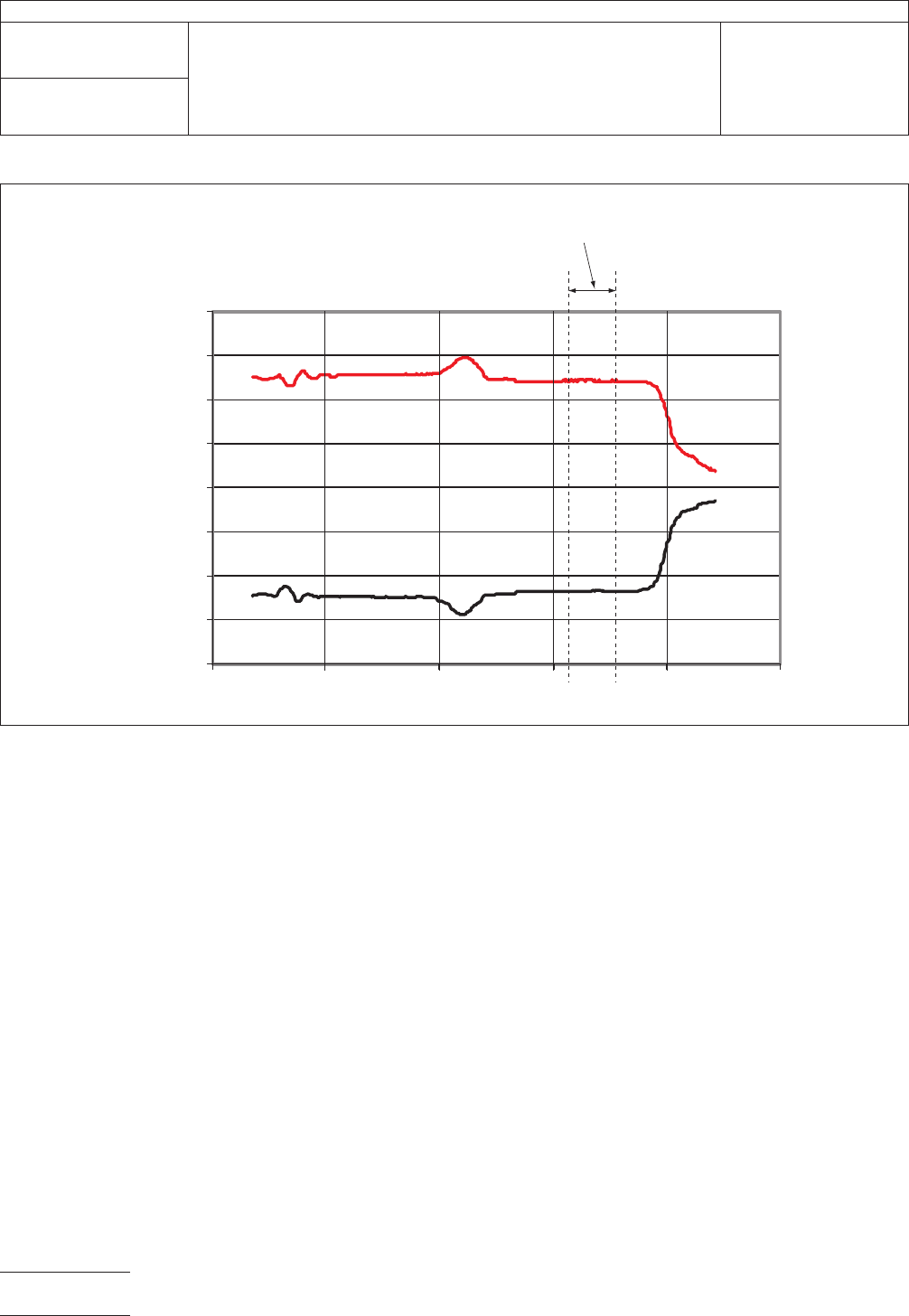
test. A typical TDR waveform from such an instrument is
shown in Figure 5-13.
Follow the manufacturer’s recommended procedure and
schedule for in-house as well as factory calibrations of the
TDR. Prior to beginning each measurement and no less than
once daily, check the skew between the two output signals of
the differential source of the TDR. This skew should be
checked at the output end of the probe not at the TDR output
or at the end of the connecting cables. The skew should be
adjusted to be a minimum. Check that the amplitude of the
differential signals have equal but opposite polarity and verify
that they are in specification. Use the appropriate probes (see
4.3.3.1).
IPC-2257a-5-12
Figure
5-12 TDR Measurement of Transmission Line
PROBE
SPD
TDR
INSTRUMENT
V
C,ave
PRECISION
RF CABLE
V
check
TRANSMISSION LINE UNDER TEST
MEASUREMENT ZONE
for TRANSMISSION
LINE UNDER TEST
t
f,TL
t
i,TL
TIME
V
r,1
IPC-TM-650
Number
2.5.5.7
Subject
Characteristic
Impedance of Lines on Printed Boards by TDR
Date
03/04
Revision
A
Page
15 of 23
电子技术应用 www.ChinaAET.com
5.3.2
Determination of Measurement Zone
The
deter-
mination of the measurement zone is done similarly to that for
single-ended transmission line test methods as discussed in
5.1.3. However, for this differential test method, the TDR
waveform will appear similar to that shown in Figure 5-14.
The instants shown in Figure 5-14, t
i,TS
,t
f,TS
,t
i,TL
, and t
f,TL
,
are
the initial and final instants of the measurements zones for
the transfer standard and transmission line under test. The
t
i,TS
,t
f,TS
are
the same as t
i,Ref
and t
f,Ref
described
for single-
ended transmission lines in 5.1.3.
5.3.3
Measurement Calibration Procedure
The
instru-
ment setting must be the same for Steps 1 and 2. This pro-
cedure will determine the characteristic impedance of the
transfer standard from which characteristic impedance of the
transmission line under test will be determined (see 5.3.4).
Step
1 –
Hold
the probe in air and measure the average volt-
age levels corresponding to the high and low states of the two
differential TDR waveforms, which are labeled V
TS,Ch1,1
,
V
TS,Ch2,1
, V
open,Ch1
,
and V
open,Ch2
in
Figure 5-15. There are a
total of four states, two for each of the differential waveforms.
Calculate the amplitude, V
inc,Ch1
,
of the incident voltage step
for Channel 1 (Ch1) using:
V
inc,Ch1
= V
TS,Ch1,1
− V
open,Ch1
and
the amplitude, V
inc,Ch2
,
of the incident voltage step for
Channel 2 (Ch2) using:
V
inc,Ch2
= V
TS,Ch2,1
− V
open,Ch2
where:
V
TS,Ch1,1
is
the average voltage level of that part of the Ch1
TDR waveform corresponding to the transfer standard,
V
TS,Ch2,1
is
the average voltage level of that part of the Ch2
TDR waveform corresponding to the transfer standard,
V
open,Ch1
is
the average voltage level of that part of the Ch1
TDR waveform corresponding to the high state of the differen-
tial signal applied to Ch1, and
V
open,Ch2
is
the average voltage level of that part of the Ch2
TDR waveform corresponding to the high state of the differen-
tial signal applied to Ch2.
IPC-2257a-5-13
Figure
5-13 Differential TDR Waveform
-0.4
-0.3
-0.2
-0.1
0.0
0.1
0.2
0.3
0.4
Time
Signal (V)
Ch1
Ch2
T
ransmission Line
Measurement Zone
t
i
t
f
IPC-TM-650
Number
2.5.5.7
Subject
Characteristic
Impedance of Lines on Printed Boards by TDR
Date
03/04
Revision
A
Page
16 of 23
电子技术应用 www.ChinaAET.com