IPC-TM-650 EN 2022 试验方法.pdf - 第300页
4 Equipment/Apparatus 4.1 Precision surface plate 4.2 Thickness measurement shims (feeler or pin gauges) 4.3 Leveling jacks 4.4 Standard metrology height dial indicator gauge 4.5 Gauge blocks 4.6 Linear measuring devices…
1
Scope
This
test method covers three procedures used to
determine the bow and twist percentage of individual rigid
printed boards, rigid portions of rigid-flex printed boards,
and/or multiple printed panels. Measurements on non-
rectangular samples pose a unique testing problem and may
necessitate careful evaluation of the requirements imposed by
the users of this test method. This test method does not
describe the special considerations necessary when testing
the bow and twist of printed board assemblies (i.e., compo-
nent placement & weight, edge supports & connectors, etc.).
The first two procedures describe production (Go/No-Go)
methods that generally characterize the bow and twist as
being no more than a specific value. The other procedure is a
referee method used to precisely determine the twist.
1.1
Definitions
Bow
and twist are defined in IPC-T-50.
The definitions are repeated in this test method for conve-
nience.
1.1.1
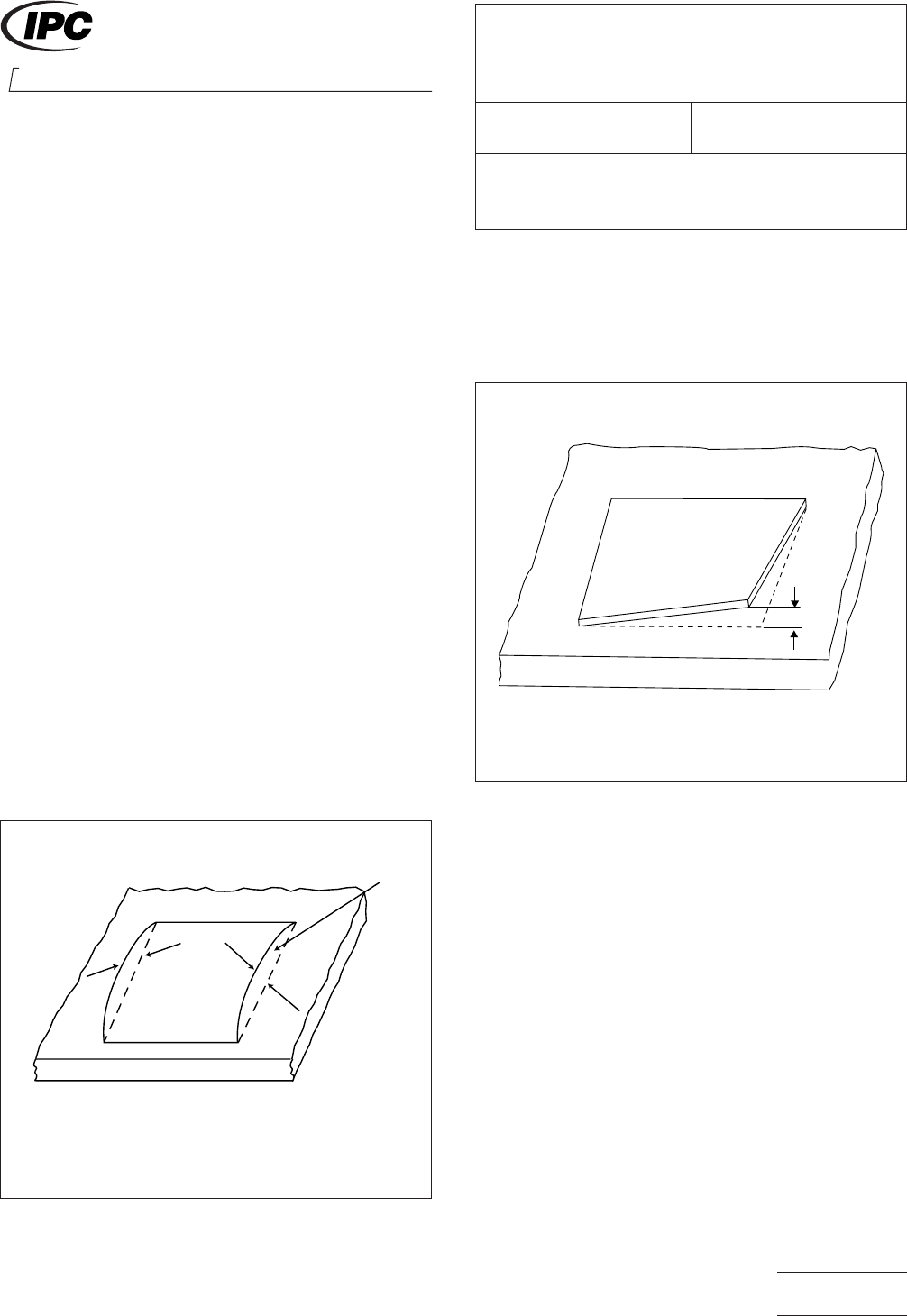
Bow (Sheet, Panel, or Printed Board)
The
devia-
tion from flatness of a board characterized by a roughly cylin-
drical or spherical curvature such that, if the product is rect-
angular, its four corners are in the same plane (see Figure 1).
1.1.2
Twist
The
deformation of a rectangular sheet, panel,
or printed board that occurs parallel to a diagonal across its
surface, such that one of the corners of the sheet is not in the
plane that contains the other three corners (see Figure 2).
2 Applicable Documents
IPC-T-50
Terms
and Definitions for Interconnecting and
Packaging Electronic Circuits
IPC-TM-650
Test
Methods
3
Test Specimens
The
test specimens shall be in the form
of either printed boards or multiple printed panels (single-
sided, double-sided, multilayer, or rigid-flex boards).
3.1 For
non-rectangular test specimens, the most conve-
nient way to measure bow and twist is approximating a rect-
angle over the test specimen. To accomplish this, an imagi-
nary rectangle that totally encloses the sample must be
superimposed over the test specimen. The dimensions of this
superimposed rectangle should be the smallest that will fully
enclose the specimen. Although this technique will give an
approximation of bow and twist, the actual noted values will
be less than the actual bow and twist of the sample.
IPC-2422-1
Figure
1 Box
BOW
2
1
With constraining f
orce applied
to both corners of the same edge.
1 & 2 deflection from surface plane.
IPC-2422-2
Figure
2 Twist
B
A
x
x
x
x
C
P
oints A, B, C
Touching Base
With constraining force
applied to one corner only.
2215
Sanders Road
Northbrook, IL 60062-6135
IPC-TM-650
TEST
METHODS MANUAL
Number
2.4.22
Subject
Bow
and Twist (Percentage)
Date
6/99
Revision
C
Originating Task Group
Rigid Printed Board Test Methods Task Group
(7-11d)
Material
in this Test Methods Manual was voluntarily established by Technical Committees of the IPC. This material is advisory only
and its use or adaptation is entirely voluntary. IPC disclaims all liability of any kind as to the use, application, or adaptation of this
material. Users are also wholly responsible for protecting themselves against all claims or liabilities for patent infringement.
Equipment referenced is for the convenience of the user and does not imply endorsement by the IPC.
P
age1of5
ASSOCIA
TION CONNECTING
ELECTRONICS INDUSTRIES
电子技术应用 www.ChinaAET.com
4
Equipment/Apparatus
4.1
Precision
surface plate
4.2
Thickness
measurement shims (feeler or pin gauges)
4.3
Leveling
jacks
4.4
Standard
metrology height dial indicator gauge
4.5
Gauge
blocks
4.6
Linear
measuring devices of suitable accuracy
4.7
Micrometer
of suitable accuracy for thickness measure-
ment
5
Procedure
Unless
otherwise specified, testing shall be
performed at standard laboratory conditions (see IPC-TM-
650, Section 1.3).
5.1
Production Testing (Bow)
5.1.1
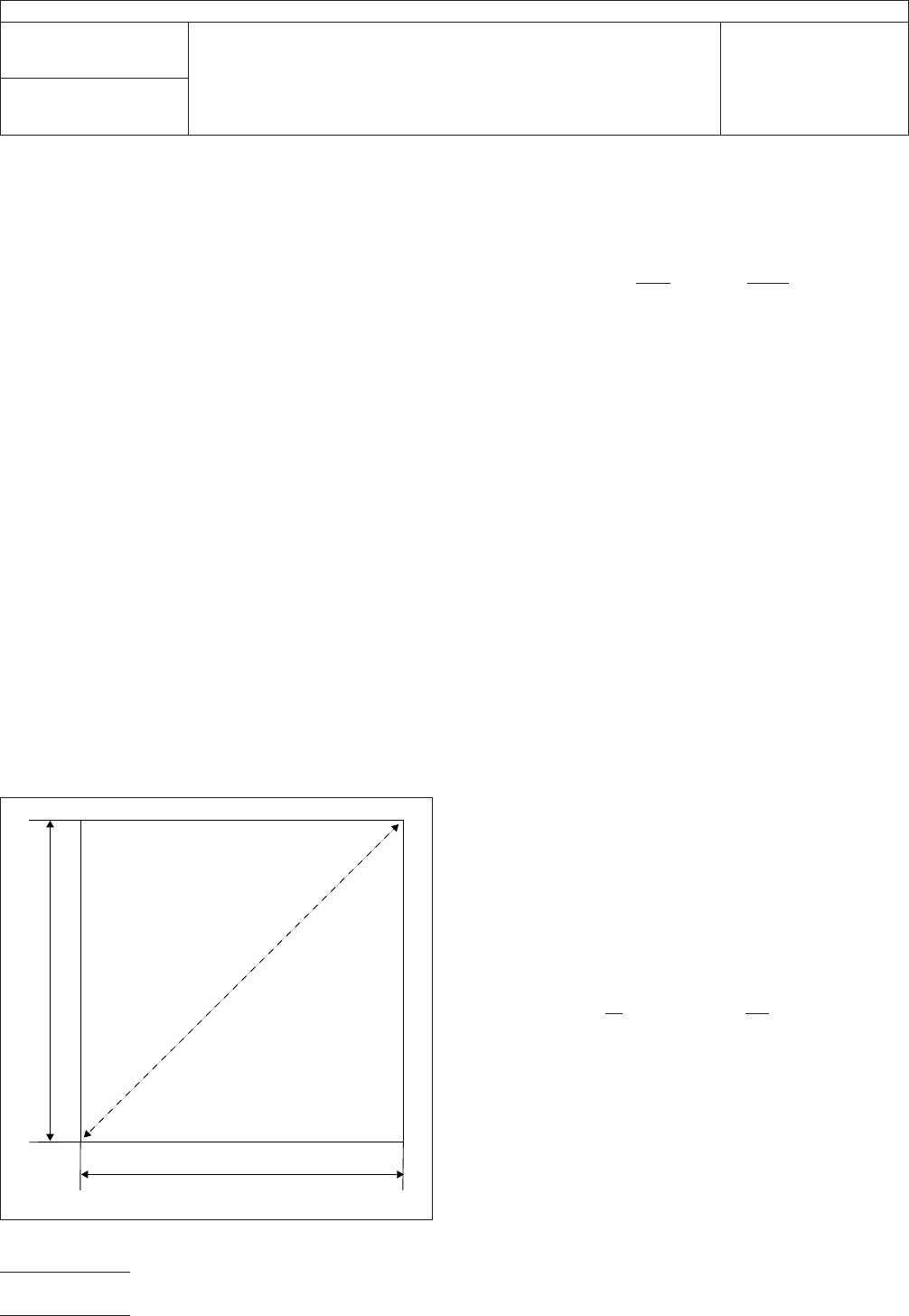
Place
the sample on the surface plate. While applying
sufficient pressure to flatten the test sample, measure the
length and width of the sample and record it as length (L) &
width (W) (see Figure 3).
5.1.2
Calculate
the size of the feeler/pin gauge (Go/No-Go)
to be used for maximum bow percentage using the following
formula:
R
L
=
L (B)
100
Rw =
W (B)
100
Where:
R
L
=
Go/No-Go feeler/pin gauge size for sample length
R
W
=
Go/No-Go feeler/pin gauge size for sample width
L = Length measurement as determined above
W = Width measurement as determined above
B = Maximum allowable bow percentage
5.1.3
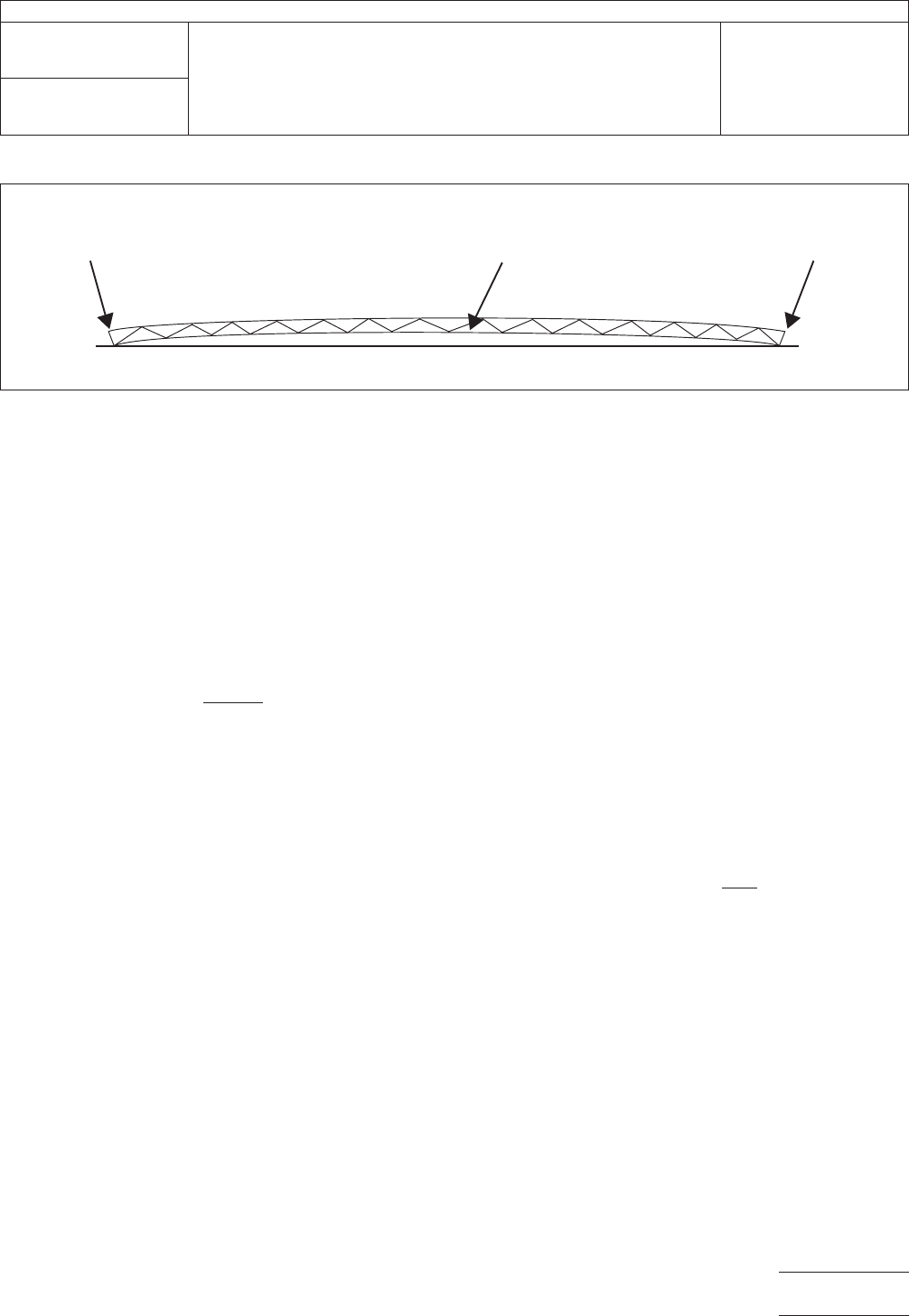
Place
the sample to be measured on the surface plate
with the convex of the sample facing upwards. For each edge,
apply sufficient pressure on both corners of the same sample
edge to ensure contact with the surface (see Figure 4).
5.1.4
Attempt
to slide the feeler/pin gauge of thickness R
L
under
the length side(s) of the sample and R
W
under
the width
side(s) of the sample. If the Go/No-Go feeler/pin gauge will
slide between the sample and the surface plate, the bow in
that direction exceeds the allowable percentage used in the
calculation above. Repeat this procedure until all sides of the
sample have been measured.
5.1.5
If
a determination of actual percentage of bow is
desired, repeat 5.1.1 through 5.1.4 using a feeler/pin gauge
that will easily fit between the side of the sample and the sur-
face plate. Continue to increase the feeler/pin gauge size until
the largest feeler/pin gauge that will fit between the sample
and the surface plate for both the length (x2) and width (x2) is
obtained. Measure this feeler/pin gauge with the micrometer
and record as R
L
or
R
W
.
Calculate
the percentage for bow as follows:
B
L
=
R
L
L
X
100 B
w
=
Rw
W
X
100
Where:
B
L
=
Percentage bow in the length direction
B
W
=
Percentage bow in the width direction
R
L
=
Measured maximum feeler/pin gauge size across
sample length
R
W
=
Measured maximum feeler/pin gauge size across
sample width
L = Length measurement as determined above
W = Width measurement as determined above
IPC-2422-3
Figure
3 External Measurements
L
D
W
IPC-TM-650
Number
2.4.22
Subject
Bow
and Twist (Percentage)
Date
6/99
Revision
C
P
age2of5
电子技术应用 www.ChinaAET.com
5.2
Production Testing (Twist)
5.2.1
Place
the sample on the surface plate. While applying
sufficient pressure to flatten the test sample, take the diagonal
measurement across the sample and record it as D (see Fig-
ure 3).
5.2.2
Calculate
the size of the feeler/pin gauge (Go/No-Go)
to be used for maximum twist percentage using the following
formula:
R =
2 (D)(T)
100
Where:
R
= Go/No-Go feeler/pin gauge size
D = Diagonal measurement across the sample as determined
above
T = Maximum allowable twist percentage
Note: This formula includes a factor of two because, by con-
straining one corner of the sample on a surface plate, the ver-
tical deflection of twist is approximately doubled.
5.2.3
Place
the sample to be measured on the surface plate
with any three corners of the sample touching the surface.
Apply sufficient pressure (if necessary) to only one corner of
the sample to ensure three of the four corners are in contact
with the surface plate. It may be necessary to turn the sample
over to accomplish this (see Figure 5).
5.2.4
If
it is not possible to get three corners of the sample
to touch the surface plate by restraining only one corner, this
production test is not applicable and the referee test
described in 5.3 shall be used.
5.2.5 Attempt
to slide the feeler/pin gauge of thickness R
under the corner not touching the surface plate. If the
Go/No-Go feeler/pin gauge will slide under the corner not
touching the surface plate without lifting any of the other three
corners of the sample from the surface plate, the twist in that
direction exceeds the allowable percentage used in the calcu-
lation above. Repeat this procedure until all corners of the
sample that can be measured using this technique have been
measured.
5.2.6
If
a determination of actual percentage of twist is
desired, repeat 5.2.1 through 5.2.5 using a feeler/pin gauge
that will easily fit under the corner that is not touching the sur-
face plate. Continue to increase the feeler/pin gauge size until
the largest feeler/pin gauge size that does not lift any of the
three touching corners from the surface plate is obtained.
Measure this feeler/pin gauge with the micrometer and record
as R.
5.2.7
Calculate
the percentage of twist as follows:
Percentage Twist =
R
2 (D)
X
100
Where:
R = Go/No-Go feeler/pin gauge size
D = Diagonal measurement across the sample as determined
above
Note: This formula includes a factor of two because, by con-
straining one corner of the sample, the vertical deflection of
twist is approximately doubled.
5.3
Referee Method (Twist)
5.3.1
Place
the sample to be measured on the datum sur-
face with the two lower opposite corners touching the datum
surface or on a raised parallel surface of equal height from the
datum surface (see Figure 6).
IPC-2422-4
Figure
4 Bow Measurement
T
ouching Datum
Surface
HIGHEST POINT
measured as R or R
L
W
Touching Datum
Surface
IPC-TM-650
Number
2.4.22
Subject
Bow
and Twist (Percentage)
Date
6/99
Revision
C
P
age3of5
电子技术应用 www.ChinaAET.com