IPC-TM-650 EN 2022 试验方法.pdf - 第74页
1.0 Scope This method is intended to describe optically enhanced measurement techniques for dimensions of 3 mm or less, typically referenced on a Printed Board drawing. This method will not cover mechanical dimensional v…

1.0
Scope
This
method is intended to cover all mechanical
dimension inspections typically referenced on a Printed Board
drawing. This will cover non-optically enhanced measurement
techniques which are not covered by IPC-TM-650, Method
2.2.2.
2.0
Applicable Documents
ANSI NCSL Z540
International
Calibration Standards or
Physical Constants
3.0
Test Specimens
The
test specimen(s) shall be defined
in the applicable performance specification or standard.
4.0
Apparatus or Material
4.1
Mechanical
measurement gage capable of sufficient
accuracy precision and resolution to accomplish the neces-
sary measurement (i.e., calipers, micrometers, pin gages,
templates, etc.).
4.2
All
mechanical measurement gages shall be calibrated in
accordance with ANSI NCSL Z540, International Calibration
Standards or Physical Constants.
5.0
Procedure
5.1
Gages which use an origin based system (i.e., calipers,
micrometers) shall be initialized at the origin.
5.2
Operate
the gage in a manner consistent to obtain the
accuracy, repeatability, and precision required.
5.3 If
the attribute to be measured can vary across the
printed board, multiple measurements must be made to char-
acterize the variation within the sampled area (i.e., hole sizes,
thickness).
5.4
Read
and record the dimensions for the attribute(s)
measured using the same number of significant digits speci-
fied by the drawing, standard, or specification as a minimum
or maximum limiting value.
6.0 Notes
The
following items can affect the test results.
Tool wear & maintenance
Environment effects
Delicacy of gages – proper storage
Improper calibration
The
Institute for Interconnecting and Packaging Electronic Circuits
2215 Sanders Road • Northbrook, IL 60062
IPC-TM-650
TEST
METHODS MANUAL
Number
2.2.1
Subject
Mechanical
Dimensional Verification
Date
8/97
Revision
A
Originating Task Group
Rigid Board T.M. Task Group, 7-11d
Material
in this Test Methods Manual was voluntarily established by Technical Committees of the IPC. This material is advisory only
and its use or adaptation is entirely voluntary. IPC disclaims all liability of any kind as to the use, application, or adaptation of this
material. Users are also wholly responsible for protecting themselves against all claims or liabilities for patent infringement.
Equipment referenced is for the convenience of the user and does not imply endorsement by the IPC.
P
age1of1
电子技术应用 www.ChinaAET.com

1.0
Scope
This
method is intended to describe optically
enhanced measurement techniques for dimensions of 3 mm
or less, typically referenced on a Printed Board drawing. This
method will not cover mechanical dimensional verification
which is covered by IPC-TM-650, Method 2.2.1. This method
is intended to supersede IPC-TM-650, Method 2.2.3.
2.0
Applicable Documents
IPC-OI-645
Standard
for Visual Optical Inspection Aids
IPC-A-600E
Acceptability
of Printed Boards
3.0
Test Specimens
3.1
The
test specimen(s) shall be defined in the applicable
performance specification or standard.
4.0
Apparatus or Material
4.1
Optical
inspection aid capable of a magnification where
the feature(s) to be measured occupies at least 20% of the
field of view. (See IPC-OI-645 for detailed description.)
4.2
Reticle
or Filar Micrometer attachment to Optical Inspec-
tion Aid that contains gradiations or a scale, which will provide
a minimum measurement resolution of 50% of the last signifi-
cant digit of the referenced dimensional requirement. The
Reticle or Filar Micrometer should be calibrated at the given
magnification to ascertain the distance in mm (inches)
between each division.
5.0
Procedure
5.1
Select
an optical aid which allows for clear viewing of the
area(s) containing the attributes to be measured.
5.2
Adjust
the optical aid so that both the feature(s) to be
measured and the reticle or filar micrometer attachment are in
focus.
5.3 Align
the reticle or filar micrometer so that the measure-
ment scale is visible and aligned with the edges of the fea-
ture(s) to be measured.
5.4 Read
the reticle or filar micrometer to obtain the number
of divisions between feature edges.
5.5
To
obtain the actual dimensions of the feature, multiply
the number of divisions read by the calibration data previously
obtained for the reticle or filar micrometer in (µm/division)
(inches/division) at the given magnification.
5.6
Record
the dimensions for the attribute(s) measured
using the same number of significant digits specified by the
drawing, standard, or specification as a minimum or maximum
limiting value.
6.0 Notes
6.1
For
a thorough description of the requirements, defini-
tions, and certification provisions for optical inspection aids,
see IPC-OI-645.
6.2
IPC-A-600
contains figures and diagrams which depict
measurement techniques for certain attributed.
The
Institute for Interconnecting and Packaging Electronic Circuits
2215 Sanders Road • Northbrook, IL 60062
IPC-TM-650
TEST
METHODS MANUAL
Number
2.2.2
Subject
Optical
Dimensional Verification
Date
8/97
Revision
B
Originating Task Group
Rigid Board T.M. Task Group, 7-11d
Material
in this Test Methods Manual was voluntarily established by Technical Committees of the IPC. This material is advisory only
and its use or adaptation is entirely voluntary. IPC disclaims all liability of any kind as to the use, application, or adaptation of this
material. Users are also wholly responsible for protecting themselves against all claims or liabilities for patent infringement.
Equipment referenced is for the convenience of the user and does not imply endorsement by the IPC.
P
age1of1
电子技术应用 www.ChinaAET.com
1
Scope
This
test method is used to establish and define
the procedures for determining thermal gradient dimensional
changes of a plastic dielectric, metal clad or unclad.
This method may also be used to determine dimensional
changes after metal removal of a clad.
2
Applicable Documents
None
3
Test Specimen
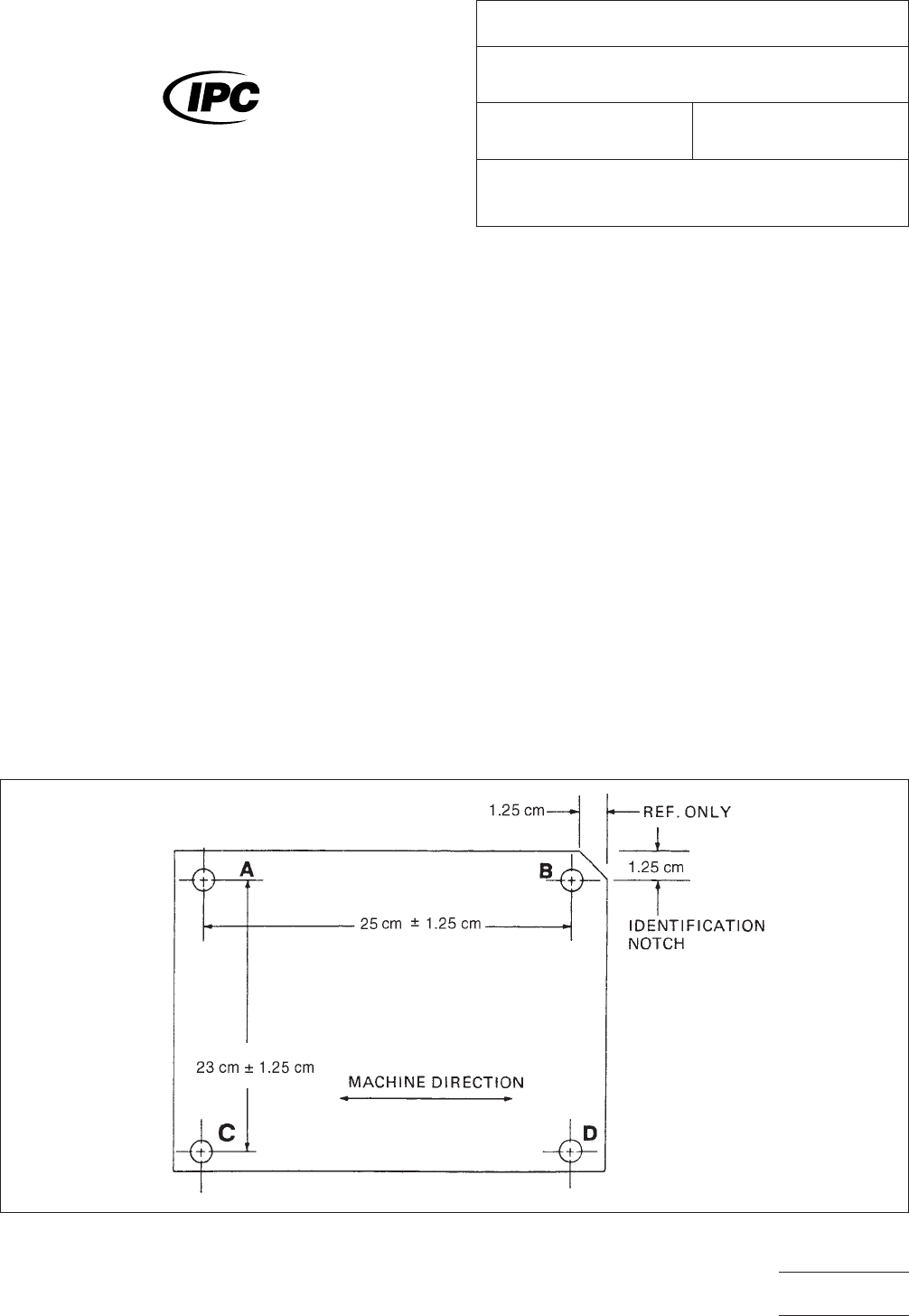
The
test specimen shall be at least 27
cm x 29 cm of unclad or metal clad dielectric material cut and
punched per Figure 1.
4
Test Equipment
• Shear —
for cutting 27 cm x 29 cm test specimens.
• Micro-Rule — with dial indicator reading to 0.0125 mm or
less or an equivalent optical system.
• Hole Punch — 0.889 mm minimum diameter.
• Oven — mechanical convection type capable of maintaining
a temperature of 150°C ± 2°C.
• Etcher — capable of maintaining test specimens a 43°C ±
5°C during the metal removal.
• Line Scribe — capable of producing a line 0.125 mm wide
maximum.
• Chemical Etchant — capable of metal removal without det-
rimental effect to either the adhesive or dielectric.
5
Procedure
5.1 Sample Preparation
Scribe
0.125 mm wide lines or
punch holes at positions A through D in specimen at locations
shown in Figure 1.
Allow specimen to stabilize at 23°C ± 2°C and 50% ± 5%
relative humidity (RH) and measure separation of holes/lines
between corresponding positions (center of hole or center of
line). For example, the distance between hole centers A-B and
C-D, also A-C and B-D. Record as initial measurement (1).
Stabilization times may be reduced if statistically sound evi-
dence has been generated on the specific product line to
support shorter stabilization times to reach equilibrium.
IPC-224-1
Figure
1 Dimensional Stability Test Pattern
The
Institute for Interconnecting and Packaging Electronic Circuits
2215 Sanders Road • Northbrook, IL 60062
IPC-TM-650
TEST
METHODS MANUAL
Number
2.2.4
Subject
Dimensional
Stability, Flexible Dielectric Materials
Date
5/98
Revision
C
Originating Task Group
Flex Peel Strength Test Methods Task
Group (D-13A)
Material
in this Test Methods Manual was voluntarily established by Technical Committees of the IPC. This material is advisory only
and its use or adaptation is entirely voluntary. IPC disclaims all liability of any kind as to the use, application, or adaptation of this
material. Users are also wholly responsible for protecting themselves against all claims or liabilities for patent infringement.
Equipment referenced is for the convenience of the user and does not imply endorsement by the IPC.
P
age1of2
电子技术应用 www.ChinaAET.com