IPC-TM-650 EN 2022 试验方法.pdf - 第416页
IPC-TM-650 Number Subject Date Revision Page 4 of 7 2.4.54 Test Method for Thermal Transmission Properties of 09/2022 Metal Based Printed Boards (MBPB) N/A T able 1 Equations Equation Unit Reference ̇ = ̇ = ̇ = ̇ + ̇ /2 …
IPC-TM-650
Number Subject Date
Revision
Page 3 of 7
2.4.54 Test Method for Thermal Transmission Properties of 09/2022
Metal Based Printed Boards (MBPB)
N/A
observed temperature range. It is recommended to use high conductive metals for the heat flow meter bars when measuring
high conductive specimens e.g., aluminum alloy with a thermal conductivity of 100 W/(mK) or higher.
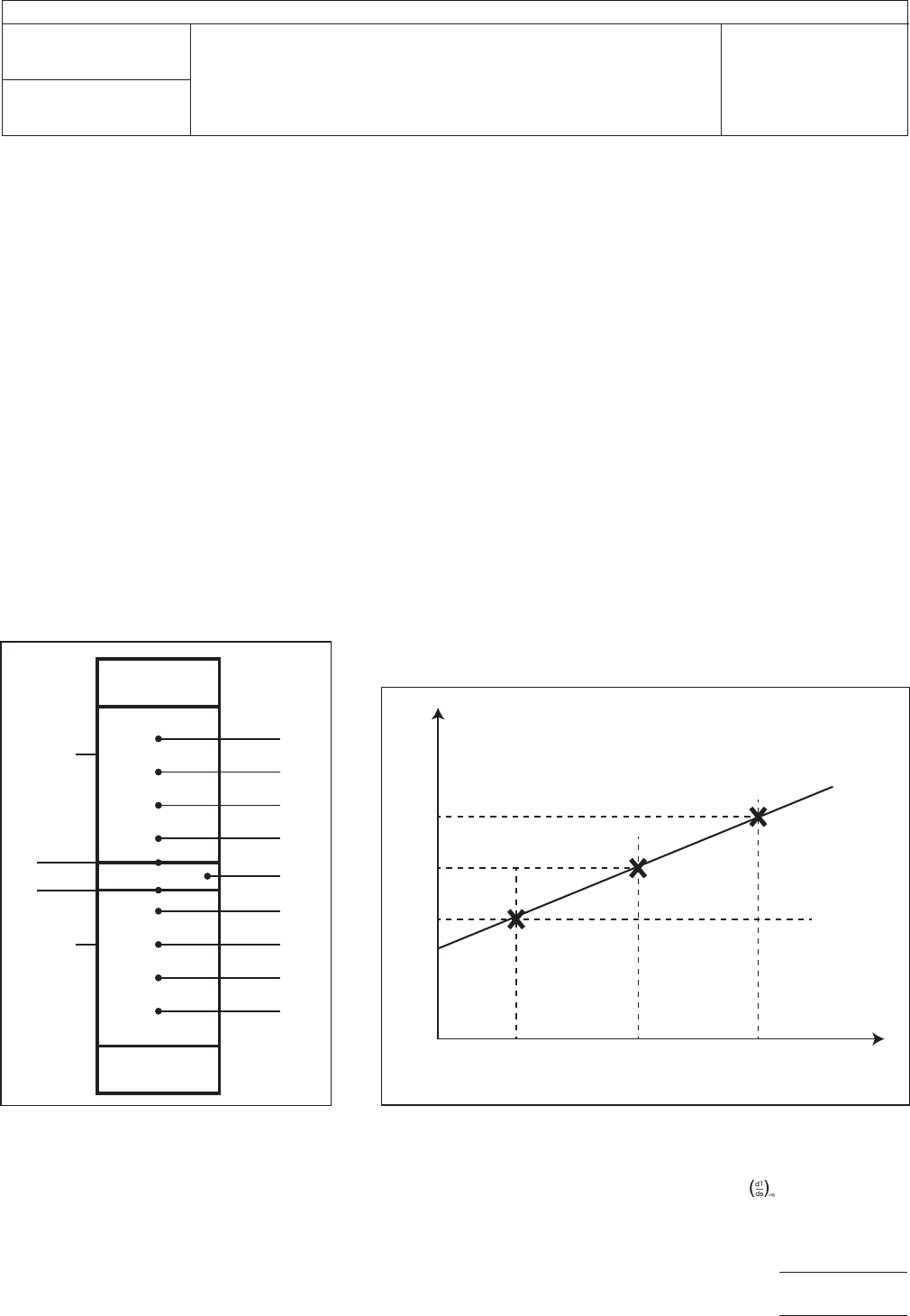
4.7 Use more than two thermocouples for the heat flow measurement on each meter bar. It is recommended to use four
thermocouples on every bar. This reduces the error in the slope (Figure 2). The thermocouples should be located in extreme
proximity to the surfaces (about 1.5 mm) (Table 1 Equations 1 to 3). Use thin calibrated thermocouples with a diameter of
< 0.6 mm and a measurement accuracy smaller than +/- 0.1 K. This increases the measurement accuracy significantly.
4.8 The heat flow meter bars are used to determine the temperature of the test surfaces by extrapolating the linear array of meter
bar temperatures to the test surfaces (Table 1 Equations 4, 5 and 6). This should be done for both, the hot side and cold side
meter bars (see Figure 1 Notes 2 and 3).
4.9 The recommended way to create a cooling source in the apparatus is with a metal block cooled by a temperature controlled
circulating liquid (e.g., silicone oil or even water, depending on the temperatures, which should be measured).
4.10 The temperature stability of both, the heating and cooling source, should be very high due to stationary conditions during
the test. Typical stabilities are +/- 0.1 K/(300 seconds).
4.11 The thermal contact resistances between the specimen and the heat flow meter bars is highly dependent on the contact
pressure, which is the reason why this parameter is important. A high contact pressure reduces the thermal contact resistances
and maintains the parallelism and alignment of the surfaces.
4.12 For MBPB a high pressure ≥ 2.0 N/mm² should be applied due to a significant reduction of the thermal contact resistant.
This guarantees more accurate testing results.
1
2
3
4
8
9
10
11
12
13
14
15
16
7
5
6
Figure 1 Hot and Cold Meter Bards with More
Than Two Thermocouples
Note 1 – Hot Meter Bar,
see 1.3.1
Note 2 – T
H
Note 3 – T
C
Note 4 – Cold Meter Bar
Note 5 – Heat Source
Note 6 – Specimen
Note 7 – Heat Sink
Note 8 – T
HB,1
Note 9 – T
HB,2
Note 10 – T
HB,3
Note 11 – T
HB,4
Note 12 – T
S
,
see 6.4.2 and
Table 1
Equation 18
Note 13 – T
CB,1
Note 14 – T
CB,2
Note 15 – T
CB,3
Note 16 – T
CB,4
1
2
3
4
5 6
8
7 x
y
Figure 2 Linear Regression to Determine the Heat Flow in the Hot Meter Bar
Out of Three or More Thermocouples
Note 1 – T
HB,1
Note 2 – T
HB,2
Note 3 – T
HB,3
Note 4 – T
H
Note 5 – S
HB,3
Note 6 – S
HB,2
Note 7 – S
HB,1
Note 8 – Slope:
Note 9 – x – Path s in m
Note 10 – y – Temperature in K
IPC-TM-650
Number Subject Date
Revision
Page 4 of 7
2.4.54 Test Method for Thermal Transmission Properties of 09/2022
Metal Based Printed Boards (MBPB)
N/A
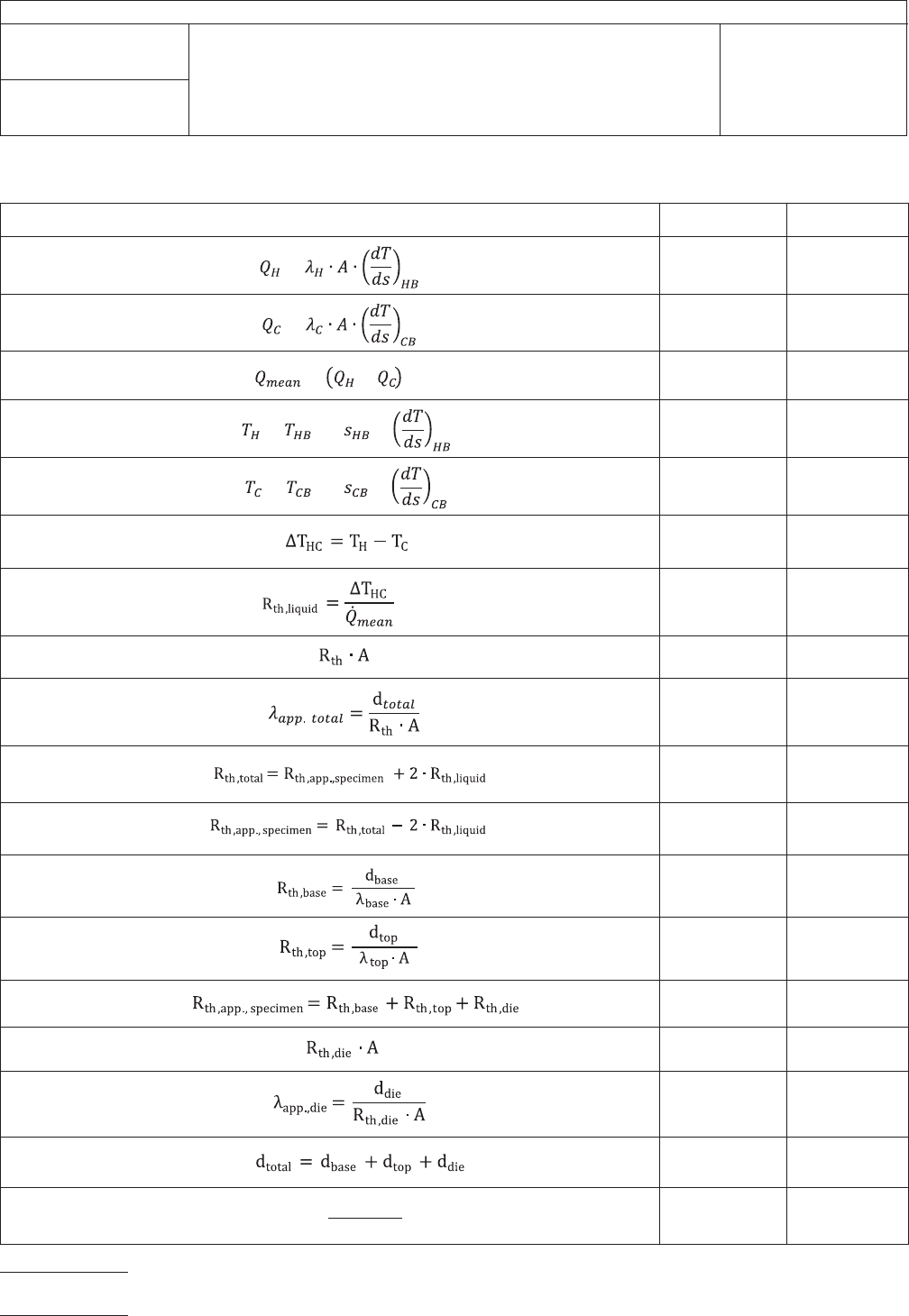
Table 1 Equations
Equation Unit Reference
̇
=
̇
=
̇
=
̇
+
̇
/2
=
,3
−
,3
∙
=
,1
+
,1
∙
Δ
HC
= −
=
Δ
HC
̇
.
=
d
ℎ = ℎ
.
+2∙ ℎ
ℎ
.
= ℎ −2∙ ℎ
,
=
d
,
=
d
, .
=
,
+
,
+
,
.,
=
d
,
= + +
W 1
̇
=
̇
=
̇
=
̇
+
̇
/2
=
,3
−
,3
∙
=
,1
+
,1
∙
Δ
HC
= −
=
Δ
HC
̇
.
=
d
ℎ = ℎ
.
+2∙ ℎ
ℎ
.
= ℎ −2∙ ℎ
,
=
d
,
=
d
, .
=
,
+
,
+
,
.,
=
d
,
= + +
W 2
̇
=
̇
=
̇
=
̇
+
̇
/2
=
,3
−
,3
∙
=
,1
+
,1
∙
Δ
HC
= −
=
Δ
HC
̇
.
=
d
ℎ = ℎ
.
+2∙ ℎ
ℎ
.
= ℎ −2∙ ℎ
,
=
d
,
=
d
, .
=
,
+
,
+
,
.,
=
d
,
= + +
W 3
̇
=
̇
=
̇
=
̇
+
̇
/2
=
,3
−
,3
∙
=
,1
+
,1
∙
Δ
HC
= −
=
Δ
HC
̇
.
=
d
ℎ = ℎ
.
+2∙ ℎ
ℎ
.
= ℎ −2∙ ℎ
,
=
d
,
=
d
, .
=
,
+
,
+
,
.,
=
d
,
= + +
°C 4
̇
=
̇
=
̇
=
̇
+
̇
/2
=
,3
−
,3
∙
=
,1
+
,1
∙
Δ
HC
= −
=
Δ
HC
̇
.
=
d
ℎ = ℎ
.
+2∙ ℎ
ℎ
.
= ℎ −2∙ ℎ
,
=
d
,
=
d
, .
=
,
+
,
+
,
.,
=
d
,
= + +
°C 5
̇
=
̇
=
̇
=
̇
+
̇
/2
=
,3
−
,3
∙
=
,1
+
,1
∙
T
S
=
(T
H
+T
C
)
2
K 6
̇
=
̇
=
̇
=
̇
+
̇
/2
=
,3
−
,3
∙
=
,1
+
,1
∙
T
S
=
(T
H
+T
C
)
2
K/W 7
̇
=
̇
=
̇
=
̇
+
̇
/2
=
,3
−
,3
∙
=
,1
+
,1
∙
T
S
=
(T
H
+T
C
)
2
mm²K/W 8
̇
=
̇
=
̇
=
̇
+
̇
/2
=
,3
−
,3
∙
=
,1
+
,1
∙
T
S
=
(T
H
+T
C
)
2
W/(mK) 9
̇
=
̇
=
̇
=
̇
+
̇
/2
=
,3
−
,3
∙
=
,1
+
,1
∙
T
S
=
(T
H
+T
C
)
2
K/W 10
̇
=
̇
=
̇
=
̇
+
̇
/2
=
,3
−
,3
∙
=
,1
+
,1
∙
T
S
=
(T
H
+T
C
)
2
K/W 11
̇
=
̇
=
̇
=
̇
+
̇
/2
=
,3
−
,3
∙
=
,1
+
,1
∙
T
S
=
(T
H
+T
C
)
2
K/W 12
̇
=
̇
=
̇
=
̇
+
̇
/2
=
,3
−
,3
∙
=
,1
+
,1
∙
T
S
=
(T
H
+T
C
)
2
K/W 13
̇
=
̇
=
̇
=
̇
+
̇
/2
=
,3
−
,3
∙
=
,1
+
,1
∙
T
S
=
(T
H
+T
C
)
2
K/W 14
̇
=
̇
=
̇
=
̇
+
̇
/2
=
,3
−
,3
∙
=
,1
+
,1
∙
T
S
=
(T
H
+T
C
)
2
mm²K/W 15
̇
=
̇
=
̇
=
̇
+
̇
/2
=
,3
−
,3
∙
=
,1
+
,1
∙
T
S
=
(T
H
+T
C
)
2
W/(mK) 16
̇
=
̇
=
̇
=
̇
+
̇
/2
=
,3
−
,3
∙
=
,1
+
,1
∙
T
S
=
(T
H
+T
C
)
2
µm 17
T
S
=
(T
H
+T
C
)
2
°C 18
IPC-TM-650
Number Subject Date
Revision
Page 5 of 7
2.4.54 Test Method for Thermal Transmission Properties of 09/2022
Metal Based Printed Boards (MBPB)
N/A
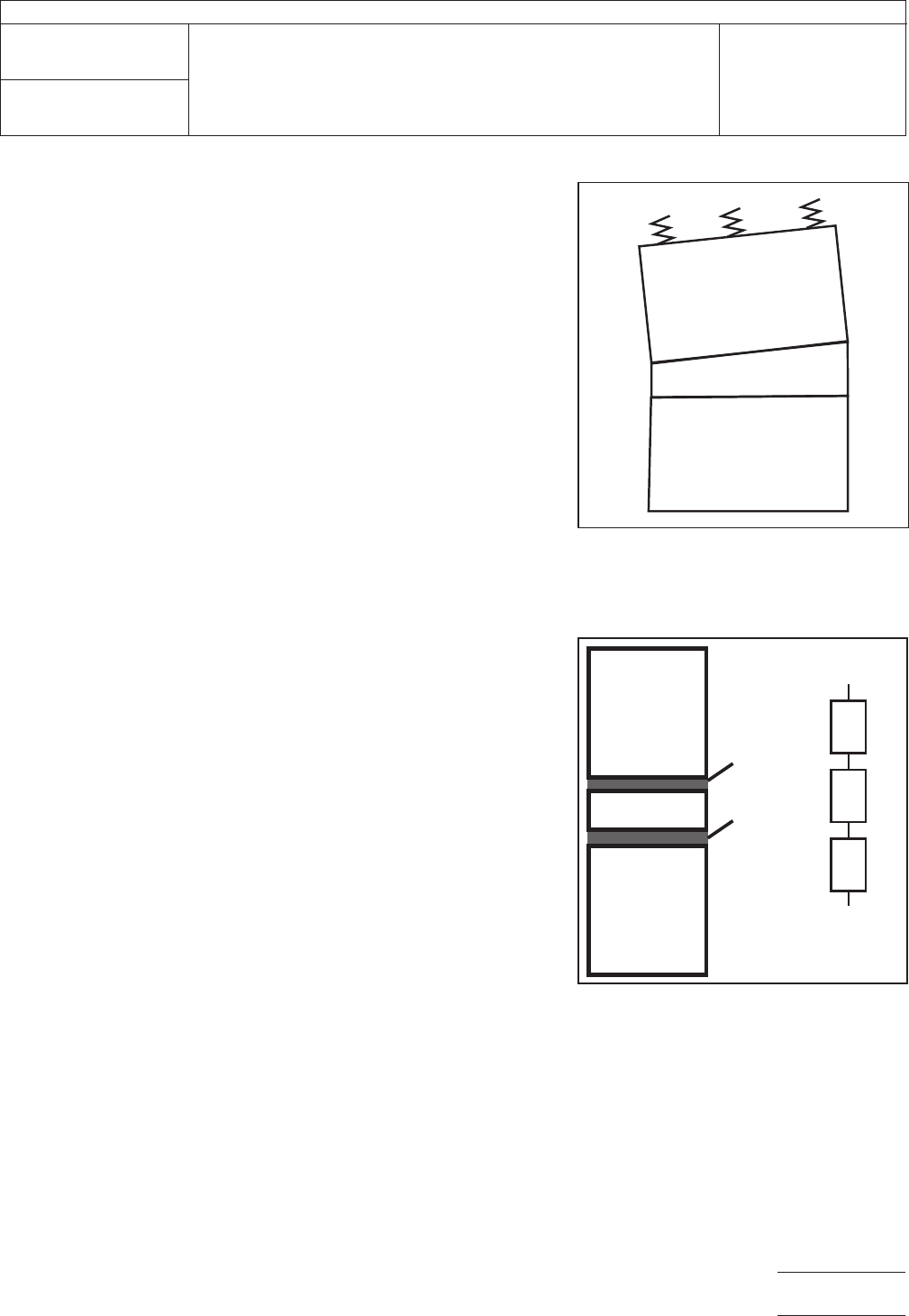
4.13 Use an element that maintains plane parallelism of the specimen and/or
the meter bars themselves (see Figure 3).
4.14 An appropriate device is required to produce the micro section. In order
to generate clean and reproducible results in the form of micro section, the
device must be able to grind and polish the sample (see IPC-TM-650 Test
Methods 2.1.1 or 2.1.1.2).
5 Procedure
5.1
First of all the heating and cooling source should be tempered. Tempering
of the apparatus / the system could have an influence of the measured force
and gap.
5.2 After the apparatus is tempered, tare the force measuring device, when
the heat flow meter bars do not touch.
5.3 After the force is tared, the thickness measuring device needs to be set
to zero as well, if it is implemented in the machine. Otherwise, it has to be
measured before and after measurement. Therefore, the specified surface
pressure should be applied without any specimen between the meter bars.
When the temperature field inside the meter bars is in steady state condition
(∆T/t ≤ 0.2 K/300s) the thickness measurement can be tared.
5.4 Use a liquid like oil or water-glycol to reduce the contact resistance
between the meter bars or the meter bars and the specimen.
5.5 Use a surface pressure of ≥ 2.0 N/mm² to reduce the influence of the
contact resistances and improve the repeatability of the measurements.
5.6 Measure first the pure liquid (which reduces the contact resistances
between the sample to the meter bars) between the meter bars at the same
surface pressure as the sample (Table 1 Equation 7). From the measured
thermal resistance of the metal based substrate with the used liquid on the
upper and lower side, subtract the measured thermal resistance two times
from this value. See Equations 10 and 11 in Table 1.
5.7 We recommend having a temperature difference ∆T across the sample ≥
1.5 K to reduce the uncertainty. Measure below the glass transition point (TG)
to avoid nonlinear behavior. Show the middle temperature, the ∆T across the
sample and the uncertainty in the results file.
5.8 The measured values are the apparent thermal resistance of the stack
(e.g., Al-die-Cu) (Table 1 Equation 11). Show the results of the thermal
resistance in the dimension (mm²K)/W (Table 1 Equation 8) and the total
apparent thermal conductivity in W/(mK) (Table 1 Equation 9).
5.9 In order to get the apparent thermal conductivity and the thermal resistance
of the dielectric layer between top and base plate of the sample, it is necessary
to know the layer thicknesses of every sample layer. To measure these
thicknesses a microsection of the sample must be made (see IPC-TM-650
Test Methods 2.1.1 or 2.1.1.2 and Table 1 Equation 14). With
known thermal conductivities of the base and top plate of the sample (show in the results the assumed thermal
conductivity of the metals), the thermal resistances of these layers can be determined (Table 1 Equations 12
and 13). With a subtraction of the determined resistances from the apparent thermal resistance of the specimen,
the thermal resistance of the dielectric layer (incl. thermal contact resistances) can be determined (Table 1
1
2
3
Figure 3 Element to Maintain the Plane Parallelism of
the Specimen
Note 1 – Hot Meter Bar
Note 2 – Specimen
Note 3 – Cold Meter Bar
1
2
4
5
7
6
4
3
Figure 4 Order of Materials in the Measuring Section
(incl. the liquid) and Substitute Image Regarding the
Thermal Resistances
Note 1 – Hot Meter Bar
Note 2 – Specimen
Note 3 – Cold Meter Bar
Note 4 – Liquid to Reduce
the Thermal
Contact
Resistances
Note 5 – R
th,liquid
Note 6 – R
th,specimen
Note 7 – R
th,liquid