IPC-TM-650 EN 2022 试验方法.pdf - 第76页
Twenty-four hour stabilization is referee method. 5.2 Method A Dimensional stability of unclad material due to thermal exposure—standard condition. (1) Place test specimen unconstrained in an oven maintained at 150°C ± 2…
1
Scope
This
test method is used to establish and define
the procedures for determining thermal gradient dimensional
changes of a plastic dielectric, metal clad or unclad.
This method may also be used to determine dimensional
changes after metal removal of a clad.
2
Applicable Documents
None
3
Test Specimen
The
test specimen shall be at least 27
cm x 29 cm of unclad or metal clad dielectric material cut and
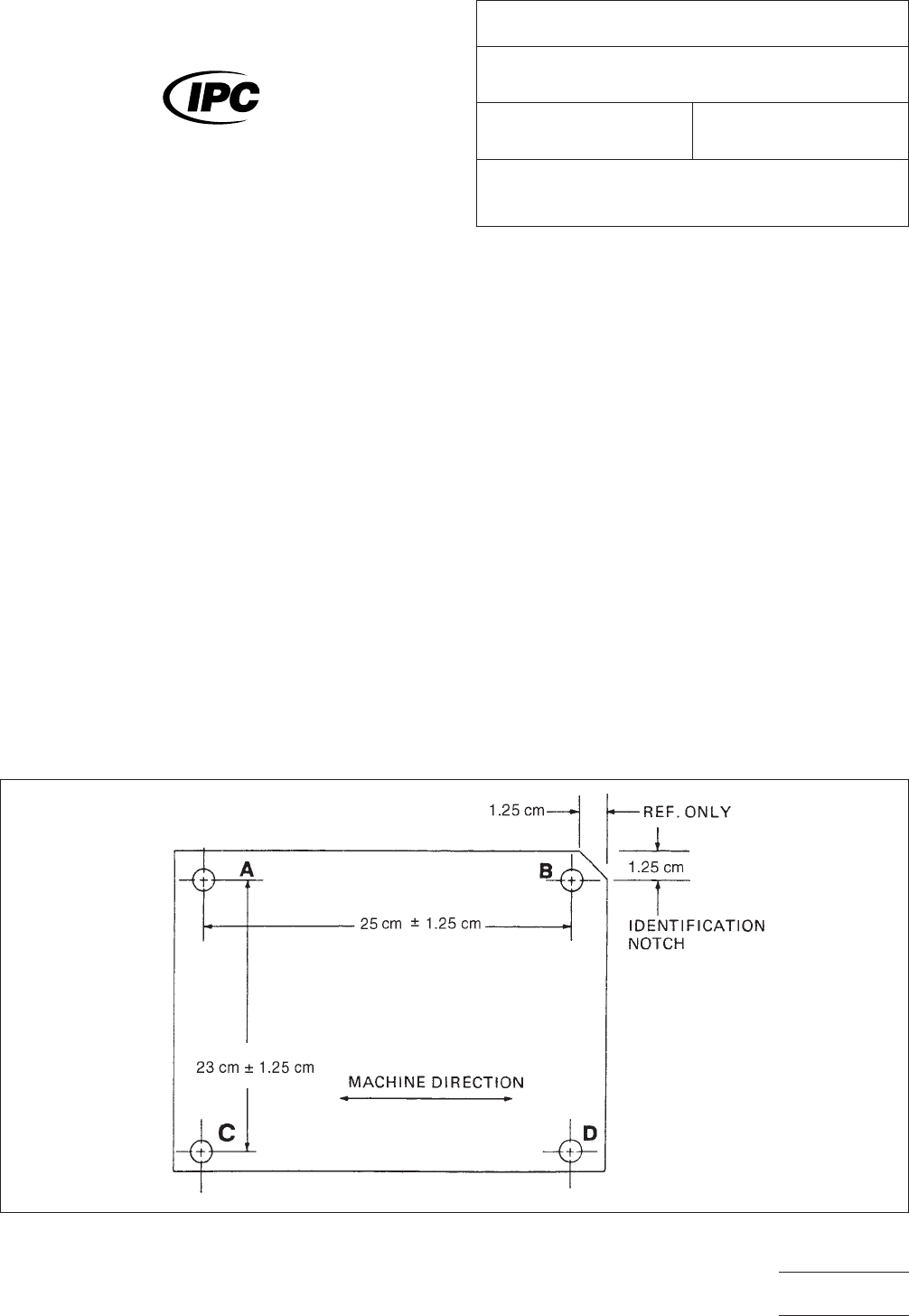
punched per Figure 1.
4
Test Equipment
• Shear —
for cutting 27 cm x 29 cm test specimens.
• Micro-Rule — with dial indicator reading to 0.0125 mm or
less or an equivalent optical system.
• Hole Punch — 0.889 mm minimum diameter.
• Oven — mechanical convection type capable of maintaining
a temperature of 150°C ± 2°C.
• Etcher — capable of maintaining test specimens a 43°C ±
5°C during the metal removal.
• Line Scribe — capable of producing a line 0.125 mm wide
maximum.
• Chemical Etchant — capable of metal removal without det-
rimental effect to either the adhesive or dielectric.
5
Procedure
5.1 Sample Preparation
Scribe
0.125 mm wide lines or
punch holes at positions A through D in specimen at locations
shown in Figure 1.
Allow specimen to stabilize at 23°C ± 2°C and 50% ± 5%
relative humidity (RH) and measure separation of holes/lines
between corresponding positions (center of hole or center of
line). For example, the distance between hole centers A-B and
C-D, also A-C and B-D. Record as initial measurement (1).
Stabilization times may be reduced if statistically sound evi-
dence has been generated on the specific product line to
support shorter stabilization times to reach equilibrium.
IPC-224-1
Figure
1 Dimensional Stability Test Pattern
The
Institute for Interconnecting and Packaging Electronic Circuits
2215 Sanders Road • Northbrook, IL 60062
IPC-TM-650
TEST
METHODS MANUAL
Number
2.2.4
Subject
Dimensional
Stability, Flexible Dielectric Materials
Date
5/98
Revision
C
Originating Task Group
Flex Peel Strength Test Methods Task
Group (D-13A)
Material
in this Test Methods Manual was voluntarily established by Technical Committees of the IPC. This material is advisory only
and its use or adaptation is entirely voluntary. IPC disclaims all liability of any kind as to the use, application, or adaptation of this
material. Users are also wholly responsible for protecting themselves against all claims or liabilities for patent infringement.
Equipment referenced is for the convenience of the user and does not imply endorsement by the IPC.
P
age1of2
电子技术应用 www.ChinaAET.com

Twenty-four
hour stabilization is referee method.
5.2
Method A
Dimensional
stability of unclad material due
to thermal exposure—standard condition.
(1) Place test specimen unconstrained in an oven maintained
at 150°C ± 2°C for 30 ± 2 minutes.
(2) Cool specimen to standard conditions of 23°C ± 2°C and
50% ± 5% RH for 24 hours minimum (see 5).
(3) Remeasure separation of holes/lines and record as final
measurement after thermal exposure (F
l
).
5.3
Method B
Dimensional
stability of metal clad dielectrics
due to metal removal.
(1) Chemically erode the metal away except for the target
areas, which can have up to 13 mm x 13 mm square metal,
using an etchant that has no detrimental effect on either the
dielectric or adhesive. Wash and dry. The test specimen
should be unconstrained during the etching, washing, and
drying operation.
(2) Stabilize test specimen for 24 hours at 23°C ± 2°C and
50% ± 5% RH (see 5.1).
(3) Remeasure separation of holes/lines and record as final
measurement after etching (F
2
).
5.4
Method C
Dimensional
stability of dielectric due to
thermal exposure and metal removal, using specimens from
Method B.
(1) Place unconstrained etched, conditioned, and measured
specimen from Method B in an oven maintained at 150°C ±
2°C for 30 ± 2 minutes.
(2) Stabilize specimen at 23°C ± 2°C and 50% ± 5% RH for
24 hours and remeasure separation of holes (see 5.1).
(3) Remeasure separation of holes/lines and record as final
after etching and thermal exposure (F
3
).
5.5
Calculate
the linear dimensional changes as follows:
(Start with initial reading (I) from 5.1)
M.D. =
(A−B)
F
−(A−B)
I
(A−B)
I
+
(C−D)
F
−(C−D)
I
(C−D)
I
2
x
100
T.D. =
(A−C)
F
−(A−C)
I
(A−C)
I
+
(B−D)
F
−(B−D)
I
(B−D)
I
2
x
100
Where:
M.D. = % change in machine dimension.
T.D. = % change in transverse dimension.
I = Initial Reading.
F = Final Reading (Either F
1
,F
2
,o
rF
3
).
A-B
= Distance Between PointsA&B.
A-C = Distance Between PointsA&C.
C-D = Distance Between PointsC&D.
B-D = Distance Between PointsB&D.
6 Notes
The
alternate method for marking clad samples
allows the use of scribed lines. Caution must be used to pro-
tect scribed lines during etch operation.
IPC-TM-650
Number
2.2.4
Subject
Dimensional
Stability, Flexible Dielectric Materials
Date
5/98
Revision
C
P
age2of2
电子技术应用 www.ChinaAET.com

1.0
Scope
This
test method is to describe the procedures
to be used for performing dimensional inspections on micro-
sections of printed boards. This method does not apply to
measurements less than 1.25 µm (0.00005 in). This method is
intended to supersede IPC-TM-650, Methods 2.2.9 and
2.2.11.
2.0
Applicable Documents
IPC-TM-650
Method
2.1.1
IPC-TM-650
Method
2.1.1.2
IPC-A-600
Acceptability
of Printed Boards
3.0
Test Specimens
The
test specimens are to be micro-
sections of printed boards or the associated quality conform-
ance test circuitry prepared in accordance with IPC-TM-650,
Methods 2.1.1 or 2.1.1.2.
4.0
Apparatus or Material
4.1
Metallographic
equipment and consumables as
described in IPC-TM-650, Methods 2.1.1 or 2.1.1.2.
4.2 In
addition, the microscope or metalllograph described
in Methods 2.1.1 or 2.1.1.2 shall be equipped with a measur-
ing reticle or filar eyepiece.
4.2.1 Reticle
or Filar Micrometer attachment to Optical
Inspection Aid that contains gradiations or a scale, which will
provide a minimum measurement resolution of 50% of the last
significant digit of the referenced dimensional requirement.
The Reticle or Filar Micrometer should be calibrated at the
given magnification to ascertain the distance in µm (inches)
between each division.
5.0
Procedure
5.1
The
dimensional inspections are to be performed on
freshly prepared and etched microsections. When oxidation
and/or staining are present that would inhibit the clear viewing
of the areas to be measured the microsections(s) shall be pre-
pared again beginning with the finest grinding step in the met-
allographic preparation sequence.
5.2 The
microscope’s or metallograph’s measuring reticle or
filar eyepiece shall be calibrated in accordance with the manu-
facturer’s instructions using a stage micrometer. The calibra-
tion frequency shall be at a minimum of one (1) year intervals
or more frequently, if required, to maintain accuracy of the
dimensional inspections.
5.3
Attributes
that can be measured using microsections of
printed boards include but are not limited to: plating , coating,
or solder resist thickness, the size of laminate voids or cracks,
the amount of positive or negative etchback, conductor thick-
ness, dielectric spacing, either laterally or vertically, annular
ring width, layer-to-layer registration, or the extent of wicking.
5.4
Select
a magnification that allows clear viewing of the
areas containing the attributes to be measured. For instance,
when viewing multilayer printed boards with plated-through
holes or vias for layer-to-layer registration, magnifications of
50X to 100X would be used. When measuring plating thick-
nesses of electrodeposited copper or nickel, a magnification
of 200X would be used.
5.5
Read
and record the dimensions for the attributes(s) to
be measured using the same number of significant digits
specified by the drawing, standard, or specification as a mini-
mum or maximum limiting value.
6.0 Notes
6.1
Measurements
less than 1.25 µm (0.00005 in) cannot
accurately be made using optical techniques. Electronic mea-
surement techniques should be considered for these mea-
surements.
6.2
IPC-A-600
contains figures and diagrams which depict
microsectional attributes and measurements.
The
Institute for Interconnecting and Packaging Electronic Circuits
2215 Sanders Road • Northbrook, IL 60062
IPC-TM-650
TEST
METHODS MANUAL
Number
2.2.5
Subject
Dimensional
Inspections Using Microsections
Date
8/97
Revision
A
Originating Task Group
Rigid Board T.M. Task Group, 7-11d
Material
in this Test Methods Manual was voluntarily established by Technical Committees of the IPC. This material is advisory only
and its use or adaptation is entirely voluntary. IPC disclaims all liability of any kind as to the use, application, or adaptation of this
material. Users are also wholly responsible for protecting themselves against all claims or liabilities for patent infringement.
Equipment referenced is for the convenience of the user and does not imply endorsement by the IPC.
P
age1of1
电子技术应用 www.ChinaAET.com