IPC-TM-650 EN 2022 试验方法.pdf - 第534页
operation is specified in Equation 5-2. I_R j = RB j − RB j − 1 t j − t j − 1 I_T j = TB j − TB j − 1 t j − t j − 1 [5-2] 5.2.2.4 RIE Results The reference structure, RIE reference ,i s the square root of the square of t…
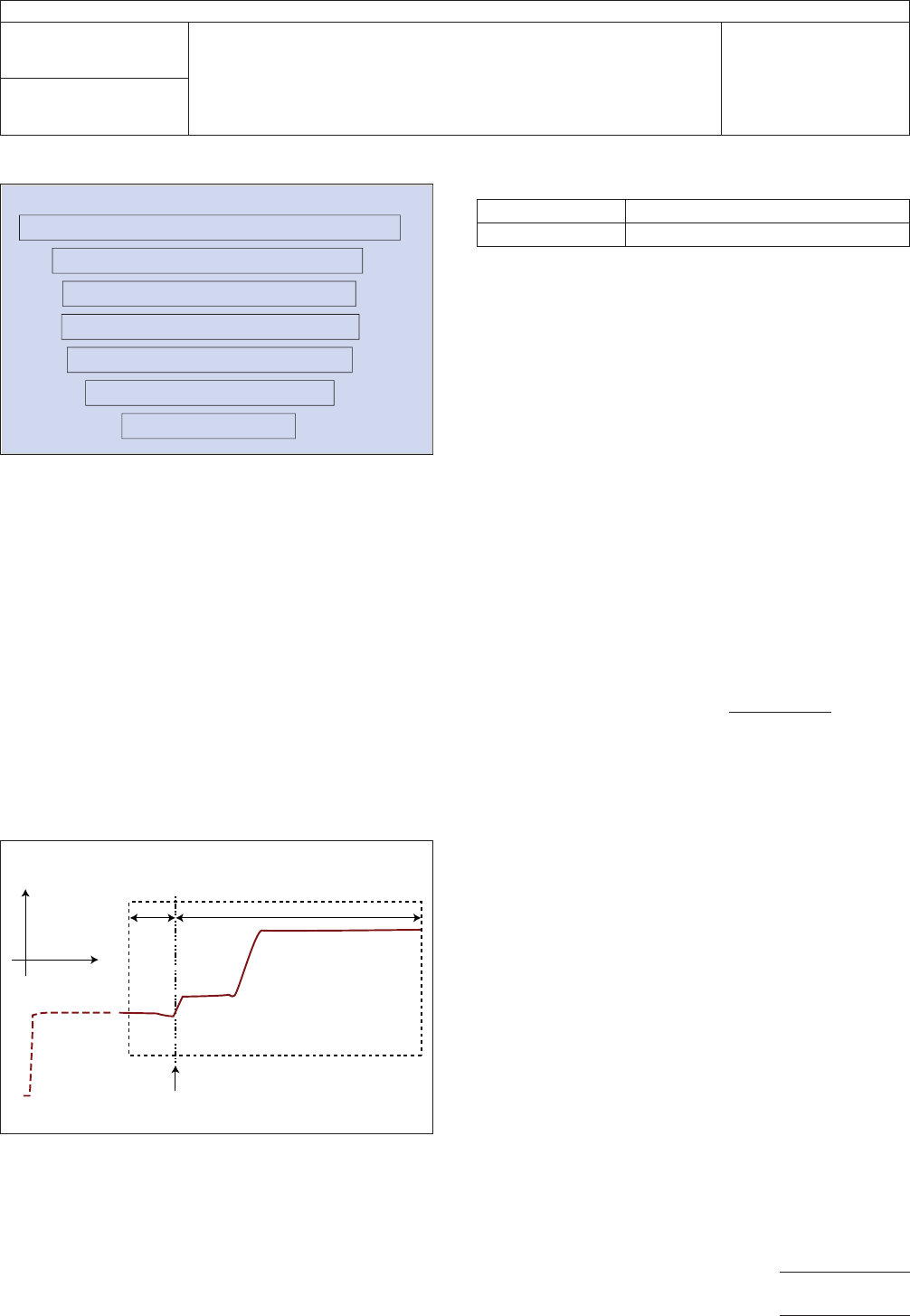
These are the TDR waveforms used in the RIE loss calcula-
tion.
It is recommended to be positioned within 80% of the vertical
screen scale in reference to the representative waveform. The
signal on the screen must have a resolution of at least 5% of
the measured signal.
Figure 5-3 specifies two time regions. T0 and T1. The sum of
T0 and T1 represents the time range for the captured wave-
form. Figure 5-3 specifies the point between T0 and T1 which
corresponds to the point where the probe contacts the
printed board, or where the rising edge would be if the probe
were disconnected from the sample. The TDR specification
for T0 and T1 is found in Table 5-1.
Each TDR waveform is averaged on the TDR instrument at
least 16 times. The time base and offset remain the same for
all measurements.
5.2.2 Measurement and Processing Two TDR wave-
forms are captured. One corresponds to a reference and the
second corresponds to the test line.
The measured waveforms require post-processing. TDR
waveform is processed as follows:
a) Filtering
b) Cubic spline fit
c) Using derivative to find impulse response
d) Calculating RIE loss ratio
5.2.2.1 Recursive Digital Filtering of Spline Data The
two TDR waveforms are filtered using the method prescribed
in Equation 5-1.
Let S
j,0
= A
j
for k = 1 to N
?
S
j,k
=
S
2,k +
Σ
i=1
j
(
2
i-1
⋅ S
i,k
)
2
j
Assign B
j
= S
j,N
[5-1]
Where:
N is the number of filtering iterations
A
j
is the j
th
point of the on of the acquired TDR waveforms
Sj,k is the j
th
point of the k
th
filtered waveform
j is an index for the waveform points
Bj is the j
th
point of the filtered waveform
The number of filter iterations depends on the number of
samples in the acquired TDR waveform and specified in Table
5-2.
5.2.2.2 Resampling with a Cubic Spline Fit The next
step is to resample the filtered TDR data to 10,000 points (J).
This is accomplished with a cubic spline fit.
5.2.2.3 Impulse Response The impulse response of the
reference and test specimen, respectively I_R
j
and I_T
j
is cal-
culated by taking the derivative of the respective resample
step waveforms RB
j
and TB
j
. One method to perform this
Figure 5-2 RIE Flowchart
RIE TDR PROCESS
Acquire TDR response for one reference and line under test
Averaging filter of re-sampled TDR waveforms
Cubic spline re-sampling of TDR waveforms
Perform Derivative of filtered TDR waveforms
Determine RIE loss from reference Sample
Determine RIE loss from test Sample
Determine RIE loss ratio
IPC-25512-5-3
Figure 5-3 Waveform Position on TDR Screen
Voltage
Time
Corresponds to probe launch
T0 T1
TDR Display Window for RIE
Table 5-1 RIE TDR Time Range Specifications
T0 50 ps (typical)
T1 At least twice the transit delay
IPC-TM-650
Number
2.5.5.12
Subject
Test Methods to Determine the Amount of Signal Loss on
Printed Boards
Date
07/12
Revision
A
Page 13 of 24
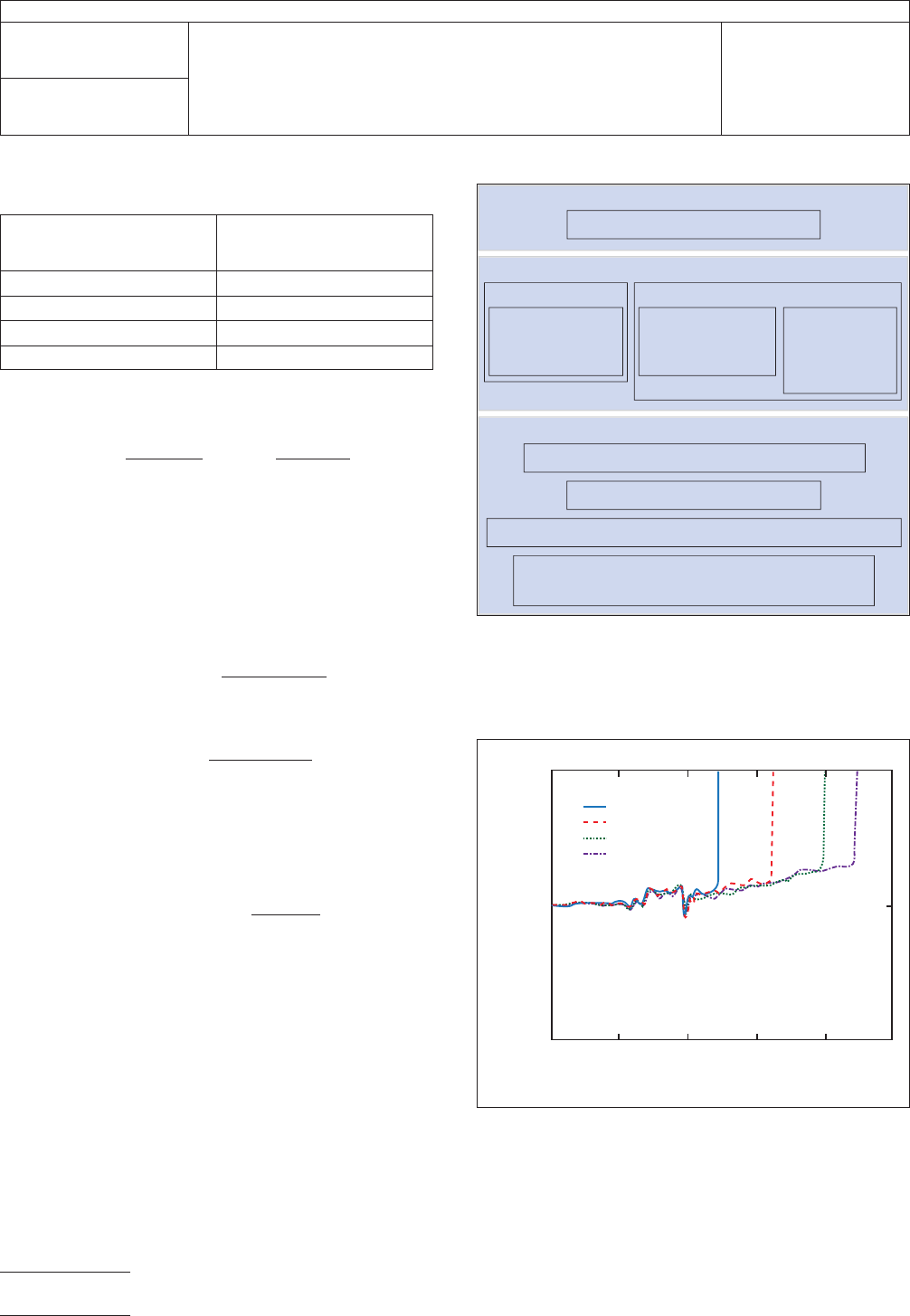
operation is specified in Equation 5-2.
I_R
j
=
RB
j
− RB
j−1
t
j
− t
j−1
I_T
j
=
TB
j
− TB
j−1
t
j
− t
j−1
[5-2]
5.2.2.4 RIE Results The reference structure, RIE
reference
,is
the square root of the square of the integral of the square of
the impulse response I_R, and can be calculated from J
samples as show in Equation 5-3. The test structure, RIE
test
,
is the square root of the square of the integral of the square
of the impulse response I_T, and is calculated from J samples
as show in Equations 5-3 and 5-4.
RIE
reference
=
√
Σ
j=1
J
I_R
j
2
(t
1
− t
0
)
[5-3]
RIE
test
=
√
Σ
j=1
J
I_T
j
2
(t
1
− t
0
)
[5-4]
The RIE loss in dB, RIE
loss_dB
, is calculated by dB ratio of the
RIE
test
to RIE
reference
as show in Equation 5-5.
RIE
loss_db
= 20 * log
(
RIE
test
RIE
reference
)
[5-5]
5.3 SPP Procedure Figure 5-4 summarizes the SPP mea-
surement extraction process.
5.3.1 Selecting Optimum SPP Transmission Lines SPP
utilizes measurements on two lines of different lengths such as
2.0 cm and 8.0 cm. The pair shall be designed to be identi-
cal in every way except for length. The SPP is used to extract
parameters such as α(f) β(f), Γ(f) and Z
0
(f) by utilizing the dif-
ference between the two specimen line lengths. Effects due to
the connectors, cables, probes, and oscilloscope circuitry can
be minimized using this method. Screening the two lines
improves accuracy. Figure 5-5 illustrates lines of similar
design. Accuracy is improved when the slope and deviation
along the lengths of overlaid portions of the respective TDR
waveforms are coincident.
5.3.1.1 Additional SPP Step for Differential Lines There
are a few additional steps needed when analyzing differential
lines. The TDR screening still needs to be performed first. In
Table 5-2 Filter iterations, N, vs.
number of points, n, in TDR capture
Number of Points
in TDR capture (n)
Number of
Filtering Iterations
(N in Equation 5-1)
0>n≥750 1
750>n≥1500 2
1500 > n ≥3000 6
> n >3000 21
Figure 5-4 SPP Flowchart
TDR
Select best candidates for line pairs
Low Freq
TDT
disc
Determine
1MHzε
r
and Tan δ
(LCR meter)
Determine
Capacitance/unit
length (LCR meter)
Determine
Resistance/unit
length ρ and
(LCR meter)
Lines
Acquire Impulse response for 2 lines of 2 lengths
Window and filter Impulse response
FFT to get Propagation Constant Γ (Attenuation and Phase)
Use itrative matching of Γ, Att, and low freq
parameters to determine tline modeling parameters
IPC-25512-5-5
Figure 5-5 Example of Similar TDR Responses for
Different Lengths of Lines
0.3
0.2
0.25
1.5 2.5
Time (nsec)
Voltage (V)
3.52
1=2 cm
1=5 cm
1=8 cm
1=9.8 cm
34
IPC-TM-650
Number
2.5.5.12
Subject
Test Methods to Determine the Amount of Signal Loss on
Printed Boards
Date
07/12
Revision
A
Page 14 of 24

this case, the screening has to be done for odd-mode, with
TDR pulse polarity of + -, and even-mode, + +. It is also rec-
ommended to perform TDR for +0 and 0+ single mode to see
how close to each other the two lines’ characteristics are.
5.3.2 Measuring Frequency Relative Permittivity with
SPP
The capacitance shall be measured at 1 MHz with an
LCR meter for several lengths of lines. Such measurements
are generally made at a low enough frequency such as 1 MHz
so that the reactance associated with the lead inductance is
negligible. In a subsequent step line resistance measurements
usinga4wireKelvin method are also made. The measure-
ments determine the resistance per unit length and the
capacitance per unit length. By taking the difference between
results at two lengths and dividing by the difference in lengths,
the effect of parasitic end load is eliminated. The LCR meter
shall be also used to measure the capacitance between the
layers of the large circular disc designated for dielectric per-
mittivity determination.
Relative permittivity, ε
r
, is calculated with Equation 5-6 using
the known area, A, of the test specimen disc, the distance
between the layers h, and the capacitance, C, as measured
with the LCR at 1 MHz. The value for ‘‘h’’ may be determined
by cross-sectioning analysis.
ε
r
=
hC
ε
0
A
[5-6]
5.3.3 Measuring Low Frequency Copper Resistivity, ρ,
with SPP
The resistivity (ρ) per unit length of the signal line
conductor is determined with Equation 5-7. R
l
is the resis-
tance measured usinga4wireKelvin method for the long line
of length l
l
. R
s
is the resistance measured usinga4wireKel-
vin method for the short line of length l
s
.
ρ=
(R
l
− R
s
)A
l
l
− l
s
[5-7]
A is the cross-section area (equal to the conductor width mul-
tiplied by the conductor thickness).
5.3.4 SPP Low Frequency Permittivity It should be
noted that the two ground planes that are above and below
the signal of interest are always shorted together, in the trans-
mission line region and in the parallel plate disc area. The disc
that is used should have a diameter that is 100x the height, h
to, the nearest ground in order to be able to calculate ε
r
directly from (1) without any fringe capacitance consideration.
The typical diameter of the disc is 12.7 mm [0.5 in]. It is use-
ful to have a dummy structure that is nearby the disc that has
only the via connection between the surface pad and the disc
and the small lateral line extension. Typical configuration was
shown in 3.3.4.2. The capacitance of this parasitic structure is
subtracted from the total disc C so that the end effects are not
included in the result for ε
r
.
Finally, the dielectric loss, tanδ, is also measured for the large
disc using the same LCR meter in the range of 10 KHz to
1 MHz.
The line capacitance per unit length, together with the cross
sectional dimensions can also be used for determining the
dielectric constant at 1 MHz. The procedure is to calculate the
capacitance with a 2D field solver for an assumed dielectric
constant. Iteration is used on this assumed value until the
agreement is obtained between measured and calculated C.
The implicit assumption here is that the lines are uniform and
that the cross section is well known along the length. Both
these assumptions have limitations and this is why the extrac-
tion based on line C is not as accurate. On the other hand, the
composition of glass fiber and dielectric resin might differ in
the disc area from the line area which could introduce errors
in the extracted ε
r
at 1 MHz.
5.3.5 SPP TDT Measurement TDT measurements are
also made with several lines, but especially with the 2 cm
[0.787 in] and 8 cm [3.15 in] lines of interest. In addition, it is
useful to measure a very short line of ‘‘zero length,’’ (e.g., 0.25
- 0.45 mm [0.0098 - 0.0177 in]) in order to obtain the band-
width of the time-domain set-up and for use as a reference for
delay extraction. The TDT measurement monitors the propa-
gation delay at 50% of the signal swing, the propagated rise
time between 10% and 90% levels. By taking the difference in
delays for the two lines and dividing by the difference in
lengths, one obtains the line propagation delay per unit length,
τ, without the effect of probes, pads, and via discontinuities.
The assumption is that these features are of similar character-
istics for the two lines. The propagated risetime through the
‘‘zero length’’ line indicates the bandwidth for the setup based
on the simplified formula for the upper 3 dB frequency given
in Equation 5-8.
, =
0.35
tr
[5-8]
The correlation of propagation delay and rise time shape with
simulation can provide a very useful validation of the broad-
band model that is being created using this method.
Examples are given in Figure 5-6.
IPC-TM-650
Number
2.5.5.12
Subject
Test Methods to Determine the Amount of Signal Loss on
Printed Boards
Date
07/12
Revision
A
Page 15 of 24