IPC-TM-650 EN 2022 试验方法.pdf - 第548页
the substrate extends beyond the circumference of both cav- ity sections. Adjust the separation of the two resonator sec- tions so that the substrate is held by the weight of the upper cavity between the two cavity secti…
5.4.1 Measure the length L of each of the two split-cylinder
resonator sections over several locations and compute the
mean length of both sections.
5.4.2 With the split-cylinder empty (no substrate) and closed
(d=0), find the TE
011
resonance with the network analyzer.
To reduce the coupling losses to a negligible level, adjust
the radial position of the coupling loops so that the peak of
the resonance curve is less than -40 dB. For the particular
10 GHz split-cylinder resonator described in this method, the
resonant frequency should be approximately 10.04 GHz. If
another split-cylinder geometry is being used, use the follow-
ing approximation to estimate the TE
011
resonant frequency of
an empty split-cylinder resonator:
ƒ
011
=
c
2π
√
(
j
1
a
)
2
+
(
π
2L
)
2
where c is the speed of light in a vacuum, j
1
is the first zero of
the Bessel function of the first kind J
1
, a is the split-cylinder
radius in meters and L is the length, in meters, of each of the
split-cylinder sections as shown in Figure 2.
5.4.3 Once the TE
011
resonance has been identified and
displayed on the network analyzer display, measure the reso-
nant frequency f
011
and quality factor Q of the resonance and
use the following expressions to compute the radius a and the
conductivity σ of the empty split-cylinder’s resonator sections:
a=j
1
[
(
2πƒ
011
c
)
2
−
(
π
2L
)
2
]
−
1
2
σ=
2πƒ
011
µ
0
2R
s
2
where µ
0
is the permeability of free space and
√
µ
0
ε
0
[
(
j
1
a
)
2
+
(
π
2L
)
2
]
3
2
R
s
=
2Q
[
1
2L
(
π
2L
)
2
+
1
a
(
j
1
a
)
2
]
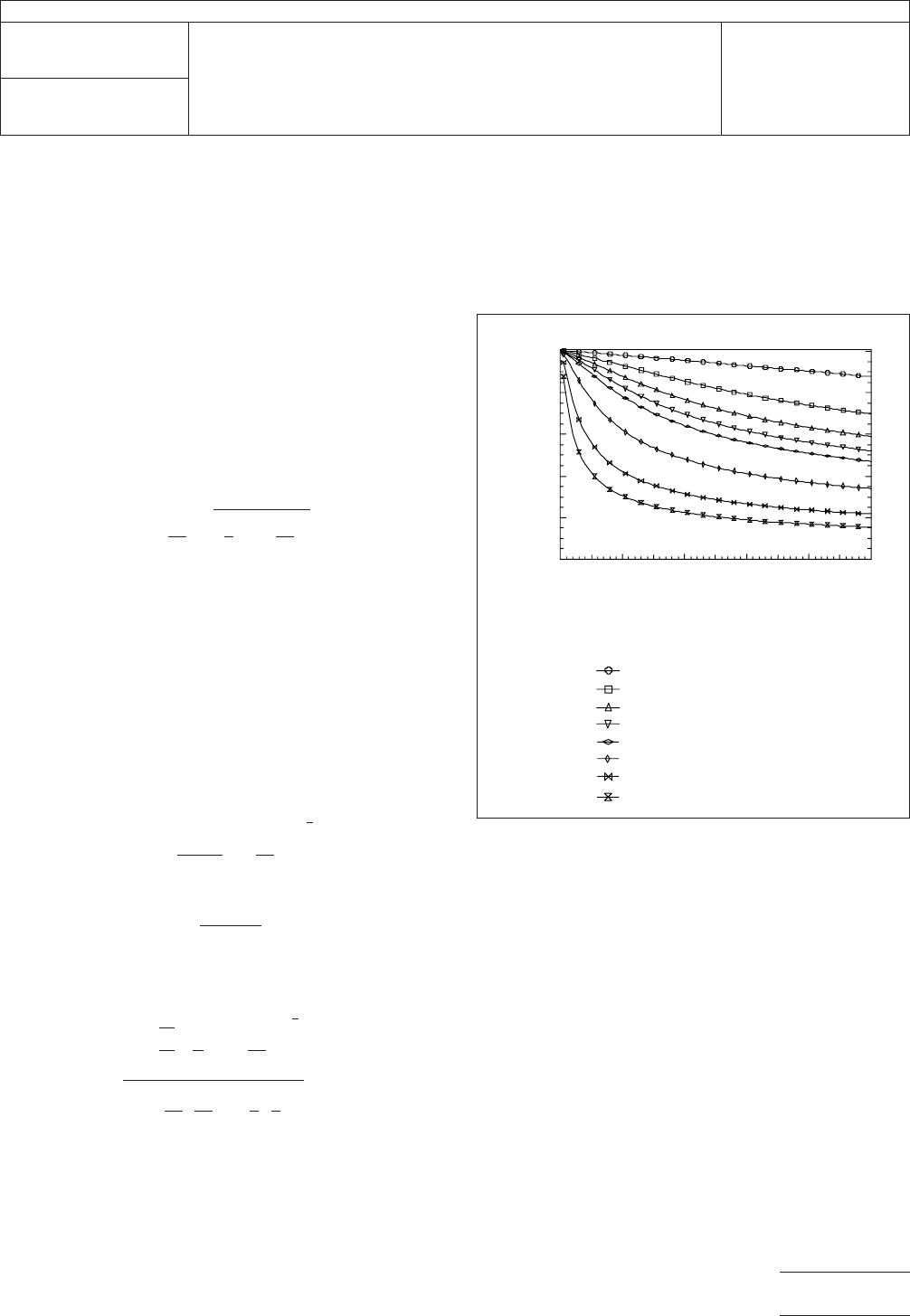
5.5 Estimate the TE
011
Resonant Frequency of
Substrate-Loaded Split-Cylinder Resonator
In addition
to the desired TE
011
resonant mode, other modes are excited
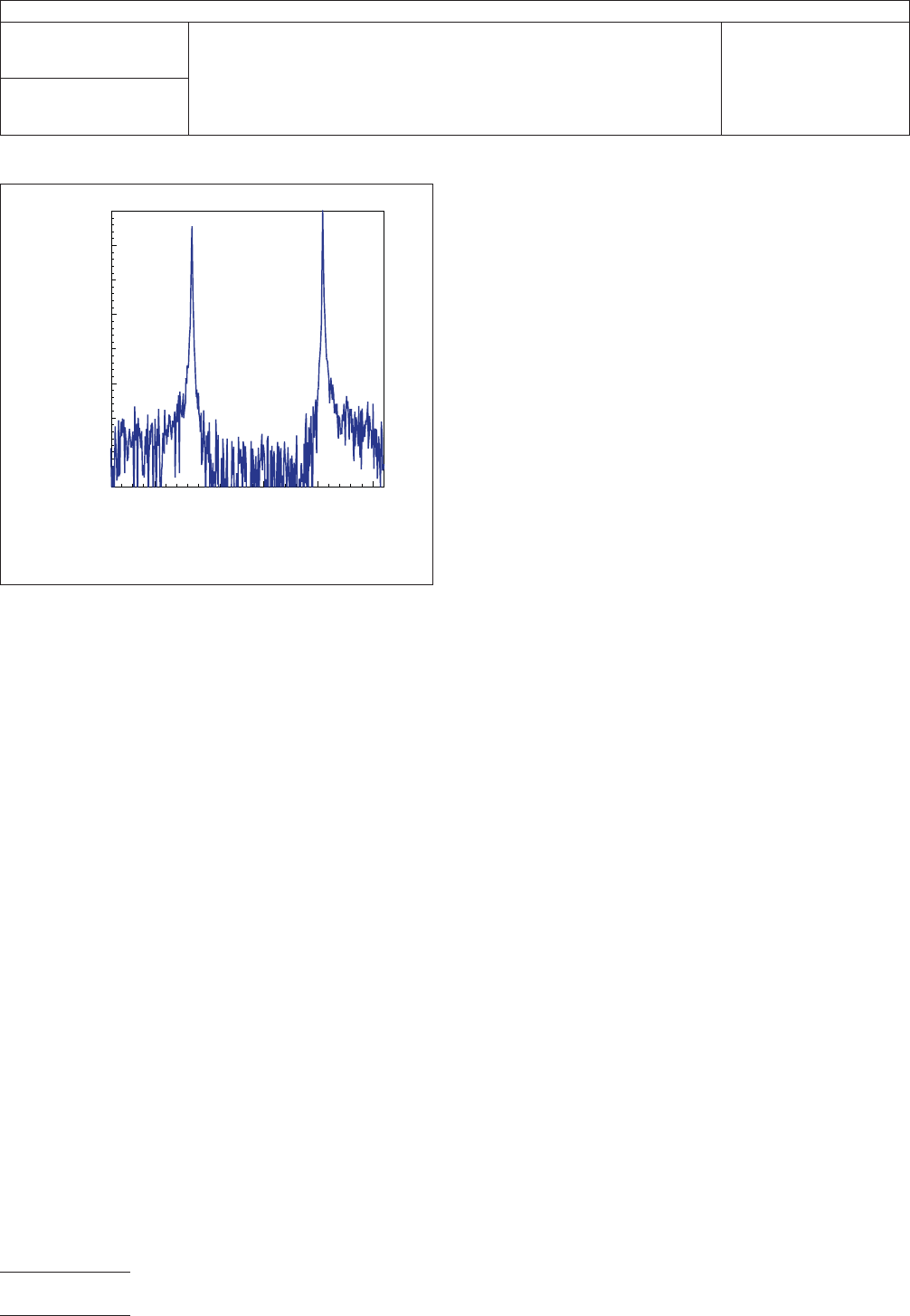
in the split-cylinder resonator as shown in Figure 5. Depend-
ing on the thickness and relative permittivity of the dielectric
substrate being measured, the resonant frequency for the
split-cylinder plus substrate can be significantly lower than the
resonant frequency of the empty split-cylinder resonator as
shown in Figure 6.
In order to identify the correct mode, one can use Figure 6 to
predict the resonant frequency of the TE
011
resonant mode.
For a more accurate estimate of this resonant frequency and
the frequencies of the higher-order resonant modes, software
is available from the National Institute of Standards and Tech-
nology (NIST) which calculates the split-cylinder resonator
dimensions, substrate thickness, and provides an estimate of
the relative permittivity of the substrate. As of the publication
of this method, additional commercial vendors are developing
similar software and will be listed through the IPC-TM-650
Test Methods web page.
5.6 Measure the Relative Permittivity and Loss Tangent
5.6.1
Place the substrate in the gap separating the two cav-
ity sections of the split-cylinder resonator in such a way that
IPC-25513-5
Figure 5 Frequency of the TE
011
Resonant Mode as a
Function of Permittivity and Substrate Thickness for
the 10 GHz Split-Cylinder Resonator
Substrate Thickness (mm)
Sample Relative Permittivity
2
4
6
8
10
20
50
100
10
8
6
4
2
0
01234
5
TE
011
Resonant Frequency (GHz)
IPC-TM-650
Number
2.5.5.13
Subject
Relative Permittivity and Loss Tangent Using a Split-Cylinder
Resonator
Date
01/07
Revision
Page3of4
the substrate extends beyond the circumference of both cav-
ity sections. Adjust the separation of the two resonator sec-
tions so that the substrate is held by the weight of the upper
cavity between the two cavity sections.
5.6.2 Using the estimate calculated in 5.3, measure the
resonant frequency and quality factor of the TE
011
resonant
mode using the network analyzer. Since the split-cylinder
resonator is a two-port cavity, the network analyzer should be
set to measure S
21
, the scattering parameter that measures
the transmission through the cavity. The resonance may have
a significant amount of noise, so it may be necessary to adjust
the amount of averaging performed by the network analyzer.
In some cases where the resonance curve is near the noise
floor, increasing the coupling level of the split-cylinder resona-
tor may be necessary to improve the signal to noise level,
although this may introduce a small amount of coupling loss.
5.6.3 When using the available software, the routine will cal-
culate the relative permittivity and loss tangent of the dielectric
substrate after properly identifying the TE
011
resonant mode.
These values are displayed in the software front panel, includ-
ing an estimate of the measurement uncertainties for the rela-
tive permittivity and loss tangent.
6 Notes If additional measurements are needed at higher
frequencies, the available software will provide the frequencies
of the higher-order TE
0np
resonant modes. The user must
ensure that these modes are symmetric and not distorted by
adjacent resonant modes.
The uncertainties in the real part and loss tangent measure-
ment will be calculated automatically from the uncertainties in
various dimensions that are specified. The major source of
uncertainty will be the uncertainty in the substrate thickness.
Note that the electric field of the TE
011
resonant mode is in the
plane of the substrate. Therefore, if the substrate is anisotro-
pic, the measured component of the relative permittivity also
is in the plane of the substrate.
6.1 Software Availability Software may be available from
commercial vendors and in addition executable code is avail-
able from the Electromagnetic Properties of Materials Project
at the National Institute of Standards and Technology (NIST,
Boulder, CO). As commercial vendor software becomes avail-
able, IPC will provide listings for these at the IPC-TM-650 web
page located at www.ipc.org, under ‘‘Standards.’’
6.2 References
M.D. Janezic, ‘‘Nondestructive Relative Permittivity and Loss
Tangent Measurements using a Split-Cylinder Resonator,’’
Ph.D. Thesis, University of Colorado at Boulder, 2003.
M.D. Janezic, E.F. Kuester, J. Baker-Jarvis, ‘‘Broadband
Complex Permittivity Measurements of Dielectric Substrates
using a Split-Cylinder Resonator,’’ IEEE MTT-S International
Microwave Symposium Digest, pp. 1817-1820, 2004.
M.D. Janezic and J. Baker-Jarvis, ‘‘Full-Wave Analysis of a
Split-Cylinder Resonator for Nondestructive Permittivity Mea-
surements,’’ IEEE Transactions on Microwave Theory and
Techniques, vol. 47, no. 10, pp. 2014-2020, 1999.
K.J. Coakley, J.D. Splett, M.D. Janezic, R.F. Kaiser, ‘‘Estima-
tion of Q-factors and resonant frequencies,’’ IEEE Transac-
tions on Microwave Theory and Techniques, vol. 51, no. 3,
pp. 862-868, 2003.
J. Baker-Jarvis et al, ‘‘Dielectric and Conductor Measure-
ments of Electronic Packaging Materials,’’ NIST Technical
Note 1520, 2001.
J. Baker-Jarvis et al, ‘‘Measuring the permittivity and perme-
ability of lossy materials: solids, liquids, building materials, and
negative-index materials,’’ NIST Technical Note 1536, 2005.
B.N. Taylor, ‘‘Guidelines for Expressing the Uncertainties of
NIST Measurement Results,’’ NIST Technical Note 1297,
1994.
IPC-25513-6
Figure 6 Typical Multiple Split-Cylinder Resonator
Resonances
Frequency (GHz)
-60
-70
-80
-90
8.6 8.7 8.8 8.9 9.0
Magnitude of S
21
(dB)
IPC-TM-650
Number
2.5.5.13
Subject
Relative Permittivity and Loss Tangent Using a Split-Cylinder
Resonator
Date
01/07
Revision
Page4of4
1 Scope and Purpose
1.1 Scope
This document describes the frequency domain
test methods to accurately determine the amount of signal
propagation loss and delay for electrical printed boards, to
meet the demand of high speed applications nowadays. As
the data rate of high speed IO continues to increase (e.g., 10
Gbps and above), production testing and development testing
require more precise and accurate high frequency methods.
(Existing IPC-TM-650 Test Methods such as Method
2.5.5.12A are not adequate). Additionally, previous IPC test
methods do not encompass traditional industry methods
using VNA, such as thru-reflect-line (TRL), and recent devel-
opments of 2X-Thru test methods, etc. This test method is
defined to close the gaps.
The scope of this test method includes:
• Calibration and/or de-embedding techniques
• Probing/test fixture choices that impact measurement
quality
• Coupon Design
• Test sample pre-conditioning
• Environmental impact, etc.
1.2 Purpose
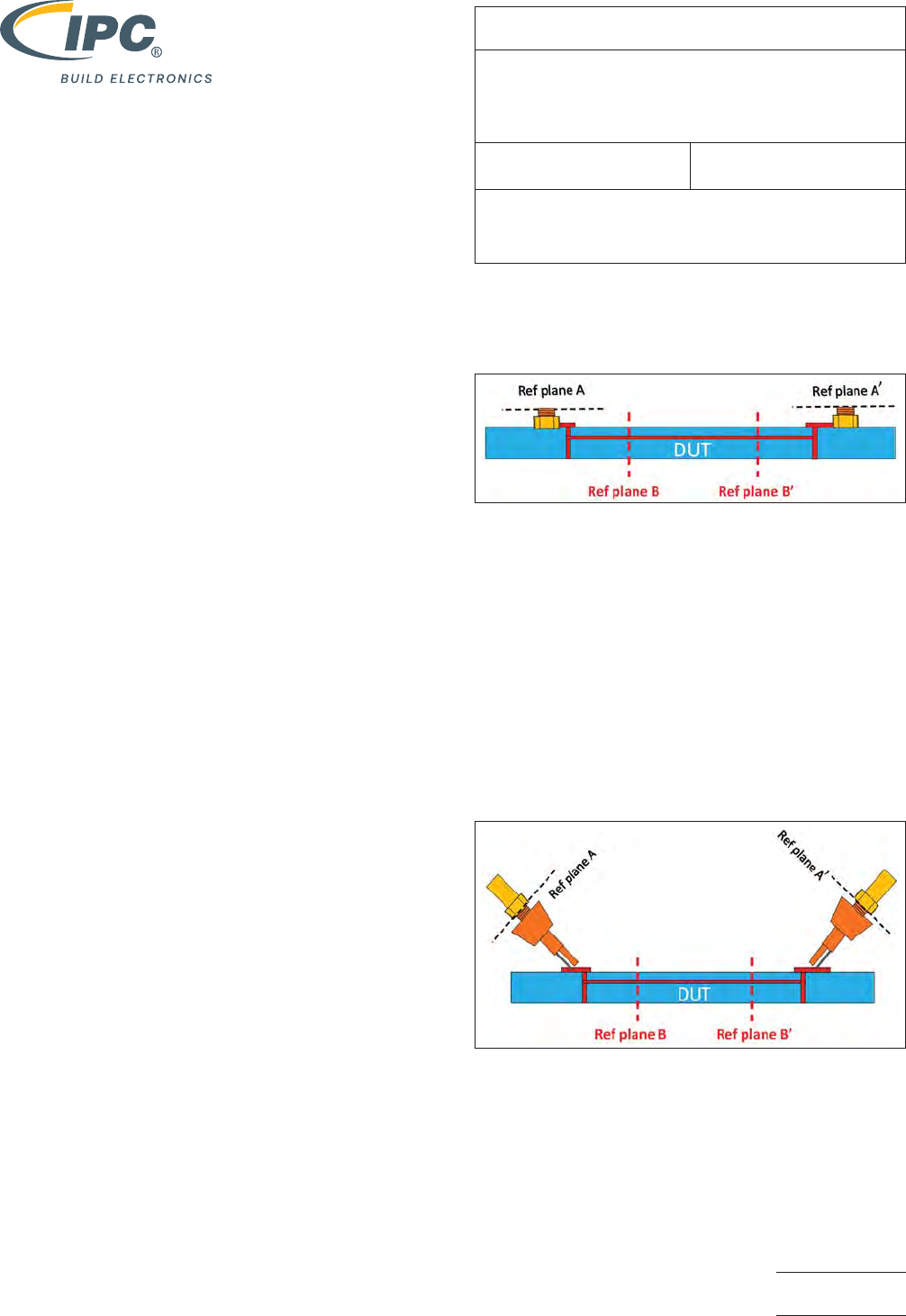
1.2.1 The importance of Setting up Correct Reference
Plane for Printed Board Characterization
The impor-
tance of setting up a correct reference plane in a typical inter-
connect measurement setup is illustrated in Figure 1-1. The
vector network analyzer (VNA) has been the de-facto standard
for accurate passive interconnect characterization including
the printed circuit board, connector, cables, etc. Making high
quality VNA measurement is straight-forward with standard
coaxial connectors and precision SOLT (short, open, load,
through) calibration kits. However, test fixtures are usually
required to connect the standard coaxial connectors to the
non-coaxial device under test (DUT). SOLT calibration can
readily move the reference plane to Ref plane A and Ref plane
A’ in the figure, while the intended DUT is the printed board
conductor only (between Ref plane B and Ref plane B’). The
test fixtures (between A and B, A’ and B’) need to be charac-
terized and then de-embedded to recover the insertion loss of
DUT.
Microwave probes are often used to probe interconnect struc-
tures for quick measurement, as shown Figure 1-2. A similar
calibration or de-embedding procedure is needed to move the
reference plane to the target location (Ref plane B and B’
shown in the figure). Note that sometimes, an SOLT calibra-
tion procedure can be carried out using calibration substrates
provided by probe vendor, to move the reference plane to the
probe tip, but it does not move the reference plane to the tar-
get location and additional de-embedding procedure is still
needed.
In a general calibration/de-embedding process, specialized
calibration standards with known electrical properties are
inserted at the end of the test fixture, and a calibration pro-
cess is performed to move the reference plane to the end of
IPC-25514-1-1
Figure 1-1 Reference Planes in Printed Board Insertion
Loss Characterization
IPC-25514-1-2
Figure 1-2 Reference Planes in Printed Board Insertion
Loss Characterization with Microwave Probe
3000 Lakeside Drive, Suite 105N
Bannockburn, IL 60015-1249
IPC-TM-650
TEST METHODS MANUAL
Number
2.5.5.14
Subject
Measuring High Frequency Signal Loss and
Propagation on Printed Boards with Frequency
Domain Methods
Date
02/2021
Revision
Originating Task Group
High Frequency Signal Loss Test Methods Task
Group (D-24D)
Material in this Test Methods Manual was voluntarily established by Technical Committees of IPC. This material is advisory only
and its use or adaptation is entirely voluntary. IPC disclaims all liability of any kind as to the use, application, or adaptation of this
material. Users are also wholly responsible for protecting themselves against all claims or liabilities for patent infringement.
Equipment referenced is for the convenience of the user and does not imply endorsement by IPC.
Page1of11