IPC-TM-650 EN 2022 试验方法.pdf - 第256页
5.3.3 Report any presence of laminate degradation as observed in 5.2.1.2. 6.0 Notes 6.1 Test strip breakage may be caused by either a bond greater than the tensile strength of the foil, or foil brittleness. Where superio…
5.1.3
Thin
specimens may be provided with support by
bonding them to a rigid substrate base, or may be tested with
the aid of the keyhole fixture (see Figure 2). For referee testing
of laminates less than 0.51 mm [0.020 in], the specimens shall
be bonded to a rigid substrate or laminate.
Note: Peel values can be affected by the adhesive used to
bond the specimen to the rigid substrate. It is imperative that
the best adhesive be found for the type of materials being
bonded to least influence the true peel strength value.
5.1.4 Peel
the test strip back no more than 12.7 mm [0.5 in]
at the tab end.
5.1.5
For
qualification or referee testing purposes, speci-
mens shall be preconditioned by baking at 125 ± 2°C [257 ±
3.6°F] for a minimum of two hours. This preconditioning is in
addition to elevated test temperature requirements on the
appropriate material specification.
5.1.6
Heat
fluid bath to specified temperature and stabilize
at least 5 minutes. Measure temperature approximately 25.4
mm [1.0 in] below surface.
5.2
Measurement
5.2.1 Peel Strength Determination
5.2.1.1
Clamp
the tab end (if present) of each individual test
strip and place specimen and clamp into fluid bath immersing
specimen horizontally approximately 25.4 mm [1.0 in] below
the surface.
5.2.1.2
Fasten
specimen with hold down fixture so that an
unencumbered vertical pull can be exerted. The end of the
test strip and the wire connecting the clamp to the tensile
tester must be free to pull vertically within 5°.
5.2.1.3
Prior
to starting test, allow immersed specimen to
stabilize at the specified temperature for laminates to 0.51 mm
[0.020 in] or for laminates greater than 0.51 mm [0.20 in].
5.2.1.4
Start
test and apply force in the vertical direction at
the rate of 50.8 mm [2.0 in] per minute, until at least 25.4 mm
[1.0 in] of the test strip has been pulled, or the strip breaks or
tears. (See 6.1).
5.2.1.5
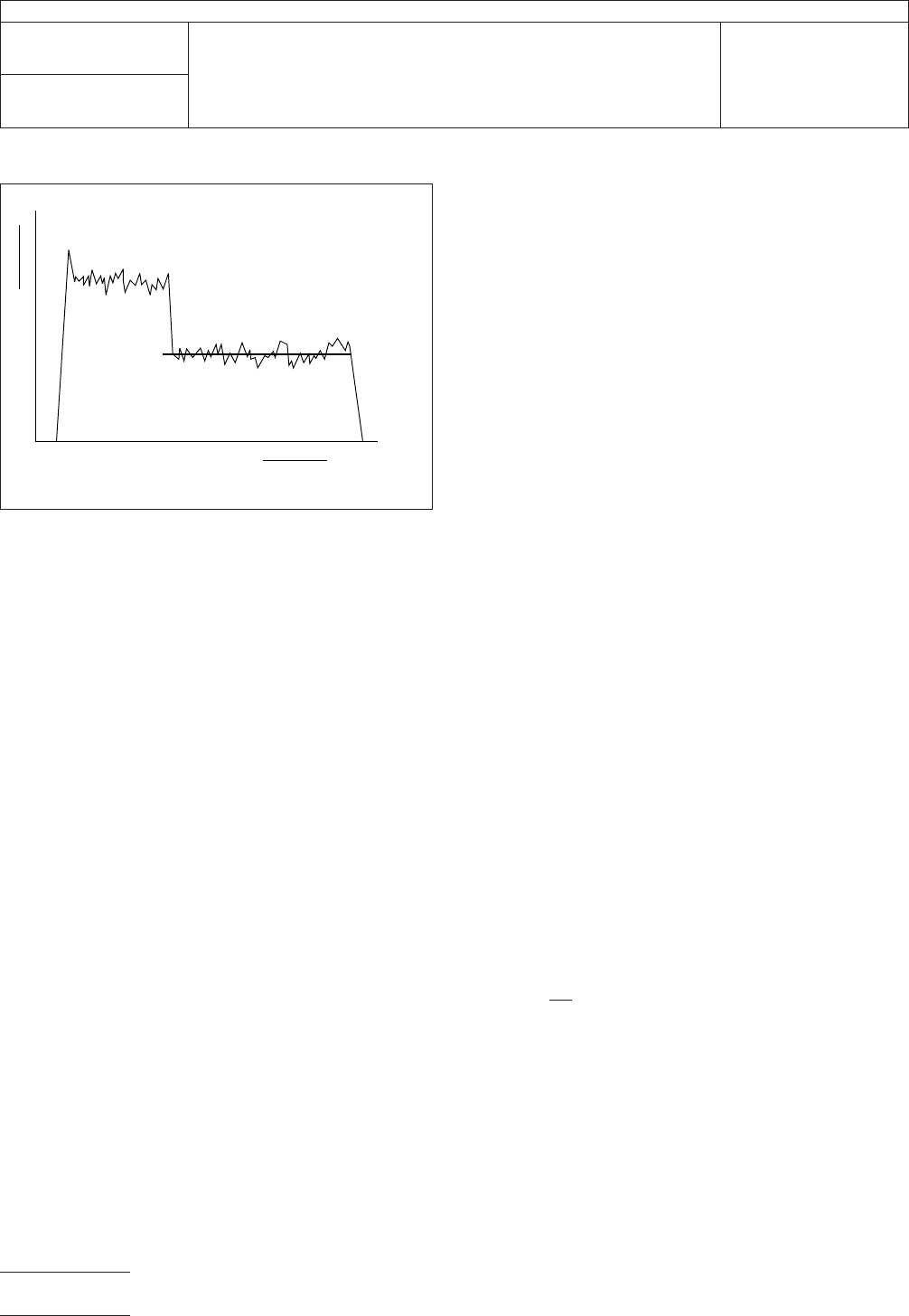
Observe
and record the minimum load as defined
by Figure 1. Measure the actual width of the test strip and
record with the minimum load.
5.2.1.6
If
the full width of the test strip does not peel, the
results shall be discarded and another strip tested.
5.2.1.7
Perform
the procedure as per 5.2.1.1 through
5.2.1.4 on a minimum of 2 strips per side per specimen. Any
unusual event or irregularity in the data shall be cause to void
the strip’s results and repeat the sequence on a different strip.
5.2.2
Determination of Degradation
Examine
the speci-
mens using normal or corrected 20/20 vision. Record the
presence of any base laminate degradation, including loss of
surface resin, discoloration, resin softening, delamination, blis-
tering, propagation of imperfections, measling, crazing, or
voids.
5.3
Calculation and Report
5.3.1
Calculate
the peel strength load as shown:
Lbs/in =
L
M
W
S
where:
L
M
=
Minimum load
W
S
=
Measured width of peel strip
5.3.2
Record
and report such individual peel strength value
as determined in 5.3.1. Average the individual peel strength
values for each side and each grain direction of the laminate
sampling. For example, if the sampling plan calls for one
specimen per side and per grain direction, there will be at
least two values to be averaged from four different specimens.
IPC-I-002102
Figure
1 Multiple Failure Modes
Peel Distance
▼
▼
Load
High Peel Strength
Failure Mode
Low Peel Strength
Failure Mode
Minimum
Average
Load
IPC-TM-650
Number
2.4.8.2
Subject
Peel
Strength of Metallic Clad Laminates at Elevated
Temperature (Hot Fluid Method)
Date
12/94
Revision
A
P
age2of3
电子技术应用 www.ChinaAET.com

5.3.3
Report
any presence of laminate degradation as
observed in 5.2.1.2.
6.0 Notes
6.1
Test
strip breakage may be caused by either a bond
greater than the tensile strength of the foil, or foil brittleness.
Where superior bond is shown (value at break above specifi-
cation) value at break may be used instead of minimum peel.
The average reported shall indicate that the value is greater
than average.
6.2 For
metallic cladding less than one ounce thickness,
copper plating or solder coating may be used to build up to
0.035 ± 0.0035 mm [0.0014 ± 0.00014 in] to previous strip
strength.
IPC-TM-650
Number
2.4.8.2
Subject
Peel
Strength of Metallic Clad Laminates at Elevated
Temperature (Hot Fluid Method)
Date
12/94
Revision
A
P
age3of3
电子技术应用 www.ChinaAET.com

1.0
Scope
This
test is designed to determine the peel
strength of the metal cladding to the base laminate while
exposed to elevated temperature by means of heated air
chamber; and to evaluate the base laminate material after the
peel strength test is completed for degradation due to the
conditioning.
2.0
Applicable Documents
IPC-TM-650
Method
2.4.8.1, Peel Strength, Keyhole
Method 5.8.3, Peel Strength Test Pattern
3.0
Test Specimens
3.1 Size and Configuration
Specimen
size shall be 50.8 x
50.8 mm [2 x 2 in] by the thickness of the laminate. Cladding
test strips shall be as specified (see 5.1.2).
3.2
Quantity and Sampling
Unless
otherwise specified,
specimens shall be one lengthwise for each clad side and one
crosswise for each clad side. The outside 25.4 mm [1 in] bor-
der of the parent sheet or panel shall be excluded.
4.0
Apparatus or Material
4.1 Tensile Tester
A
tensile strength tester equipped with
a load cell, capable of measuring to the nearest 0.0045kg
[0.01 lbs.] and a light load wire or chain and clamp at least
457 mm [18 in] long (its weight is included in the load cell cal-
culation). The clamp jaws must cover the entire conductor
width of each peel strip tab. Any equipment or apparatus
having the described accuracy, precision, and reproducibility
may be used.
4.2
Thermal Chamber
An
enclosure of the specimen loca-
tion of the tester, capable of maintaining the test temperatures
as specified, to within 3°C [5.4°F].
4.3
Specimen Hold-down
A
suitable hold-down clamping
system equivalent in performance to that defined in IPC-TM-
650, Method 2.4.8.1.
4.4
Oven
Circulating
air oven capable of maintaining 125 ±
2°C [257 ± 3.6°F].
4.5
Timer
Timing
device capable of timing to within 1
second.
4.6
Measuring
device capable of measuring from 0.0000 to
12.7 mm [0.0000 to 0.50 in] to within 0.0127 mm [0.0005 in].
4.7 Etching
system capable of complete removal of metal
cladding.
4.8
Etch Resist Materials or Systems
4.8.1
Printer’s
tape, or equivalent, of the specified width
(see 5.1.4) to act as etch resist for strip formation.
4.8.2
Photo
resist system (printing, developing, and strip-
ping).
5.0
Procedure
5.1 Specimen Preparation
5.1.1
Cut
the specimens from the laminate sample. Speci-
mens shall be taken no closer than 2.54 mm [1.0 in] from the
edge of the laminate sheet.
5.1.2
Specimens
shall be prepared with suitable etch resist
material so that four strips of 3.18 mm [0.125 in] width are
etched, and then cleaned and processed using standard
industry practices and equipment. For qualification and ref-
eree testing, the specimens shall be photo-imaged in accor-
dance with Method 5.8.3 of IPC-TM-650, except that tab
ends are optional.
Specimens shall be etched so that the test strips on one
specimen are in one direction per Figure 2. Double clad lami-
nate shall have each side tested using separate specimens.
The opposite side cladding shall be either fully removed or left
fully clad. Separate samples for both the warp and fill direc-
tions are required for each side. For referee testing, the clad-
ding on the opposite side shall not be removed.
5.1.3
Thin
specimens may be provided with support by
bonding them to a rigid substrate base, or may be tested with
the aid of the keyhole fixture (see Figure 1). For referee testing
of single sided laminates less than 0.51 mm [0.020 in], the
specimens shall be bonded to a rigid substrate or laminate.
The
Institute for Interconnecting and Packaging Electronic Circuits
2215 Sanders Road • Northbrook, IL 60062-6135
IPC-TM-650
TEST
METHODS MANUAL
Number
2.4.8.3
Subject
Peel
Strength of Metallic Clad Laminate at Elevated
Temperature (Hot Air Method)
Date
12/94
Revision
A
Originating Task Group
MIL-P-13949 Test Methods Task Group (7-11b)
Material
in this Test Methods Manual was voluntarily established by Technical Committees of the IPC. This material is advisory only
and its use or adaptation is entirely voluntary. IPC disclaims all liability of any kind as to the use, application, or adaptation of this
material. Users are also wholly responsible for protecting themselves against all claims or liabilities for patent infringement.
Equipment referenced is for the convenience of the user and does not imply endorsement by the IPC.
P
age1of3
电子技术应用 www.ChinaAET.com