IPC-TM-650 EN 2022 试验方法.pdf - 第374页
5.11 On some instruments ∆ L and ∆ T may be read directly from the recorder chart. On other instruments, constant fac- tors (from the instrument calibration - see section 6.3) may need to be applied to the chart readings…
1.0
Scope
This test method establishes a procedure for
determining the in-plane coefficient of linear thermal expan-
sion of organic films from 0-200°C using thermal mechanical
analysis (TMA).
2.0
Applicable Documents
ASTM D 618
Standard
Practice for Conditioning Plastics
and Electrical Insulating Materials for Testing
ASTM
D 3386
Standard
Test Method for Coefficient of Lin-
ear Thermal Expansion of Electrical Insulating Materials
3.0
Test Specimen
The
test specimen shall consist of a
strip 15-20 mm long and 2 mm wide with a minimum thick-
ness of 10 µm and maximum thickness of 200 µm.
4.0
Apparatus or Material
Perkin-Elmer
TMA-7 with a film
fixture in extension mode or equivalent equipment capable of
handling films less than 25 µm thick.
5.0
Procedure
5.1
The
test specimens should be conditioned at 23 ± 2°C
and 50 ± 5% relative humidity for not less than 24 hours prior
to testing. Refer to ASTM D 618.
5.2
Follow
the manufacturer’s recommendations for equip-
ment startup and calibration.
5.2
Mount
the test specimen in the film holder. The sample
length (between the grips) should be between 11-13 mm.
Refer to ASTM D 3386.
5.3
Set
the force at 30 mN.
5.4
Perform
a prescan by heating a rate of 20°C/min. Under
inert atmosphere from −10°C to either 10°C above the mate-
rial glass transition temperature, T
g
,
or 10°C below the mate-
rial decomposition limit, T
max
,
determined using nitrogen. T
g
may
be determined using IPC Test Methods 2.4.24.2,
2.4.24.3, or 2.4.25.
5.5
Hold
the temperature for 60 min.
5.6 Cool
at a rate of 5°C/min to −10°C.
5.7
Hold
the temperature for 10 min.
5.8
Reheat
the specimen at a rate of 5°C/min to a maximum
temperature of 25°C below the glass transition temperature of
the polymer or 10°C below the material decomposition limit,
T
max
,
determined under nitrogen. Ar least two temperature
scans of the test specimen should be conducted without dis-
turbing the specimen in the TMA to confirm repeatability of
observed test results.
5.9
Calculate
the average coefficient of thermal expansion,
over the temperature intervals of interest as follows:
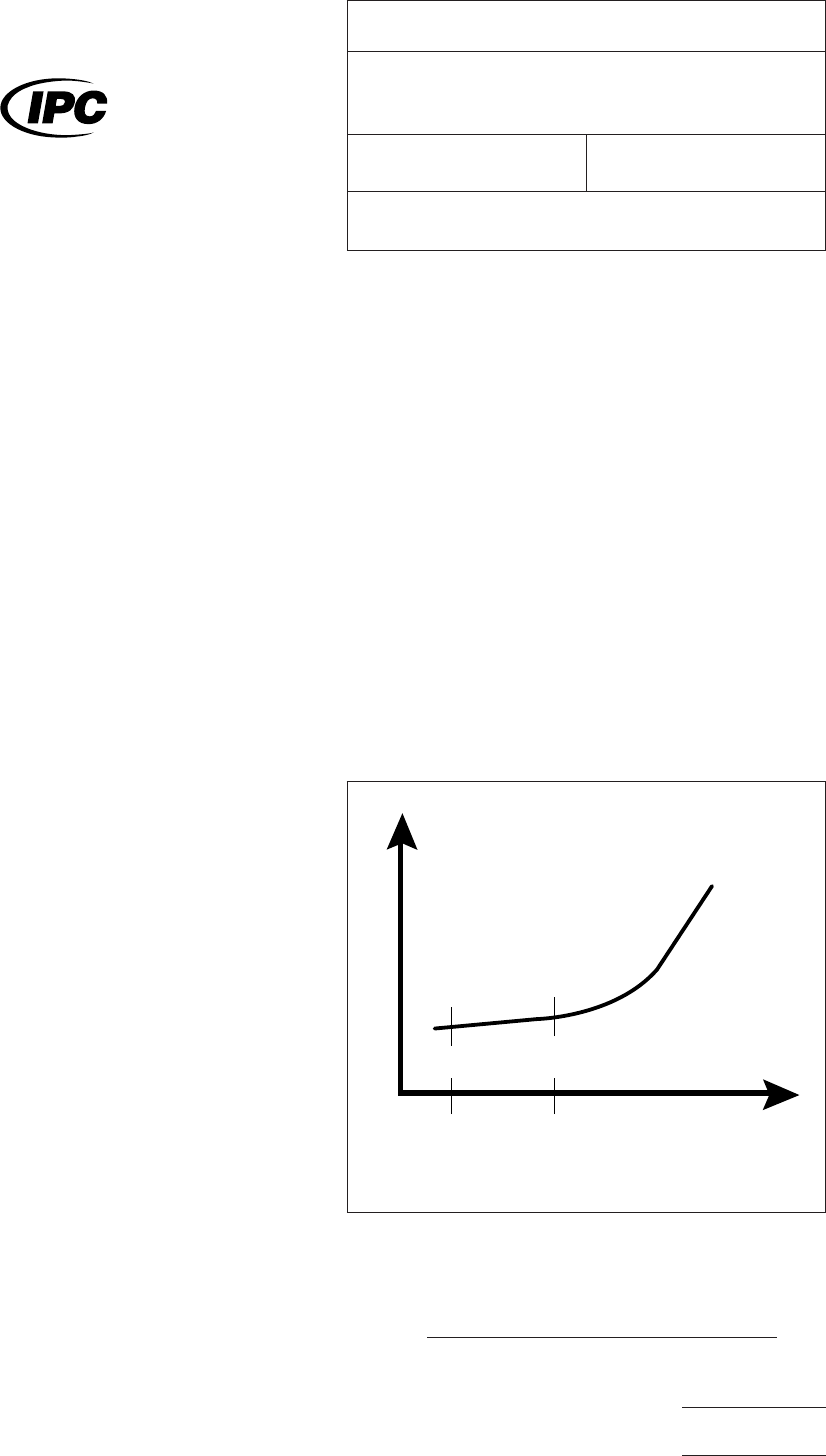
α =(∆L/∆T)/L
where L is the length of the test specimen between the grips,
∆L is the change in the length of the specimen (in the same
units) over the temperature interval ∆T, and ∆T is the tempera-
ture interval (normally 200°C) as illustrated in Figure 1. The
units are°C
-1
.
5.10 The
coefficient of linear thermal expansion from 0
200°C (below the glass transition) is
α=
(Length B − Length A)
(Length
A)(Temperature B − Temperature A)
2.4.41.2-01
Figure
1
T
emperature (°C)
A
0
B
200
Extension
The
Institute for Interconnecting and Packaging Electronic Circuits
2215 Sanders Road • Northbrook, IL 60062-6135
IPC-TM-650
TEST
METHODS MANUAL
Number
2.4.41.3
Subject
In-Plane
Coefficient of Thermal Expansion, Organic
Films
Date
7/95
Revision
Originating Task Group
Deposited Dielectric Task Group (C-13a)
Material
in this Test Methods Manual was voluntarily established by Technical Committees of the IPC. This material is advisory only
and its use or adaptation is entirely voluntary. IPC disclaims all liability of any kind as to the use, application, or adaptation of this
material. Users are also wholly responsible for protecting themselves against all claims or liabilities for patent infringement.
Equipment referenced is for the convenience of the user and does not imply endorsement by the IPC.
P
age1of2
电子技术应用 www.ChinaAET.com

5.11
On
some instruments ∆L and ∆T may be read directly
from the recorder chart. On other instruments, constant fac-
tors (from the instrument calibration - see section 6.3) may
need to be applied to the chart readings to obtain these val-
ues.
6.0 Notes
6.1
Calibration
of the instrument must be carried out
according to the manufacturer’s recommendations. Two cali-
brations are required, one to establish the baseline and the
other to calibrate the TMA relative to a standard.
6.2
A
quartz specimen of 11-13 mm in length (between the
grips) is run at 5°C/min under inert gas purge (He) from −20
to 400°C to establish a baseline. The baseline is used to elimi-
nate the effects of grip expansion on extension measure-
ments. The coefficient of average thermal expansion of quartz
is 0.57 x 10
-6
/°C
(16-500°C)
1
.
This baseline procedure should
be used to either correct the instrument performance to
obtain the literature stated value of linear thermal expansion
quartz, or, in the event the instrument cannot be adjusted to
obtain this value, obtain an estimated correction factor which
is then applied to results from test specimens.
6.3
Using
a calibration standard with dimensions equivalent
to the test specimen, a calibration standard is run between
−10 and 200 °C and the observed coefficient of thermal
expansion is calculated using the expression:
α
ob
=(∆L/∆T)/L
where L is the length of the test specimen between the grips.
∆L is the change in the length of the specimen (in the same
units) over the temperature interval ∆T, and ∆T is nominally
200 °C. The units of α
ob
are
°C
−1
.
An estimated test specimen
correction factor, C, is then determined by dividing α
ob
by
the
literature value, α
lit
,
for the standard(s). The estimated test
specimen correction factor is then as a multiplcation factor
and applied to the observed linear thermal expansion results
for the test specimens.
6.4
The
maximum temperature used in this test should be at
least 25°C below the glass transition temperature of the mate-
rial being studied. Heating above the glass transition may alter
the morphology of the specimen (e.g., change the molecular
orientation) leading to erroneous results. For materials with
glass transitions below 250°C, the temperature range over
which the coefficient of linear thermal expansion was deter-
mined must be noted, e.g., 50 x 10
-6
/°C
(0-150°C).
1.
Lange’s Handbook of Chemistry, 12th edition, J. A. Dean, ed., McGraw-Hill, New York (1979).
IPC-TM-650
Number
2.4.41.3
Subject
In-Plane
Coefficient of Thermal Expansion, Organic Films
Date
7/95
Revision
P
age2of2
电子技术应用 www.ChinaAET.com

1.0
Scope
This
test method defines the procedure for
determining the Volumetric Thermal Expansion of polymer
coatings on inorganic substrates, such as polyimide on a sili-
con wafer. The expansion is measured using an apparatus
designed for the determination of the Pressure/Volume/
Temperature behavior of solid samples.
2.0
Applicable Documents
None
3.0
Test Specimens
See
Sample Preparation 5.1.
4.0
Apparatus or Material
GNOMIX
PVT or equivalent
capable of providing PVT data over its pressure range 0-200
MPa (2000 bar or 29,000 psi), and from ambient tempera-
tures to 400°C.
5.0
Procedure
5.1 Sample Preparation
Samples
are prepared by form-
ing a 25 mm thick film on a wafer and lifting the specimen free
according to manufacturer’s recommendations. Sample is cut
and folded to fit in the sample chamber of the PVT apparatus.
5.2
Test Procedure
The
film sample (1 to 2 grams mass)
is placed in a rigid stainless steel cell. The cell is surrounded
by a ‘‘sample cup’’ which guarantees a hydrostatic state of
stress in the sample at all times. Follow the testing protocol
according to the PVT Operations Manual for the measurement
of the volumetric expansion.
5.3
Test Analysis
Report
the volumetric expansion of the
material from room temperature to 300°C and the tempera-
ture of any observed transitions.
6.0 Notes
6.1
Pressure/Volume/Temperature
(PVT) Apparatus: One
source is Gnomix, 3809 Birchwood Drive in Boulder, CO (303)
444-3395.
The
Institute for Interconnecting and Packaging Electronic Circuits
2215 Sanders Road • Northbrook, IL 60062-6135
IPC-TM-650
TEST
METHODS MANUAL
Number
2.4.41.4
Subject
Volumetric
Thermal Expansion Polymer Coatings on
Inorganic Substrates
Date
7/95
Revision
Originating Task Group
Deposited Dielectric Task Group (C-13a)
Material
in this Test Methods Manual was voluntarily established by Technical Committees of the IPC. This material is advisory only
and its use or adaptation is entirely voluntary. IPC disclaims all liability of any kind as to the use, application, or adaptation of this
material. Users are also wholly responsible for protecting themselves against all claims or liabilities for patent infringement.
Equipment referenced is for the convenience of the user and does not imply endorsement by the IPC.
P
age1of1
电子技术应用 www.ChinaAET.com