IPC-TM-650 EN 2022 试验方法.pdf - 第324页
1 Scope This test is designed to determine the glass tran- sition temperature (T g ) and coefficient of thermal expansion (CTE) of dielectric materials used in high density interconnect (HDI) and microvias by the use of …

DSC
measures the heat capacity of a specimen, TMA mea-
sures the expansion of a specimen, and DMA measures the
stiffness of the specimen. The T
g
determined
from TMA, DSC,
and DMA may vary significantly (up to 20°C) because they are
measuring different physical properties, which change differ-
ently as the specimen goes through T
g
.
As a result, the test
equipment used should be noted after the reported T
g
value
(i.e., 136°C; DSC, TMA, or DMA).
6.3
Most
thermal analysis equipment have the software
capability to determine sample T
g
and
modulus values; it is
recommended that this approach be used for consistency.
6.4
Load Selection Criteria
The
initial load should be 5 g
of tension (approximately 50 mN). The load (or force) may be
adjusted for differences in material types or specimen configu-
ration in order to assure the specimen is being held without
slack. Avoid an excessive load (or force), which may result in
elongation of the specimen due to the applied tension. Speci-
mens above T
g
may
become so soft as to be stretched.
Examine all specimens after the test to look for signs of exces-
sive loads, distortions, tears, and other defects.
6.5
Thermal Stresses and Other Anomalies
DMA
results
may be affected by any stresses that might have been frozen
into the sample during processing. Samples showing anoma-
lous behavior should be run a second time or preconditioned
to remove such stresses. Holding the sample temperature at
20°C above the glass transition and holding for five minutes,
followed by slow cooling, will normally remove the stresses in
the sample.
6.6
Understanding DMA
Refer
to ASTM D-4092 for a bet-
ter understanding of concepts and definitions of terms for
dynamic mechanical measurements.
6.7
Instrument Suppliers
DMA
instruments capable of
meeting the requirements of this test method are known to be
available from:
TA Instruments
Perkin Elmer Corp.
Seiko Instruments, Inc.
Rheometrics Scientific
Netzsch Instruments, Inc.
IPC-TM-650
Number
2.4.24.4
Subject
Glass
Transition and Modulus of Materials Used in High Density
Interconnection (HDI) and Microvias - DMA Method
Date
11/98
Revision
P
age5of5
电子技术应用 www.ChinaAET.com

1
Scope
This
test is designed to determine the glass tran-
sition temperature (T
g
)
and coefficient of thermal expansion
(CTE) of dielectric materials used in high density interconnect
(HDI) and microvias by the use of thermal mechanical analysis
(TMA). For isotropic (unreinforced) materials, either method (A
= thick specimen; B = thin specimen) may be used. For aniso-
tropic materials (reinforced), both methods shall be used,
since the z axis expansion (Method A) is not the same as the
x-y axis expansion (Method B).
2
Applicable Documents
None
3
Test Specimens
3.1 Size
Method A
Volumetric
or Z-axis expansion – thick specimens
(>0.50 mm): Specimens shall be approximately 6.5 mm x 6.5
mm. The thickness shall be a minimum of 0.5 mm; for thick-
nesses <0.5 mm, use Method B. Exact specimen dimensions
may be determined by the apparatus used.
Method
B
In-plane
(x-y) expansion – thin specimens (<0.5
mm): Specimens shall be approximately 15 mm to 20 mm
long and 2 mm wide, with a minimum thickness of 10 µm and
a maximum thickness of 0.75 mm. Exact specimen dimen-
sions may be determined by the apparatus used.
3.2
All
specimens should be fully cured according to manu-
facturer’s recommendations. Thick specimens may be made
by use of multiple lamination/cure cycles if required.
3.3
For
Method B, two samples are to be measured, taken
at 90° to each other and labeled in the x and y directions. Iso-
tropic materials are anticipated to have the same CTE for x
and y, and reinforced materials are likely to have differing x
and y CTE.
4
Equipment/Apparatus
4.1
A
TMA capable of determination of dimensional change
to within 0.0025 mm over the specified temperature range.
Preferably the TMA will have computer data acquisition and
analysis. The TMA must have an environmental chamber
capable of having nitrogen flush gas and heating of the speci-
men to 310°C.
4.2
Diamond
blade or saw, sanding equipment, or equiva-
lent to provide specimens of the size and edge quality
required for Method A
4.3 Scissors
or razor blades or equivalent to provide speci-
mens of size and edge quality for Method B
4.4
Air
circulating oven capable of maintaining 105°C ± 2°C
4.5
Dessicator
capable of an atmosphere less than 30% RH
at 23°C
4.6
Etching
system capable of complete removal of metallic
cladding
5
Procedure
5.1.1
Metallic
clad specimens shall be tested without the
cladding. Etch and dry using appropriate procedures and
equipment.
5.1.2
Specimens
shall be cut to the specified size using
appropriate procedures and equipment to minimize thermal
shock and mechanical stress. Method A specimens shall have
their edges smooth and burr-free by means of sanding or
equivalent (to allow the specimen to rest flat on the mounting
stage). Method B specimens shall be rectangular, with their
long edges parallel (to ensure good mounting in the film fix-
ture). Method B specimens shall have smooth edges without
nicks or tears.
5.1.3
Specimens
shall be preconditioned by baking for one
hour ± 15 minutes at 105°C, then cooled to room temperature
in a dessicator.
5.2
Measurement
5.2.1 Apparatus Set-up
5.2.1.1 Install the Correct TMA Probe
Method A
Set
up the TMA with a non-penetrating quartz
expansion probe.
Method
B
Set
up the TMA with a thin film fixture/clamp.
The
Institute for Interconnecting and Packaging Electronic Circuits
2215 Sanders Road • Northbrook, IL 60062-6135
IPC-TM-650
TEST
METHODS MANUAL
Number
2.4.24.5
Subject
Glass
Transition Temperature and Thermal
Expansion of Materials Used in High Density
Interconnection (HDI) and Microvias - TMA Method
Date
11/98
Revision
Originating Task Group
HDI Test Methods Task Group (D-42a)
Material
in this Test Methods Manual was voluntarily established by Technical Committees of the IPC. This material is advisory only
and its use or adaptation is entirely voluntary. IPC disclaims all liability of any kind as to the use, application, or adaptation of this
material. Users are also wholly responsible for protecting themselves against all claims or liabilities for patent infringement.
Equipment referenced is for the convenience of the user and does not imply endorsement by the IPC.
P
age1of5
电子技术应用 www.ChinaAET.com
5.2.1.2
Apply the Load
Method A
Mount
the specimen on the stage of the TMA
and apply load at 5 g (see 6.5 for an explanation of load cri-
teria). Enclose the specimen and probe in the environmental
chamber.
Method
B
Mount
the specimen in the clamps of the film fix-
ture according to the manufacturer’s instructions and apply 2
g tension force (see 6.5 for an explanation of the load criteria).
Enclose the specimen and probe in the environmental cham-
ber.
5.2.1.3
Provide
an inert gas purge (helium or nitrogen) at a
rate of 30 ml/min to 150 ml/min to the environmental cham-
ber. Temperature calibration of the TMA must be performed
under the same gas conditions.
5.2.1.4
Measure
the inital specimen thickness (Method A) or
length (Method B) prior to each heat cycle (L
O
).
5.2.2
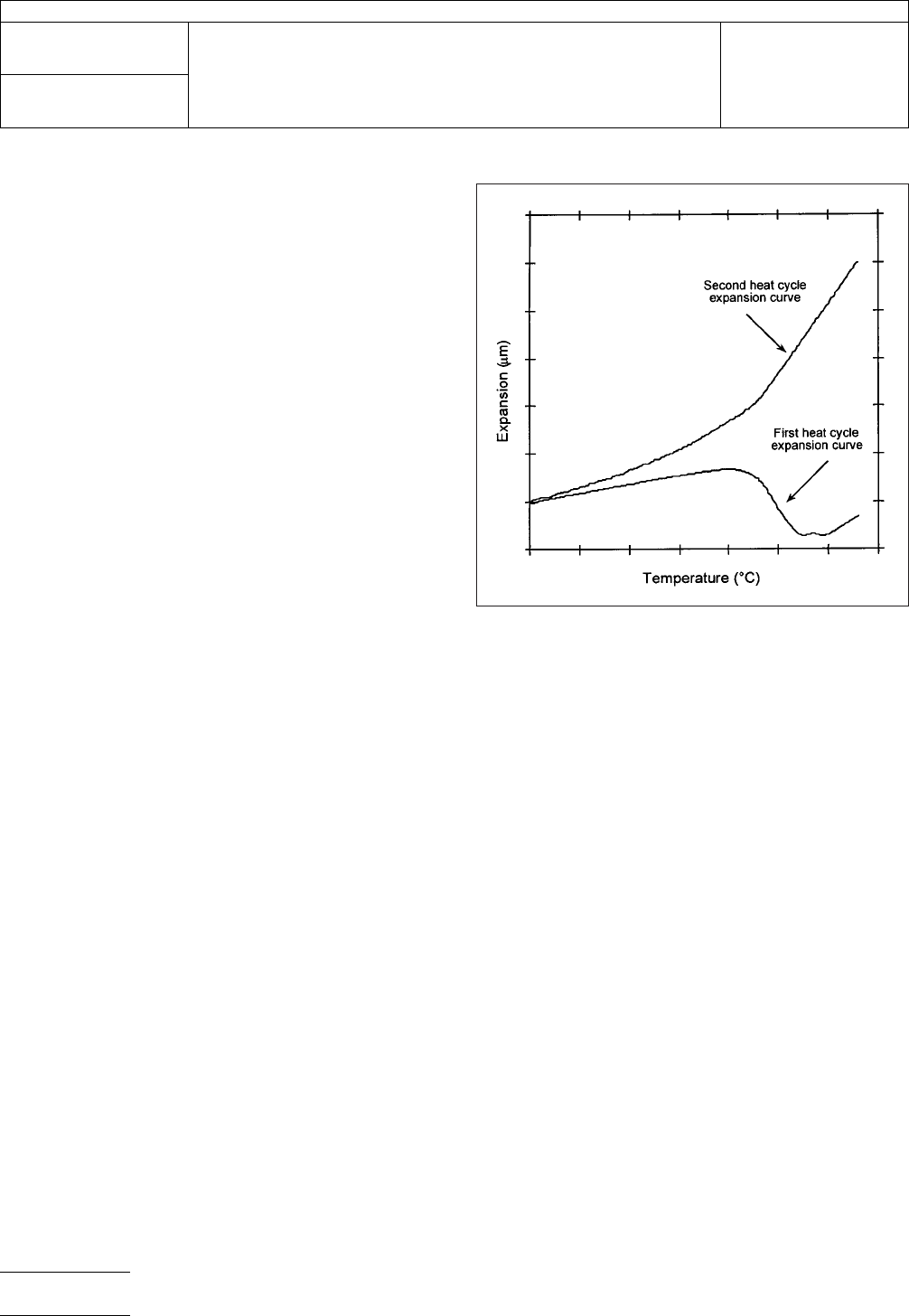
Many
specimens have built in thermal stresses from
the curing step, which relaxes during the specimen heating
during a TMA test. This relaxation results in TMA scans, which
make determination of T
g
and
CTE impossible (see Figure 1).
Two heat cycles are required to obtain valid T
g
and
CTE val-
ues.
5.2.3
Running the TMA Temperature Scan
5.2.3.1
Initial
Temperature (T
initial
)
a.
For specimens with T
g
below
or near room temperature,
start the scan at least 20°C below the anticipated transi-
tion. This may require a TMA with refrigeration control of
the environmental chamber.
b. For specimens with T
g
greater
than room temperature,
start the scan at 30°C.
5.2.3.2
Temperature Rate
Depending
on sample prepa-
ration, two heating cycles may be required to obtain accurate
T
g
and
CTE above T
g
.
If the sample shows unexpected
shrinkage above T
g
(see
Figure 1), the two heat test method
is required. If the sample does not show anomalous behavior,
only one heat cycle (the second heat cycle at 5°C/min) is
required.
a. First heat: The first heat cycle of the specimen shall be run
at 10°C/min.
b. Second heat (reportable data heat cycle): The second
heat cycle of the specimen shall be run at 5°C/min.
5.2.3.3
Temperature Excursion
a.
First heat: Continue heating the specimen to a tempera-
ture 20°C greater than the anticipated T
g
or
until the
anomalous thermal relaxation has stopped. See Figure 1
for an example of anomalous first heat behavior. Hold the
specimen at this temperature for a minimum of five min-
utes. Avoid holding the sample at this temperature for too
long; sample degradation might occur. Cool the specimen
to the initial temperature under temperature control at
5°C/min to 10°C/min. This should prevent reestablishment
of thermal stresses.
b. Second heat (reportable data heat cycle): The second
heat cycle of the specimen shall continue to 310°C (to
ensure good data at 300°C).
5.3
Evaluation
5.3.1
The
TMA expansion curve should resemble the plot
shown in Figure 2.
IPC-24245-1
Figure
1 TMA Expansion Curves: First Heat Cycle and
Second Heat Cycle
IPC-TM-650
Number
2.4.24.5
Subject
Glass
Transition Temperature and Thermal Expansion of
Materials Used in High Density Interconnection (HDI) and
Microvias - TMA Method
Date
11/98
Revision
P
age2of5
电子技术应用 www.ChinaAET.com