IPC-TM-650 EN 2022 试验方法.pdf - 第310页
1.0 Scope This test is designed to determine the Glass Transition Temperature (T g ) and the Thermal Expansion in the Z-Axis of dielectric materials used in printed boards by the use of thermal mechanical analysis (TMA).…
5.3.1
Clean
the metal clad specimen by light abrasion or
other suitable method, then flux the metal surface with a rosin
flux conforming to MIL-F-14256.
5.3.2
Clean
the unclad specimens by standard production
techniques, then flux the laminate material with a rosin flux
conforming to MIL-F-14256.
5.3.3
Carefully
examine all specimens, then perform the
tests described in 5.1.1 through 5.2.5.
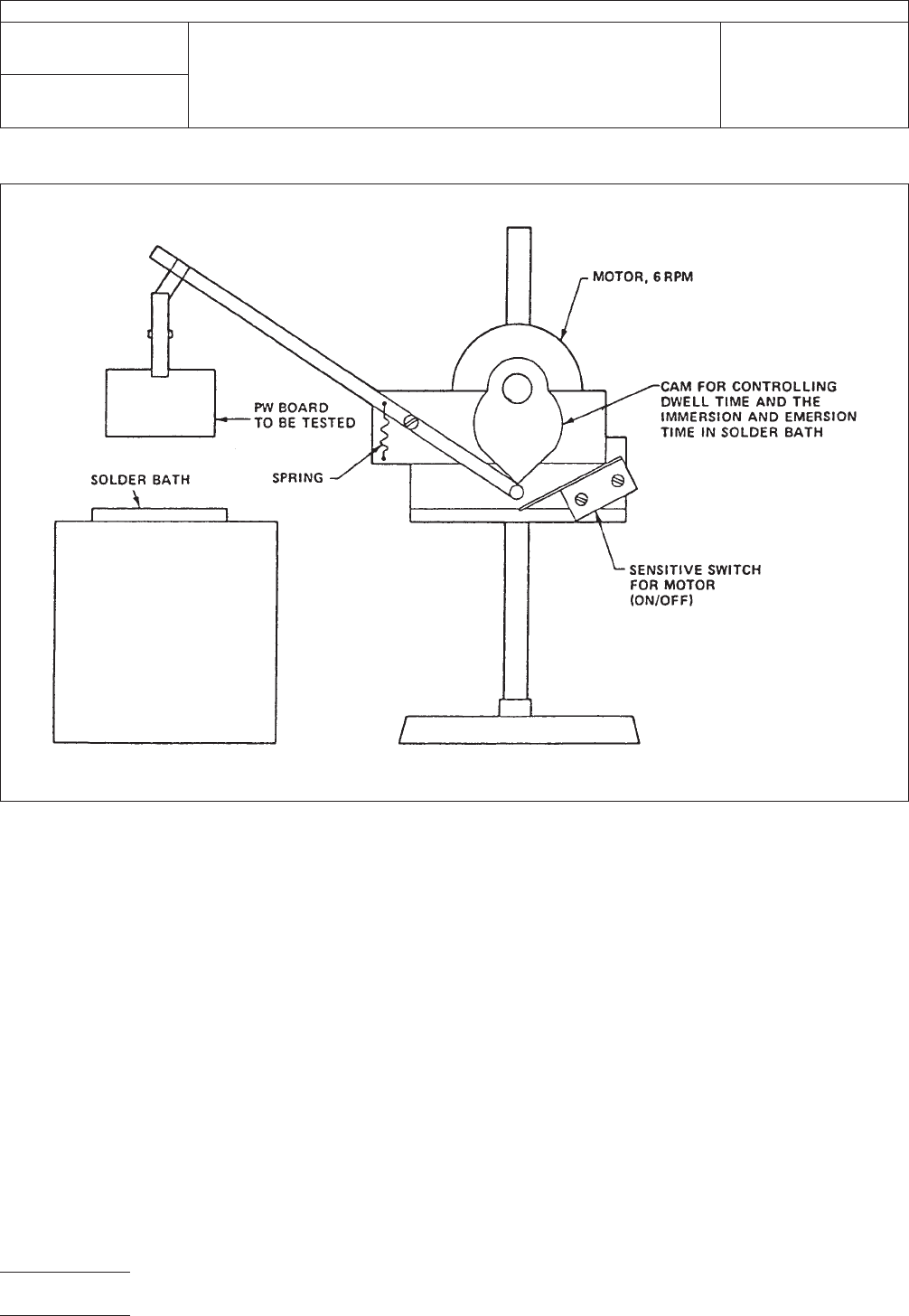
IPC-2412-1
Figure
1 Suggested Dipping Device
IPC-TM-650
Number
2.4.23
Subject
Soldering
Resistance of Laminate Materials
Date
3/79
Revision
P
age2of2
电子技术应用 www.ChinaAET.com

1.0
Scope
This
test is designed to determine the Glass
Transition Temperature (T
g
)
and the Thermal Expansion in the
Z-Axis of dielectric materials used in printed boards by the use
of thermal mechanical analysis (TMA).
Thermal Expansion (TE) is expressed in Coefficient of Thermal
Expansion (CTE) or Percent of Thermal Expansion (PTE).
2.0
Applicable Documents
None
3.0
Test Specimens
3.1 Size
Specimens
shall be approximately 6.35 mm x
6.35 mm [0.25 in x 0.25 in]. The thickness shall be a minimum
of 0.51 mm [0.020 in]; for thicknesses less than 0.51 mm
[0.020 in], or to increase the accuracy of the test, see 6.4.
3.2
Quantity and Sampling
Unless
otherwise specified,
two specimens shall be tested, to be taken from random loca-
tions of the material in question.
4.0
Apparatus or Material
4.1
Thermomechanical
analyzer (TMA) capable of determi-
nation of dimensional change to within 0.0025 mm [0.0001 in]
over the specified temperature range.
4.2
Diamond
blade or wheel, sanding equipment, or equiva-
lent, to provide a specimen of the size and edge quality speci-
fied.
4.3
Desiccator
capable of an atmosphere less than 30%
R.H. at 23°C [73.4°F].
4.4
Etching
system capable of complete removal of metallic
cladding.
4.5 Air
circulating oven capable of maintaining 105 ± 2°C
[221 ± 3.6°F].
4.6
Micrometer
capable of thickness measurements to
within 0.00025 mm [0.0001 in].
5.0
Procedure
5.1 Specimen Preparation
5.1.1
Metallic
clad laminate shall be tested without the clad-
ding. Specimens taken from multilayer boards shall have no
internal metal layers, if possible. Exterior metallic cladding shall
be removed by etching using standard industry practices.
5.1.2
Specimens
shall be cut to the specified size using
appropriate procedures and equipment to minimize mechani-
cal stress or thermal shock.
5.1.3
The
edges shall be smooth and burr-free by means of
sanding or equivalent (to allow the specimen to rest com-
pletely flat on the mounting stage). Use care to minimize
stress or heat on the specimen.
5.1.4
Specimens
shall be preconditioned by baking for 2 ±
0.25 hours, at 105 ± 2°C [221 ± 3.6°F], then cooled to room
temperature in a desiccator.
5.1.5
If
applicable, determine the thickness of the specimen
(for determination of Percent of Thermal Expansion) and
record as T
o
.
5.2
Measurement
5.2.1
Mount
the specimen on the stage of the TMA and
apply a load between 0.1 g and 10.0 g (see note 6.5 for
explanation of the load selection criteria).
5.2.2
Initial Temperature for Startup
a.
For T
g
determination,
start the scan at a temperature no
higher than 35°C [95°F]. An initial temperature of 23°C
[73°F] is recommended.
b. For TE determination start the scan at a temperature suf-
ficiently lower than the specified temperature range such
that the specified heat rate is stabilized (see 6.6).
5.2.3
Unless
otherwise specified, maintain the scan rate at
10°C [18°F] per minute.
5.2.4
Temperature Excursion
a.
For Tg determination, continue the temperature ramp to
at least 30°C [54°F] above the anticipated transition
region.
b. For TE determination, continue the temperature ramp to
The
Institute for Interconnecting and Packaging Electronic Circuits
2215 Sanders Road • Northbrook, IL 60062-6135
IPC-TM-650
TEST
METHODS MANUAL
Number
2.4.24
Subject
Glass
Transition Temperature and Z-Axis Thermal
Expansion by TMA
Date
12/94
Revision
C
Originating Task Group
MIL-P-13949 Test Methods Task Group (7-11b)
Material
in this Test Methods Manual was voluntarily established by Technical Committees of the IPC. This material is advisory only
and its use or adaptation is entirely voluntary. IPC disclaims all liability of any kind as to the use, application, or adaptation of this
material. Users are also wholly responsible for protecting themselves against all claims or liabilities for patent infringement.
Equipment referenced is for the convenience of the user and does not imply endorsement by the IPC.
P
age1of3
电子技术应用 www.ChinaAET.com
250°C
[482°F] or other temperature as specified (such
as, representative of a soldering operation).
For example, determination of T
g
on
a material with an antici-
pated T
g
of
270°C [518°F] would require that the test tem-
perature should reach in excess of 300°C [572°F]. TE mea-
surements should be determined only from that part of the
plot reaching 250°C [482°F] (or other temperature of interest).
5.2.5
If
residual stresses cause a sudden irreversible deflec-
tion at the glass transition, a second scan shall be run, either
on the same specimen or if desired, a new specimen.
5.3
Evaluation
5.3.1
The
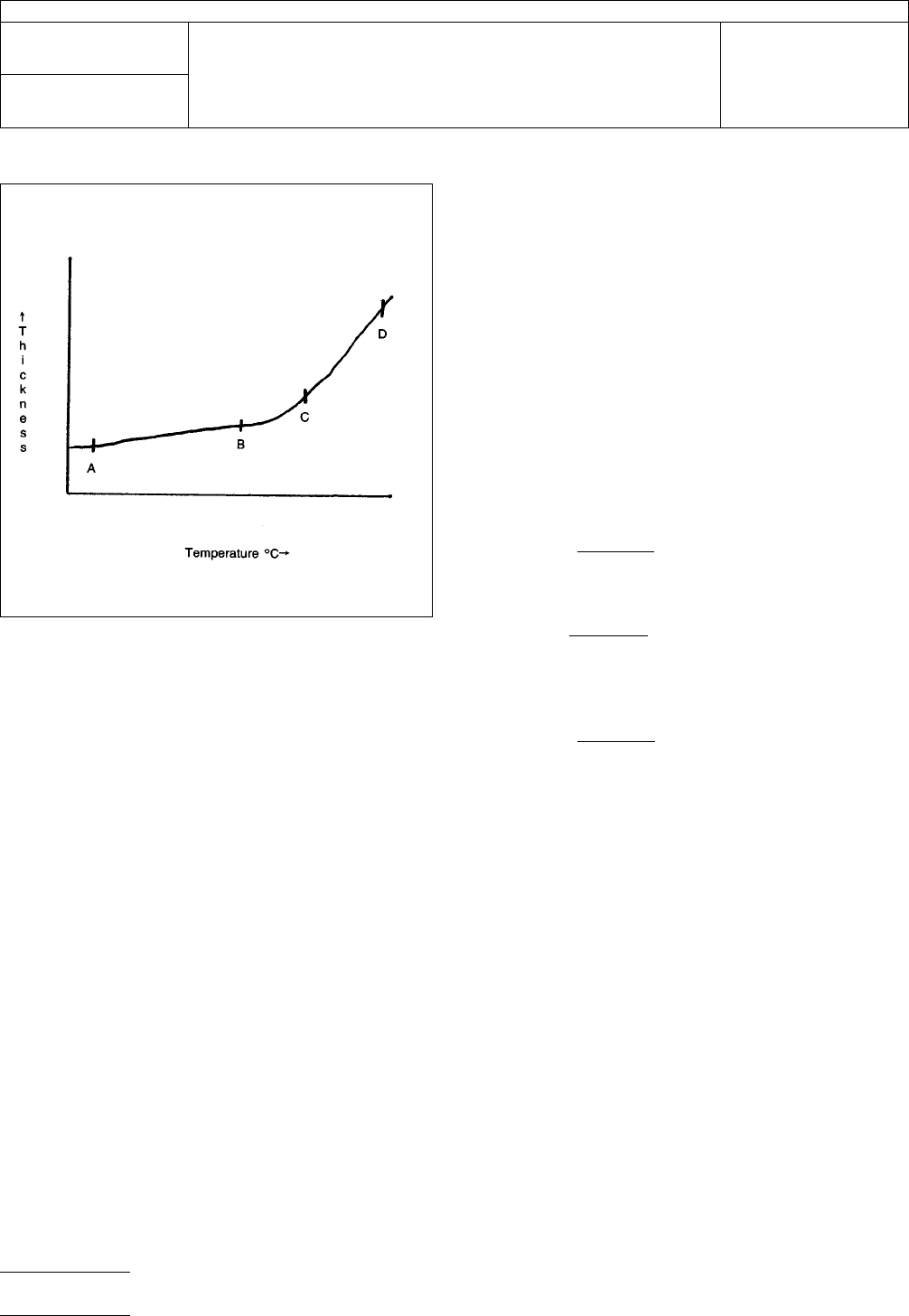
data for the scan should resemble the plot as
shown in Figure 1.
5.3.2
From
the TMA plot, record the thickness of the speci-
men as four points: Temperature ‘‘A’’ shall be chosen just
above room temperature, e.g., 25°C [77°F]. Temperatures
‘‘B’’ and ‘‘C’’ shall be chosen such that they are on the linear
portion of the graph, but just below and above the transition
region, respectively. Temperature ‘‘D’’ shall be selected to
represent a temperature of interest, such as a soldering
operation. Unless otherwise specified, Temperature ‘‘D’’ shall
be 250°C [482°F].
5.4
Calculations
5.4.1 Glass Transition Temperature
Determine
the point
at which lines drawn through points A and B and points C and
D will intersect. The temperature at which the tangent lines
intersect is the T
g
.
5.4.2
Coefficient of Thermal Expansion in the Z-Axis
The
CTE shall be calculated over the specified regions and
recorded in units of ppm/°C.
a.
CTE Below the Glass Transition
∝(A − B)=
(t
B
−t
A
)10
6
t
A
(T
B
− T
A
)
b.
CTE Above the Glass Transition.
∝(C − D)=
(t
D
−t
C
)10
6
t
C
(T
D
− T
C
)
c.
CTE from Near Room Temperature to 250°C.
(Or Other Temperature of Interest)
∝(A − D)=
(t
D
−t
A
)10
6
t
A
(T
D
− T
A
)
Where:
T
A
=
Temperature at point A on plot
T
B
=
Temperature at point B on plot
T
C
=
Temperature at point C on plot
T
D
=
Temperature at point D on plot
t
A
=
Thickness at T
A
t
B
=
Thickness at T
B
t
C
=
Thickness at T
C
t
D
=
Thickness at T
D
5.4.3
Percent of Thermal Expansion in the z-axis.
5.4.3.1
Select
the temperature range over which the expan-
sion in percentage shall be determined. The temperature
range from point A to point D is considered most meaningful.
Figure
1
IPC-TM-650
Number
2.4.24
Subject
Glass
Transition Temperature and Z-Axis Thermal Expansion by
TMA
Date
12/94
Revision
C
P
age2of3
电子技术应用 www.ChinaAET.com