IPC-TM-650 EN 2022 试验方法.pdf - 第199页
1 Scope This test method is designed to determine the residual solids content of flux after evaporation of the volatile chemicals from within the flux; typically 15% by weight mini- mum. 2 Applicable Documents IPC J-STD-…
from
a true color change. A retest on the representative paste
flux or flux extracted from the paste is advised.
6
Notes
6.1 Safety
Observe
all appropriate precautions on MSDS
for chemicals involved in this test method.
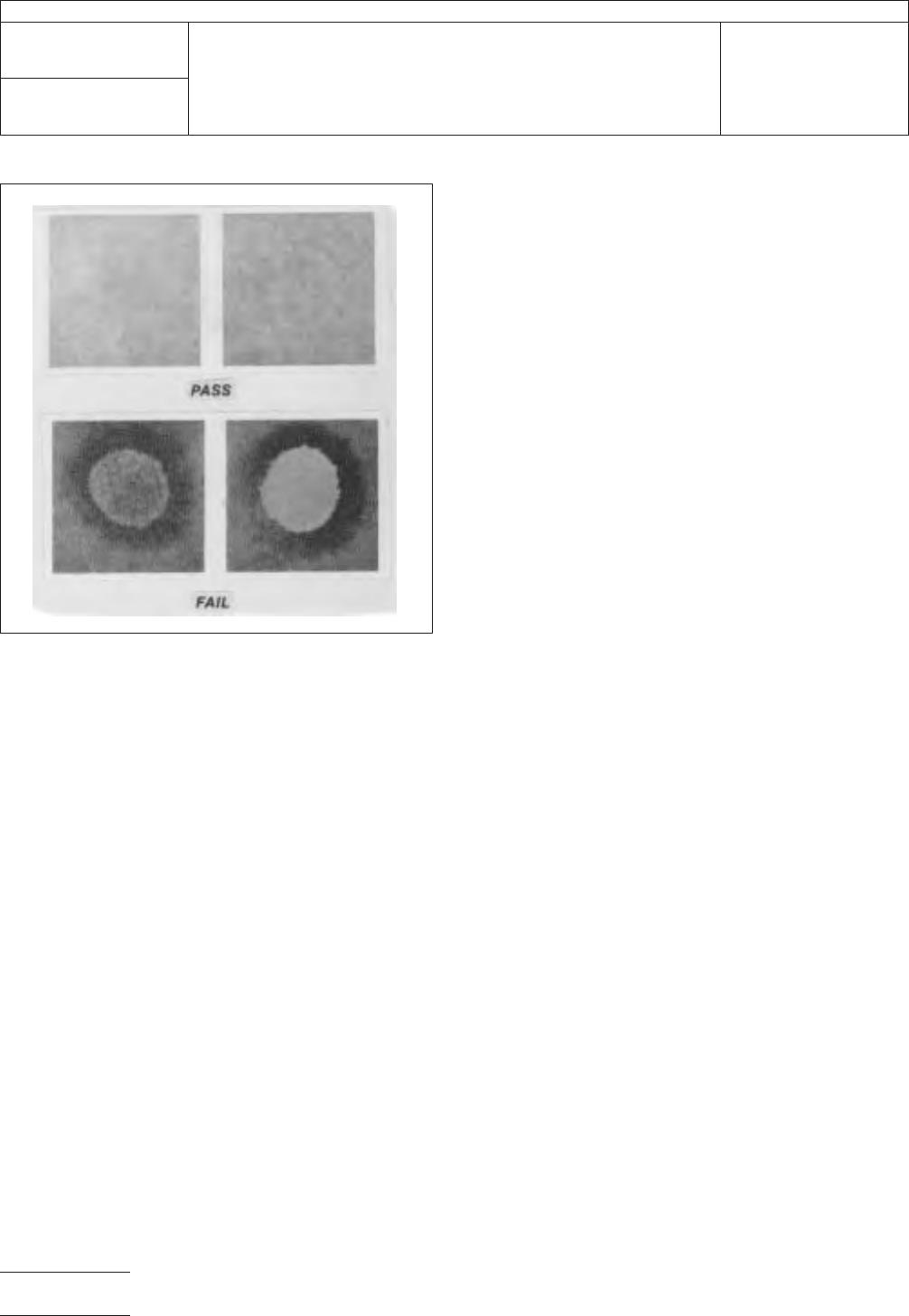
Figure
1 Chlorides and/or Bromides Test Results
IPC-TM-650
Number
2.3.33
Subject
Presence
of Halides in Flux, Silver Chromate Method
Date
06/04
Revision
D
P
age2of2
电子技术应用 www.ChinaAET.com

1
Scope
This
test method is designed to determine the
residual solids content of flux after evaporation of the volatile
chemicals from within the flux; typically 15% by weight mini-
mum.
2
Applicable Documents
IPC J-STD-004
Requirements
for Soldering Fluxes
3
Test Specimen
A
minimum of 6 grams by weight per
test of liquid flux or flux extracted from solder paste, solder
preforms or flux-cored wire (see 6.1).
4
Apparatus and Reagents
4.1
A
circulating air drying oven capable of maintaining 50 to
85 ± 5 °C [122 to 185 ± 9 °F].
4.2
Glass
pipettes.
4.3
Three
glass petri dishes, 30 ml capacity.
4.4
Silica
gel desiccant, or equivalent, in a glass desiccator.
4.5
Analytical
balance with a resolution of of 0.001 g.
4.6 Solder
Pot.
4.7
Stirrer.
5
Procedures
Carry
out the following procedures in tripli-
cate.
5.1
Preparation
5.1.1
Place
an empty glass petri dish in the drying oven for
30 to 60 minutes or until dry, then cool in the desiccator to
room temperature.
5.1.2
Weigh
the dish to the nearest 0.001 gram.
5.2
Test
5.2.1 Liquid Flux
5.2.1.1
Pipette
approximately 6 grams (see 6.1) by weight
of test flux specimen into the petri dish and weigh to the near-
est 0.001 gram.
5.2.1.2 Heat
in the drying oven maintained between 50 (±
5 °C) and 85 °C [122 (± 9 °F) and 185 °F] (see 6.2) for one
hour + 15 min - 0 min, then reweigh after allowing the sample
to come to room temperature in the desiccator.
5.2.1.3
Repeat
heating and drying procedure until the mass
is decreased by less than 0.005 gram from the previous
weighing.
5.2.1.4
Evaluation
Calculate
the percentage residual sol-
ids as follows:
100 − m
2
m
1
where:
m
2
=
the mass of residual after drying, in grams
m
1
=
the mass of original test flux specimen, in grams
Report the average of the three determinations as the per-
centage solids.
5.2.2
Solder Paste, Solder Preforms or Flux-Cored Wire
5.2.2.1
Weigh
a clean dry Petri dish = m
0
.
5.2.2.2
Weigh
the as-received sample to be reflowed to the
nearest 0.001 gram (in the clean dry Petri dish) = m
1
.
5.2.2.3
Using
a solder pot, reflow the sample, let it cool, and
remove any residue from the outside of the dish.
5.2.2.4
Remove
the metal from the dish. Rinse the metal
with appropriate solvent allowing the solvent to run off into the
petri dish. Dry and weigh the metal = m
2
.
5.2.2.5
m
3
=
weight of flux in original sample = m
1
-m
0
-m
2
.
5.2.2.6
Add
enough solvent to the reflowed flux to dissolve
it and spread it evenly over the bottom of the dish. This may
require some gentle heating and/or stirring. Rinse the stirrer
into the dish with additional solvent.
2215
Sanders Road
Northbrook, IL 60062-6135
IPC-TM-650
TEST
METHODS MANUAL
Number
2.3.34
Subject
Solids
Content, Flux
Date
06/04
Revision
C
Originating Task Group
Flux Specifications Task Group (5-24a)
Material
in this Test Methods Manual was voluntarily established by Technical Committees of IPC. This material is advisory only
and its use or adaptation is entirely voluntary. IPC disclaims all liability of any kind as to the use, application, or adaptation of this
material. Users are also wholly responsible for protecting themselves against all claims or liabilities for patent infringement.
Equipment referenced is for the convenience of the user and does not imply endorsement by IPC.
P
age1of2
ASSOCIA
TION CONNECTING
ELECTRONICS INDUSTRIES
®
电子技术应用 www.ChinaAET.com

5.2.2.7
Heat
in the drying oven for one hour, then reweigh
after allowing the sample to come to room temperature in the
desiccator.
5.2.2.8
Repeat
heating and drying procedure until the mass
is decreased by less than 0.005 gram from the previous
weighing = m
4
.
5.2.2.9 The
weight of the solid portion of the flux is m
4
-m
0
.
Calculate
the Solids Content (%) of the flux portion of the sol-
der paste, solder perform, or flux cored solder:
m
4
− m
0
m
3
x
100
5.3
Reporting
5.3.1
Report
the average of the three determinations as the
percentage solids.
6
Notes
6.1 Sample Size
Larger
sample sizes of approximately 18
grams may be required to obtain accurate data on low solids
(<15%) fluxes.
6.2 Many low-solids liquid fluxes may contain adipic acid
which sublimates relatively quickly at 85 °C [185 °F]. It is rec-
ommended to validate that the drying method used does not
sublimate flux acids, which can be verified by analyzing
samples of the raw flux and the dried flux to ensure that the
same ratio and amount of flux acids are still present in the
dried samples.
6.3
Safety
Observe
all appropriate precautions on MSDS
for chemicals involved in this test method.
IPC-TM-650
Number
2.3.34
Subject
Solids
Content, Flux
Date
06/04
Revision
C
P
age2of2
电子技术应用 www.ChinaAET.com