IPC-TM-650 EN 2022 试验方法.pdf - 第164页
6.0 Notes 6.1 Moisture Content 6.1.1 Exclusion of Moisture Content Desiccation of the specimens is performed for the following reasons. 6.1.1.1 This test method is based on the understanding that ‘‘Volatile Content’’ ref…
5.3
Method B
5.3.1
Apply
mold release to the alligator clips on the appa-
ratus shown in Figure 1 and allow to air dry.
5.3.2
Weigh
each specimen to the nearest milligram [0.001
gram]. Record as W1.
5.3.3
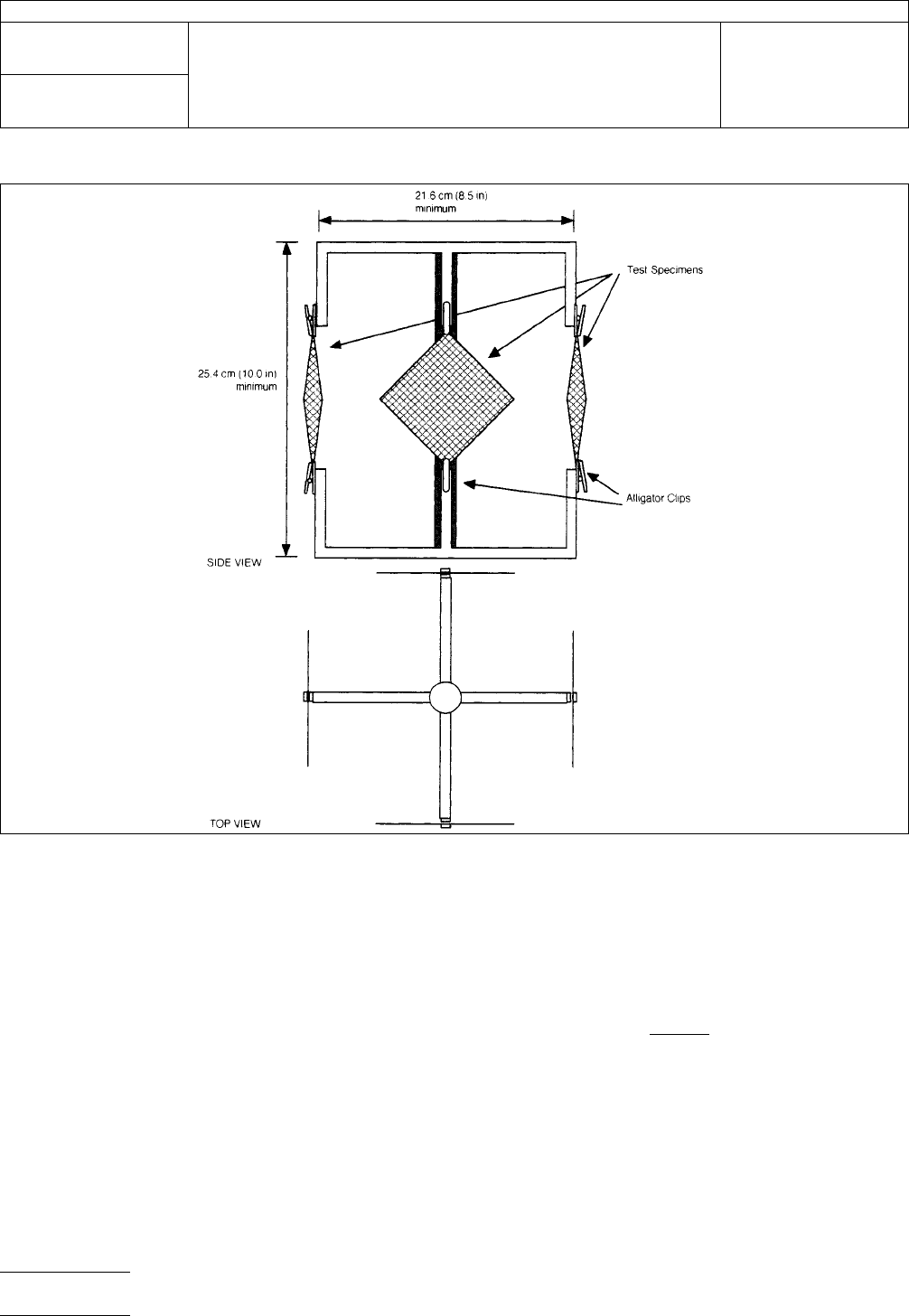
Secure
each specimen at diagonally opposite corners
from the metal hanging apparatus as shown in Figure 1.
5.3.4
Place
the apparatus with specimens in the air circulat-
ing oven at the temperature and for the time specified in Table
1 or by the governing document.
5.3.5 Remove
the specimens from the oven and from the
holding apparatus and weigh each specimen within two min-
utes to the nearest milligram [0.001 gram]. Record as W2.
5.4
Calculation
Calculate
and record the volatile content
as follows:
Volatile Content (%) =
(
W
1
− W
2
W
1
)
x
100
5.5
Report
The
results should be reported and shall con-
tain the following:
(1) Identification of prepreg material type tested.
(2) Percent volatile content for each specimen tested and the
average.
(3) Test temperature and time in oven.
Figure
1 Method of holding device
IPC-TM-650
Number
2.3.19
Subject
Volatile
Content of Prepreg
Date
12/94
Revision
C
P
age2of3
电子技术应用 www.ChinaAET.com

6.0 Notes
6.1
Moisture Content
6.1.1 Exclusion of Moisture Content
Desiccation
of the
specimens is performed for the following reasons.
6.1.1.1
This
test method is based on the understanding that
‘‘Volatile Content’’ refers to organic solvents and other ingre-
dients of the prepreg that may remain in the material after
curing. Water or moisture content is not considered as a
‘‘Volatile’’ for purposes of this test, and therefore desiccation
is a fundamental step to exclude H
2
0
from the data. It is not
possible to remove all H
2
0
from material that is hygroscopic,
but the most significant content is removed.
6.1.1.2 This
method has a high intrinsic variability potential,
and since moisture content is extremely variable and depen-
dent on the storage environment, meaningful data is best
achieved by removing the moisture.
6.1.2
Moisture Content Determination
This
method can
be performed in an alternative manner, in which the specimen
is weighed before it is desiccated. The difference between the
‘‘As Is Weight’’ and the ‘‘Weight After Desiccation’’ (but
before oven drying) is the moisture content.
6.2
Alternate Specimen Holder
Method B has been
designed to minimize the problem of specimens flopping
around in the air circulating oven.
6.3
Desiccator Conditions
The
Test Methods Task Group
determined that a great majority of test laboratories are unable
to consistently hold the Relative Humidity in a desiccator to
less than 20%. Based on data from participating company lab
management, the lowest practically feasible RH for use with
the affected IPC Test Methods is 30% maximum.
IPC-TM-650
Number
2.3.19
Subject
Volatile
Content of Prepreg
Date
12/94
Revision
C
P
age3of3
电子技术应用 www.ChinaAET.com

1.0
Scope
1.1
The
Hull Cell is a miniature plating unit designed to pro-
duce cathode deposits on a panel that correlates the charac-
teristics of the plating unit being evaluated. Interpretation of
the ‘‘as plated’’ cathode panel give rapid information about
brightness levels, irregular plate deposits, uniformity of depos-
its, coverage, throwing power, impurities, and plating bath
chemistry.
1.2
Theory:
Within the parameters of recommended operat-
ing characteristics of a particular plating solution, the HULL
CELL will duplicate what is actually occurring in the plating
unit proper.
Correlation of the ‘‘as plated’’ panel and the HULL CELL
SCALE allows rapid, nondestructive testing of plating solu-
tions for research, preventative maintenance, troubleshooting,
and quality control.
2.0
Applicable Documents
R.
O. Technical Bulletin No. 404
The Hull Cell, by Sedusky and Mohler
3.0
Test Specimen
3.1 Description of Specimen
A
representative sample
from the plating unit to be evaluated is withdrawn and should
be a composite sampling from various areas in the plating
tank and from various depths within these areas.
3.2
Specimen Preparation
The
representative sample
should be analyzed chemically for those critical components
recommended by the supplier of the plating bath. Correlation
of Hull Cell panels without the information on the bath chem-
istry can be very misleading.
3.3
Operating Conditions
Particular
attention shall be
given to the physical conditions of the plating unit at the time
of sampling and these operating conditions should be dupli-
cated during Hull Cell testing. If this is not done, interpretation
will be meaningless. Example: temperature, cathode agitation,
air agitation.
4.0
Apparatus
4.1 Description of Equipment
A
bench or portable minia-
ture plating cell is employed using the following components.
a. A rectifier (D.C. power source) with variable controls for
amperage from 0-10 amps, 0-12 volts. This power source
should have less than 5% ripple.
b. Hull Cell Anode ‘‘+’’ chemistry of the anode the same as
is in the plating unit or as recommended by the chemical
supplier. Example: zinc anode for zinc plating bath.
c. Color coded coated cables capable of carrying the current
required with an alligator clip soldered to cell end. Color
code recognized universally is as follows: anode ‘‘+’’
black; cathode ‘‘–’’ red.
d. Hull Cell Cathode Panels—two most widely used are zinc
plated steel and thin plastic protected brass panels.
e. Hull Cell—with scribed solution level line, 267 ml, 524 ml,
or 1000 ml size. The most commonly used size is the 267
ml. Hull Cells are available in Lucite, Polypropylene, and
Porcelain.
f. Hull Cell Scale—a calibrated ruler for interpretation of 1, 2,
3, and 5 amp panels to determine current densities.
g. Hull Cell Agitator—optional motor driven arm and panel
assembly for duplicating solution and/or cathode agita-
tion.
h. Air Agitation Hull Cell—specially designed for introducing
air into the miniature plating unit to duplicate air agitation
operations.
i. Timer—separate or built into the DC power unit depend-
ing upon the sophistication desired.
5.0
Procedure
5.1 Preparation
(It
is recommended that panels be
handled with tweezers and gloves to prevent misleading
results.)
5.1.1
Pre-clean
cathode test panel.
5.1.2
For
zinc plated steel panels: immerse in 50% by vol-
ume C.P. Hydrochloric acid to strip off protective zinc film.
The
Institute for Interconnecting and Packaging Electronic Circuits
2215 Sanders Road • Northbrook, IL 60062-6135
IPC-TM-650
TEST
METHODS MANUAL
Number
2.3.21
Subject
Plating
Quality Hull Cell Method
Date
8/97
Revision
A
Originating Task Group
N/A
Material
in this Test Methods Manual was voluntarily established by Technical Committees of the IPC. This material is advisory only
and its use or adaptation is entirely voluntary. IPC disclaims all liability of any kind as to the use, application, or adaptation of this
material. Users are also wholly responsible for protecting themselves against all claims or liabilities for patent infringement.
Equipment referenced is for the convenience of the user and does not imply endorsement by the IPC.
P
age1of3
电子技术应用 www.ChinaAET.com