IPC-TM-650 EN 2022 试验方法.pdf - 第721页
a. Contamination on the insulating surface of the board such as lint, solder splines, or water droplets from the condition- ing chamber. b. Incompletely etched patterns that decrease the insulating space between conducto…
5.5.6 Upon completion of the 168 hours, turn off the bias
and open the test chamber and allow the test specimens to
return to laboratory ambient conditions.
5.6 Class H – Measurements/Evaluation
5.6.1
Upon specimen stabilization at laboratory ambient
temperature, take the resistance measurements, as specified
in 5.5.1, with 10 VDC and record.
5.6.2 Examine the test specimens with 10X magnification
with backlighting for electrochemical migration.
5.7 Class T – Test Chamber Method
5.7.1
Prior to testing, take insulation resistance measure-
ments of the test specimens using 45 -100 VDC. This step will
ensure that the resistance measurements are sufficient to pro-
ceed with testing.
5.7.2 Place the test specimens into the test chamber and
route the wires through the porthole of the test chamber and
seal, if necessary.
5.7.3 Set the chamber’s parameters for 85 °C [185 °F] with
85% relative humidity minimum. Close the chamber doors and
activate the test chamber.
5.7.4 Allow the test specimens to stabilize at test conditions
for 96 hours (four days).
5.7.5 After the 96-hour (four days) stabilization period at test
conditions, take measurements of initial insulation resistance
as specified in 5.7.1 with 45 -100 VDC.
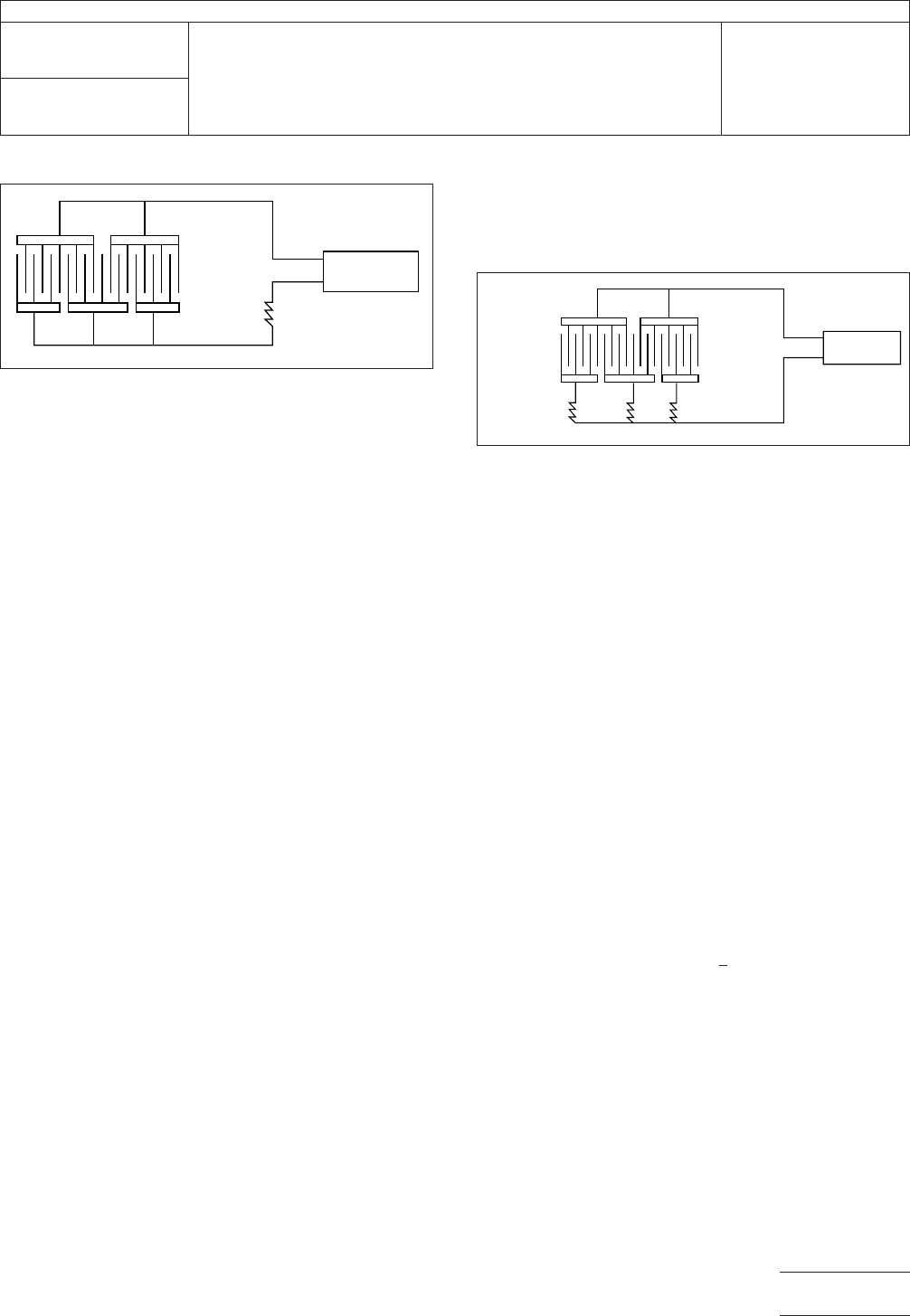
5.7.6 After obtaining the measurements, connect each test
point as specified in 5.3.1 and 5.3.2 to a 1-megohm resistor
before the positive terminal of power supply. (See Figure 3 for
configuration of qualification testing.) Apply the bias voltage of
10VDC. The test polarity shall be the same as the measure-
ment polarity stated in 5.7.1.
5.7.7 Allow the specimens to remain in the test chamber an
additional 404 hours (500 hours total test time).
5.8 Class T – Measurements/Evaluations
5.8.1
Upon completion of the 500 hours (21 days), discon-
nect the power supply and repeat the measurements as
stated in 5.7.5 with the specimens under test conditions.
5.8.2 The chamber is then turned off and the specimens are
removed from the test chamber and visually inspected with
backlighting at 10X magnification for electrochemical migra-
tion.
5.8.3 The individual resistance measurements obtained at
96 hours and 500 hours shall be averaged using the following
calculation. These initial and final average insulation resistance
readings shall then be reported.
IR
avg
=10
[
1
N
Σ
1
N
log IR
i
]
Where:
N = Number of test points (12 nominal)
IR
i
= Individual insulation resistance measurements
5.8.4 Where an assignable cause can be found, exception-
ally low insulation resistance readings can be excluded from
calculating the average value, provided that 11 (of the original
12) measurements are included in the average. Such assign-
able causes are attributable to the laminate itself or to the
process used to produce the printed board. They include:
IPC-2614-2
Figure 2 Configuration for Class H Qualification Testing
Power Supply
10 VDC
10 Megohm resistor
+
-
IPC-2614-3
Figure 3 Test Point Connection for Class T Qualification
Testing
Power Supply
10 VDC
-
1 megohm resistors
+
IPC-TM-650
Number
2.6.14
Subject
Solder Mask - Resistance to Electrochemical Migration
Date
03/07
Revision
D
Page3of4

a. Contamination on the insulating surface of the board such
as lint, solder splines, or water droplets from the condition-
ing chamber.
b. Incompletely etched patterns that decrease the insulating
space between conductors by more than the amount
allowed in the appropriate design requirements drawing.
c. Scratched, cracked or obviously damaged insulation
between conductors.
6 Notes
6.1
Protective coatings are helpful in preventing electro-
chemical migration, but there is no assurance that the protec-
tion is complete unless the coating is adequately bonded to a
good clean board.
IPC-TM-650
Number
2.6.14
Subject
Solder Mask - Resistance to Electrochemical Migration
Date
03/07
Revision
D
Page4of4
1
Scope
This
test method provides a means to assess the
propensity for surface electrochemical migration. This test
method can be used to assess soldering materials and/or
processes.
2
Applicable Documents
2.1 IPC
IPC-B-25
Multipurpose
Test Board
IPC-B-25A
Multipurpose
Test Board
IPC-6012A
Qualification
and Performance Specification for
Rigid Printed Boards
IPC-9201
Surface
Insulation Resistance Handbook
2.1
American Society for Testing and Materials (ASTM)
ASTM D-257-93
Standard
Test Methods for DC Resistance
or Conductance of Insulating Materials
3
Test Specimens
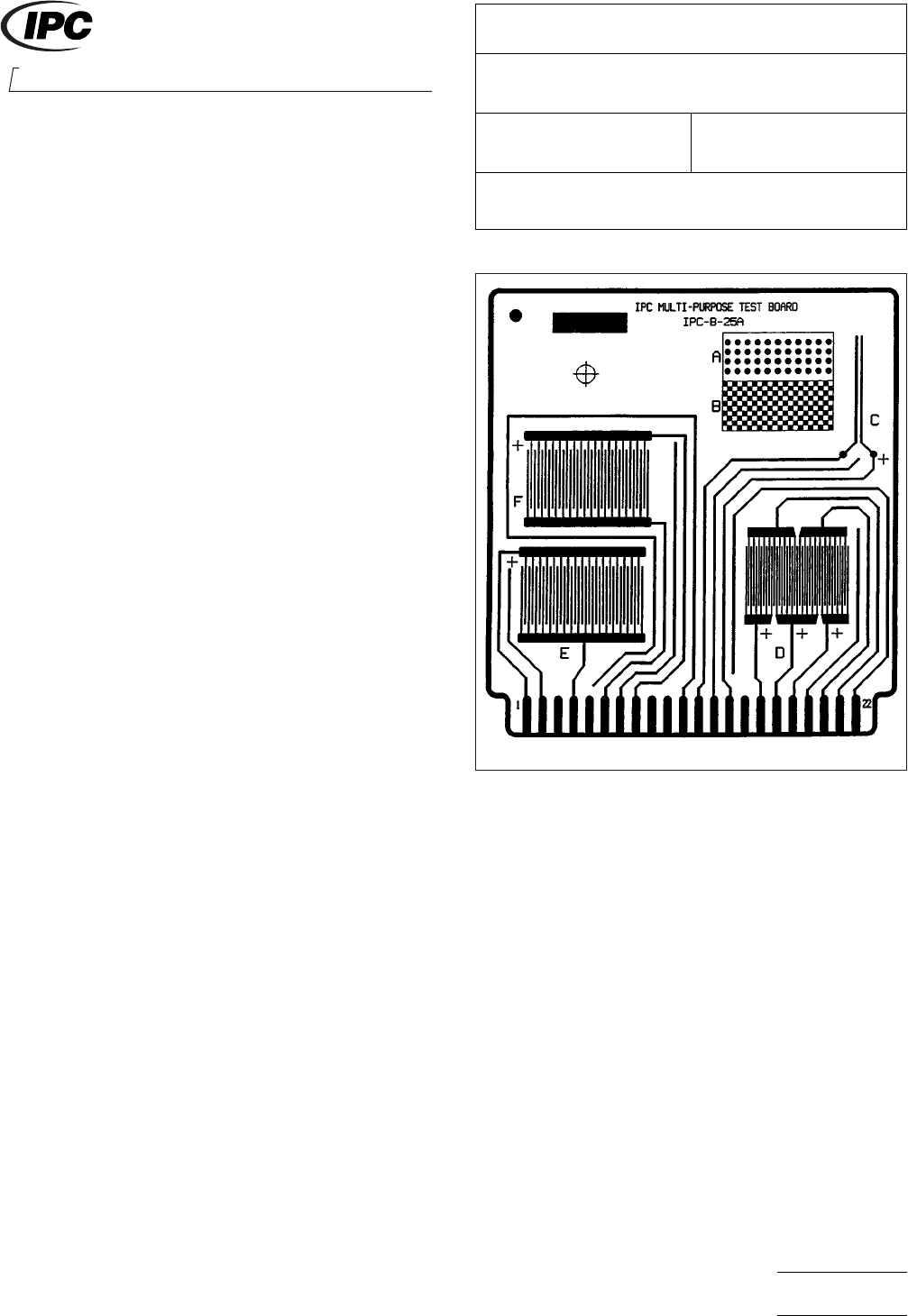
IPC-B-25
(B or E pattern) or IPC-B-25A
(D pattern) test boards shall be used, with conductor line
widths and spacings of 0.318 mm [0.01250 in]. The method
of manufacture should provide optimized conductor edge
definition (refer to the Class 2 and 3 conductor width require-
ments in IPC-6012). The finished test boards should be
untreated, bare copper, unless another surface finish is part of
the evaluation. Figure 1 shows the IPC-B-25A test board; the
D pattern is identical to the IPC-B-25 B or E pattern. For pro-
cess evaluation, the test pattern board should be made using
the same substrate material as will be used in practice to
duplicate actual working conditions.
4
Equipment/Apparatus
4.1 Test Chamber
A
temperature/humidity chamber
capable of producing an environment of 40°C ± 2°C [104 ±
3.6°F], 93% ± 2% RH, 65°C ± 2°C [149 ± 3.6°F], 88.5% ±
3.5% RH, or 85°C ± 2°C [185 ± 3.6°F], 88.5% ± 3.5% RH
and allowing test boards to be electrically biased and mea-
sured without being opened under these temperature and
humidity conditions is used.
4.2
Measuring Equipment
High
resistance measuring
equipment, equivalent to that described in ASTM D-257-93,
with a range up to 10
12
ohm
and capable of yielding an accu-
racy of ± 5% at 10
10
ohm
with an applied potential of 100 VDC
(10% tolerance); standard resistors should be used for routine
calibration.
4.3
Power Supply
Equipment
capable of providing 10
VDC at 100 µA, with a 10% tolerance, shall be used.
4.4
Current-Limiting Resistors
Use
one 10
6
ohm
resistor
in each current path. This equates to three current-limiting
resistors for each 5-point comb pattern. Note that some test
equipment has the current limiting resistors built into the test-
ing system.
4.5
Connecting Wire
Use
PTFE-insulated, solid-
conductor, copper wire, or equivalent. (See IPC-9201 Surface
Insulation Resistance Handbook.)
IPC-26141-1
Figure
1 IPC-B-25A Test Board
2215
Sanders Road
Northbrook, IL 60062-6135
IPC-TM-650
TEST
METHODS MANUAL
Number
2.6.14.1
Subject
Electrochemical
Migration Resistance Test
Date
09/00
Revision
Originating Task Group
Electrochemical Migration Task Group
Material
in this Test Methods Manual was voluntarily established by Technical Committees of IPC. This material is advisory only
and its use or adaptation is entirely voluntary. IPC disclaims all liability of any kind as to the use, application, or adaptation of this
material. Users are also wholly responsible for protecting themselves against all claims or liabilities for patent infringement.
Equipment referenced is for the convenience of the user and does not imply endorsement by IPC.
P
age1of3
ASSOCIA
TION CONNECTING
ELECTRONICS INDUSTRIES
电子技术应用 www.ChinaAET.com