IPC-TM-650 EN 2022 试验方法.pdf - 第609页
1 Scope This method describes the test procedures required to measure propagation delay in flat cables. Propa- gation delay is defined as the time required for a pulse to traverse a unit length of cable. Excessive propag…
6 Notes
6.1
The
TDR employs a pulse rise time less than 250 pico-
seconds. A pulse of this rise time is extremely rich in harmon-
ics extending well into the GHz region of the frequency spec-
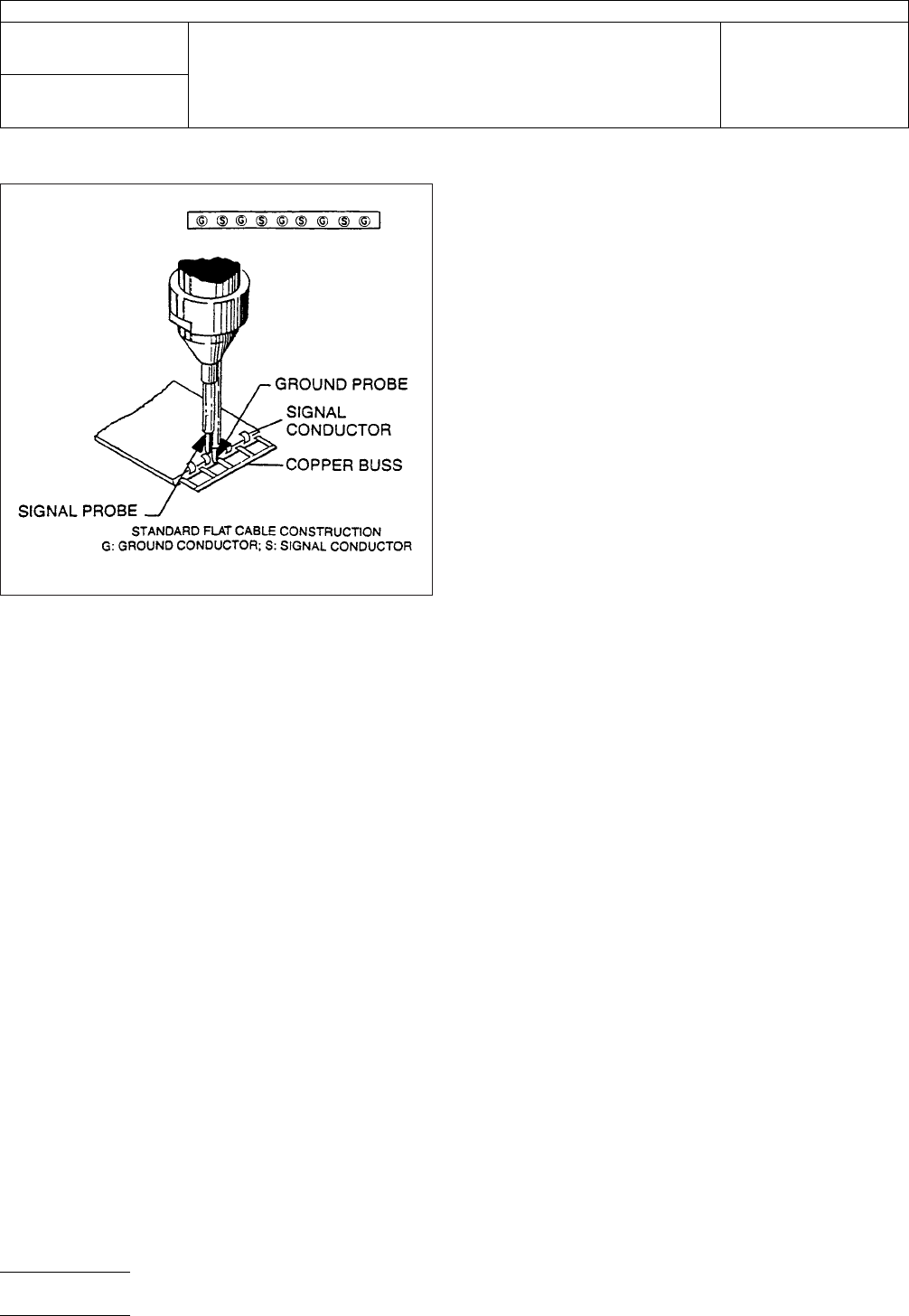
trum. The impedance probe illustrated in Figure 1 is designed
to minimize the effects of impedance mismatch at the con-
nection; therefore, it is suggested that a probe of this type be
used for the impedance measurement. The importance of a
good connection between the cable under test and the TDR
can not be overemphasized.
Cables longer than3minlength may be tested, but care
must be exercised so as not to confuse the effect of increased
wire resistance with an apparent increase in impedance as the
magnifier delay dial is rotated to observe the longer cable
length (function of attenuation, which includes wire size).
6.2
Under
no circumstances should the cable be tested
while in a coiled form due to the effect of increased induc-
tance.
6.3
Keep
cable a minimum of 15 cm away from any dielec-
tric or ground plane including metal, wood, etc. (except in
step 5.5).
6.4
Measurement
of Z
0
of
unknown cable length should be
made as close as possible to the cable connection device
(after overshoot and undershoot).
6.5
The
reference Z
0
cable
may be positioned after the
RG58C cable and before the cable connection device. There-
fore, the reference Z
0
is
adjacent to the test cable on the TDR
trace.
IPC-2-5-18-4
Figure
5 Connection of Impedance Probe to Sample
under Test
IPC-TM-650
Number
2.5.18
Subject
Characteristic
Impedance Flat Cables (Unbalanced)
Date
7/84
Revision
B
P
age4of4
电子技术应用 www.ChinaAET.com
1
Scope
This
method describes the test procedures
required to measure propagation delay in flat cables. Propa-
gation delay is defined as the time required for a pulse to
traverse a unit length of cable. Excessive propagation delay
will result in the malfunction of critical circuits due to the late
arrival of pulses. Propagation delay is directly proportional to
the effective dielectric constant of the insulation.
2
Applicable Documents
None
3
Test Specimen
3.1
One
pre-production or production sample1mto3m
long. The number of test samples should be determined by
the manufacturer and/or user.
4
Apparatus
4.1
In this test, propagation delay is measured using time
domain reflectometry (TDR). Commercial TDRs are readily
available and consist of a pulse generator and sampling oscil-
loscopes. The TDR to be used should be a Hewlett-Packard
1415A, Hewlett-Packard 1815A, Tektronix 1 S2 or equal.
4.2 Two
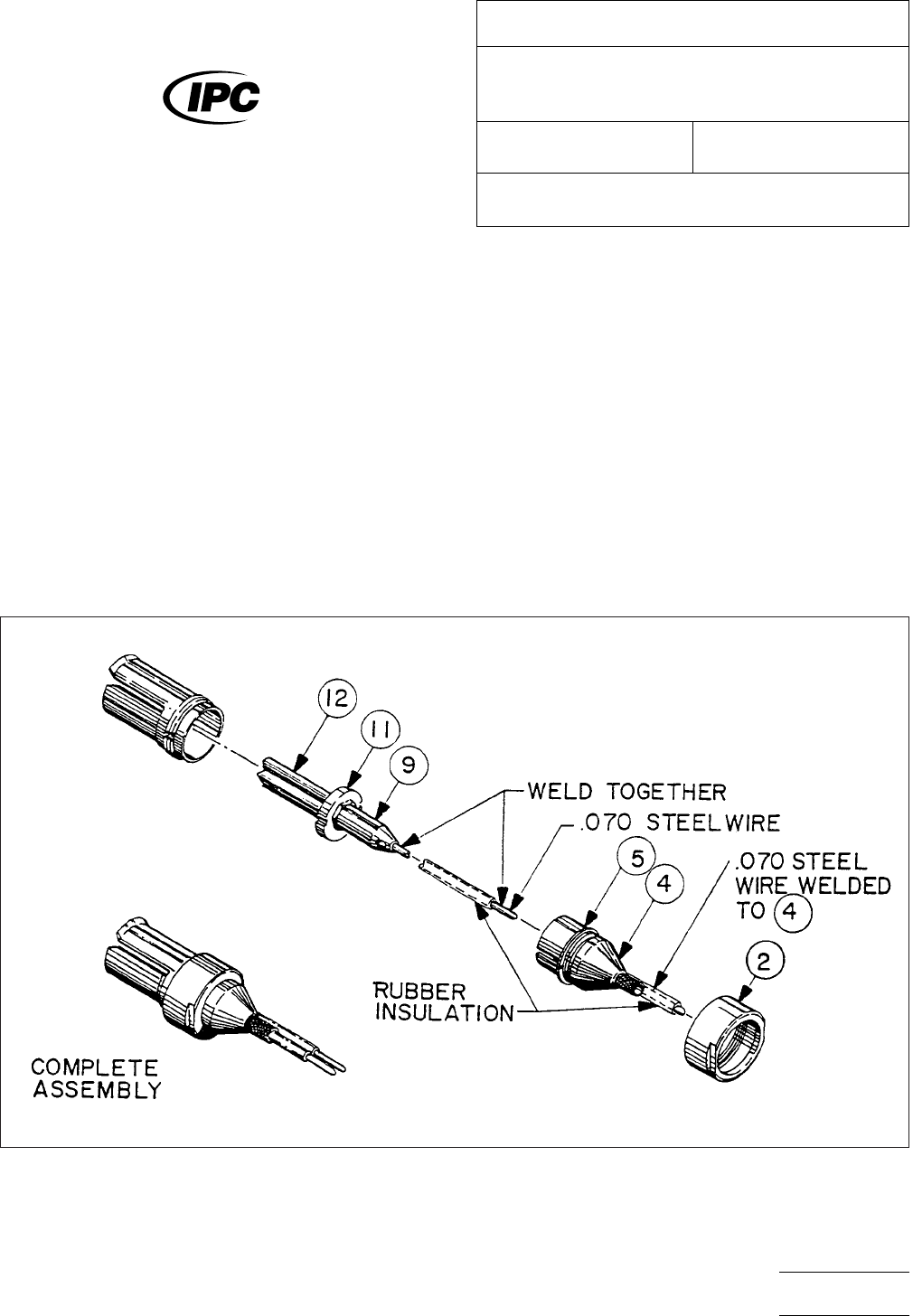
standard cable connection devices to terminate
each end of the test cable, which should match Figure 1. It is
made from a General Radio cable connector type 874-C62A.
4.3
A
509 load, type GR874 or equivalent, to terminate the
output of the TDR
IPC-2-5-18-3
Figure
1 Cable Connection Device
The
Institute for Interconnecting and Packaging Electronic Circuits
2215 Sanders Road • Northbrook, IL 60062
IPC-TM-650
TEST
METHODS MANUAL
Number
2.5.19
Subject
Propagation
Delay of Flat Cables Using Time
Domain Reflectometer
Date
7/84
Revision
A
Originating Task Group
Material
in this Test Methods Manual was voluntarily established by Technical Committees of the IPC. This material is advisory only
and its use or adaptation is entirely voluntary. IPC disclaims all liability of any kind as to the use, application, or adaptation of this
material. Users are also wholly responsible for protecting themselves against all claims or liabilities for patent infringement.
Equipment referenced is for the convenience of the user and does not imply endorsement by the IPC.
P
age1of3
电子技术应用 www.ChinaAET.com
4.4
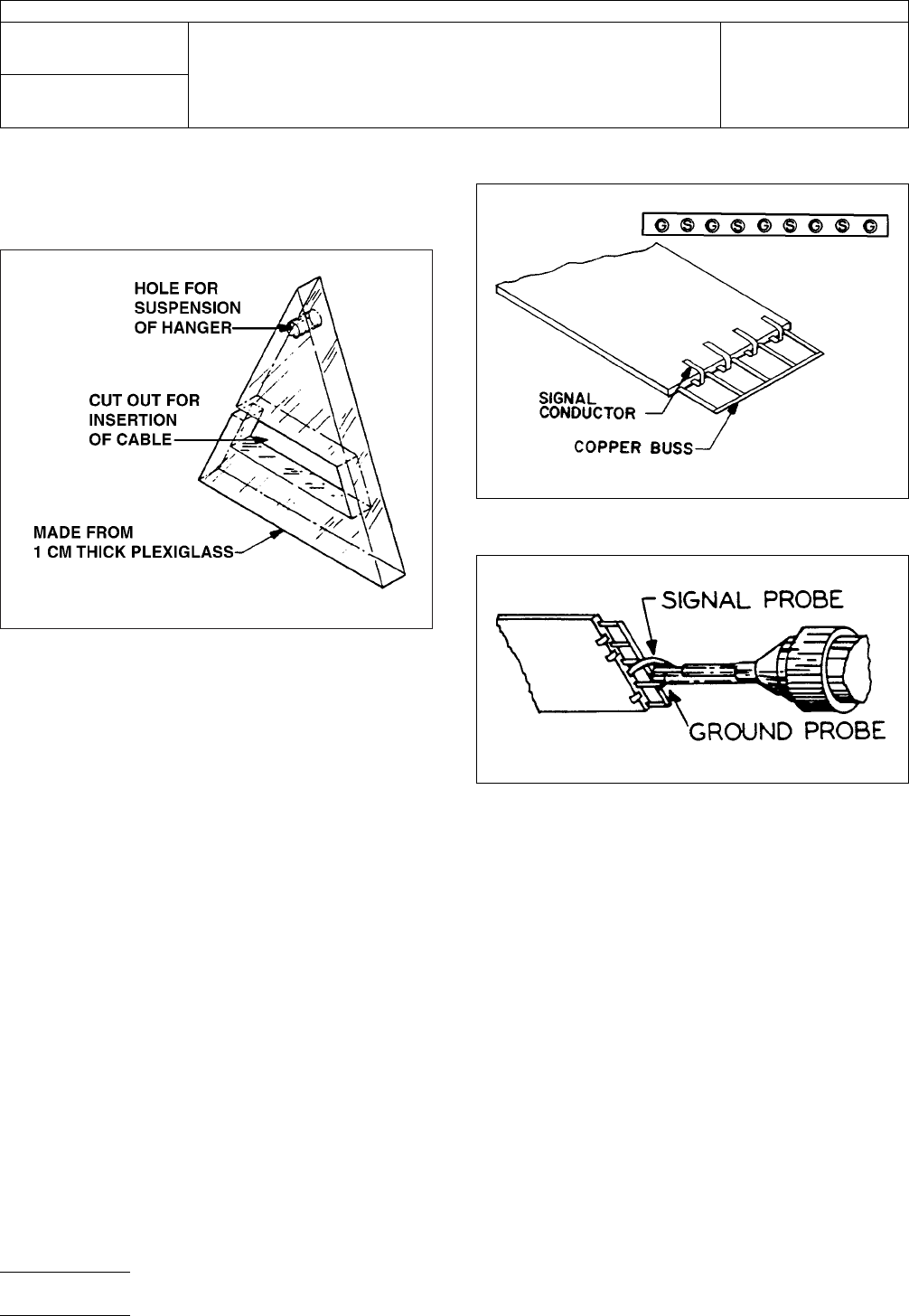
Fixture
of plexiglass or other nonmetallic material. Cable
hangers to suspend the cable in air (see Figure 2)
5
Procedure
5.1
Allow
a minimum of one hour for TDR warmup and cali-
brate the instrument per manufacturer’s instructions.
5.2
Prepare
the test specimen by stripping approximately 13
mm of insulation from both ends of the cable. Separate the
ground and signal conductors and solder a copper buss
across the grounds of each end (see Figure 3). Solder a stan-
dard cable connection device to each end of the cable (see
Figure 4).
5.3
Adjust
the TDR settings as follows: Vertical-0.2 p/cm;
Distanceltime-20 ns/cm; Magnifier-10X. (For equipment other
than Hewlett-Packard, use settings as close as possible to
these.)
5.4
Terminate
TDR output using the 509 load.
5.5
Adjust
the magnitude delay dial so the 50Ω termination
is visible and positioned to the left on the screen. Adjust the
vertical position so the pulse trace leading edge crosses the
horizontal graticule center line at 10% of pulse height (see
Figure 5). Mark the position of the leading edge of the pulse
on the horizontal graticule (mentally or by camera). If a cam-
era is used, don’t advance the film; a second exposure will be
made in 5.8.
5.6 Remove
the U section of coaxial GR connectors con-
necting the step out and signal in. Position each L connector
(made from the U connector) in the ‘‘STEP OUT’’ and ‘‘SIG-
NAL IN’’ connectors.
5.7
Connect
the test specimen, one end to the ‘‘Step Out’’
and the other end to ‘‘Signal In’’ (see Figure 6).
5.8
The
trace on the TDR screen will have moved to the
right from its original position in 5.5. Mark the position of the
leading edge of the pulse on the horizontal graticule (again at
10% of pulse height). At this time, a second exposure on the
same film used in 5.5 can be made. This will result in both
traces on one film. The distance between this mark and the
mark in 5.5 is the measured propagation delay (TD). Multiply
the measured T
D
by
20 (distance/time set at 20 ns/cm), then
IPC-2-5-19-1-4
Figure
2 Sample Hanging Device
IPC-2-5-19-2
Figure
3 Cable Preparation
IPC-2-5-19-3
Figure
4 Cable Connection
IPC-TM-650
Number
2.5.19
Subject
Propagation
Delay of Flat Cables Using Time Domain
Reflectometer
Date
7/84
Revision
A
P
age2of3
电子技术应用 www.ChinaAET.com