IPC-TM-650 EN 2022 试验方法.pdf - 第599页
5.1.1.1 Metallic-clad materials having a thickness of less than 0.51 mm [0.020 in] shall be photoprinted with a pattern of the outline of the conductors and etched in accordance with IPC-TM-650, Methods 2.3.6, 2.3.7, or …

1.0
Scope
This
test method is designed to determine vol-
ume resistivity and surface resistivity of metallic-clad or unclad
laminates under conditions of specified humidity and tempera-
ture and at elevated temperatures.
2.0
Applicable Documents
ASTM-D-257 D-C Resistance or Conductance of Insulating
Materials
IPC-TM-650
Method
2.3.6, Etching, Ammonium Persulfate
Method, 2.3.7 Etching, Ferric Chloride
Method 2.3.7.1, Cupric Chloride Etching
Method 2.6.3, Moisture and Insulation Resistance, Rigid,
Rigid/Flex and Flex Printed Wiring Boards
3.0
Test Specimens
3.1
Laminate
thickness of 0.51 mm [0.020 in] or greater.
Three specimens of dimensions 101.6 ± 3.2 mm x 101.6 ±
3.2 mm [4.0 ± 0.125 in x 4.0 ± 0.125 in] by thickness shall be
prepared for each test condition, unless otherwise specified.
3.2
Laminate
thickness of less than 0.51 mm [0.020 in].
Three specimens of dimensions 50.8 ± 1.6 mm x 50.8 ± 1.6
mm [2.0 ± 0.062 x 2.0 ± 0.062 in] by the thickness shall be
prepared for each test condition, unless otherwise specified.
4.0
Equipment Apparatus
4.1
Conditioning
chamber capable of maintaining 35 ± 2°C
[95 ± 3.6°F] and 90 +5, –0% relative humidity.
4.2
Conditioning
chamber capable of attaining the tempera-
ture and humidity conditions specified in IPC-TM-650, Method
2.6.3.
4.3
Air
circulating oven capable of maintaining the specified
test temperatures to within ± 2°C[±3.6°F].
4.4
Resistance
measuring instrumentation capable of mea-
suring to 10
12
meg-ohms,
minimum, with an accuracy of ± 5
percent at its highest scale setting. The equipment shall have
the capability of applying 500 volts dc to the test specimen.
4.5
A
system/fixture for electrical connections into the tem-
perature and humidity chambers (see 4.1, 4.2, 4.3). Three
separate cables shall be provided to make connections to
each specimen being conditioned/tested. The center conduc-
tor of each cable shall be connected to one of the three elec-
trodes applied to the test specimen. The opposite ends of the
cables shall be brought outside the chamber and terminated
at a convenient location for connection to the measuring
instrument. Shields shall be trimmed back from the ends of
the center conductor insulation and interconnected to the
guard post of the measuring instrument. See 6.2 for additional
information.
Support the specimen parallel to the air flow through the
chamber during conditioning.
Special care should be taken to ensure that materials used in
the fixture are such that resistance readings are that of the
material being tested and not the fixture.
4.6
A
measurement device capable of measuring laminate
thickness to the nearest 0.0025 mm [0.0001 in].
4.7
Material
and apparatus for formation of specimen con-
ductors.
4.7.1 Conductor
silver paint; composition 4817 by Dupont
Company, or equivalent.
4.7.2
A
system for applying the paint to the specimen, such
as silk screening.
4.7.3
A
mask, fixture, photoprinting system, or equivalent,
for applying the applicable electrodes/test pattern to the
specimen (See Dimension Table).
4.8
Etching
system in accordance with IPC-TM-650,
Method 2.3.6, 2.3.7, or 2.3.7.1.
5.0 Procedure
5.1 Specimen Preparation
5.1.1
Test
patterns with the applicable dimensions shown in
the Dimension Table, and in accordance with Figures 1, 2,
and 3 shall be generated, as follows:
The
Institute for Interconnecting and Packaging Electronic Circuits
2215 Sanders Road • Northbrook, IL 60062
IPC-TM-650
TEST
METHODS MANUAL
Number
2.5.17.1
Subject
Volume
and Surface Resistivity of Dielectric
Materials
Date
12/94
Revision
A
Originating Task Group
MIL-P-13949 Test Methods Task Group (7-11b)
Material
in this Test Methods Manual was voluntarily established by Technical Committees of the IPC. This material is advisory only
and its use or adaptation is entirely voluntary. IPC disclaims all liability of any kind as to the use, application, or adaptation of this
material. Users are also wholly responsible for protecting themselves against all claims or liabilities for patent infringement.
Equipment referenced is for the convenience of the user and does not imply endorsement by the IPC.
P
age1of4
电子技术应用 www.ChinaAET.com

5.1.1.1
Metallic-clad
materials having a thickness of less
than 0.51 mm [0.020 in] shall be photoprinted with a pattern
of the outline of the conductors and etched in accordance
with IPC-TM-650, Methods 2.3.6, 2.3.7, or 2.3.7.1. The elec-
trodes shall then be completed (filled in) using silver conduc-
tive paint.
5.1.1.2
Metallic-clad
laminates 0.51 mm [0.020 in] or thicker
shall be etched in accordance with IPC-TM-650, Method
2.3.6, 2.3.7, or 2.3.7.1. A pattern of the outline of the conduc-
tors may be photoprinted before etching. Test electrodes shall
be applied using silver conductive paint and an appropriate
test pattern application system.
5.1.1.3
Solid
metal foil electrodes shall not be acceptable in
any case, except for the outer electrode for laminates less
than 0.51 mm [0.020 in]. A small pad of retained cladding may
be retained within the electrode borders to facilitate soldering
of leads.
5.1.2
If
soldering techniques are used to attach leads, suit-
able cleaning procedures shall be used to remove flux and
other residue.
5.2
Conditioning
5.2.1 Humidity Conditioning
5.2.1.1
Specimens
of a thickness less than 0.51 mm [0.020
in] shall be subjected to 90 + 5-0% relative humidity and 35 ±
2°C [95 ± 3.6°F] for a period of 96 +2, -0 hours prior to elec-
trical measurement.
5.2.1.2
Specimens
of a thickness greater than, or equal to,
0.51 mm [0.020 in] shall be subjected to the conditioning
specified in IPC-TM-650, Method 2.6.3, paragraph 5.1.3. Fol-
lowing the tenth cycle, the conditioning chamber shall main-
tain a temperature of 25 ± 2°C [77 ± 3.6°F] and 90 +5, 0%
relative humidity during the interval that electrical measure-
ments are being made.
5.2.2
At Elevated Temperature Conditioning
Speci-
mens
shall be subjected to the specified temperature (based
on material type and specification requirements) for a period
of 24 hours -0, +2 hours. Unless otherwise specified, the tem-
perature shall be 125 ± 2°C [257 ± 3.6°F].
5.3
Electrical Measurements
All
electrical measurements
shall be made inside the applicable conditioning chamber and
at the conditions specified in 5.2.
5.3.1
Electrical
measurements taken on specimens condi-
tioned in accordance with paragraph 5.2.1 shall be completed
within the 2 hour tolerance of the conditioning.
5.3.2
Electrical
measurements taken on specimens condi-
tioned in accordance with paragraph 5.2.2 shall be made after
achieving 1.5 hours steady state of 25 ± 2°C [77 ± 3.6°F] and
90 +5, -0% relative humidity. All measurements shall be com-
pleted within 2 hours.
5.3.3 Electrical
measurements taken on specimens condi-
tioned in accordance with paragraph 5.3 shall be completed
within the 2 hour tolerance of the conditioning.
Dimension
Table
Base
Thickness
D
1
Diameter
D
2
Diameter
D
3
Diameter
D
4
D
5
A(cm
2
)
P/D
4
Less
than
0.51 mm
(0.020 inches)
1.000
(2.540)
1.020
(2.591)
1.375
(3.493)
0.010
(0.025)
0.177
(0.460)
5.169 317.4
±0.005
(0.013)
±0.005
(0.013)
±0.005
(0.013)
±0.001
(0.003)
±0.005
(0.013)
0.51 mm
(0.020 inches)
and greater
2.000
(5.080)
2.500
(6.350)
3.000
(7.520)
0.250
(0.636)
0.250
(0.636)
25.652 28.27
±0.015
(0.038)
±0.015
(0.038)
±0.015
(0.038)
±0.005
(0.038)
±0.015
(0.038)
For the above: Do = (D
1
+D
2
)/2
A=πDo
2
4
P=πD
O
Note:
Dimensions
are in inches with metric equivalents in parenthesis (1 inch = 2.54 cm).
IPC-TM-650
Number
2.5.17.1
Subject
Volume
and Surface Resistivity of Dielectric Materials
Date
12/94
Revision
A
P
age2of4
电子技术应用 www.ChinaAET.com
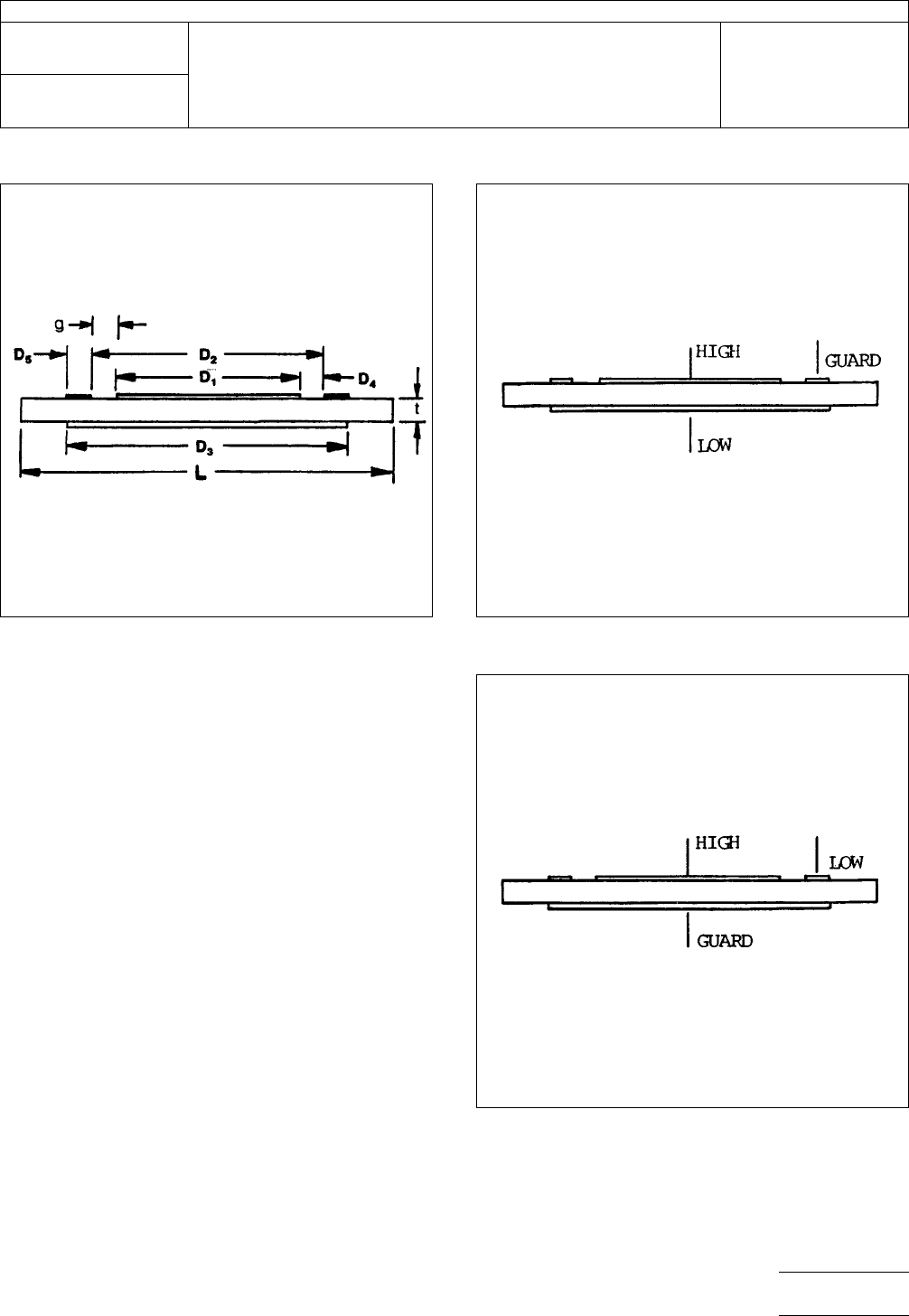
5.3.4
All
electrical measurements shall be made using 500
volts direct current. The voltage shall be applied to the speci-
men for 60 +5, -0 seconds prior to taking the actual reading,
for stabilization purposes.
5.3.5
Measure
the volume resistance by connecting the
resistance measuring device to the specimen electrodes
through the fixture system as described in 4.5 in accordance
with Figure 2.
5.3.6
Measure
the surface resistance by interchanging the
test cables connecting the solid back electrode and the outer
ring to the instrument for the arrangement shown in Figure 3.
5.4
Specimen Thickness
Each
specimen shall be mea-
sured for its thickness without cladding. Specimens for each
test condition shall have their thickness readings averaged.
Figure
1 Test pattern dimensions (See table)
Figure
2
Figure
3
IPC-TM-650
Number
2.5.17.1
Subject
Volume
and Surface Resistivity of Dielectric Materials
Date
12/94
Revision
A
P
age3of4
电子技术应用 www.ChinaAET.com