IPC-TM-650 EN 2022 试验方法.pdf - 第806页
B. The rate of change of frequency (Hz/min.) shall be con- stant for any one band. C. The ratio of the rate of change of frequency of each band to the maximum frequency of that band shall be approxi- mately the same as t…
5.3.3 Resonant modes of the test sample shall be deter-
mined by varying the frequency of the applied sinusoidal vibra-
tion slowly through the frequency range from 55 to 2000 Hz
at an amplitude of less than±2Gpeak. The test sample shall
be vibrated at a peak acceleration of ± 10G for 5 minutes at
each critical resonant frequency observed (see Table 1, Note
3).
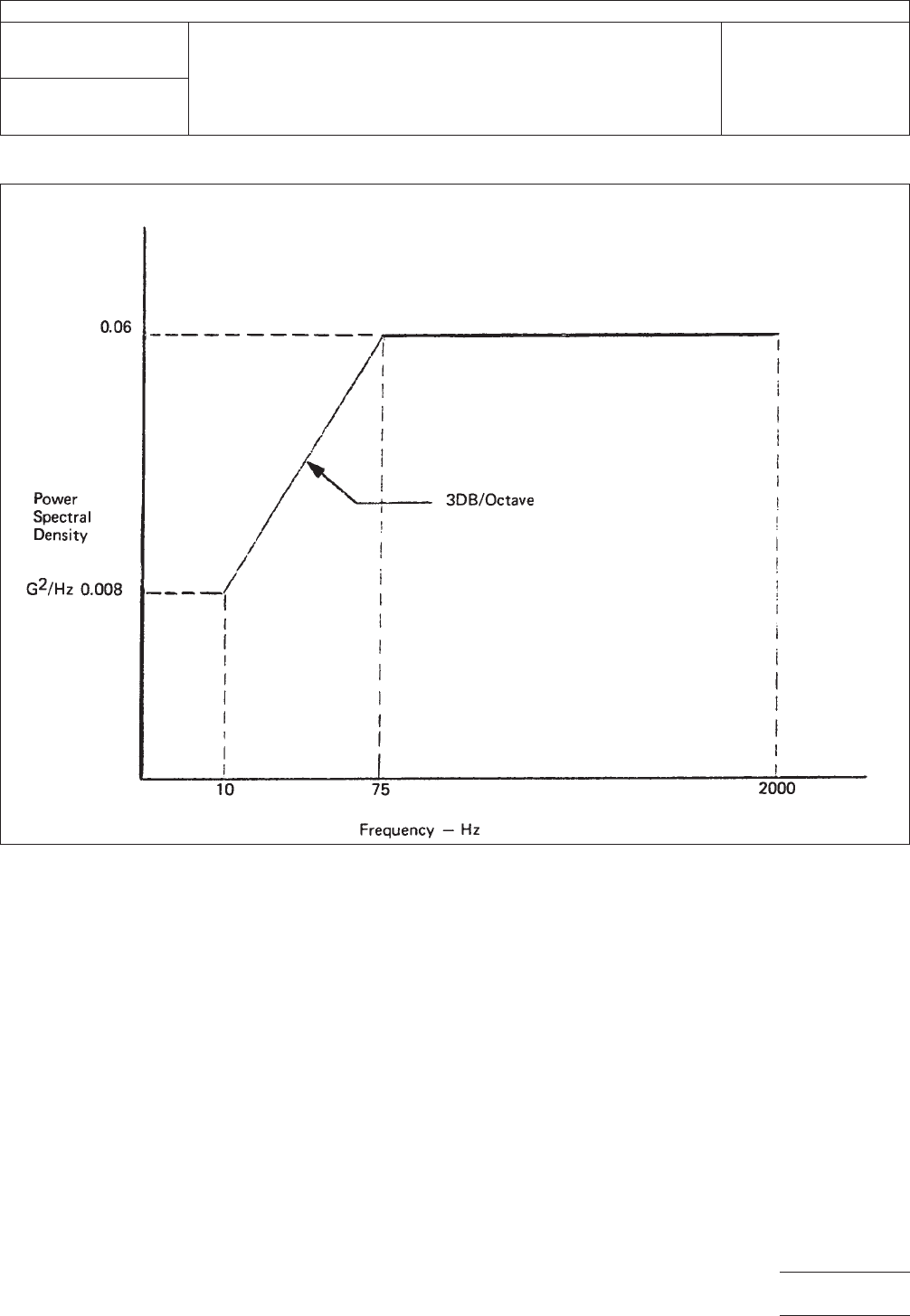
5.3.4 The test sample shall be subjected to random vibration
in accordance with Test Condition F, Table 1 and Figure 4.
5.3.5 During the test along each axis, the contacts shall be
continuously monitored for discontinuities in excess of 1
microsecond.
6.0 Notes
6.1
Acceptance criteria shall be established in terms of one,
or any combination, of the following:
A. Loss of continuity during or after any imposed shock.
B. Mechanical damage.
C. Increase in contact resistance.
D. Decrease in contact normal force.
6.2 A linear rate of change of frequency is permissible in
place of the specified logarithmic rate under the following con-
ditions:
A. The frequency range above 55 Hz shall be subdivided into
not less than three bands. The ratio of the maximum fre-
quency to the minimum frequency in each band shall not
be less than two.
IPC-3-12-4
Figure 4 Random Vibration Input
IPC-TM-650
Number
3.12
Subject
Vibration, Connectors
Date
7/75
Revision
A
Page5of6

B. The rate of change of frequency (Hz/min.) shall be con-
stant for any one band.
C. The ratio of the rate of change of frequency of each band
to the maximum frequency of that band shall be approxi-
mately the same as that ratio for every other band.
EXAMPLE:
As an example of the computation of rates of
change, assume that the frequency spectrum has been
divided into three bands, 55 to 125 Hz, 125 to 500 Hz,
and 500 to 2000 Hz, in accordance with 6.2A. Let the
(constant) ratio of rate of frequency change in Hz/min. to
maximum frequency in Hz be k for each band. Then the
rates of change for the three bands will be 125k, 500k
and 2000k, respectively. The times, in minutes, to traverse
the three frequency bands will therefore be, respectively,
125−55
125k
500−125
500k
and 2000−500
2000k
EXAMPLE:
If the range traverse time is 30 minutes –
30 =
70
125k
+
375
500k
±
1500
2000k
from which: k = 0.0687
The required maximum constant rates of frequency
change for the three bands are therefore 8.55, 34.2 and
137 Hz/min., respectively, and the times of traverse of the
bands are 8.2, 10.9 and 10.9 minutes, respectively.
IPC-TM-650
Number
3.12
Subject
Vibration, Connectors
Date
7/75
Revision
A
Page6of6

1.0 Scope
1.1
To determine the ability of the connector to operate
safely at its rated voltage and to withstand momentary over-
potentials due to switching, surges, or other similar phenom-
ena. The dielectric withstanding voltage test is also called
high-potential, over-potential, or dielectric-strength test, but
differs from a dielectric-breakdown test as described in para-
graph 6.2.
2.0 Reference Documents
2.1
Information in this section is intended to parallel the test
method described in EIA-RS-364/TP-20.
3.0 Specimen
3.1
A plug, receptacle or mated combination as specified in
the individual connector specification.
4.0 Apparatus
4.1
High voltage source adjustable to within ± 5% of
required test voltage (DC or RMS) and capable of delivering a
minimum current of 1 milliampere.
4.2 Leakage current meter accurate to ± 5% of reading.
NOTE:
Commercial devices are available that incorporate
the voltage source and leakage monitor, as well as a fault
monitor (e.g., light, bell, automatic shut-down) into one instru-
ment.
4.3 Altitude chamber capable of maintaining a simulated alti-
tude at temperature extremes of –65°C to + 125°C.
5.0 Procedure
WARNING:
POTENTIALS USED DURING THIS TEST MAY
PROVE HAZARDOUS TO PERSONNEL. TAKE PRECAU-
TIONS TO PROTECT PERSONNEL FROM ACCIDENTAL
EXPOSURE TO THESE TEST POTENTIALS.
5.1 The withstanding voltage shall be applied between indi-
vidual pairs of immediately adjacent contacts and between the
shell and/or engaging hardware (if they exist) and the closest
individual contact(s). The method of connection of the test
voltage if significant shall be specified in the individual connec-
tor specification. When special preparations or conditions
such as special test fixtures, reconnection, or grounding iso-
lation are required, they shall be so specified.
5.2 Under the specified conditions of temperature and baro-
metric pressure, the test voltage shall be increased from zero
to the specified value as uniformly as possible at an approxi-
mate rate of 500 volts (DC or RMS) per second unless other-
wise specified.
5.3 The test voltage shall be applied for a minimum period
of 60 seconds during which time the connector under test
shall be observed for evidence of disruptive discharge or for
leakage current in excess of one (1) milliampere.
5.4 The test voltage shall be gradually reduced to zero to
avoid surges.
6.0 Notes
6.1
Acceptance criteria shall be established by the lack of
disruptive discharge as evidenced by flashover (surface dis-
charge), sparkover (air discharge), or breakdown (puncture
discharge), or of excessive leakage current. Resistance to
these conditions is an inherent characteristic of connector
geometry (e.g., contact spacing), contact configuration (e.g.,
smooth contours), and insulator materials.
6.2 Dielectric withstanding voltage shall be defined as 75
percent of the nominal dielectric breakdown voltage mea-
sured under the same conditions of altitude and temperature.
6.3 Simulated altitudes used during this test shall be
selected from those shown in Table 1.
2215 Sanders Road
Northbrook, IL 60062-6135
IPC-TM-650
TEST METHODS MANUAL
Number
3.13
Subject
Withstanding Voltage, Connectors
Date
7/75
Revision
A
Originating Task Group
N/A
Material in this Test Methods Manual was voluntarily established by Technical Committees of the IPC. This material is advisory only
and its use or adaptation is entirely voluntary. IPC disclaims all liability of any kind as to the use, application, or adaptation of this
material. Users are also wholly responsible for protecting themselves against all claims or liabilities for patent infringement.
Equipment referenced is for the convenience of the user and does not imply endorsement by the IPC.
Page1of2
ASSOCIATION CONNECTING
ELECTRONICS INDUSTRIES