IPC-TM-650 EN 2022 试验方法.pdf - 第118页
continuously recorded, and the recorded load for the entire length of peeled conductor shall be evaluated by averaging the chart recording values for each segment (immersed and non-immersed) of each test specimen. A mini…
be rinsed for one (1) minute minimum to five (5) minutes maxi-
mum in its own dedicated deionized (DI) water rinse which is
maintained at 55 °C ± 5 °C [131 °F ± 9 °F].
a) Etchant Solution: An aqueous solution of 450 grams ± 4.5
grams Cupric Chloride Dihydrate [CuCl
2
.2H
2
0] (CAS
10125-13-0) and 150 ml±2mlReagent Grade (36.5-
38%) Hydrochloric Acid [HCl] (CAS 7647-01-0) with a spe-
cific gravity of 1.155 - 1.164 [19° - 21° Baum?] diluted in
one liter of water, 55 °C ± 5 °C [131 °F ± 9 °F].
b) Stripper Solution: An aqueous solution of 5.0% Potassium
Hydroxide [KOH] (CAS 1310-58-3) with the equivalent
of 0.5% Monoethanolamine [HO(CH
2
)
2
NH
2
] (CAS 141-
43-5) and 0.5% Propylene Glycol Monobutyl Ether
[CH
3
CH(OH)CH
2
O(CH
2
)
3
CH
3
] (CAS 5131-66-8), 55 °C ±
5 °C [131 °F ± 9 °F] or an equivalent commercial stripper
solution.
c) Acid Cleaner: 2N Sulfuric Acid [H
2
SO4] (CAS 7664-93-9),
23 °C ± 2 °C [73.4 °F ± 3.6 °F]
d) Organic Cleaner: 70% ± 5% Isopropanol [(CH
3
)
2
CHOH]
(CAS 67-63-0), 23 °C ± 2 °C [73.4 °F ± 3.6 °F]
4.7.1 Other Chemicals Other specified chemicals may be
added where the customer/supplier have specific process
requirements. A list of fluids or chemicals may be specified
where the end product circuit will be subjected to specific
environments, such as: fuels, cleaning solvents, etc.
5 Procedures
5.1 Method A – Metal-Clad Dielectric
5.1.1 Test Specimen Preparation
Prepare a minimum of
six (6) test specimens [twice as many minimum as required for
one set of tests, allowing for at least one repetition, if needed]
in accordance with Figure 1 using standard commercial prac-
tices. Do not remove the etch resist. Measure the conductor
width of the test specimen to ensure compliance with width
requirements. Mark the halfway line for the subsequent dip-
ping tests with a piece of platers tape or similar method on the
nonpatterned side (back side) of each test specimen, in
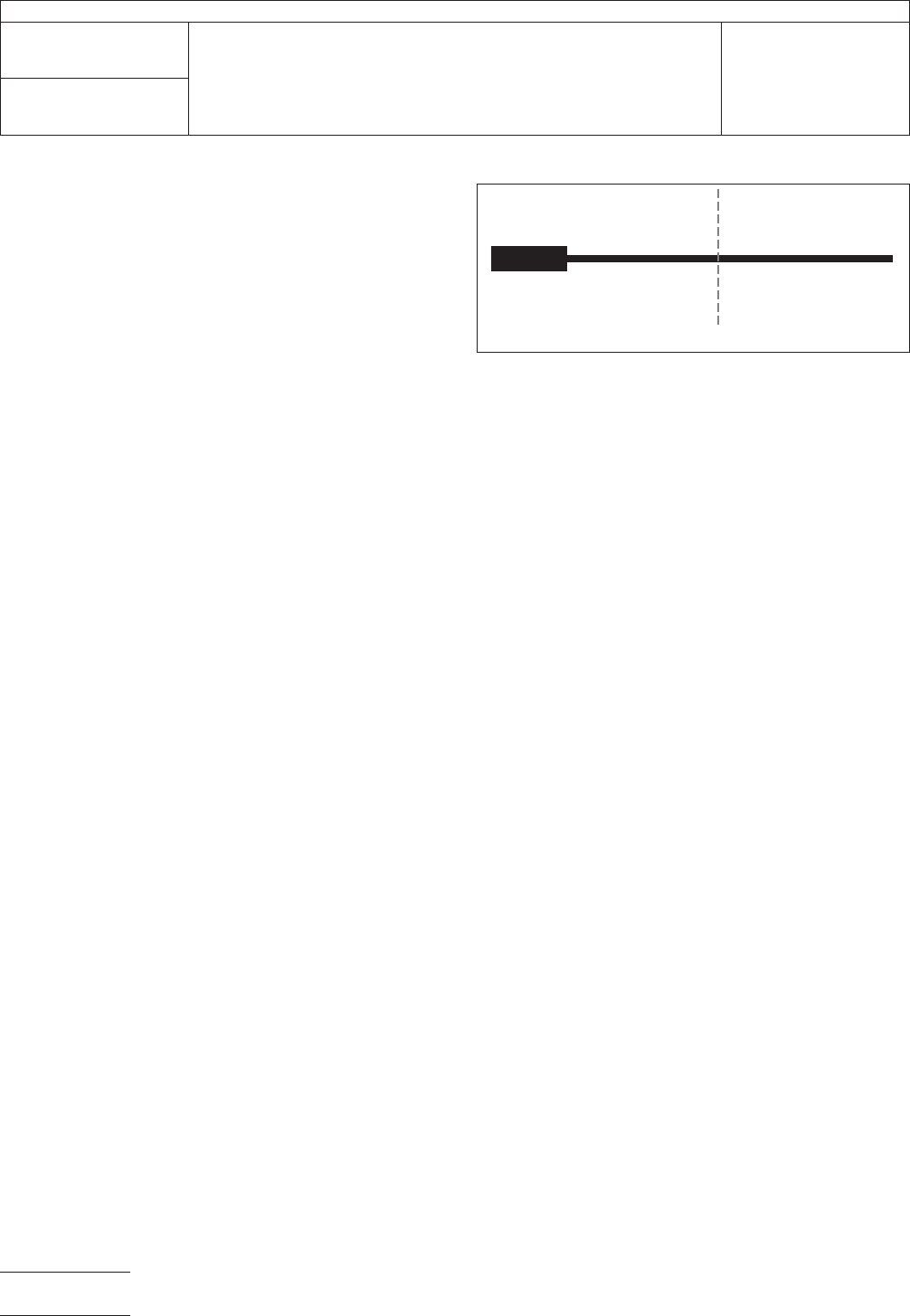
accordance with Figure 2.
5.1.2 Conditioning Condition each test specimen for 24
hours +1/-0 hours at 23 °C±2°C[73.4 °F ± 93.6 °F] and
50% ± 5% relative humidity prior to testing.
5.1.3 Test Procedure
5.1.3.1 Sequential Chemical Exposure Test
Immerse
three (3) test specimens for one minute [+10 seconds/-0 sec-
onds] halfway into each of the specified chemicals. After
immersion in each chemical, rinse each test specimen in the
appropriate dedicated immersion DI water rinse which is
maintained at 55 °C±5°C[131 °F ± 9 °F] for one (1) minute
minimum and five (5) minutes maximum. Use the sequence as
follows:
1. Etchant Solution
2. Dedicated Etchant DI Immersion Rinse
3. Stripper Solution
4. Dedicated Stripper DI Immersion Rinse
5. Acid Cleaner
6. Dedicated Acid Cleaner DI Immersion Rinse
7. Organic Cleaner
8. Dedicated Organic Cleaner DI Immersion Rinse
Within fifteen (15) to thirty (30) minutes after completion of the
sequential chemical exposure, observe for tackiness, blister-
ing, bubbles, delamination, or swelling within the dielectric,
blistering or delamination of the copper and dielectric, or
change in color of dielectric. After sixteen (16) to twenty-four
(24) hours, repeat the observations and peel the conductors
for the immersed and non-immersed specimens, using the
following procedure [see IPC-TM-650, Method 2.4.9 (Method
A)].
Attach the test specimen to the free wheeling rotary drum test
fixture with double-sided tape, cement and/or mechanical
clamps. The referee attachment technique will be double-
sided adhesive tape. Peel the conductor at a rate (crosshead
speed) of 50.8 mm/minute [2.0 in/minute]. The peel load shall
be between 15 - 85 percent of the range of the scale used on
the testing machine.
5.1.4 Data Evaluation Record and report all discrepancies
noted during the observation periods The peel load shall be
IPC-232g-2
Figure 2 Chemical Resistance Test Pattern with Halfway
Line Marking Example
Immersion Line
Tab end Immerse this end
IPC-TM-650
Number
2.3.2
Subject
Chemical Resistance of Flexible Printed Board Materials
Date
12/07
Revision
G
Page2of3

continuously recorded, and the recorded load for the entire
length of peeled conductor shall be evaluated by averaging
the chart recording values for each segment (immersed and
non-immersed) of each test specimen. A minimum of 57.2
mm [approximately 2.25 in] shall be peeled for each seg-
ment, with the first 6.4 mm [approximately 0.25 in] to be dis-
regarded. Compare the average peel strengths of the
immersed segments of the three (3) test traces with those of
the non-immersed segments of the same three (3) test traces,
in accordance with the following formula:
[Average Peel Strengths of three (3)
immersed test trace segments]
x100=%ofOriginal
†
[Average Peel Strengths of three (3)
non-immersed test trace segments]
†
NOTE: Values may be higher than 100%, which may indicate chemical
absorption.
5.2 Method B – Bare Dielectric
5.2.1 Test Specimen Preparation
Cut twelve (12) test
specimens, as per 3.2. This allows for at least one full repeti-
tion of tests, if needed.
5.2.2 Conditioning Condition each specimen for 24 hours
at23°C±2°C[73.4 °F ± 3.6 °F] and 50% ± 5% relative
humidity prior to testing.
5.2.3 Test Procedure
5.2.3.1 Sequential Chemical Exposure Test
Fully
immerse three (3) test specimens for one (1) minute [+10
seconds/-0 seconds] into each of the specified chemicals on
a sequential basis. After immersion in each chemical, rinse the
specimen in the appropriate dedicated immersion DI water
rinse which is maintained at 55 °C±5°C[131 °F ± 9 °F] for
one (1) minute minimum and five (5) minutes maximum. Use
the sequence as follows:
1. Etchant Solution
2. Dedicated Etchant DI Immersion Rinse
3. Stripper Solution
4. Dedicated Stripper DI Immersion Rinse
5. Acid Cleaner
6. Dedicated Acid Cleaner DI Immersion Rinse
7. Organic Cleaner
8. Dedicated Organic Cleaner DI Immersion Rinse
Within fifteen (15) to thirty (30) minutes after completion of the
sequential chemical exposure, observe for tackiness, blister-
ing, bubbles, delamination, or swelling within the dielectric or
change in color of dielectric. After sixteen (16) to twenty-four
(24) hours, repeat the observations and determine the tensile
strength and elongation using the procedure as described in
IPC-TM-650, Method 2.4.18.3.
5.2.4 Data Evaluation Record and report all discrepancies
noted during the observation periods. The evaluation is con-
sidered to have passed when the immersed specimens meet
or exceed the minimum tensile strength and elongation
requirements for the material under test. If the immersed test
specimens do not pass, then the non-immersed specimens
shall be tested for both tensile strength and elongation to
verify that these parameters pass the requirements for the
material under test. If the non-immersed test specimens do
not pass, then the lot of bare dielectric, represented by the
test specimens, shall be rejected.
IPC-TM-650
Number
2.3.2
Subject
Chemical Resistance of Flexible Printed Board Materials
Date
12/07
Revision
G
Page3of3
1.0
Scope
This
test method is used for determining that
marking inks and/or color coding will not become illegible or
discolored when subjected to solutions that are normally used
as cleaning agents for printed boards or printed board assem-
blies.
2.0
Applicable Documents
None
3.0
Test Specimens
Test
specimens may consist of test
coupons or production printed boards with the appropriate
markings. The amount or size of the marking on the test
specimen shall be sufficient enough to satisfactorily perform
the procedure of section 5.
4.0
Apparatus or Material
4.1
Vessel
for each solution used.
4.2
Toothbrush
or suitable applicator for each solution used.
4.3
Optical
Aid capable of a 3X magnification.
4.4
Solution
A: Mixture of one part isopropyl alcohol and
three parts by volume of mineral spirits at 25 ± 5°C.
4.5
Solution
B: Terpene defluxer consisting of a minimum of
90% d-limonene and 10% surfactant at 25 ± 5°C.
4.6
Solution
C: Mixture of 42 parts by volume of water (1
megohm resistivity), one part by volume of propylene glycol
monmethyl ether, and one part by volume of monoethanola-
mine at 63 to 70°C.
5.0
Procedure
5.1
The
following procedure shall be using solutions A, B,
and C individually.
5.1.1
The
test specimens shall be submerged for a mini-
mum of 3 minutes (+ .5 minutes/ – 0.0 minutes) in a vessel
containing the solution.
5.1.2
The
test specimens shall be removed from the vessel
and with a toothbrush (wetted with solution) the specimen
shall be brushed for a minimum of 10 strokes on the area
where the marking is present.
5.1.3
Steps
5.1.1 and 5.1.2 shall be repeated on the test
specimen two additional times.
5.1.4 After
the third submersion and brushing, the test
specimens shall be air or blown dry.
5.1.5
The
test specimens shall be evaluated in accordance
with 5.2.
5.2
Evaluation
After
the test has been performed, the test
specimens shall be examined for any markings that are miss-
ing in whole or part, faded, smeared, blurred or shifted to the
extent that they cannot be identified from a distance of 150
mm [6.0 in] or by examining with a optical aid using a magni-
fication of no more than 3X shall constitute a failure.
6.0 Notes
6.1
If
test solutions other than those described herein are to
be used, then the solutions should be agreed upon between
the vendor and customer prior to testing.
6.2
The
three solutions being used to perform this test
exhibit some potential for health and safety hazards. Safety
precautions shall be observed.
6.3
It
is the intent of this test method to subject a different
set of test samples to each test solutions. It is at the option of
the tester to subject the samples through the test solutions
consecutively. If the samples fail after consecutive solutions
the test should be performed with individual test solutions.
The
Institute for Interconnecting and Packaging Electronic Circuits
2215 Sanders Road • Northbrook, IL 60062-6135
IPC-TM-650
TEST
METHODS MANUAL
Number
2.3.4
Subject
Chemical
Resistance, Marking Paints and Inks
Date
8/97
Revision
B
Originating Task Group
Rigid Board T.M. Task Group, 7-11d
Material
in this Test Methods Manual was voluntarily established by Technical Committees of the IPC. This material is advisory only
and its use or adaptation is entirely voluntary. IPC disclaims all liability of any kind as to the use, application, or adaptation of this
material. Users are also wholly responsible for protecting themselves against all claims or liabilities for patent infringement.
Equipment referenced is for the convenience of the user and does not imply endorsement by the IPC.
P
age1of1
电子技术应用 www.ChinaAET.com