IPC-TM-650 EN 2022 试验方法.pdf - 第309页
5.3.1 Clean the metal clad specimen by light abrasion or other suitable method, then flux the metal surface with a rosin flux conforming to MIL-F-14256. 5.3.2 Clean the unclad specimens by standard production techniques,…

1
Scope
This
test method is used to determine the resis-
tance of laminate materials (both unclad and etched surfaces)
to the thermal abuse of a solder dip. Resistance to softening,
loss of surface resin, scorching, delamination, blistering and
measling are considered in the evaluation.
2
Applicable Documents
IPC-TM-650
Test
Methods Manual
2.4.1 Adhesion, Tape Testing
2.4.12 Solderability, Edge Dip Method
MIL-F-14256
Flux
3
Test Specimen
Each
specimen must be 3.18 cm x 3.18
cm thickness. A separate specimen is required for the unclad,
etched, fluxed, and unfluxed tests. Three samples are
required from each sheet.
4
Equipment/Apparatus
4.1
An
electrically heated, thermostatically controlled pot of
sufficient size to accommodate the specimen and containing
no less than 2.25 kg of Sn6O or Sn63
4.2
A
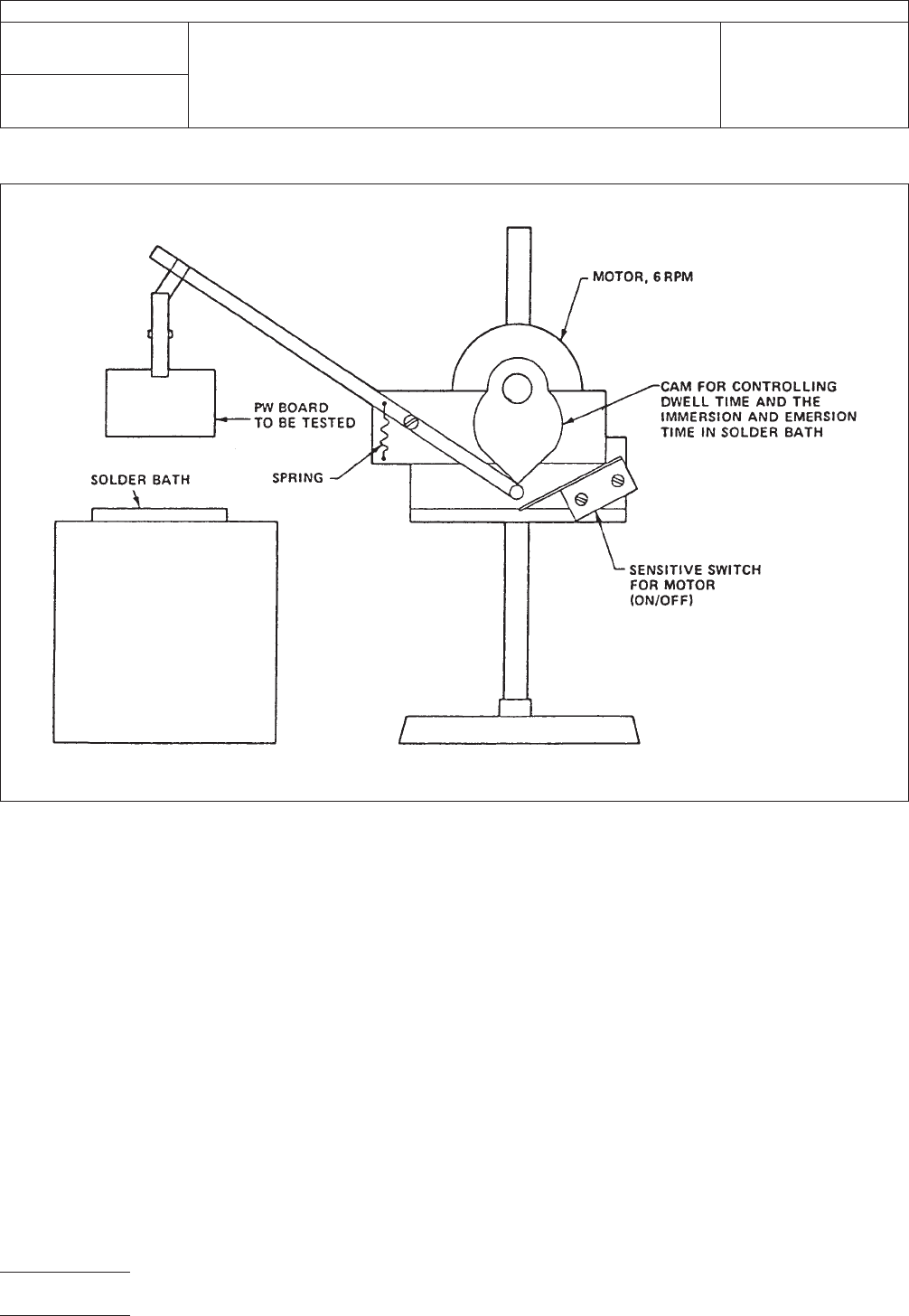
device, as shown in Figure 1, or some other similar
device may be used, if:
• The rate of immersion, dwell time, and withdrawal are within
the test limits described in the procedure
• The specimen and solder surface remain perpendicular
within 5°
• Wobble, vibrations, and other extraneous movements are
eliminated
4.3
Warnow
2-710 black acid resisting ink, or equivalent
4.4
NAZ-DAR
ER-111 black epoxy ink, or equivalent
4.5
A
convection drying oven capable of attaining at least
149°C
5
Procedure
5.1 Etched and Unetched Specimen
5.1.1
Expose:
•
One specimen having a surface upon which no metal clad-
ding was ever applied
• One specimen on which the metal cladding has been
removed by standard etching processes
• One specimen with metal cladding remaining to the Solder-
ability Edge Dip Method in IPC-TM-650, Method 2.4.12
5.1.2
Examine
the specimens for evidence of discoloration
or surface contaminants, loss of surface resin, softness,
delamination, interlaminar blistering, or measles. The speci-
men having metal cladding must also be examined for blister-
ing or delamination of the metal foil from the laminate material.
5.2
Plastic Surface Tape Test
5.2.1
Screen
print one of the test inks to the surfaces of an
unclad specimen and an etched specimen.
5.2.2
Treat
test inks as follows:
1. Warnow 2-710: Cure for a minimum of 30 minutes in air or
oven. The dry film must be hard and dull in finish.
2. NAZ-DAR ER-111: Cure for a minimum of 8 minutes at
135°C. The cured ink must have a hard glossy finish.
5.2.3
After
the specimens have cured properly, perform the
plating adhesion test on the inked surfaces, as defined in IPC-
TM-650, Method 2.4.1. Use type I class A tape.
5.2.4
Carefully
examine specimens for the items discussed
in 5.1.2.
5.2.5
Examine
for evidence of mold release agents, indi-
cated by particles of ink adhering to the tape, or by the
absence of ink from the laminate surface, or both.
5.3
Fluxed and Unfluxed Specimens
The
Institute for Interconnecting and Packaging Electronic Circuits
2215 Sanders Road • Northbrook, IL 60062-6135
IPC-TM-650
TEST
METHODS MANUAL
Number
2.4.23
Subject
Soldering
Resistance of Laminate Materials
Date
3/79
Revision
Originating Task Group
N/A
Material
in this Test Methods Manual was voluntarily established by Technical Committees of the IPC. This material is advisory only
and its use or adaptation is entirely voluntary. IPC disclaims all liability of any kind as to the use, application, or adaptation of this
material. Users are also wholly responsible for protecting themselves against all claims or liabilities for patent infringement.
Equipment referenced is for the convenience of the user and does not imply endorsement by the IPC.
P
age1of2
电子技术应用 www.ChinaAET.com
5.3.1
Clean
the metal clad specimen by light abrasion or
other suitable method, then flux the metal surface with a rosin
flux conforming to MIL-F-14256.
5.3.2
Clean
the unclad specimens by standard production
techniques, then flux the laminate material with a rosin flux
conforming to MIL-F-14256.
5.3.3
Carefully
examine all specimens, then perform the
tests described in 5.1.1 through 5.2.5.
IPC-2412-1
Figure
1 Suggested Dipping Device
IPC-TM-650
Number
2.4.23
Subject
Soldering
Resistance of Laminate Materials
Date
3/79
Revision
P
age2of2
电子技术应用 www.ChinaAET.com

1.0
Scope
This
test is designed to determine the Glass
Transition Temperature (T
g
)
and the Thermal Expansion in the
Z-Axis of dielectric materials used in printed boards by the use
of thermal mechanical analysis (TMA).
Thermal Expansion (TE) is expressed in Coefficient of Thermal
Expansion (CTE) or Percent of Thermal Expansion (PTE).
2.0
Applicable Documents
None
3.0
Test Specimens
3.1 Size
Specimens
shall be approximately 6.35 mm x
6.35 mm [0.25 in x 0.25 in]. The thickness shall be a minimum
of 0.51 mm [0.020 in]; for thicknesses less than 0.51 mm
[0.020 in], or to increase the accuracy of the test, see 6.4.
3.2
Quantity and Sampling
Unless
otherwise specified,
two specimens shall be tested, to be taken from random loca-
tions of the material in question.
4.0
Apparatus or Material
4.1
Thermomechanical
analyzer (TMA) capable of determi-
nation of dimensional change to within 0.0025 mm [0.0001 in]
over the specified temperature range.
4.2
Diamond
blade or wheel, sanding equipment, or equiva-
lent, to provide a specimen of the size and edge quality speci-
fied.
4.3
Desiccator
capable of an atmosphere less than 30%
R.H. at 23°C [73.4°F].
4.4
Etching
system capable of complete removal of metallic
cladding.
4.5 Air
circulating oven capable of maintaining 105 ± 2°C
[221 ± 3.6°F].
4.6
Micrometer
capable of thickness measurements to
within 0.00025 mm [0.0001 in].
5.0
Procedure
5.1 Specimen Preparation
5.1.1
Metallic
clad laminate shall be tested without the clad-
ding. Specimens taken from multilayer boards shall have no
internal metal layers, if possible. Exterior metallic cladding shall
be removed by etching using standard industry practices.
5.1.2
Specimens
shall be cut to the specified size using
appropriate procedures and equipment to minimize mechani-
cal stress or thermal shock.
5.1.3
The
edges shall be smooth and burr-free by means of
sanding or equivalent (to allow the specimen to rest com-
pletely flat on the mounting stage). Use care to minimize
stress or heat on the specimen.
5.1.4
Specimens
shall be preconditioned by baking for 2 ±
0.25 hours, at 105 ± 2°C [221 ± 3.6°F], then cooled to room
temperature in a desiccator.
5.1.5
If
applicable, determine the thickness of the specimen
(for determination of Percent of Thermal Expansion) and
record as T
o
.
5.2
Measurement
5.2.1
Mount
the specimen on the stage of the TMA and
apply a load between 0.1 g and 10.0 g (see note 6.5 for
explanation of the load selection criteria).
5.2.2
Initial Temperature for Startup
a.
For T
g
determination,
start the scan at a temperature no
higher than 35°C [95°F]. An initial temperature of 23°C
[73°F] is recommended.
b. For TE determination start the scan at a temperature suf-
ficiently lower than the specified temperature range such
that the specified heat rate is stabilized (see 6.6).
5.2.3
Unless
otherwise specified, maintain the scan rate at
10°C [18°F] per minute.
5.2.4
Temperature Excursion
a.
For Tg determination, continue the temperature ramp to
at least 30°C [54°F] above the anticipated transition
region.
b. For TE determination, continue the temperature ramp to
The
Institute for Interconnecting and Packaging Electronic Circuits
2215 Sanders Road • Northbrook, IL 60062-6135
IPC-TM-650
TEST
METHODS MANUAL
Number
2.4.24
Subject
Glass
Transition Temperature and Z-Axis Thermal
Expansion by TMA
Date
12/94
Revision
C
Originating Task Group
MIL-P-13949 Test Methods Task Group (7-11b)
Material
in this Test Methods Manual was voluntarily established by Technical Committees of the IPC. This material is advisory only
and its use or adaptation is entirely voluntary. IPC disclaims all liability of any kind as to the use, application, or adaptation of this
material. Users are also wholly responsible for protecting themselves against all claims or liabilities for patent infringement.
Equipment referenced is for the convenience of the user and does not imply endorsement by the IPC.
P
age1of3
电子技术应用 www.ChinaAET.com