IPC-TM-650 EN 2022 试验方法.pdf - 第458页
1.0 Scope 1.1 Summary This method is for measurement of relative permittivity ( ε r ) and dissipation factor or loss tangent (tan δ )o f circuit board substrates under stripline conditions. Measure- ments are made by mea…
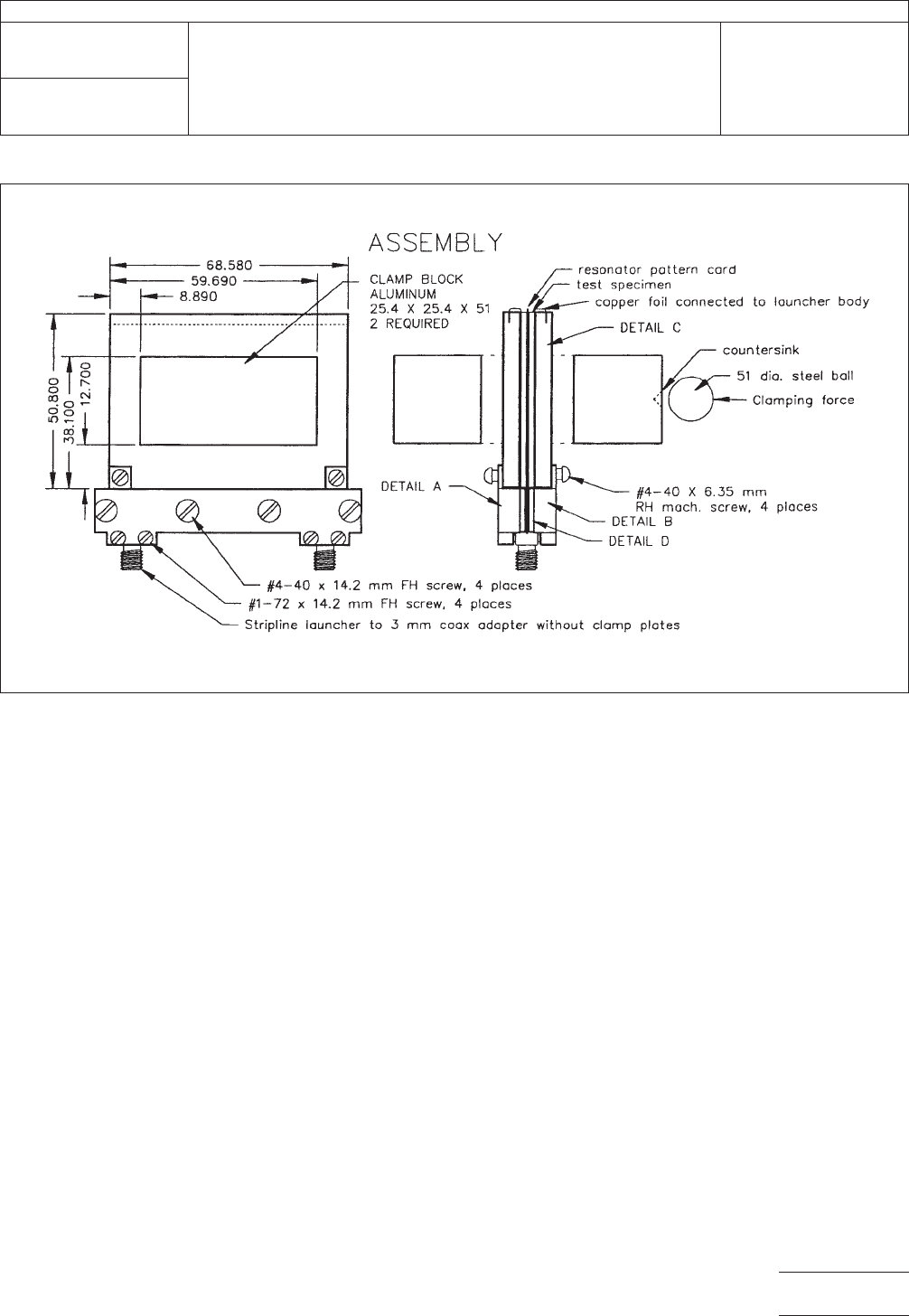
IPC-2555-17
Figure
17 Test Fixture Construction, Older Design (Continued)
IPC-TM-650
Number
2.5.5.5
Subject
Stripline
Test for Permittivity and Loss Tangent (Dielectric Constant
and Dissipation Factor) at X-Band
Date
3/98
Revision
C
Page
25 of 25
电子技术应用 www.ChinaAET.com

1.0
Scope
1.1 Summary
This
method is for measurement of relative
permittivity (ε
r
)
and dissipation factor or loss tangent (tan δ)of
circuit board substrates under stripline conditions. Measure-
ments are made by measuring resonances of a length of strip-
line over a wide frequency range from below 1 GHz to about
14 GHz
(1,2)
.
The method permits a wide variety of specimen
configurations, varying in dielectric thickness, width of center
conductor, and use of clad or laid up conductor foil
(3)
.
Sensi-
tivity to differences in tan δ are enhanced by the ability to
adjust the degree of coupling to the resonator by adjusting an
air gap between probes and the resonator ends. Many of the
principles used in IPC-TM-650, Method 2.5.5.5, are applied in
this method.
1.2
Terminology
Terms
used in this method include:
Complex Relative Permittivity—The values for relative permit-
tivity and dissipation factor considered as a complex number.
Permittivity—Dielectric constant (see IPC-T-50) or relative per-
mittivity. The symbol used in this document is ε
r
. Κ’o
rκ’ are
also sometimes used.
Relative Permittivity—A dimensionless ratio of absolute per-
mittivity of a dielectric to the absolute permittivity of a vacuum.
Loss Tangent—Dissipation factor (see IPC-T-50), dielectric
loss tangent (see 9.2). The symbol used in this document is
tan δ.
1.3
Limitations
The
limitations in described in 1.3.1
through 1.3.4 should be noted.
1.3.1
The
measured effective permittivity for the resonator
element can differ from that observed in an application.
Where the application is in stripline and the line width to
ground plane spacing is less than that of the resonator ele-
ment in the test, the application will exhibit a greater compo-
nent of the electric field in the X, Y plane. Heterogeneous
dielectric composites are anisotropic to some degree, result-
ing in a higher observed ε
r
for
narrower lines.
Microstrip lines in an application may also differ from the test
in the fraction of substrate electric field component in the X, Y
plane.
Bonded stripline assemblies have air excluded between
boards and thus tend to show greater ε
r
values
than would be
obtained with this method using specimen types A or, to
lesser extent, B, as discussed in 3.0.
1.3.2
As
with IPC-TM-650, Method 2.5.5.5, with specimen
type A, or, to a lesser extent, with B (see 3.0), we expect the
method to show a downward bias in measured ε
r
.
This is
caused by the electric field crossing clamped dielectric-
conductor interfaces with air included in the surface rough-
ness.
1.3.3
With
specimen type B, C, or D, the method shows an
upward bias in measured tan δ. This is caused by the surface
roughness and/or surface treatment of the clad copper foil
required for adequate adhesion to the dielectric.
1.3.4
Compared
to IPC-TM-650, Method 2.5.5.5, both
done with computer automated data collection, this method
requires a greater degree of operator skill and more time to
prepare specimens and perform measurements.
1.4
Advantages
1.4.1
The
sensitivity of the method to differences in ε
r
of
specimens
should be superior to that of IPC-TM-650, Method
2.5.5.5 since the specimen comprises all of the dielectric
affecting the measurement.
1.4.2
The
method is known to be more sensitive to differ-
ences in tan δ than IPC-TM-650, Method 2.5.5.5. We believe
the ability to adjust the degree of probe-to-resonator coupling
to a low enough value that Q
loaded
is
close to Q
unloaded
(see
7.2.2)
makes this possible.
1.4.3
The
method is expected to lend itself to use of stable
referee specimens of known electric properties traceable to
NIST (National Institute of Standards and Technology).
2.0
Applicable Documents
IPC-MF-150
Metal
Foil for Printed Wiring Applications
IPC-TM-650
Method
2.5.5.5, Stripline Test for Permittivity
and Loss Tangent (Dielectric Constant and Dissipation Factor)
at X-Band
2215
Sanders Road
Northbrook, IL 60062-6135
IPC-TM-650
TEST
METHODS MANUAL
Number
2.5.5.5.1
Subject
Stripline
Test for Complex Relative Permittivity of
Circuit Board Materials to 14 GHz
Date
3/98
Revision
Originating Task Group
High Speed/High Frequency Test Methods
Subcommittee (D-24)
Material
in this Test Methods Manual was voluntarily established by Technical Committees of the IPC. This material is advisory only
and its use or adaptation is entirely voluntary. IPC disclaims all liability of any kind as to the use, application, or adaptation of this
material. Users are also wholly responsible for protecting themselves against all claims or liabilities for patent infringement.
Equipment referenced is for the convenience of the user and does not imply endorsement by the IPC.
P
age1of11
ASSOCIA
TION CONNECTING
ELECTRONICS INDUSTRIES
电子技术应用 www.ChinaAET.com
3.0
Test Specimen
Specimen
length corresponds to an
available fixture length L. Longer L values enable lower mini-
mum resonant frequencies to be achieved. L is also the length
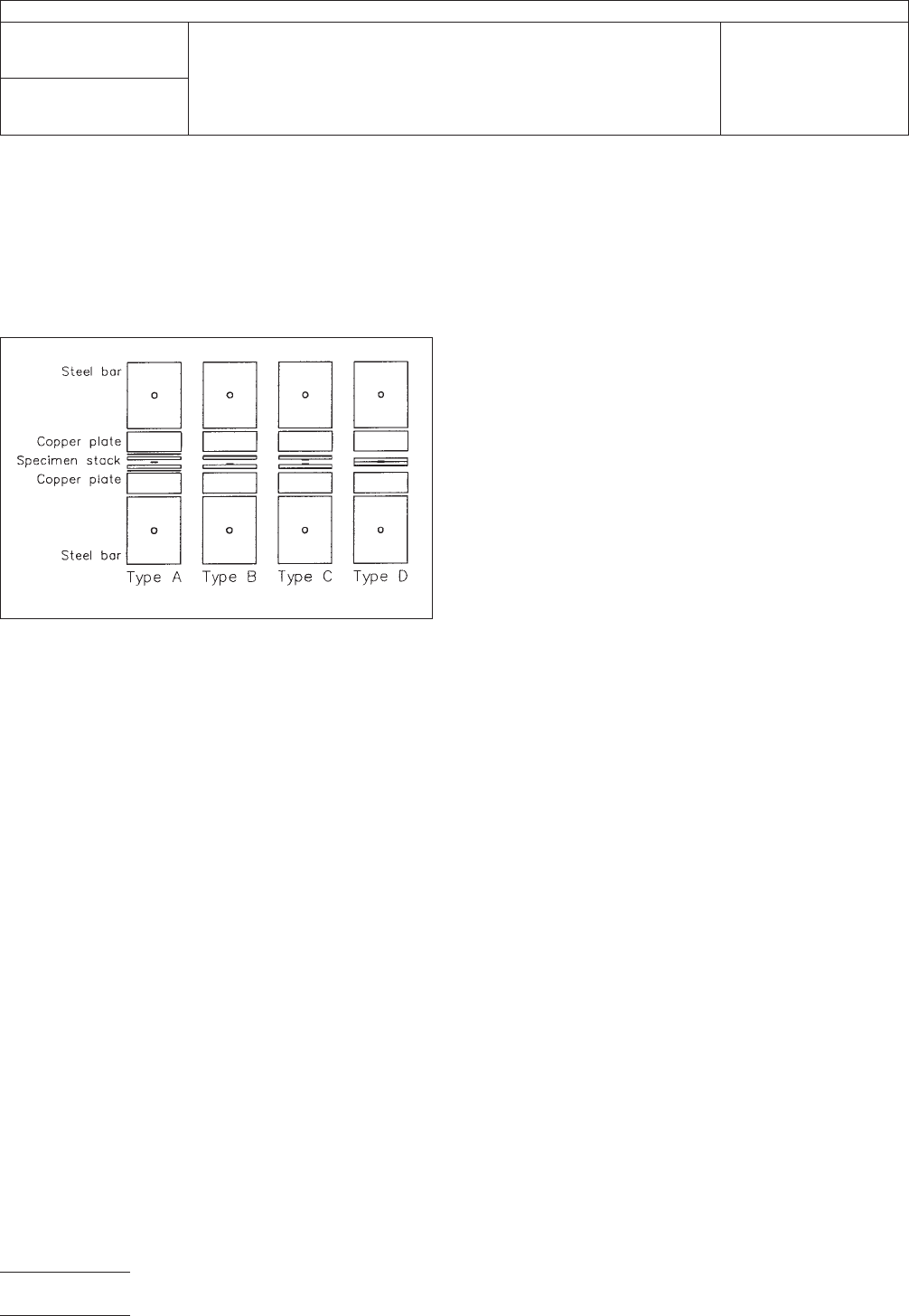
dimension of the copper plates described in 5.0. Four types of
specimens can be used for this method, as shown in Figure
1.
3.1
Type A
Two
25.4 mm wide by L long cards etched free
of copper cladding. These are placed on either side of a cen-
ter strip of smooth copper foil of specified thickness and width
and will be assembled between 25.4 mm wide by L long cop-
per foil cards.
3.2
Type B
One
25.4 mm wide by L long card with clad
copper on one side and copper etched off the other side, and
a second card of matching size with clad copper on one side
and copper etched off the other side except for a centered
strip of specified width extending to both ends of the card.
The copper free surface of the first card is assembled against
the etched strip of the other to form the stripline resonator.
3.3
Type C
Two
25.4 mm wide by L long cards with clad
copper on one side and copper etched off the other side
except for a centered strip of specified width extending to
both ends of the card. The etched strip surfaces of both cards
face together to form the stripline resonator.
3.4
Type D
Oversize
cards similar to type B are bonded
together with a selected bonding film and then trimmed to size
to form the stripline resonator assembly. This could be a test
coupon cut from a bonded stripline circuit board assembly.
For types B, C, and D, the specimen card should first be pre-
pared with about 5 mm or more excess length. Wide pressure
sensitive adhesive (PSA) tape can be used to mask the
ground plane side, and a narrow PSA tape can be used to
mask for the centered strip before etching off exposed cop-
per. Trimming the excess length after etching removes any
undercut areas at the ends. Trimming to length should be
done in a way that leaves the end surfaces with sharp edges
and no conductor edge distortion or smears over that surface.
Sanding specimens clamped between paper-phenolic lami-
nate drill-entry boards is an advised method for finishing the
end surfaces.
Type A specimens with untreated smooth copper foil will pro-
vide the most accurate values for tan δ, but will tend to have
a low bias on ε
r
.
Type C eliminates all clamped interfaces with
the air layer between the dielectric and the conductor to give
the most accurate ε
r
value
but, with the copper surfaces
treated for adhesion, tends to have a high bias on dissipation
factor. Type D gives a good measure of practical performance
in an application.
4.0
Suggested Electronic Apparatus
The
principal com-
ponents required for the test setup consist of the test fixture
described in 5.0 combined with the components described in
4.1, Figure 2, Type A and Type B, or preferably with the sys-
tem in 4.2, Figure 2, Type C.
4.1
A Test Setup for Computer Automation of Data
This
requires
a microwave signal source, an accurate means of
measuring the signal frequency, an accurate means for
detecting power level, and an accurate method of determin-
ing frequency values above and below the resonant frequency
at the half-power level for the test fixture loaded with the
specimen.
4.1.1
The
following components or equivalent, properly
interconnected, can be used most effectively with a computer
control program for automated testing.
• Sweep Frequency Generator Mainframe HP8350B
• RF Plug-In, 0.01 to 20 GHz HP83592A
• Power Splitter HP11667A
• Automatic Frequency Counter HP5343A
• Source Synchronizer HP5344A
Obtained as an interconnected assembly with the counter.
• Coaxial cables and adapters
IPC-125551-1
Figure
1 Exploded End Views of Stacked Specimen
Types A, B, C and D (See 3.0) with Copper Foil Thickness
Exaggerated and Including the Copper Plates (See 5.1.2)
and Steel Bars (See 5.1.1) of the Fixture
IPC-TM-650
Number
2.5.5.5.1
Subject
Stripline
Test for Complex Relative Permittivity of Circuit Board
Materials to 14 GHz
Date
3/98
Revision
P
age2of11
电子技术应用 www.ChinaAET.com