IPC-TM-650 EN 2022 试验方法.pdf - 第626页
• Junction overheated due to excessive forward current 6.2 Limits to Prevent Voltage Breakdown Due to Indi- vidual Transients As integrated circuit geometries shrink, dielectric breakdown voltage ratings also diminish. O…

4.2
AC
millivoltmeter capable of measuring true mvAC/rms
having a resolution of 0.1 mv AC. The frequency response of
the millivoltmeter shall be 20 Hz-to-20 Mhz. (MilliVac MV814A,
Hewlett-Packard HP3400B, or equivalent).
4.3
DC
millivoltmeter capable of measuring at least 60 mv
DC and having a resolution of 1 mv DC
4.4 Ohmmeter
with a digital readout unit. It shall possess
scales that can measure resistances beyond 5 MΩ with an
accuracy of ± 100 KΩ or better (± 10% or better of the lower
limit). The ohmmeter shall have a resolution of 0.1 MΩ or
better.
4.5
Storage
oscilloscope, 100 Mhz bandwidth or faster, 1
MΩ input vertical amplifier
4.6 Oscilloscope
probe - X10 Attenuation
4.7
Constant
current Source capable of providing 10 milli-
amps DC
4.8
Resistor,
4.99 Ω, 1% precision
1
⁄
4
w
or greater (any com-
mercially available brand carbon or metal film)
4.9
Power
line filter, 20 ampere @ 115 VAC, 50 dB insertion
loss @ 5 Mhz/50Ω
4.10
Test
box (see 5.1)
4.11
Screen
room/shielded enclosure (optional) capable of
accommodating the entire UUT, cord, and hand piece. A fil-
tered AC power receptacle shall be available from within (see
Method 2.5.33.4).
4.12
Resistor,
1.00 KΩ, 1% (any commercially available
brand carbon or metal film)
4.13
Diodes
(two), which shall be of the lowest practicable
known forward bias devices. 1N34 diodes have been found
satisfactory for this purpose.
4.14
AC
Receptacles (two)
4.15
Line
cord
4.16
Strain
relief
4.17 BNC
Connector
4.18
Edge
card connector w/mounting hardware
4.19
Metal
(bud) box
5
Procedure
All
the following test procedures should be
completed to ensure compliance with ANSI/J-STD-001:
Method 2.5.33.1 Measurement of Electrical Overstress
from Soldering Hand Tools—Ground
Measurements
Method 2.5.33.2 Measurement of Electrical Overstress
from Soldering Hand Tools—Transient
Measurements
Method 2.5.33.3 Measurement of Electrical Overstress
from Soldering Hand Tools—Current
Leakage Measurements
To construct a bench top shielded enclosure for use in lieu of
a screen room, refer to:
Method 2.5.33.4 Measurement of Electrical Overstress
from Soldering Hand Tools—Shielded
Enclosure
5.1
Test Box
Testing
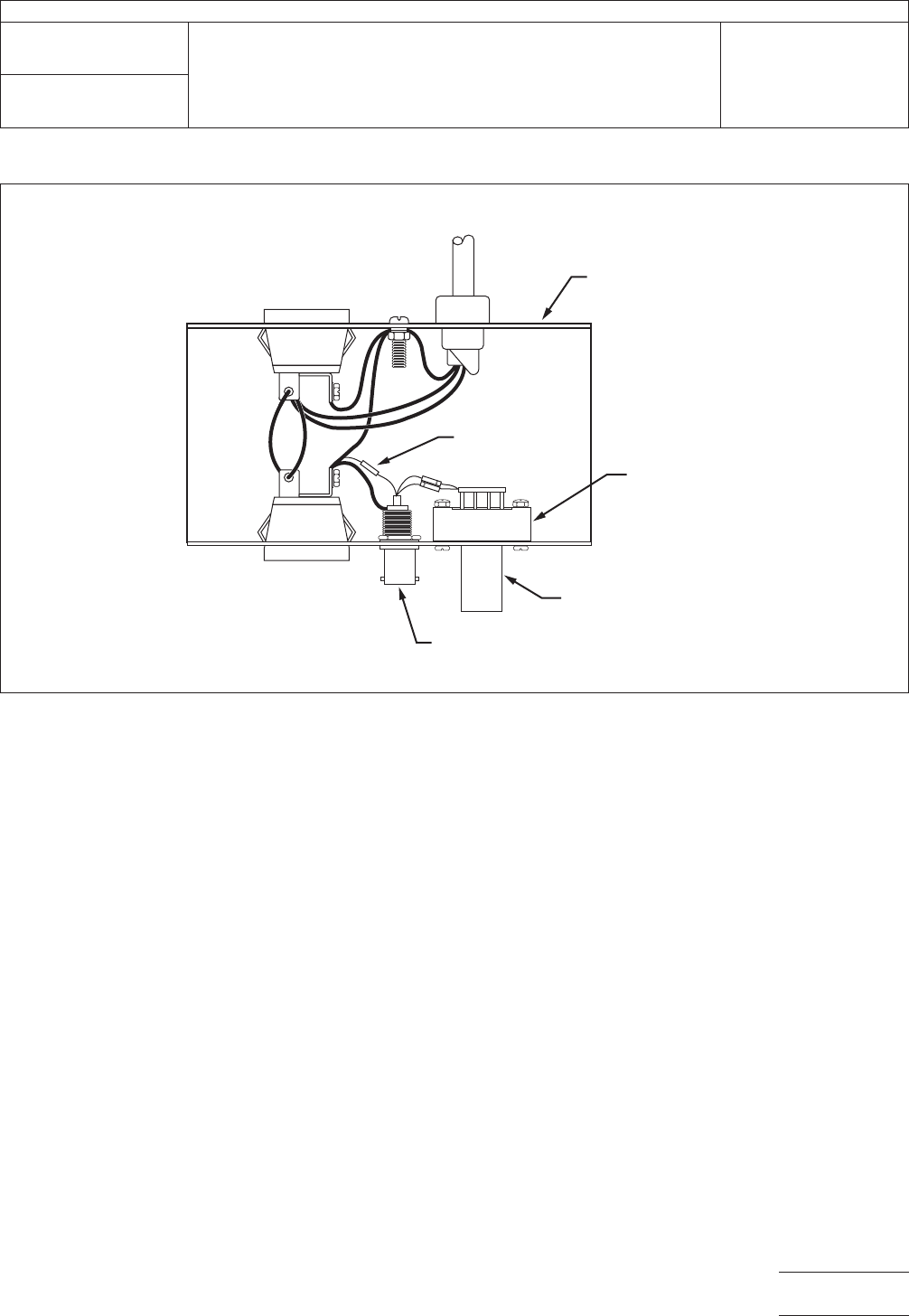
has shown that for UUTs that utilize
high frequency circuits, layout and cord positioning can influ-
ence the AC current leakage reading. A compact configura-
tion such as the one shown in Figure 1 minimizes those influ-
ences (see Method 2.5.33.3).
6 Notes
6.1
Pass/Fail Limits for Transients and Steady-Sate
Voltage
EOS/ESD
papers typically discuss possible dam-
age to electronic components coming from electrostatic dis-
charge (ESD). The potentials discussed typically are 100’s and
1000’s of volts. This test method is also concerned with the
possible damage to electronic components coming from elec-
trical overstress (EOS). The EOS potentials of concern will be
1’s of volts down to millivolts. This test method strives to set
achievable EOS limits for soldering/desoldering equipment
based upon the ability to construct soldering equipment as
well as resolve small potentials from background interference.
Although any electronic component can be damaged by suf-
ficient amounts of EOS/ESD, conventional wisdom states that
semiconductors are the most susceptible. Two obvious EOS/
ESD caused failure modes in semiconductors are:
• Dielectric breakdown or reverse voltage breakdown due to
excessive potential
IPC-TM-650
Number
2.5.33
Subject
Measurement
of Electrical Overstress from Soldering Hand
Tools
Date
11/98
Revision
P
age2of5
电子技术应用 www.ChinaAET.com
•
Junction overheated due to excessive forward current
6.2
Limits to Prevent Voltage Breakdown Due to Indi-
vidual Transients
As
integrated circuit geometries shrink,
dielectric breakdown voltage ratings also diminish. One semi-
conductor discussed here (battery operated integrated cir-
cuits) currently represents the lowest breakdown ratings.
S-MOS Systems’ SMC62L35 single-chip microcomputer is
designed to run from a single 1.5 volt battery. It has an abso-
lute maximum voltage (damage could result) of 2 volts.
The recommended limit for individual transients is 2 volts
peak.
6.3
Limits to Prevent Overheating Due to Steady-State
Leakage
Most
semiconductor junctions are intentionally
designed, but in integrated circuits, there are also unavoidable
intrinsic junctions. Also, there are junctions that are never sup-
posed to be operated in the forward direction (i.e., JFETs and
tuning diodes). The devices are not well character-ized by the
manufacturer regarding the maximum forward current.
Regardless of the nature of the junction, simultaneous forward
current and voltage drop results in power dissipation. If the
junction power results in a sufficient temperature increase, the
junction may be changed or destroyed. It is possible to pre-
vent forward current from flowing through a junction simply by
keeping the applied voltage below the forward junction volt-
age rating. Two semiconductors discussed here represent the
lowest forward junction voltage ratings: Schottky diodes and
germanium diodes. Motorola’s MBD201 Schottky diode and
most common germanium diodes begin to conduct at 220
millivolts. The test method apparatus represents these by
including commonly available 1N34 germanium diodes. To be
sure no junction heating can be caused by the UUT, the cur-
rent should be zero. But practically, since zero is difficult to
measure, a 1 microamp maximum tolerance can be permitted
without fear of overheating the junction. The recommended
limit for current leakage is 1 microamp (flowing through a
closed circuit, which includes parallel head-to-tail germanium
diodes).
IPC-2.5.33-1
Figure
1 Current Leakage Test Circuit Configuration
AC RECEPT
ACLE
FOR VOLTMETER
AC RECEPTACLE
FOR UUT
BNC CONNECTOR
FOR VOLTMETER
TEST ELECTRODE
CARD EDGE
CONNECTOR
1K RESISTOR
METAL BOX
DIODES
GRN
BLK
WHT
TO
AC
IPC-TM-650
Number
2.5.33
Subject
Measurement
of Electrical Overstress from Soldering Hand
Tools
Date
11/98
Revision
P
age3of5
电子技术应用 www.ChinaAET.com

6.4
Test Results
Complete
ALL shaded areas.
Description
of UUT (brand, model configuration, etc.):
T
est Procedure Pass/Fail Criteria Value Recorded Status
Ground
Measurements (2.5.33.1) ≤5 ΩΩ[ Pass [ Fail
Transient Measurements/Pass 1 (2.5.33.2) ≤2 V peak V [ Pass [ Fail
Transient Measurements/Pass 2 (2.5.33.2) ≤2 V peak V [ Pass [ Fail
Transient Measurements/Pass 3 (2.5.33.2) ≤ 2 V peak V [ Pass [ Fail
Current Leakage Measurements (2.5.33.3) ≤1.0 µ-amp DC µ-amp DC [ Pass [ Fail
Current Leakage Measurements (2.5.33.3) ≤1.0 µ-amp ACrms µ-amp ACrms [ Pass [ Fail
Description of Test Equipment and Configuration
Equipment
Function Brand Model Calibration Date
AC
millivoltmeter true mvAC/rms
DC millivoltmeter 60 mv DC
Ohmmeter resistances beyond 5
MΩ
Storage Oscilloscope 100 Mhz bandwidth or
faster, 1 MΩ input
vertical amplifier
Constant Current Source 10 milliamps DC
Equipment
Scale Used Cal / Std Meas. Baseline Meas.
AC
millivoltmeter
DC millivoltmeter
Ohmmeter
Storage Oscilloscope
Constant Current Source
Additional Comments:
Test
Completed by:
NAME:
DATE:
COMPANY: PHONE:
IPC-TM-650
Number
2.5.33
Subject
Measurement
of Electrical Overstress from Soldering Hand
Tools
Date
11/98
Revision
P
age4of5
电子技术应用 www.ChinaAET.com