IPC-TM-650 EN 2022 试验方法.pdf - 第471页
1.1 Measurement System Requirements 4.1.1 Measurement Accuracy The measurement accu- racy of the TDR should be sufficient to provide the required accuracy in the value of characteristic impedance. The required measuremen…

a.
The transmission line under test varies along its length
whereas the value of Z
0
obtained
assumes a uniform trans-
mission line. Therefore, the measured Z
0
only
approxi-
mates the characteristic impedance of an ideal line that is
representative of the line under test.
b. Lines on a printed circuit board may deviate significantly
from design. For example, microstrip lines longer than
15 cm [5.91 in] on boards with plated-through holes often
have variations in line width; this variation is due to plating
and/or etching variations.
c. If the transmission line is too short, the accuracy of the cal-
culated impedance value may be degraded (see 4.1.2). If
the transmission line is too long, skin effect and dielectric
loss may cause a bias in the impedance measurement.
d. Depending on where the measurements are made, the
value of Z
0
obtained
may be affected by dielectric and
conductor loss and other effects. The farther away from
the interface between the probe and the transmission line
under test, the worse these effects will be.
e. Duration of the measurement window (waveform epoch)
may need to be adjusted for sample length and location of
midpoint vias along the transmission line.
2
Reference/Applicable Documents
IPC-2141
Controlled
Impedance Circuit Boards and High
Speed Logic Design
IPC-TM-650
IPC
Test Methods Manual
1.9 Measurement Precision Estimation for Variables Data
3
Test Specimens
The
test specimen can take one of sev-
eral forms, depending on the application, but contains at least
one transmission (or interconnect) test structure. As
examples, four types are mentioned in 3.1.1 through 3.1.4.
The transmission lines to be measured may be of either strip-
line or microstrip construction and configured as either single-
ended or differential. See IPC-2141 for a recommended test
coupon design.
3.1
Test Specimen Examples
3.1.1 Example 1
Representative
samples of the actual
PCB being manufactured are selected. In some cases, this
sample set may contain all of the boards. Agreed upon func-
tional or nonfunctional transmission lines within the sample are
used for the measurement. Criteria for selection of such lines
includes:
a. Inclusion of the PCB’s critical features.
b. Accessibility of terminations for the line.
c. Absence of branching.
d. Absence of impedance changes within the transmission
line under test.
e. Representation of controlled Z
0
signal
layers in a multi-layer
board.
3.1.2
Example 2
Representative
samples should be as in
3.1.1, except that the test lines are nonfunctional lines
designed into the board for easy termination for TDR mea-
surements. Such test lines should be planned to include criti-
cal features typical of functional lines and should lie in con-
trolled Z
0
signal
layers.
3.1.3
Example 3
Representative
samples should be as in
3.1.1, except test coupons are cut from the master board at
the time the individual PCBs are separated. Such test cou-
pons will have one or more sample transmission lines with
termination suited for testing. Such test lines should include
critical features typical of functional lines and will be fabricated
in the same configuration and structure as the master board
on the same controlled Z
0
layers.
3.1.4
Example 4
A
sample of the substrate laminate to be
characterized before use in manufacturing PCBs is fabricated
with test transmission lines. The fabrication may involve lami-
nating several board layers together in the same manner
anticipated for PCB manufacture.
3.2
Identification of Test Specimen
For
specimens of
types called out in 3.1.1, 3.1.2, or 3.1.3, a board serial num-
ber, part number, and date code should be adequate. Speci-
mens from 3.1.4 should include whatever lot or panel identifi-
cation is available for the substrate laminate being evaluated.
3.3
Conditioning
If
conditioning is required, test speci-
mens shall be stored before testing at 23 °C (+1/-5) °C
[73.4 °F (+ 1.8/-0 °F)] and 50 % RH±5%RHfornoless than
16 hours. If a different conditioning procedure is used, it must
be specified by the user.
4
Equipment and Instrumentation
The
TDR measure-
ment system contains a step generator, a high-speed sam-
pling oscilloscope, and all the necessary accessories for con-
necting the TDR unit to the device under test. IPC-2141
provides a short discussion of the TDR system architecture,
system considerations, and the TDR measurement process.
IPC-TM-650
Number
2.5.5.7
Subject
Characteristic
Impedance of Lines on Printed Boards by TDR
Date
03/04
Revision
A
P
age2of23
电子技术应用 www.ChinaAET.com
1.1
Measurement System Requirements
4.1.1 Measurement Accuracy
The
measurement accu-
racy of the TDR should be sufficient to provide the required
accuracy in the value of characteristic impedance. The
required measurement accuracy of the TDR unit will depend
on the TDR measurement method. In general, the measure-
ment accuracy of the TDR unit should be better than 1% of
amplitude (either voltage or reflection coefficient). Noise in the
measured values will affect the uncertainty in the calculated Z
0
values.
The value of Z
0
may
be affected by the length of the
transmission line under test and the section of the transmis-
sion line from which Z
0
is
calculated (see 3.1.1.d).
4.1.2
Temporal/Spatial Resolution
The
resolution limit of
a given TDR unit is defined as that particular time or distance
wherein two discontinuities or changes on the transmission
line being measured, that would normally be individually dis-
cernable, begin to merge together because of limited TDR
system bandwidth. The resolution limit is specified in either
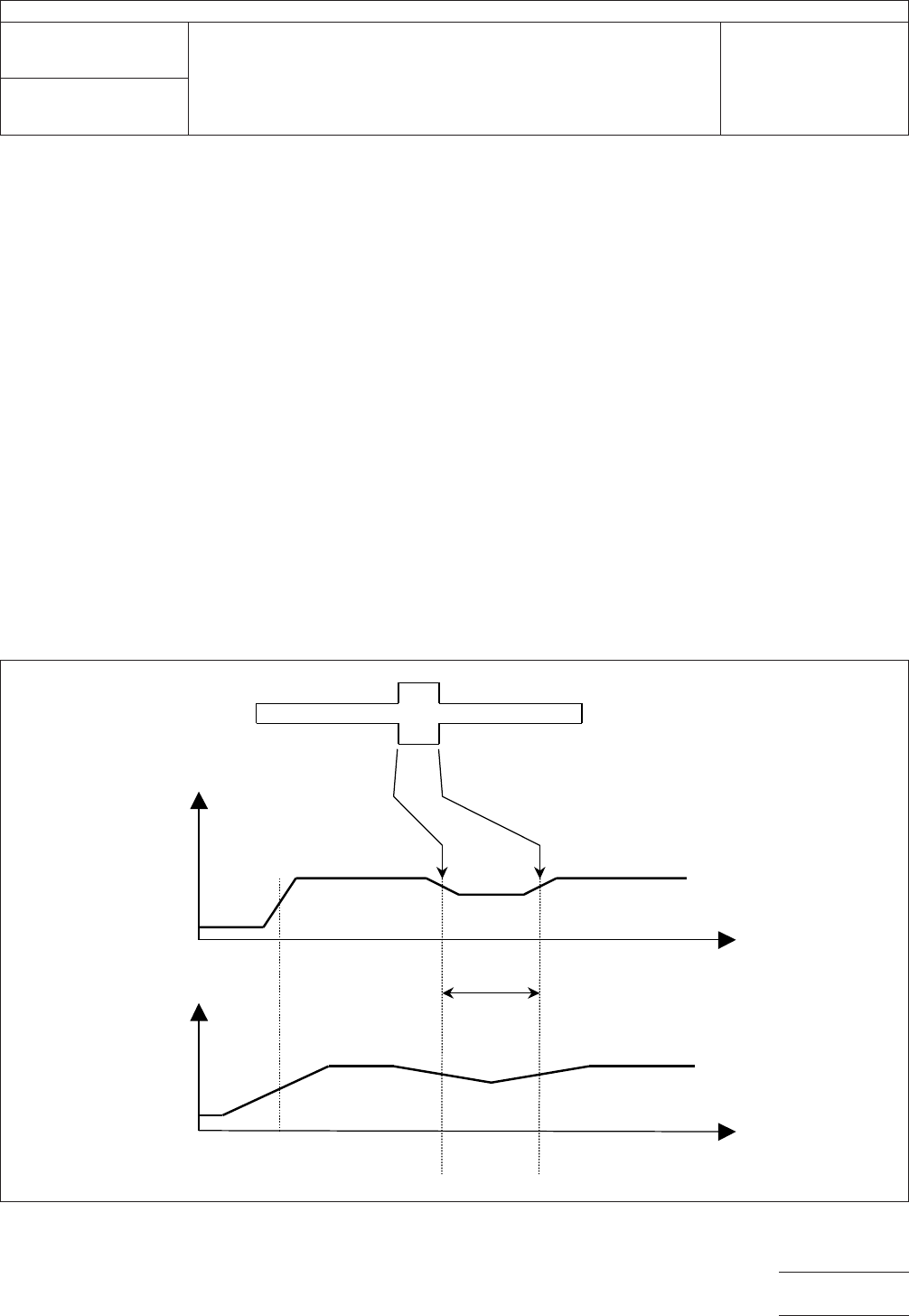
time or distance, and is always related to the one-way propa-
gation time between the two discontinuities, T
P
(see
Figure
4-1), and not the round trip propagation time.
Per this definition, the resolution limit is:
a. half the system risetime, t
sys
, where t
sys
is the 10 % to
90 % risetime or 90 % to 10 % falltime (depending on
whether the TDR response is calibrated with a short or
open circuit), or
b. 0.5 t
sys
x v
p
, where v
p
is
the signal propagation velocity in
the transmission line being measured.
These definitions are complementary.
For a given length of transmission line to be measured, the
resolution should not exceed one fourth (0.25) of the available
length, L
TL
of
the transmission line. Table 4-I provides
examples of required resolution for typical surface microstrips
in air, and on FR4 circuit board (v
p
≈ 2x10
8
m/s),
for a given
TDR system risetime.
IPC-2257a-4-1
Figure
4-1 Resolution and Electrical Length of Transmission Line
t
V
adequate resolution
t
V
inadequate resolution
2 T
p
transmission line
IPC-TM-650
Number
2.5.5.7
Subject
Characteristic
Impedance of Lines on Printed Boards by TDR
Date
03/04
Revision
A
P
age3of23
电子技术应用 www.ChinaAET.com
Intermediate
values can be linearly interpolated from Table 4-I
or using:
t
sys
≤
L
TL
2
1
v
p
For
example, if a 32 mm [1.26 in] long transmission line was
being measured, a TDR system with t
sys
≤ 80
ps should be
used. Note that, if the probe launch caused excessive ringing
in the TDR waveform, or if the launch does not repeatably
replicate the connection to the standard, then the 0.25 factor
may need to be smaller.
4.2
TDR Requirements
4.2.1 Impedance
The
impedance of the TDR unit should
be 50 Ω with an impedance uncertainty less than or equal to
± 0.5 Ω. This TDR impedance value is selected because it is
the impedance used by most high-speed/high-frequency test
instrumentation and compatibility with this instrumentation is
necessary for characterizing the dynamic TDR properties,
such as its impulse response (or transfer function). The imped-
ance of the TDR unit should be calibrated using an artifact
standard, such as an air line (see 4.3.6). However, the TDR
impedance is a function of frequency and calibration using a
fixed region of the TDR waveform (the measurement zone) will
only yield an average impedance value for the TDR unit for the
corresponding frequency range.
4.2.2
Timebase Accuracy
The
horizontal timebase accu-
racy defines how well the TDR instrument’s horizontal time
scale can display the correct length of the trace. This affects
both the accuracy of the measurement zone calculations and
any propagation delay values. The timebase accuracy should
be less than 0.25 t
sys
(see
also 4.1.2).
4.2.3
Step Aberrations
The
ability of the TDR instrument
to measure the impedance of a transmission line is related to
how well the instrument can generate a step-pulse with a
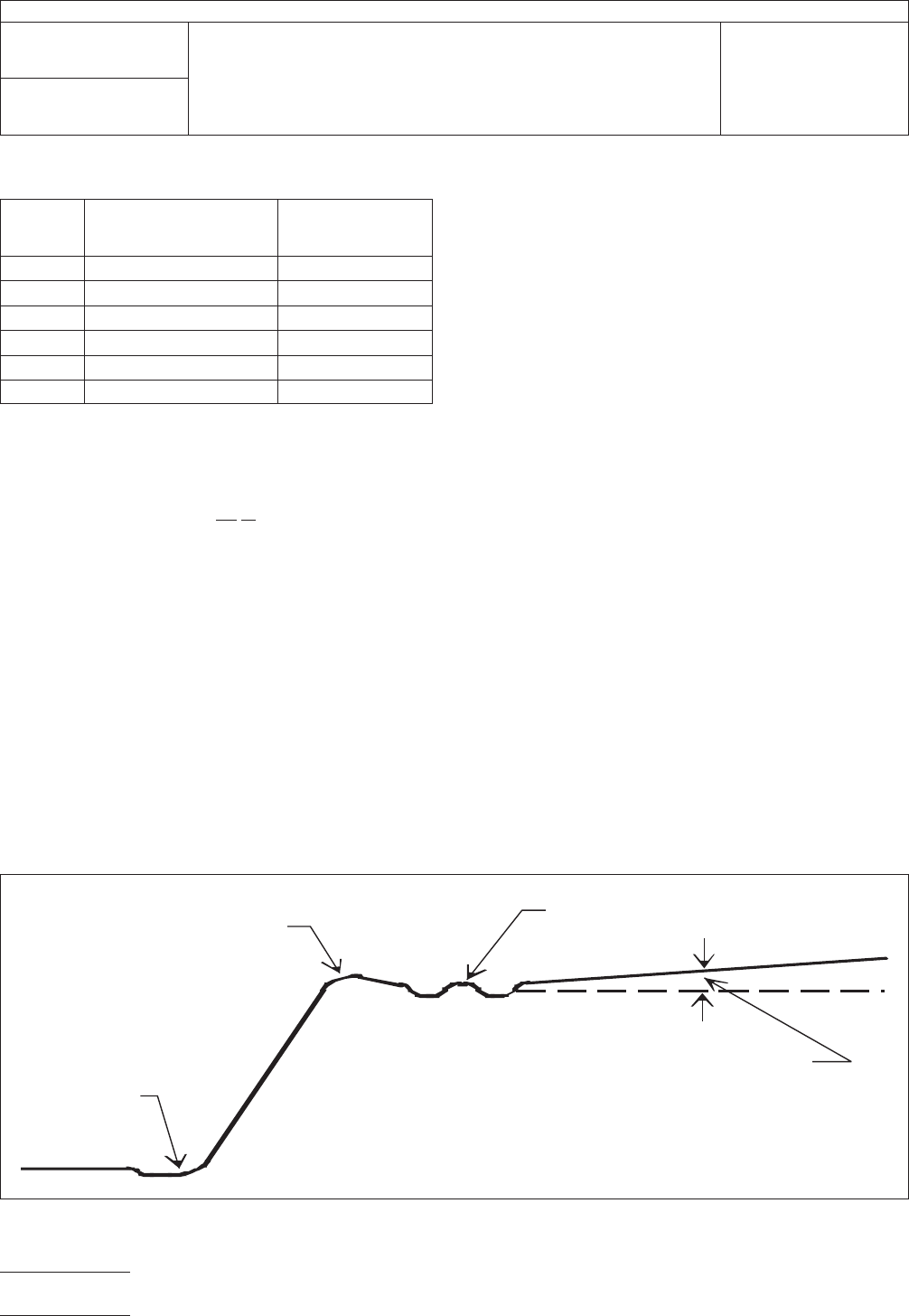
minimum of aberrations (ringing, overshoot, undershoot, set-
tling, etc.). Any ringing, overshoots, or undershoots will cause
corresponding aberrations in the TDR waveform (see Figure
4-2). These aberrations can cause significant errors in the
impedance value computed from the TDR waveform. Addi-
tionally, low frequency step aberrations may produce a ramp
in measurement zone. This ramp can cause a significant bias
in the computed impedance value. The TDR instruments step
aberrations should be less than 1% of the total step ampli-
tude. For example, the impedance error shown in Table 4-2 is
fora1mVerror of a 250 mV step. Poor settling and large
T
able 4-I Resolution of TDR Systems
TDR
System
Risetime
Resolution 4X Resolution
1
0ps 5ps/1mm[0.04 in] 4 mm [0.16 in]
20ps 10ps/2mm[0.08 in] 8 mm [0.31 in]
30ps 15ps/3mm[0.12 in] 12 mm [0.47 in]
100 ps 50 ps/ 10 mm [0.39 in] 40 mm [1.57 in]
200 ps 100 ps / 20 mm [0.79 in] 80 mm [3.15 in]
500 ps 250 ps / 50 mm [1.97in] 200 mm [7.87 in]
IPC-2257a-4-2
Figure
4-2 Potential TDR Step Aberrations
overshoot
undershoot
ringing
low frequency drift
IPC-TM-650
Number
2.5.5.7
Subject
Characteristic
Impedance of Lines on Printed Boards by TDR
Date
03/04
Revision
A
P
age4of23
电子技术应用 www.ChinaAET.com