IPC-TM-650 EN 2022 试验方法.pdf - 第412页
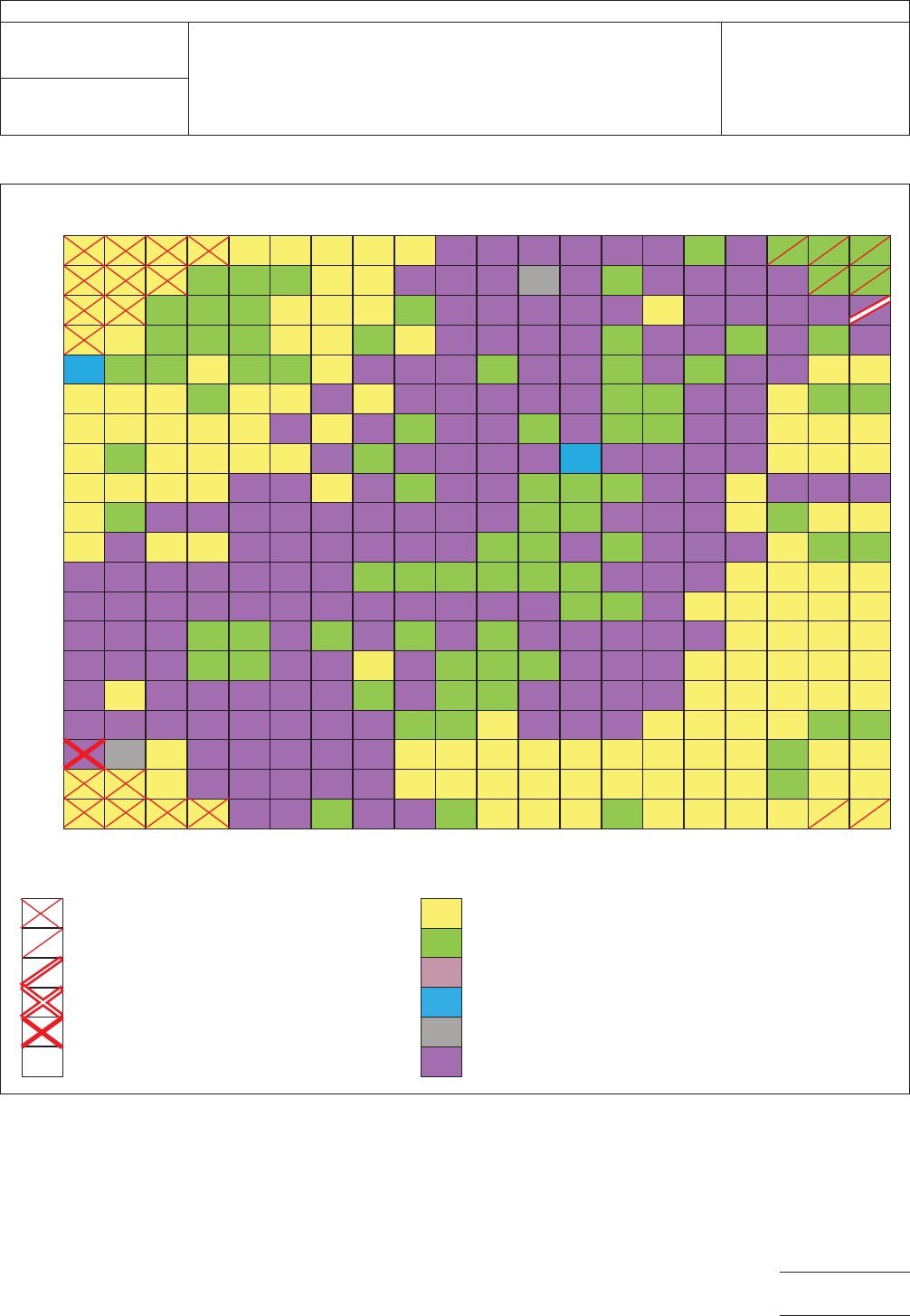
IPC-2-4-53-22 Figure 22 Second Example of Dye and Pull Location T ype Coverage Mapping a. Dye indication type b. Separation mode Note: The style of mapping in Figure 22 depicts every solder joint within the component by …
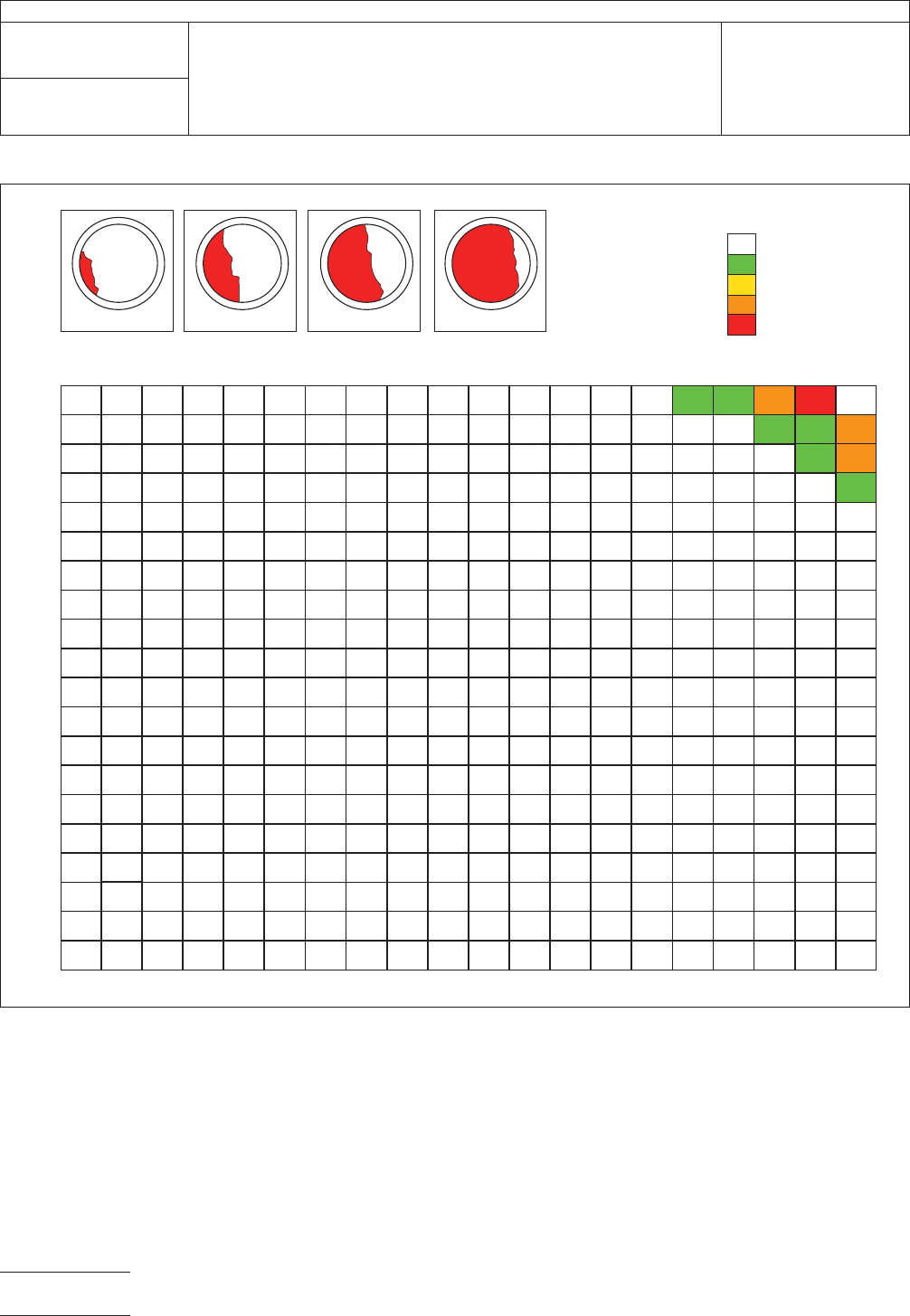
IPC-2-4-53-21
Figure 21 Example of Dye and Pull Location Type Coverage Mapping
B
A
= 0 %
= 1 to 25 %
= 26 to 50 %
= 51 to 75 %
= 76 to 100 %
B
C
D
E
CDE
1
AX
X X
X
B
C
D
E
F
G
H
J
K
L
M
N
O
P
Q
R
T
U
V
W
2345678910111213
2B 4B 3D
3D
2D
3E
3B
3B
2B
2B
14 15 16 17 18 19 20
IPC-TM-650
Number
2.4.53
Subject
Dye and Pull Test Method (Formerly Known as Dye and Pry)
Date
8/2017
Revision
Page 10 of 11
IPC-2-4-53-22
Figure 22 Second Example of Dye and Pull Location Type Coverage Mapping
a. Dye indication type
b. Separation mode
Note: The style of mapping in Figure 22 depicts every solder joint within the component by a color-coding system. Dye indications are then
additionally indicated by a red slash or “X” at each joint location as needed. Mapping components in this manner allows for quick evaluation of the
weakest interface of every solder joint and the location of any dye indications.
1
A
a
b
B
C
D
E
F
G
H
J
K
L
M
N
O
P
Q
R
T
U
V
W
2 3 45678 910111213 14 15 16 17 18 19 20
Complete dye indication
Partial dye indication
Partial dye indication at two interfaces
Complete dye indications at two interfaces
Partial and complete dye indication at two interfaces
No dye indication
Separation between board laminate and board pad
Separation between solder and board pad
Separation through solder joint
Separation between solder and component pad
Separation between component substrate and component pad
Other = Double separation between board laminate/board pad and
solder/board pad
IPC-TM-650
Number
2.4.53
Subject
Dye and Pull Test Method (Formerly Known as Dye and Pry)
Date
8/2017
Revision
Page 11 of 11
Number
Subject
Date Revision
Originating Task Group
Material in this Test Methods Manual was voluntarily established by Technical Committees of IPC. This material is advisory only
and its use or adaptation is entirely voluntary. IPC disclaims all liability of any kind as to the use, application, or adaptation of this
material. Users are also wholly responsible for protecting themselves against all claims or liabilities for patient infringement.
Equipment referenced is for the convenience of the user and does not imply endorsement by IPC.
3000 Lakeside Drive, Suite 105 N
Bannockburn, Illinois 60015-1249
IPC-TM-650
TEST METHODS MANUAL
Page 1 of 7
2.4.54
09/2022 N/A
D-33AA IPC-6012 Automotive Addendum Task Group
Test Method for Thermal Transmission Properties of
Metal Based Printed Boards (MBPB)
1 Scope
1.1
The scope of the test method is to describe a procedure for measurement of thermal resistance and calculation of an apparent
thermal conductivity for single layer Metal Based Printed Boards (MBPB). This test method has been created to address the
issue of measurement uncertainty for materials with low thermal resistance (high thermal conductivity and/or thin thicknesses).
1.2 Precise measured values of thermal resistance are very important, for multiple applications, especially within automotive
sector, but also in other areas. For materials with a low thermal resistance, the measurement uncertainty increases significantly
when using the steady state measuring method. The target for this test method is to provide good repeatability and reproducibility
in the test result. A certified reference material must be used to guarantee the measurement quality.
The test method shall show a validity of different thermal resistance values represented by different thicknesses and materials
used for the MBPB. The test method shall also describe a reliable thickness measurement.
1.3 Terms and Definitions Other than those terms listed below, the definitions of terms used in this test method are in accordance
with IPC-T-50.
1.3.1 Thermal Conductivity Thermal conductivity applies in this case to the bulk value of the metal layers (λ
base
or λ
top
see
Table 1 Equations 12 and 13) or the aluminum bars for hot or cold side (λ
h
or λ
c
see Table 1 Equations 1 and 2) and the dielectric
material filled with oxide particles of different kind of filler degree (λ
die
) (Figure 5).
1.3.2 Apparent Thermal Conductivity Apparent thermal conductivity includes the bulk thermal conductivity of the dielectric
material filled with oxide particles, the treatment or adhesive layer and the thermal contact resistances (see 1.3.5) to the upper
and lower metal layers (λ
app.,die
see Table 1 Equation 16).
1.3.3 Total Thermal Resistance Total thermal resistance R
th,total
applies to the measured thermal resistance of the MBPB and the
contact liquid (R
th,total
see Table 1 Equation 10).
1.3.4 Apparent Thermal Resistance Specimen Apparent thermal resistance specimen R
th, app,specimen
applies to the measured thermal
resistance of the MBPB. This has an upper and lower metal layer. In-between it has a dielectric layer with the two contact
resistances to the metal layers (R
th, app,specimen
see Table 1 Equation 11).
1.3.5 Thermal Contact Resistance Thermal contact resistance applies to a contact phenomenon between two bodies. A contact
resistance can arise due to suboptimal surface wetting, high surface roughness or influenced heat flow density at the boundary
layer due to the following parameters: the filler concentration, particle percolation path, particle distribution and particle size.
This contact resistance leads to a variance in measurement results.
1.3.6 Surface Area Surface area is calculated from the diameter of the meter bars in the dimension mm².
1.4 Technical safety requirements are not defined in this test method. The user must take measures to fulfil all statutory health,
safety and environmental protection requirements.