IPC-TM-650 EN 2022 试验方法.pdf - 第92页
1.0 Scope This test method is designed to determine pow- der particle size distribution in creams by image analysis. 2.0 Applicable Documents None 3.0 Test Specimen 10 grams of solder paste 4.0 Equipment/Apparatus Thinne…
1.0
Scope
This
test specifies a standard procedure for esti-
mating the particle size and the particle shape of solder pow-
der in solder pastes by microscopic methods.
2.0
Applicable Documents
None
3.0
Test Specimen
1
gram of solder paste
4.0
Equipment/Apparatus
Thinner
Spatula
Beaker
30 ml
Microscope, magnification 100 times
Measuring ocular, scale division 10 µm
Microscope slides
Microscope glass cover slips
5.0
Procedure
5.1 Preparation
5.1.1
Wait,
if necessary, until the solder paste is at room
temperature.
5.2
Test
5.2.1
Homogenize
the paste by stirring with the spatula.
5.2.2
Weigh
approximately4gofthinner.
5.2.3 Add approximately1gofthesolder paste.
5.2.4 Stir
with the spatula until a uniform mixture has been
obtained.
5.2.5
Apply
a small drop on the microscope slide.
5.2.6
Cover
the slide with the cover slip and press gently to
spread out the small drop between the glasses.
5.2.7
Measure
with the microscope the length and width of
the estimated smallest and largest solder powder particles in
a viewing area of approximately 50 particles. (Photographs
may be used for measuring and/or reference purposes).
5.2.8
Estimate
the principle shape of the particles as spheri-
cal or non-spherical.
5.3
Evaluation
Express
the masses of the powder above,
within, and below the nominal size range as percentages of
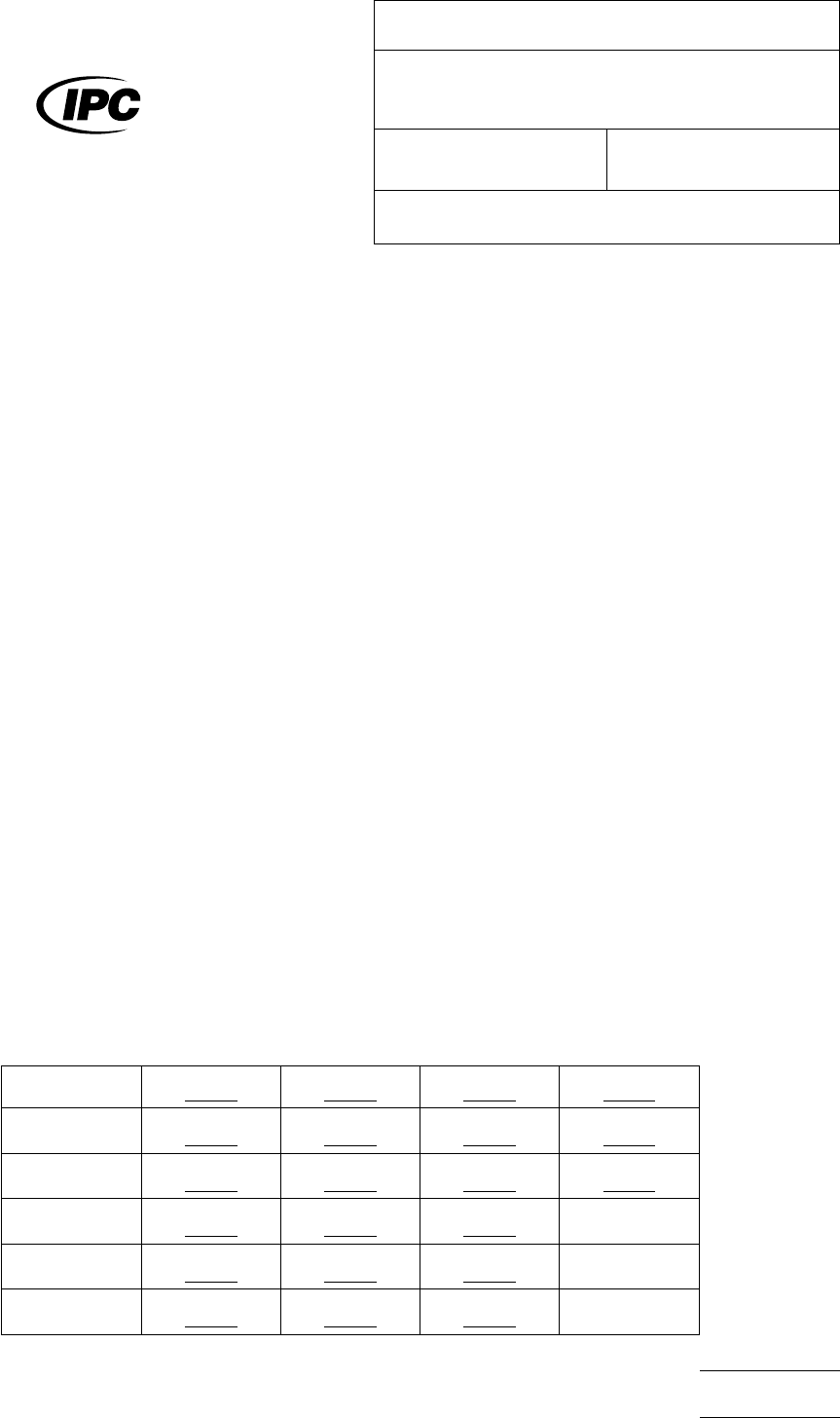
the mass of the original sample. Enter data in Table 1.
T
able 1
T
ype 1 +150µm
+75
µm
+20
µm
–20
µm
T
ype 2 + 75 µm
+45
µm
+20
µm
–20
µm
T
ype 3 + 45 µm
+25
µm
+20
µm
–20
µm
T
ype 4 + 38 µm
+20
µm
–20
µm
T
ype 5 + 30 µm
+15
µm
–15
µm
T
ype 6 + 15 µm
+5
µm
–5
µm
The
Institute for Interconnecting and Packaging Electronic Circuits
2215 Sanders Road • Northbrook, IL 60062
IPC-TM-650
TEST
METHODS MANUAL
Number
2.2.14.1
Subject
Solder
Powder Particle Size Distribution—
Measuring Microscope Method
Date
1/95
Revision
Originating Task Group
Solder Paste Task Group (5-24b)
Material
in this Test Methods Manual was voluntarily established by Technical Committees of the IPC. This material is advisory only
and its use or adaptation is entirely voluntary. IPC disclaims all liability of any kind as to the use, application, or adaptation of this
material. Users are also wholly responsible for protecting themselves against all claims or liabilities for patent infringement.
Equipment referenced is for the convenience of the user and does not imply endorsement by the IPC.
P
age1of1
电子技术应用 www.ChinaAET.com

1.0
Scope
This
test method is designed to determine pow-
der particle size distribution in creams by image analysis.
2.0
Applicable Documents
None
3.0
Test Specimen
10
grams of solder paste
4.0
Equipment/Apparatus
Thinner
5.0
Procedure
5.1 Preparation
5.1.1
Stencil
some solder cream onto a glass slide using a
5 or 6 mm diameter, 0.1 mm thick stencil.
5.1.2
Apply
a little thinner to the solder paste and gently
disperse the paste over an area about 20 mm diameter, using
a glass rod. Cover with a 22 mm diameter cover glass and
gently press to give a monolayer dispersion of powder par-
ticles under the cover glass.
It is important to get a good dispersion without a lot of
bubbles or particle agglomerates. If the paste you are exam-
ining has a high metal content, remove some of the stencilled
paste before dispersing it. The standard stencils are suitable
for 85–86% metal paste.
5.1.3
Label
the glass slide with the powder batch number.
5.2
Images for Analysis
The
next step is to put 10 or 15
images from each sample into an image directory.
5.2.1
Start
up the image analyzer.
5.2.2
Set
up the microscope illumination for X10 and select
the X10 objective.
5.2.3
Put
the slide on the microscope, focus, swing the bin-
ocular eyepiece to the left sending the light to the TV camera,
and refocus on the screen.
5.2.4 Ensure
that there are no agglomerations or badly out-
of-focus particles and then capture the image.
5.2.5
Capture
10 images covering the slide in a systematic
way without consciously selecting areas (other than avoiding
agglomerations and areas of very low particle density).
5.2.6
Record
the number of the slide and remove from the
microscope.
5.2.7
Put
the next slide on the microscope and repeat the
process.
5.2.8
When
all the samples have been recovered, swing the
eyepiece back and switch off the microscope.
5.2.9
Comments
–
Do not change the illumination between samples.
– Record a series of samples at the same magnification.
5.3
Image Analysis
5.3.1
When
images from the required number of samples
have been entered, select ‘Multi Sample Size’ on the menu (or
‘One Sample Size’ for a single sample). An image in red and
blue will then come up on the screen.
5.3.2
Using
the left and center buttons on the mouse, adjust
the thresholds until the red areas correspond to the particles
to be measured. Selecting the right hand button allows you to
vary the line on the screen where the intensity plot is mea-
sured. Adjust the top threshold so that it is about halfway
down the intensity minima. Press center and right buttons on
the mouse simultaneously.
5.3.3
You
should now see a green rectangle on a grey
image. If there is no rectangle, press the left hand button until
one appears.
5.3.4
A
particle is measured if the top of the particle lies
within the rectangle, so the size and position of the rectangle
must be adjusted so that the sides are half a particle diameter
from the sides of the screen, and the base of the rectangle a
whole particle diameter from the bottom of the screen. The
top of the rectangle should lie along the top of the screen. The
The
Institute for Interconnecting and Packaging Electronic Circuits
2215 Sanders Road • Northbrook, IL 60062
IPC-TM-650
TEST
METHODS MANUAL
Number
2.2.14.2
Subject
Solder
Powder Particle Size Distribution—Optical
Image Analyzer Method
Date
1/95
Revision
Originating Task Group
Solder Paste Task Group (5-24b)
Material
in this Test Methods Manual was voluntarily established by Technical Committees of the IPC. This material is advisory only
and its use or adaptation is entirely voluntary. IPC disclaims all liability of any kind as to the use, application, or adaptation of this
material. Users are also wholly responsible for protecting themselves against all claims or liabilities for patent infringement.
Equipment referenced is for the convenience of the user and does not imply endorsement by the IPC.
P
age1of2
电子技术应用 www.ChinaAET.com

middle
button on the mouse swaps between ‘moving’ and
‘growing’ the rectangle. When the rectangle is set, press the
right hand button on the mouse to proceed.
5.3.5
On
the keyboard that now comes up on the screen,
select the number of samples being processed.
5.3.6
On
the next keyboard select the number of particles to
be measured (200 for type 1-4 and 400 for type 5-6 is sug-
gested).
5.3
Evaluation
Express
the masses of the powder above,
within, and below the nominal size range as percentages of
the mass of the original sample. Enter data in Table 1.
T
able 1
T
ype 1 +150µm
+75
µm
+20
µm
–20
µm
T
ype 2 + 75 µm
+45
µm
+20
µm
–20
µm
Type 3 + 45 µm +25 µm +20 µm –20 µm
T
ype 4 + 38 µm
+20
µm
–20
µm
T
ype 5 + 30 µm
+15
µm
–15
µm
T
ype 6 + 15 µm
+5
µm
–5
µm
IPC-TM-650
Number
2.2.14.2
Subject
Solder
Powder Particle Size Distribution—Optical Image
Analyzer Method
Date
1/95
Revision
P
age2of2
电子技术应用 www.ChinaAET.com