IPC-TM-650 EN 2022 试验方法.pdf - 第487页
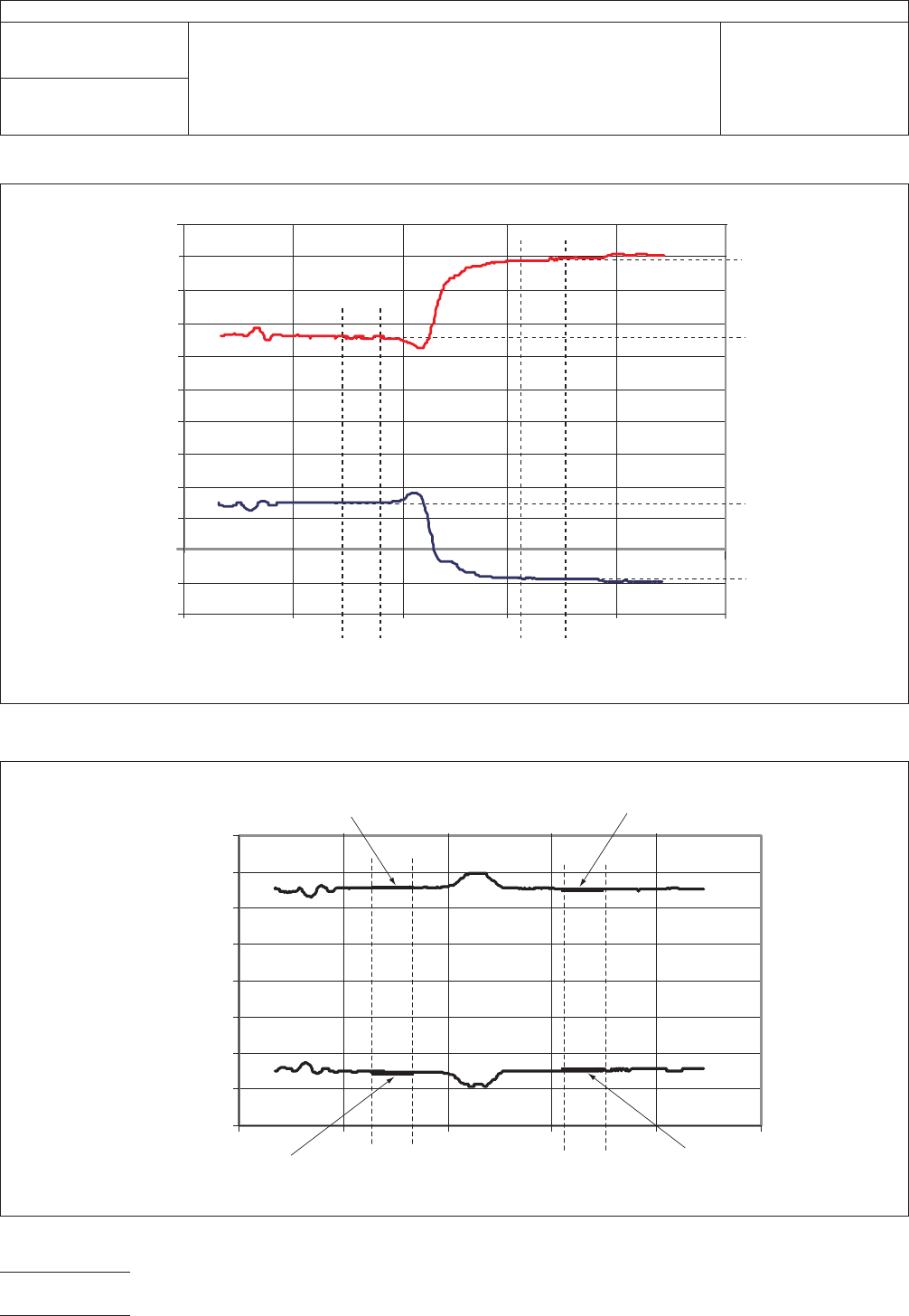
and the characteristic impedance, Z TS,Ch 2 , of the transfer standard for Channel 2 (Ch2) using Z TS,Ch 2 = ( V inc,Ch 2 − V r,Ch 2 V inc,Ch 2 + V r,Ch 2 ) Z std where: Z std the characteristic impedance of the referenc…
IPC-2257a-5-15
Figure
5-15 Measuring Amplitude for Incident Step
-0.4
-0.3
-0.2
-0.1
0.0
0.1
0.2
0.3
0.4
Signal (V)
Time
t
i,TS
t
f
,TS
V
open,Ch1
V
open,Ch
2
Ch1
Ch2
V
TS
,Ch2,1
V
TS
,Ch1,1
-0.5
-0.6
t
i,TL
t
f
,TL
0.5
0.6
IPC-2257a-5-16
Figure
5-16 Calibration of Transfer Standard
-0.4
-0.3
-0.2
-0.1
0.0
0.1
0.2
0.3
0.4
Signal (V)
Time
V
TS
,Ch2,2
V
TS
,Ch1,2
t
i,TS
t
i,std
t
f
,std
t
f
,TS
Ch1
Ch2
V
std,Ch1
V
std,Ch2
IPC-TM-650
Number
2.5.5.7
Subject
Characteristic
Impedance of Lines on Printed Boards by TDR
Date
03/04
Revision
A
Page
18 of 23
电子技术应用 www.ChinaAET.com
and
the characteristic impedance, Z
TS,Ch2
,
of the transfer
standard for Channel 2 (Ch2) using
Z
TS,Ch2
=
(
V
inc,Ch2
− V
r,Ch2
V
inc,Ch2
+ V
r,Ch2
)
Z
std
where:
Z
std
the
characteristic impedance of the reference standard
(the airline).
5.3.4
Transmission Line Measurement Process
The
instrument
setting must be the same as that for 5.3.3. This
process should be done after the measure zone has been
defined (see 5.3.2).
Step
1 –
Probe
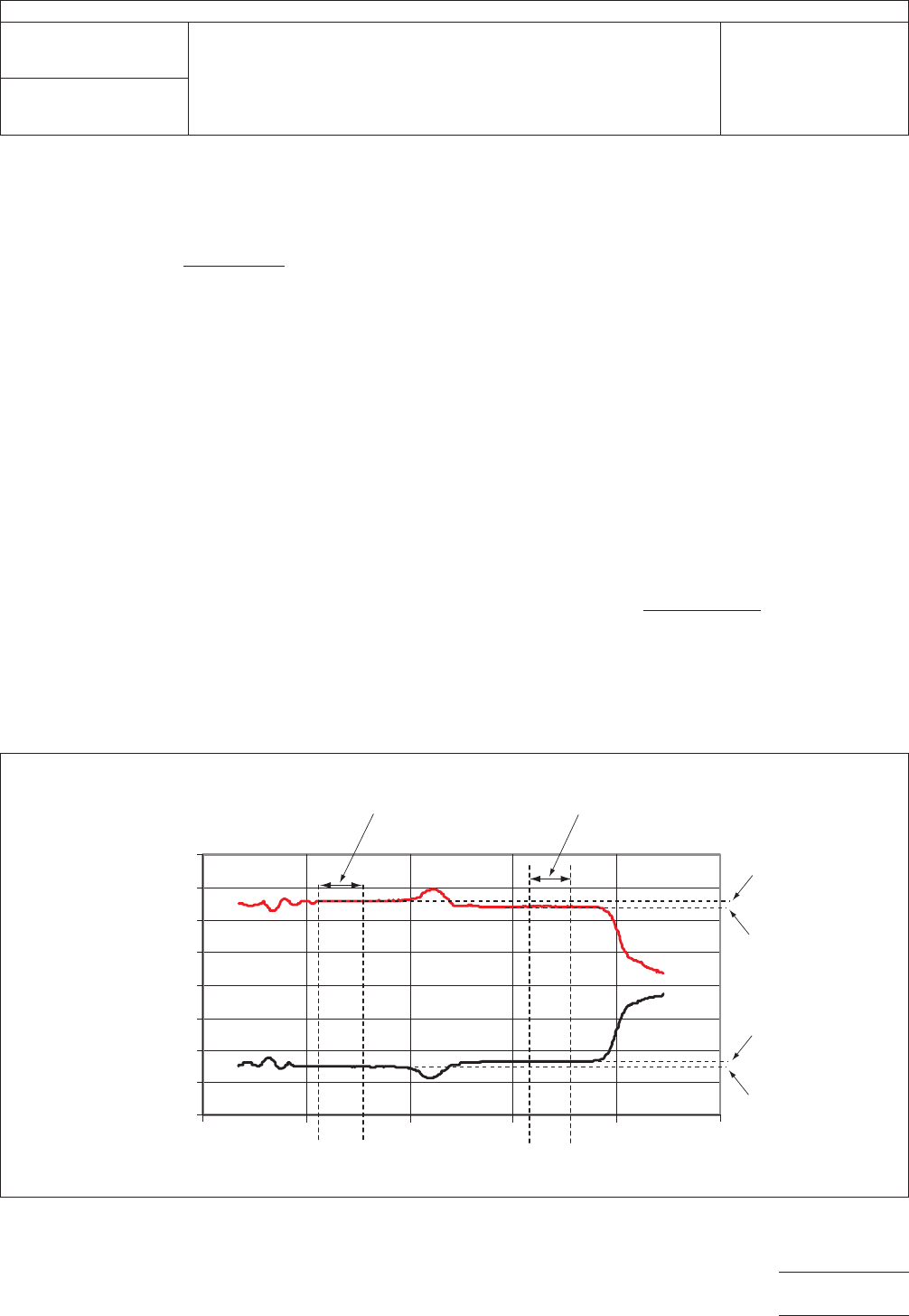
the transmission line and measure the aver-
age voltage levels for the high and low states for the two dif-
ferential TDR waveforms, which are labeled V
TS,Ch1,3
,
V
TS,Ch2,3
, V
TL,Ch1
,
and V
TL,Ch2
in
Figure 5-17. There are a total
of four states, two for each of the differential waveforms. Cal-
culate the voltage difference, V
r,Ch1,TL
for
Channel 1 (Ch1)
using:
V
r,TL,Ch1
= V
TS,Ch1,3
− V
TL,Ch1
and
the voltage difference, V
r,Ch2,TL
for
Channel 2 (Ch2) using:
V
r,TL,Ch2
= V
TS,Ch2,3
− V
TL,Ch2
where:
V
TS,Ch1,3
is
the average voltage level of that part of the Ch1
TDR waveform corresponding to the transfer standard (not
the same value as used in 5.3.3, Steps 1 and 2),
V
TS,Ch2,3
is
the average voltage level of that part of the Ch2
TDR waveform corresponding to the transfer standard (not
the same value as used in 5.3.3, Steps 1 and 2),
V
TL,Ch1
is
the average voltage level of that part of the Ch1 TDR
waveform corresponding to the transmission line under test,
and
V
TL,Ch2
is
the average voltage level of that part of the Ch2 TDR
waveform corresponding to the transmission line under test.
Step
2 –
Calculate
the odd-mode impedance, Z
odd,Ch1
,
for
the signal line of the transmission line under test connected to
Channel 1 (Ch1) using:
Z
odd,Ch1
=
(
V
inc,Ch1
− V
r,TL,Ch1
V
inc,Ch1
+ V
r,TL,Ch1
)
Z
TS,Ch1
and
the odd-mode impedance, Z
odd,Ch2
,
for the signal line of
the transmission line under test connected to Channel 2 (Ch2)
using:
IPC-2257a-5-17
Figure
5-17 Differential TDR Measurement of Transmission Line
-0.4
-0.3
-0.2
-0.1
0.0
0.1
0.2
0.3
0.4
Signal (V)
Time
T
ransmission Line
Measurement Zone
t
i,TL
t
f
,TL
V
TL,Ch2
V
TL,Ch1
Ch2
Ch1
V
TS
,Ch2,
3
V
TS
,Ch1,
3
t
i,TS
t
f
,TS
Transfer Standard
Measurement Zone
IPC-TM-650
Number
2.5.5.7
Subject
Characteristic
Impedance of Lines on Printed Boards by TDR
Date
03/04
Revision
A
Page
19 of 23
电子技术应用 www.ChinaAET.com

Z
odd,Ch2
=
(
V
inc,Ch2
− V
r,TL,Ch2
V
inc,Ch2
+ V
r,TL,Ch2
)
Z
TS,Ch2
where:
Z
TS,Ch1
is
the characteristic impedance of the transfer stan-
dard connected to Ch1 as determined in Step 3 of 5.3.3,
Z
TS,Ch2
is
the characteristic impedance of the transfer stan-
dard connected to Ch2 as determined in Step 3 of 5.3.3,
V
r,TL,Ch1
is
the reflected voltage value from Ch1 as calculated
in Step 1,
V
r,TL,Ch2
is
the reflected voltage value from Ch2 as calculated
in Step 1,
V
inc,Ch1
is
the voltage amplitude computed for Ch1 in Step 1
of 5.3.3, and
V
inc,Ch2
is
the voltage amplitude computed for Ch2 in Step 1
of 5.3.3.
Step
3 –
Calculate
the differential impedance, Z
TL,diff
, of
the
transmission line under test using:
Z
TL,diff
= Z
odd,Ch1
+ Z
odd,Ch2
6
Special Considerations and Notes
6.1 General
6.1.1 Quality Control
Measurements
for manufacturing
control are performed to identify and correct process or mate-
rials problems occurring during a manufacturing run, as well
as to assure that a product will perform electrically as
designed. To facilitate the large number of measurements
required in a production environment and to maximize mea-
surement repeatability and reproducibility between different
operators and test systems, it is particularly useful to auto-
mate the TDR calibration and measurement by using com-
puter control. This can be easily achieved using a personal
computer and suitable equipment as described in Section 4.
Examples of parameter variations detectable by TDR, and that
are evidence of process or materials problems, include the
following:
a. Over/under-retching (line width problems).
b. Over/under-plating (line width and thickness problems).
c. Permittivity of the dielectric.
d. Thickness of the dielectric.
e. Degradation from excessive heating and humidity.
f. Damage from excessive pressure during the multilayer pro-
cess.
g. Variations in the laminate glass-to-resin content.
h. Variations in additional coatings applied to the board sur-
face, e.g., solder mask.
Measurement repeatability is described in IPC-TM-650 Test
Method 1.9, Measurement Precision Estimation for Variables
Data. This test method also describes a process to evaluate
the reproducibility of a measurement system for multiple
operators, on different days, and when using different instru-
ments. This evaluation process should be followed and a
precision-to-tolerance ratio acceptable to the customer
obtained.
6.1.2
Single-Ended and Differential Lines
Increased
performance
requirements for computer and other electronic
products often demand even greater signal fidelity, time pre-
cision, and noise immunity, than can be obtained with a
single-ended transmission line. A single-ended transmission
line is a transmission line design consisting of a single signal
conductor placed over one ground plane, as in microstrip, or
between two ground planes, as in stripline. Single-ended lines
may be called unbalanced transmission lines. Differential lines
are used to increase signal fidelity with improved time preci-
sion and increased noise immunity. Differential lines may also
be called balanced or coupled transmission lines. The
required TDR method is different for differential lines.
6.1.3
Environmental Factors
Temperature
and humidity
should be monitored during the test. Long exposures to tem-
peratures and humidities other than standard laboratory con-
ditions (temperature range of 20 °C to 23 °C [68 °F to 73.4 °F]
and relative humidity range of 35 % to 65 %) can impact the
dielectric properties of the materials in the test objects. Fur-
thermore, the electrical characteristics of the TDR, such as
sampler gain, are temperature dependent. Therefore, for the
most repeatable measurements, the TDR instrumentation
should be maintained within the manufacturer recommended
temperature and humidity ranges. Low relative humidity may
result in electrostatic discharge damage to the TDR unit.
6.1.4
Measurement Accuracy and Repeatability
Accu-
racy
and repeatability depend on the impedance of the line
being measured, the type and condition of probes, cables,
sampling head, and the experience of the test technician.
Accuracy is the difference between the most likely measure-
ment and the defined standard. The most likely measurement
is also called the mode of all measurements within a sample
IPC-TM-650
Number
2.5.5.7
Subject
Characteristic
Impedance of Lines on Printed Boards by TDR
Date
03/04
Revision
A
Page
20 of 23
电子技术应用 www.ChinaAET.com