00195982-03_SM_SWS_EN.pdf - 第268页
12 Wafer stretcher 12.1 Explanation of the wafer stretcher 268 Service Manual SIPLACE Wafer System (SWS) 11/2018 Detailed description Fig.363: While picking dies from a wafer, there is a danger that the die could begin …
12 Wafer stretcher
12.1 Explanation of the wafer stretcher
Service Manual SIPLACE Wafer System (SWS) 11/2018 267
12.1.4 Placement accuracy and performance values
Refer to the appropriate specifications.
12.1.5 Description
Overview
While picking dies from a wafer, there is a danger that the die could begin to tilt. This can be
caused by an irregular adhesion of the die on the foil or an eccentric positioning of the needle. In
the case of dies which are positioned closely to one another, the neighboring die could be touched
and mutual damage can not be ruled out.
To prevent this, the wafer foil is stretched before the die is picked. This increases the distances
between the dies on the foil and makes it possible to pick dies without risks. The larger distances
between the dies also makes it easier for the Vision system to recognize them.
After the downholder plate has moved up and the clamp has been opened, the wafer foil sags. A
wafer with a sagging foil can not be moved back into the magazine.
Once the clamp and the downholder plate have been opened, the stretched wafer foil is warmed up
by the heater module. This shrinks the wafer foil (sag less than 9 mm) so that it can be moved back
into the magazine.
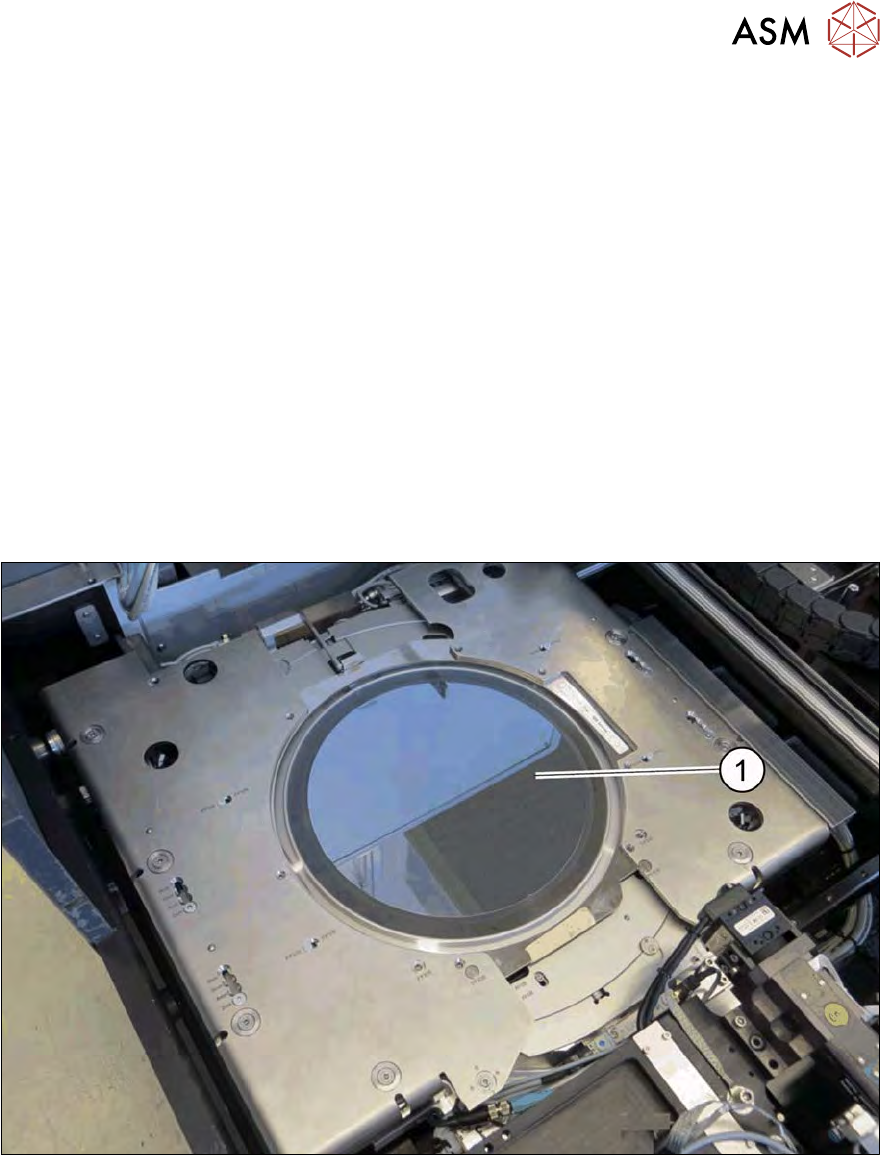
Fig.362: SIPLACE SWS wafer stretcher with stretched wafer foil
1. Stretched wafer foil in the SIPLACE SWS wafer stretcher
12 Wafer stretcher
12.1 Explanation of the wafer stretcher
268 Service Manual SIPLACE Wafer System (SWS) 11/2018
Detailed description
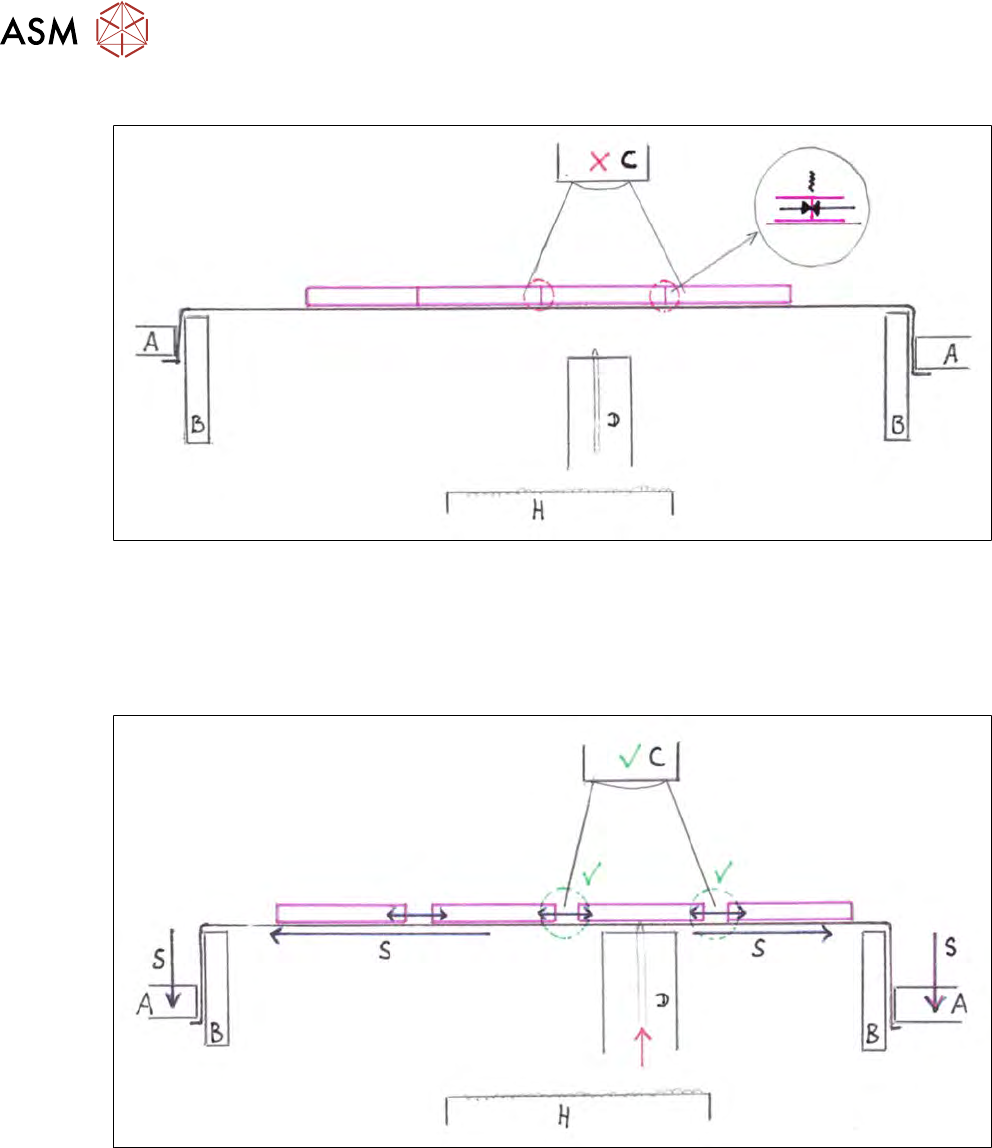
Fig.363:
While picking dies from a wafer, there is a danger that the die could begin to tilt. This can be
caused by an irregular adhesion of the die on the foil or an eccentric positioning of the needle. In
the case of dies which are positioned closely to one another, the neighboring die could be touched
and mutual damage can not be ruled out.
The limited space also makes it difficult for the Vision system (C) to recognize things!
Fig.364:
To prevent this, the wafer foil is stretched before the die is picked. This increases the distances
between the dies on the foil and makes it possible to pick dies without risks. The larger distances
between the dies also makes it easier for the Vision system (C) to recognize them.
The foil is stretched (S)by moving the downholder plate (A) downwards. This pulls the foil over the
stretcher ring (B), thereby stretching the entire foil (S). The adhesion of the die on the wafer foil in-
creases the space between the dies.
The edges of the dies no longer rub against one another. Reliable Vision recognition (C) of dies is
also possible, plus the ejection procedure (D) and pickup process can be successfully completed.
12 Wafer stretcher
12.1 Explanation of the wafer stretcher
Service Manual SIPLACE Wafer System (SWS) 11/2018 269
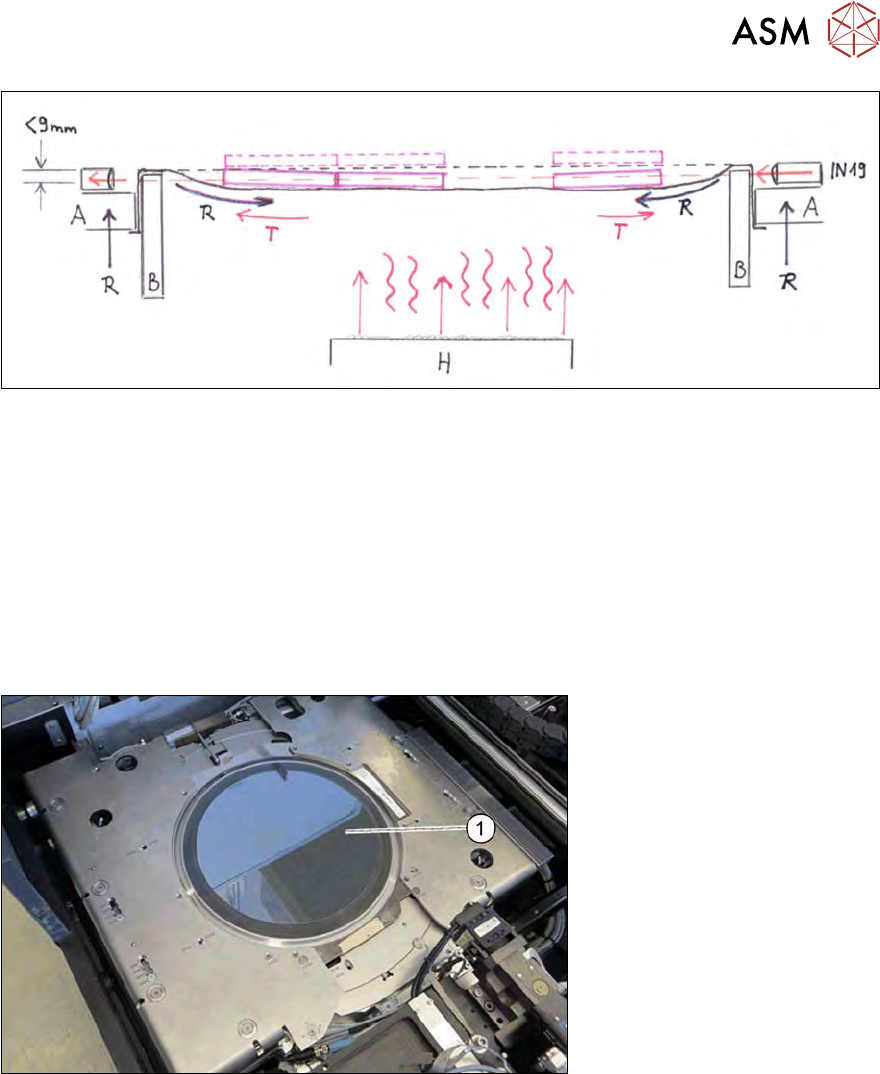
Fig.365:
After the downholder plate (A) has moved up (R=retract) and the clamp has been opened, the
wafer foil sags (R). A wafer with an excessively sagging foil can not be moved back into the
magazine.
The IN19 sensors check how far the wafer is sagging. The maximum permissible wafer foil sag is
<9mm!
The setting for the IN19 sensors to the maximum permissible sag<9mm is described in a separ-
ate chapter.
Once the clamp and the downholder plate have been opened, the stretched wafer foil is warmed up
by the heater module (H). This shrinks (T=tension) the wafer foil (sag less than 9 mm) so that it is
tensioned and can be moved back into the magazine.
Fig.366: SIPLACE SWS wafer stretcher with stretched wafer foil
1. Stretched wafer foil in the SIPLACE SWS wafer stretcher