RS-1_instruction manual.pdf - 第264页
Part 1 B asic O peration Chapter 2 Pr oduction 2- 153 When components r un out Overview of a component run - out error If a ret ry over error occurs when the syst em picks up a compon ent from a feed er , the sy stem jud…
Part 1 Basic Operation Chapter 2 Production
2-152
Tracking
If you press the “Trace” button displayed in the Operation area when the “Stop” screen is displayed,
the system enters Tracking mode of a component pick-up position.
You can track a component pick-up position of all feeders that supply components that caused a
retry error or a component run-out error.
However, the system does not track a component pick-up position of a feeder that is set to
“Unused.”
See Section 2.14.7 “Tracking a component pick-up position with a camera” for details.
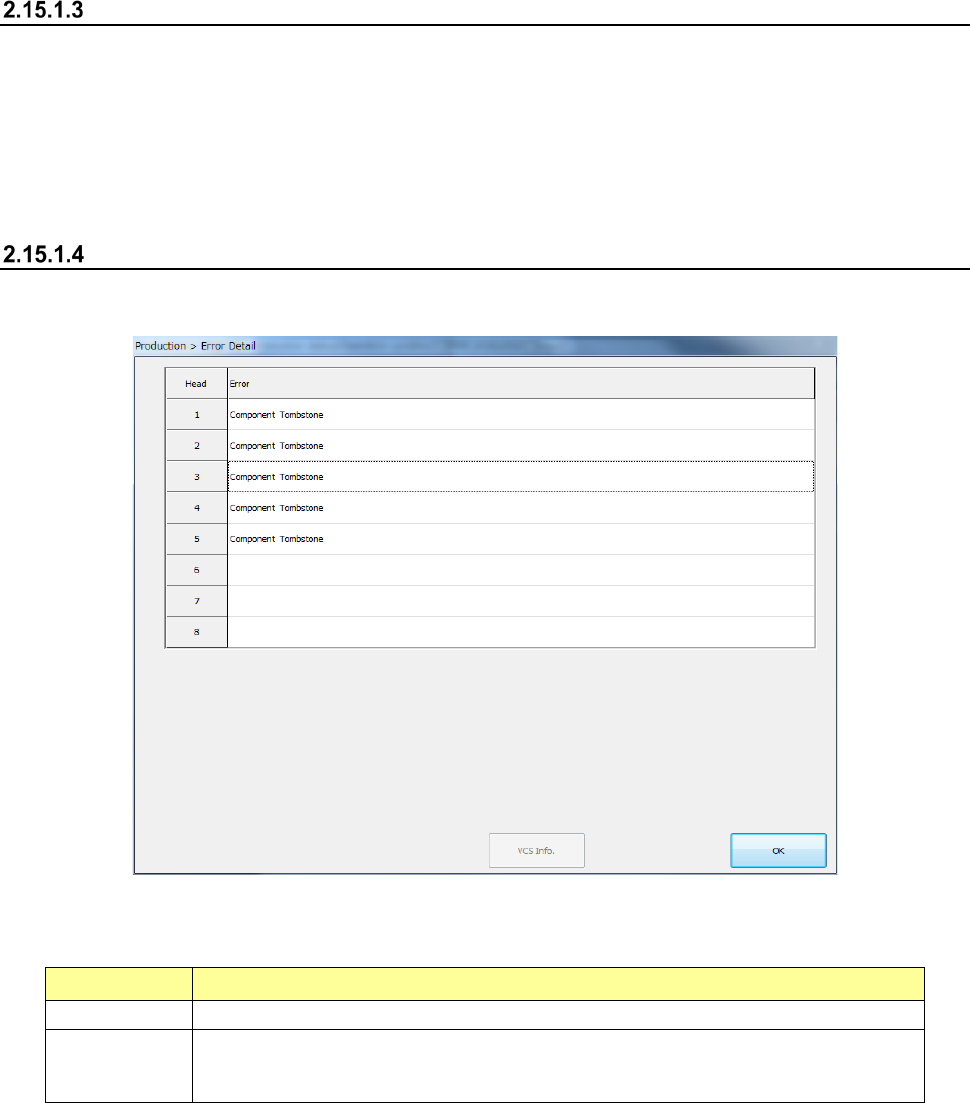
Error Detail
When you press the <Error Detail> button on the “Pause” screen, the “Pause (Detail)” screen
appears.
(1) List of the error heads
A list of heads at which an error occurred is displayed.
Menu item Description
Head
Displays the number of each head.
Error
The displayed data is the same as that displayed in the “Error” column of the “Retry list.”
See “2) Error (Type) of Section 2.11.4.2 “Displayed screen” for details.
See “Error (Detail)” of Section 2.11.4.2 “Displayed screen” for details.
When you press the <OK> button, the system quits the “Pause (Detail)” screen, and then
displays the “Pause” screen again.

Part 1 Basic Operation Chapter 2 Production
2-153
When components run out
Overview of a component run-out error
If a retry over error occurs when the system picks up a component from a feeder, the system judges
that components have run out.
If you check the option “Stop system when components run out” on the “Operation option” screen,
the system stops PWB production temporarily when components run out, and then displays the
“Pause” screen.
When you do not check this option, the system searches an alternate feeder to continue the current
PWB production. If the system cannot continue the current PWB production, the “Retry list”
appears on the screen.
• “Stop system when components run out.” of the Operation option
If this check box is checked, the system aborts the current PWB production and displays
the “Stop” screen when components run out.
Otherwise, the system searches the alternate feeder and continues the current production.
If the system cannot continue the production, it displays the Retry list.
(See Section 2.11.4 “Retry list” for details.)
• Continuation of the process
The system places a component(s) on another (other) position(s) at which the system can
place it (them).
When the check box “Stop system when components run out.” of the Operation option is
not checked, the system uses the alternate feeder from the next pick-up/placement cycle if
there is.
• Replenishment of components and setting of the number of components
If you replenish a component supply device with components when components run out,
set the number of components when necessary.
(See Section 2.11.1 “When the stocked components run out” for details.)
• Signal light
The signal light flashes in yellow.
(The signal light flashes if the JUKI standard settings are made.
See Section 8.3.6.1 “Signal lights” of Chapter 8 “Machine Setup.”
- When you press the <START> switch, the system restarts production operation. See the
section on “Restart mode” described later also.
- When you press the <STOP> switch, the system displays the “Question” message for
temporarily stopping or aborting another station to abort PWB production.
Part 1 Basic Operation Chapter 2 Production
2-154
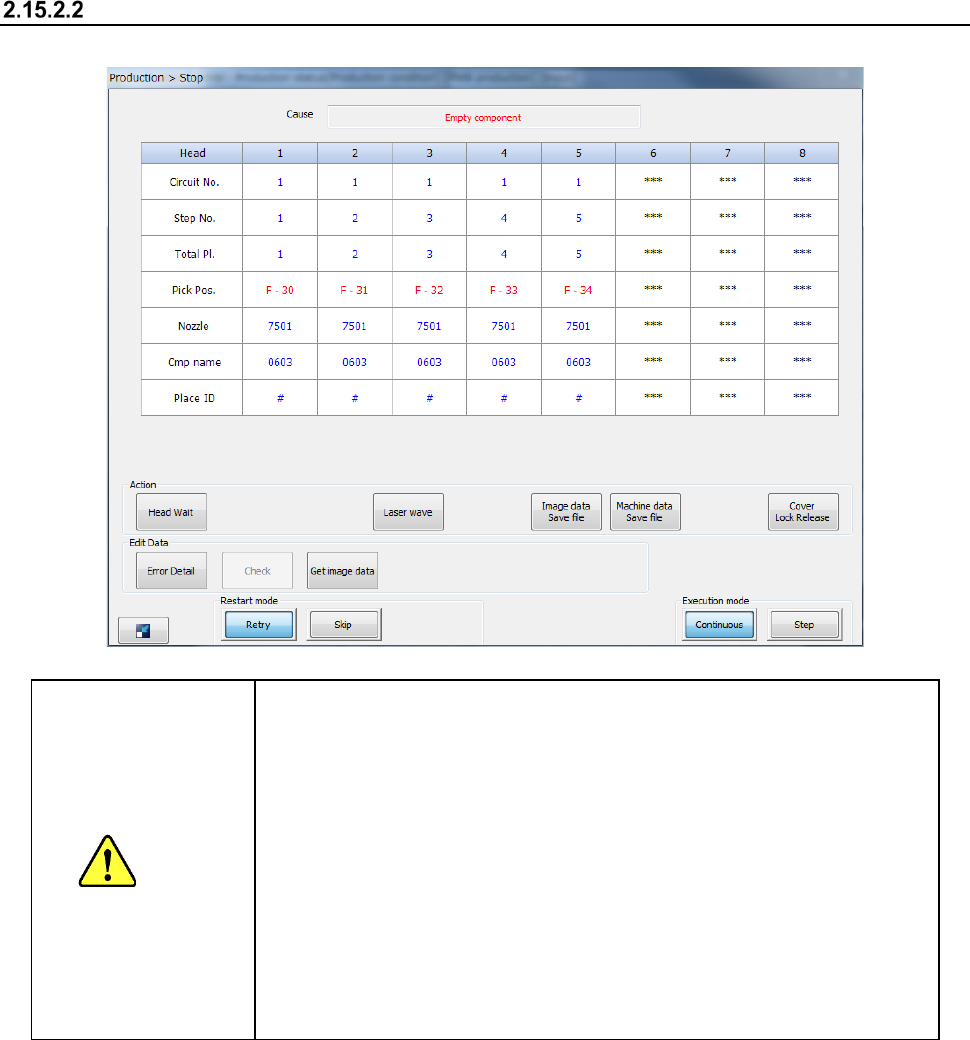
Displayed screen
When the system pauses because components run out, it displays the following dialog box.
CAUTION
When you press the <START> switch, the head moves immediately
and PWB production starts.
To prevent any accident causing injuries, never put your hand in the
machine or never bring your face or head close to the machine while it
is operating.
Be sure to check to see if there is no one who is operating the insides
of the machine before pressing the <START> switch.
Be sure to check to see if there is no one who is near the machine and
may be injured before pressing the <START> switch.
Be sure to check to see if any substance (such as an adjustment tool)
that prevents each operation of the insides of the machine is not
attached or located on/in the machine before pressing the <START>
switch.