RS-1_instruction manual.pdf - 第348页
Part 1 B asic O peration Chapter 4 Cr eating a Produc tion Progra m 4- 13 10) PWB height Enter the le ngth of the t op plane of the PWB from the transport reference plane ( reference height. This is the initial valu e (=…
Part 1 Basic Operation Chapter 4 Creating a Production Program
4-12
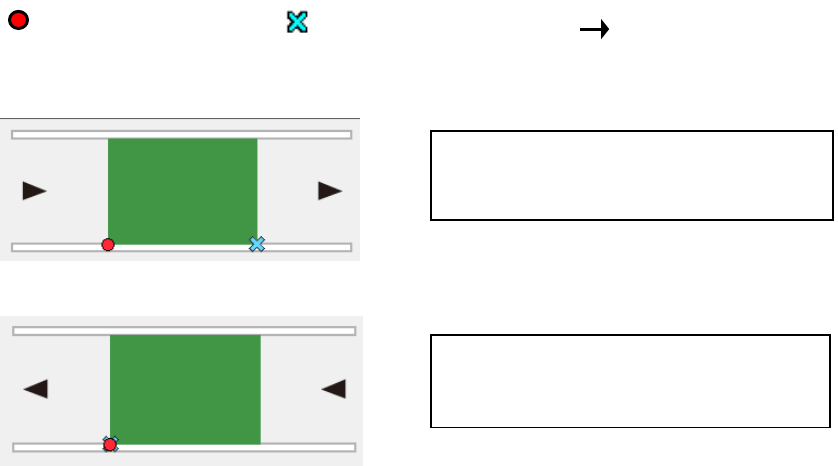
Example: When the lower left corner is specified as a PWB position reference (Unit: mm)
① For board and PWB transport direction of L → R:
② For board and PWB transport direction of R → L:
3) PWB configuration
For this item, select [Single circuit].
After the multi-circuit matrix or multi-circuit non-matrix is changed into the single circuit
matrix, single circuit expansion is performed.
At this time, a confirmation message is displayed.
4) BOC type
“BOC” is abbreviation of Board Offset Correction, and is a mark for correcting a component
placement position that helps the system to place a component on a board more accurately.
(It is called a “fiducial mark” also.)
◆ Not Used: Select this button when any BOC mark is not used.
◆ PWB marks: Select this button to use BOC marks on a board to correct the component
placement coordinates.
◆ Circuit marks: This button cannot be selected for a single-circuit PWB.
5) Circuit dimensions
6) Circuit layout offset
7) First circuit position
8) Circuit divide No.
9) Circuit pitch
You do not have to set these items for a single-circuit PWB (these items are disabled).
You have to set them for a multi-plane PWB (“Matrix circuit” or “Non-matrix circuit”).
PWB dimensions X=165 Y=125
PWB layout offset X=165 Y=0
PWB dimensions X=165 Y=125
PWB layout offset X=0 Y=0
:Reference position
:
Transport direction
:Layout end point
Part 1 Basic Operation Chapter 4 Creating a Production Program
4-13
10) PWB height
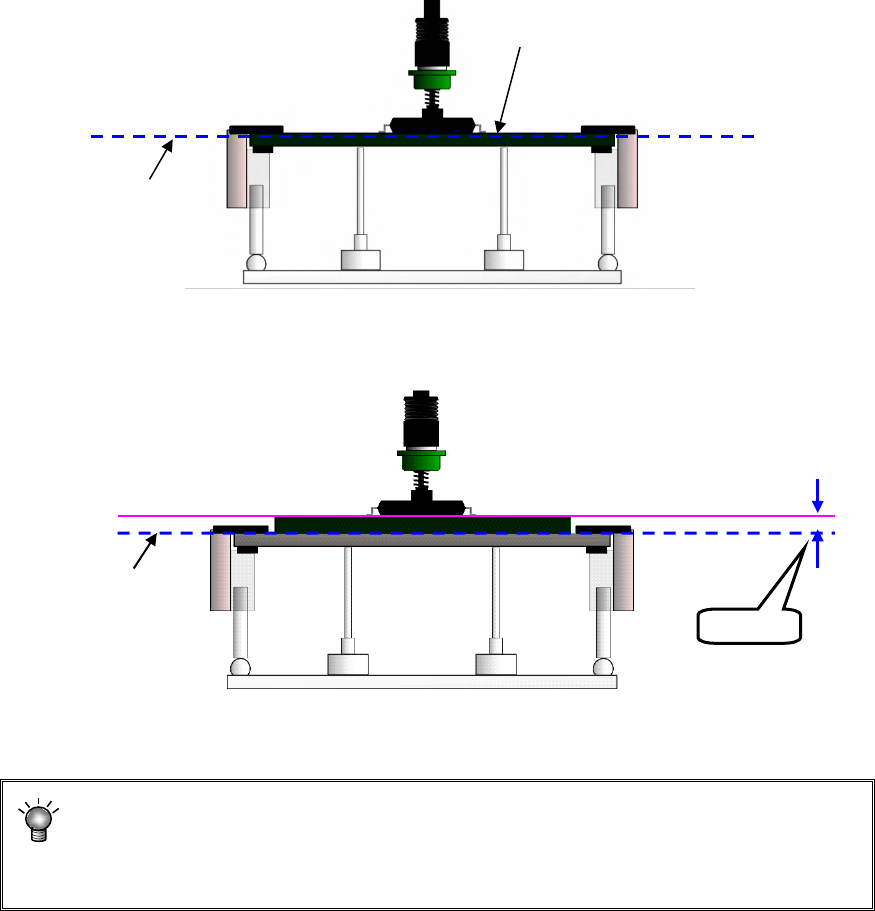
Enter the length of the top plane of the PWB from the transport reference plane (reference
height. This is the initial value (= 0.00) of the Z axis).
Usually, enter the initial value. When the transport reference plane is different in height
from the PWB top plane, enter the PWB height.
Example: Odd-shape PWBs or flexible PWBs are manufactured by piling the jig (carrier
board). In this case, enter “+t” for the PWB height.
• Normal case(Transport reference plane = PWB top plane height)
• Using the jig (Transport reference plane ≠ PWB top plane height)
If “+t” is not entered in this case, the component is pushed over the placement plane (by the
length of t) at placement, thereby damaging the component.
The nozzle height at component placement depends on the PWB height.
Accordingly if an incorrect value is set, the placement may lose uniformity. (The
component is released from a position remote to the PWB or the component is
pushed in too much in the PWB.)
Transport reference plane
PWB top plane height
Transport reference plane
PWB top plane height
Jig (carrier board)
+t
Part 1 Basic Operation Chapter 4 Creating a Production Program
4-14
11) PWB thickness
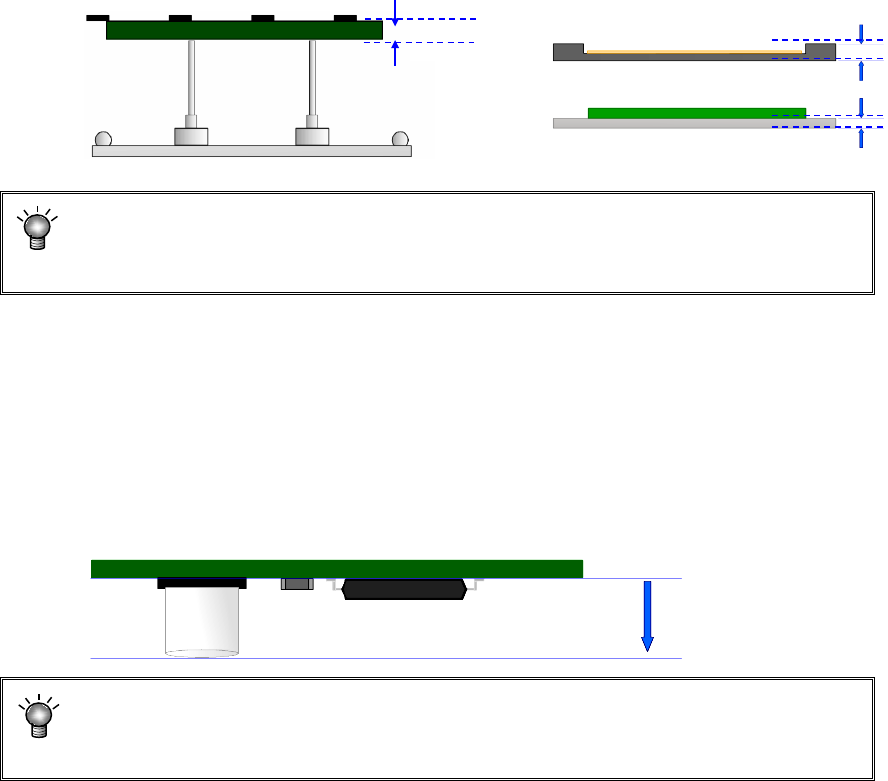
Enter the thickness of a PWB. The value you entered here is used to determine how much
the system should move up the support table when it is centering a PWB.
If an incorrect value is entered, the support pin pushes the PWB too much, thereby
damaging the PWB, and the placement may lose uniformity because the support pin
does not touch the PWB.
12) Back height
Enter the height of the tallest component among the components placed on the back side of
a PWB (you have to enter a value that causes components on the back side not to interfere
with the support pin if components are placed on both sides of a PWB).
This value determines the waiting position of the support table during production.
If you enter a small value, the traveling distance of the support table becomes shorter,
reducing the production time a little.
(Approx. 0.25-second difference between the maximum height of 5 mm and 40 mm)
If a value is entered that is smaller than the component height on the back, the
support pin may hit the component during PWB transportation. Be sure to enter a
value that is greater than the height of a component on the back
Tallest component
Height of the back side
PWB thickness