RS-1_instruction manual.pdf - 第343页
Part 1 B asic O peration Chapter 4 Cr eating a Produc tion Progra m 4-8 4.3.3 .1 Basic setting When you se lect the “ Basi c setting ” tab d i splay ed on the left side of the scre en, each item of the “ Basi c s ett ing…
Part 1 Basic Operation Chapter 4 Creating a Production Program
4-7
4.3.2 Procedure for creating a production program
A production program consists of four items: “PWB data,” “Placement data,” “Component data”
and “Pick data,” and the tabs displayed on the upper section of the screen correspond to these
types of data respectively.
Create a production program in the following order: “PWB data” -> “Placement data” ->
“Component data” -> “Pick data.”
Note that only half-sized alphanumeric characters can be entered with a soft keyboard.
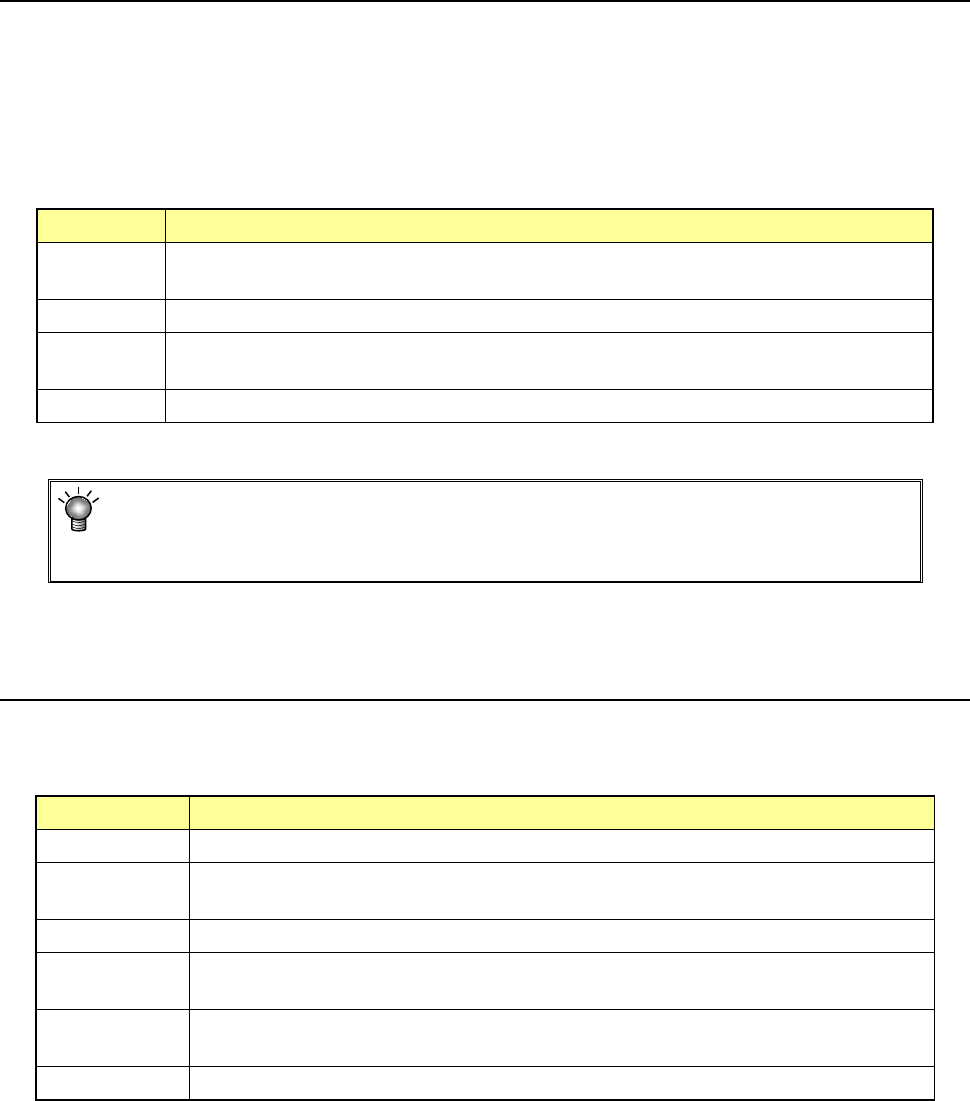
Type of data Description
PWB This covers overall PWB data such as PWB outer dimensions and the coordinates of Board
Offset Correction (BOC) mark position.
Placement This covers coordinates of the placement position, component names to be placed and others.
Component The data including component dimensions and packaging style required for laser and vision
centering is handled.
Pick This covers the data on positions of components supplied by a tape feeder, tray, etc.
You cannot open the next data screen until you completely create the data you are
supposed to create first: for example, you cannot open the “Placement” data screen if
you have not created “PWB data” completely.
4.3.3 PWB data
PWB data consists of five items: “Basic setting,” “Dimension setup,” “BOC mark,” “Circuit layout,”
“PWB Conveyor” and “Ex. Bad Mark”.
Setting Overview
Basic setting Enter the basic PWB configuration here
Dimension setup
Enter the detailed dimensions of a PWB. This item can be selected only when “Multi-circuit
non-matrix” is set in “Dimensions setting.”
BOC mark Enter the coordinates of BOC marks.
Circuit layout
Enter the position and angle of a circuit. You can enter these items only if you select
“Non-matrix circuit” as the “PWB configuration” on the “Basic setting” screen.
Ex. Bad Mark
Enter the coordinates of a bad mark on each circuit when you are to use an extended bad
mark.
PWB Conveyor Make the detailed settings of the conveyor and the support table
Part 1 Basic Operation Chapter 4 Creating a Production Program
4-8
4.3.3.1 Basic setting
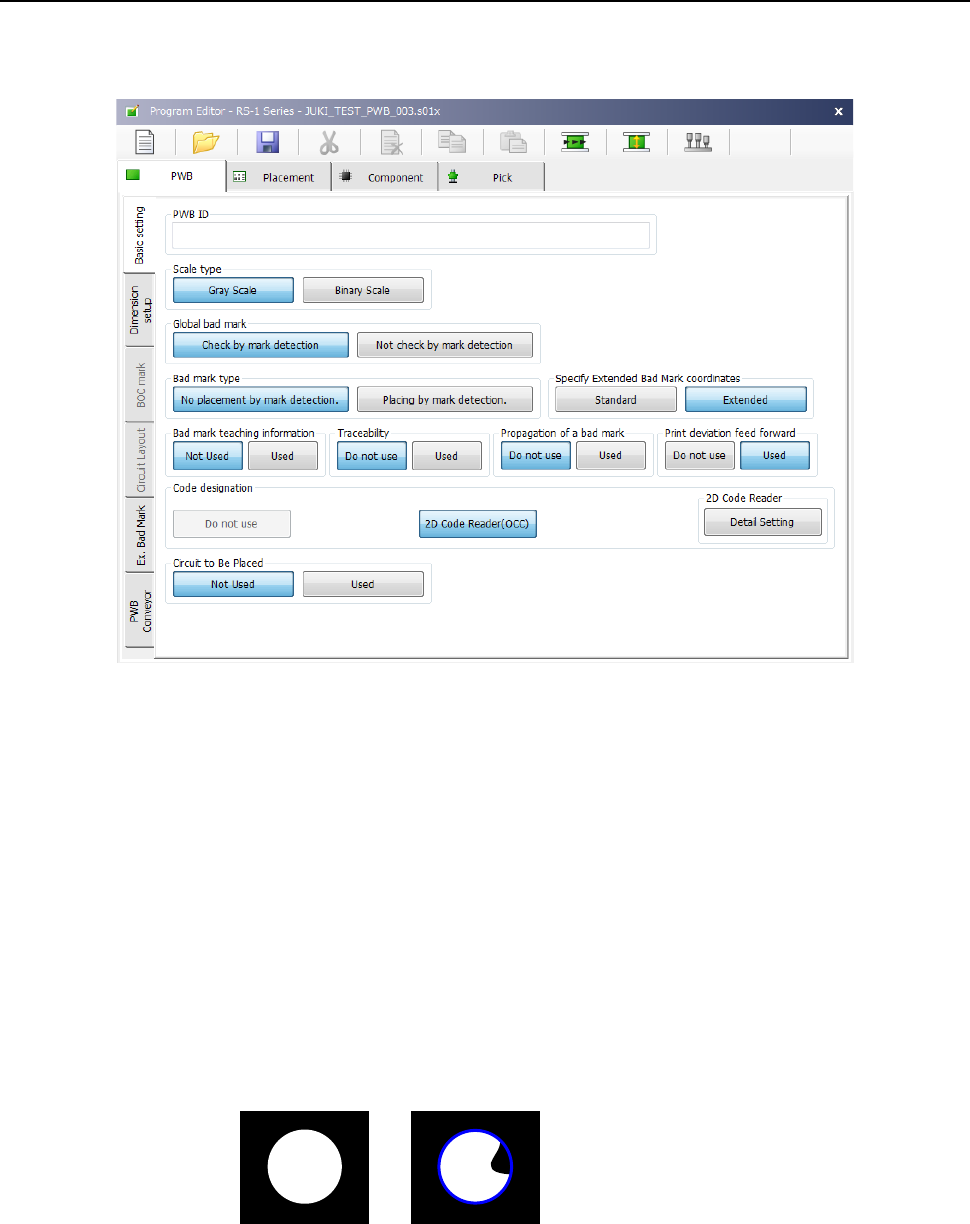
When you select the “Basic setting” tab displayed on the left side of the screen, each item of the
“Basic setting” tab is displayed on the screen.
Enter or select the appropriate items according to a PWB to be produced.
In the PWB data, the following 1) to 11) are set.
1) PWB ID
Enter a “comment” that elaborates on the PWB name.
Up to 60 alphanumeric characters/symbols can be entered.
As this PWB ID is displayed during production program creation and production, we
recommend you to describe an easy-to-understand name.
You can omit the PWB ID.
2) Scale type
For mark (BOC mark and area mark) recognition for the whole PWB, the following 2
methods are selectable.
Selection should be made according to the condition of the BOC mark.
♦ Gray Scale: With all the information obtained by OCC, mark recognition is
performed by matching method.
This method is available even in a high noise environment because much information
is used. Normally select this option.
* If a certain level of coincidence is obtained though the external shape is partially missing,
the recognition result is regarded as OK.
♦ Binary Scale: If an error occur during the gray scale recognition, select binary scale
recognition. If the edge of the mark is not shot clearly, the accuracy will be lower than
that of the gray scale recognition method.
Registration mark
Recognition mark
Part 1 Basic Operation Chapter 4 Creating a Production Program
4-9
3) Global bad mark
Specify whether to recognize a bad mark when the system recognizes a global bad mark.
4) Bad mark type
Specify a component placement operation to be performed when a bad mark is detected.
♦ No placement by mark:
Select this button so that the machine cannot place any component on a board when it
detects a bad mark.
♦ Placing by mark:
Select this button so that the machine can place a component on a board when it
detects a bad mark.
5) Specify Extended Bad Mark coordinates
Specify a position from which the bad mark coordinates are viewed, the origin of a circuit or
that of a board. If you select the “Extend” radio button when you select the “Used” radio
button in the “Multi circuit references” column, the system automatically specifies the
coordinates viewed from the origin of the reference circuit.
♦ Standard: When the bad mark is set at the same position as each circuit,
select this mark.
♦ Extended: This mark can be set at the coordinates having no same space as
the circuit pitch.
6) Bad mark teaching information
Select whether to use the bad mark teaching information of a production program.
7) Traceability (Production management system option)
◆ Not used: Select this item not to use the traceability.
◆ Used: Select this item to use the traceability.
8) Bad mark propagation (Production management system option)
◆ Not used: Select this item not to use the bad mark propagation.
◆ Used: Select this item to use the bad mark propagation.
9) Print offset feed forward (Production management system option)
◆ Not used: Select this item not to use the print offset feed forward.
◆ Used: Select this item to use the print offset feed forward.
10) Code specification
◆ Not used: Select this item not to use the code specification.
◆ Two-dimensional code (OCC): Select this item for production using the two-dimensional
code (OCC).
* When the two-dimensional code (OCC) is selected, the [Detail setting] button is enabled,
so that detail setting can be performed
* Regarding the detail setting, refer to “Instruction Manual for the production management
system.”
11) Circuit to Be Placed
You can select a circuit on which any component is not placed if “Matrix Circuit” or
“Non-matrix circuit” is selected as the “PWB configuration.”