RS-1_instruction manual.pdf - 第445页
Part 1 B asic O peration Chapter 4 Cr eating a Produc tion Progra m 4- 110 2.00mm 2.00mm 0.5mm L1 L2 • Corner recogniti on ① C ompon ent whose shape is squ are or rectan gular ② C ompon ent in which the corner forming an…
Part 1 Basic Operation Chapter 4 Creating a Production Program
4-109
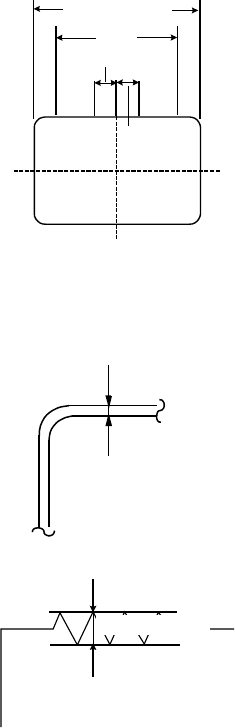
* Recognizing conditions for outline recognition components
• Side recognition
① Component whose shape is rectangular or square
② Component whose linear part of sides corresponds to 1/2 or more of the outer dimension
and yet whose straight line part (linear part) is 3 mm or more
③ Component in which the center part of sides is linear in the range of ±1.5 mm from the
center
Line
segmen
t
1.5mm
1.5mm
Dimension of a
component
④ Component whose component angle is 90° ± 5°
⑤ Component provided with a side part of 0.3 mm or more when the inside of the
component is imaged darkly at photographing (The inner part of the sides may be a
cavity.)
0.3mm以上
⑥ Component in which the roughness of the sides forming a linear part is 0.1 mm or less
0.1mm以下
⑦ Component whose shape is not convex
0.3 mm or more
0.1 mm or less
Part 1 Basic Operation Chapter 4 Creating a Production Program
4-110
2.00mm
2.00mm
0.5mm
L1
L2
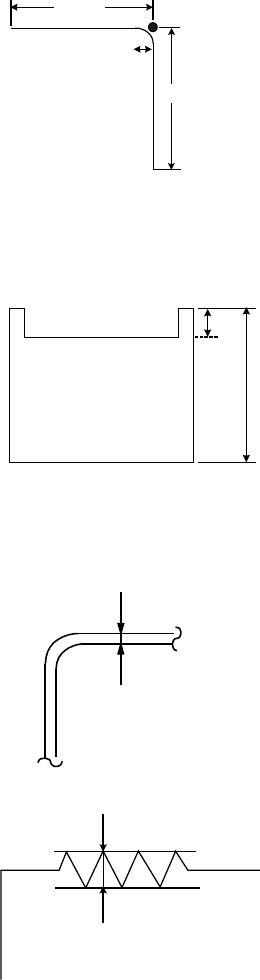
• Corner recognition
① Component whose shape is square or rectangular
② Component in which the corner forming angle (R) is 0.5 mm or less
③ Component in which the length of the linear part forming sides is 2 mm or more
④ Component in which the 4 points of corners form a vertex of a square or rectangle
⑤ Component whose outline is not convex
⑥ Component with concave parts in which L1 is 10% or less of L2
⑦ Component provided with a side part of 0.3 mm or more when the inside of the
component is imaged darkly at photographing (The inner part of the sides may be a
cavity)
0.1 mm
or shorter
⑧ Component in which the roughness of the side forming a linear part is 0.1 mm or less
0.3 mm or longer
• Center-of-gravity recognition
① Component in which the vertical/horizontal ratio is 1:2 or higher
② Component provided with a side part of 0.3 mm or more when the inside of the
component is imaged darkly at photographing
14) General-purpose vision component
See Chapter 6 “General-Purpose Vision Component” for how to create data on a
general-purpose vision component.
Part 1 Basic Operation Chapter 4 Creating a Production Program
4-111
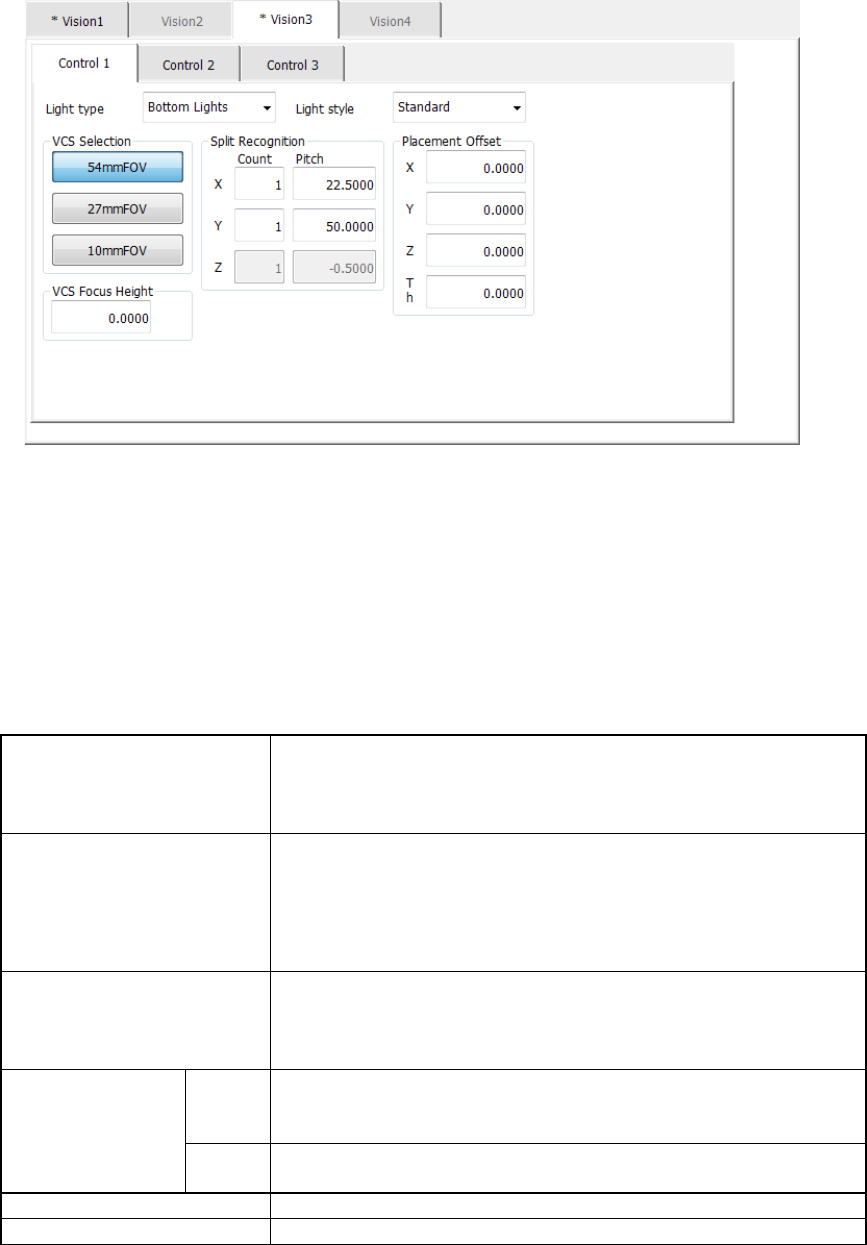
(13) Light control data screen
When you select the “Vision 3” tab, the following screen opens.
The “Control 1” tab allows you to set the light used for a component whose image is divided
to be recognized (split recognition or division recognition).
Set this type of light in the following order:
1. Set a VCS used to recognize a component.
2. Specify the split recognition.
3. Specify the light type and light style (applicable when “Bottom Lights” or “Side Lights” is
selected as the “Light type”).
4. Make other settings.
Light type
Select the light type:
- Bottom Lights
- Back Lights
- Side Lights
Light style
Select the light type in details.
- Bottom
- CBGA
- Side
- Blue
- Standard
- LGA
- Red
- Fine
VCS Selection
Select a VCS used to recognize a component.
- 54mmFOV
- 27mmFOV
- 100mFOV
Split Recognition
Count
Set the number of divisions in each direction, X, Y and Z.
The input range of the number of divisions are: X (1 to 2),
Y (1 to 3) and Z (1 to 2).
Pitch
Set the distance a VCS travels. The value you can enter
here varies depending on the selected VCS.
Placement Offset
Placement offset for each component
VCS Focus Height
Specify the height a VCS recognizes.