RS-1_instruction manual.pdf - 第927页
Part 2 D etaile d Descript ion of E ach Functi on Chapter 12 Handling th e Optional Device s 12 - 43 12.7.2.4 Limitations on t he supported long - sized board - The m achine ca nnot track a compon ent placem ent of a lon…
Part 2 Detailed Description of Each Function Chapter 12 Handling the Optional Devices
12-42
12.7.2.3.3 Notes on a BOC mark
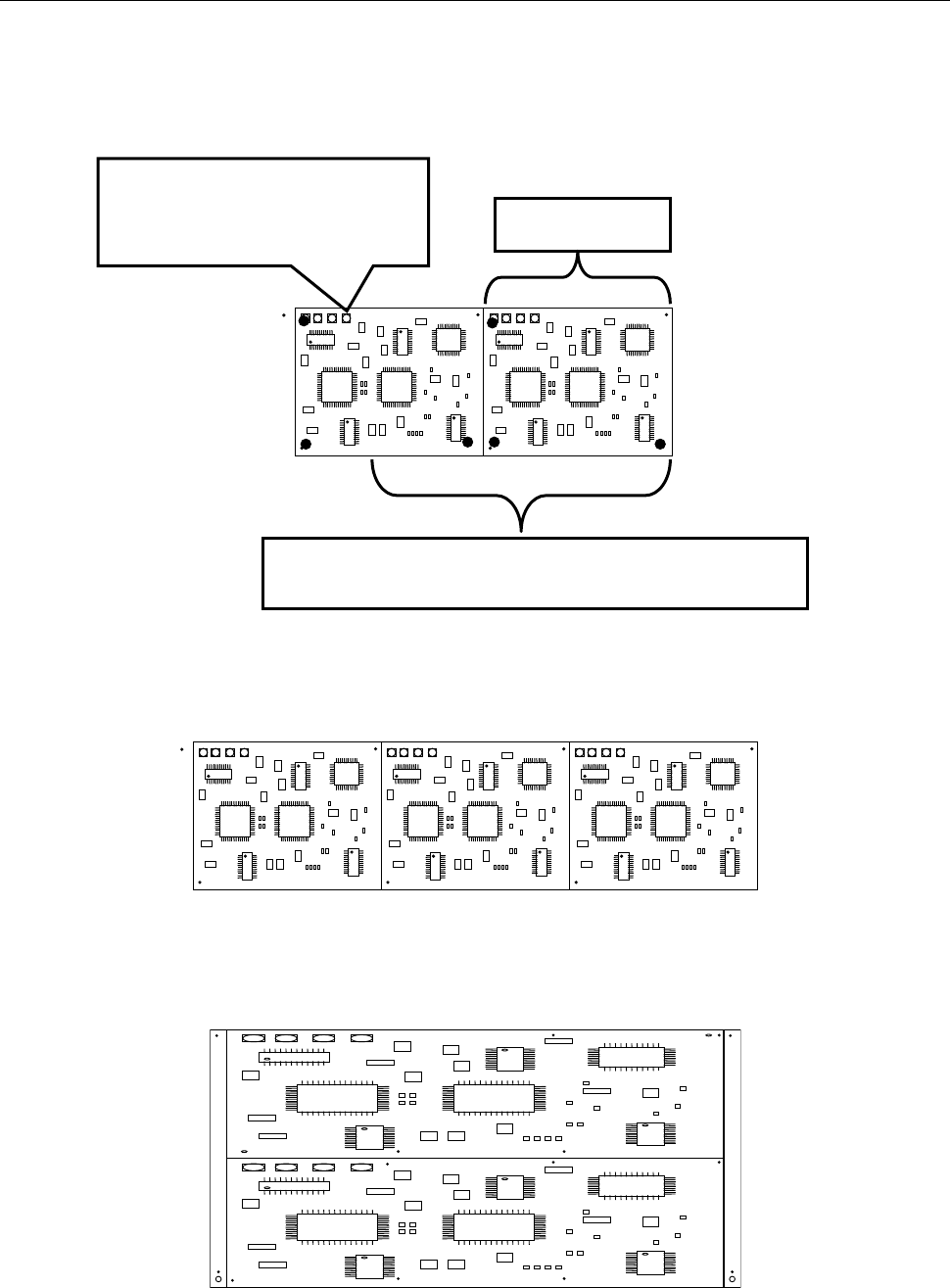
When the outer X-dimension of a multi-plane matrix or non-matrix board exceeds the regulated
size and circuits are divided in the X direction, you can select a mark for each circuit, but the
machine cannot produce any PWB. The machine displays the error before production starts.
An example where the board X-dimension is 900 mm, the long-sized board division position is at a
position 650 mm and a board is divided into two in the X direction is shown below.
When the outer X-dimension of a board exceeds 650 mm and the board is divided in the X
direction as shown below, a BOC mark is located outside the area where a board is to be clamped
for the first time. Therefore, an error is detected before production starts.
When the outer X-dimension of a board exceeds 650 mm and the board is divided in the Y
direction as shown below, any error does not occur even though there is a BOC mark outside the
area where a board is to be clamped for the first time. (You have to enter the second BOC mark.)
Since the mark position exceeds
the first clamping area 650 mm, an
error is detected before production
starts.
Area where a component is placed when a board is
clamped for the first time: 650 mm
450mm

Part 2 Detailed Description of Each Function Chapter 12 Handling the Optional Devices
12-43
12.7.2.4 Limitations on the supported long-sized board
- The machine cannot track a component placement of a long-sized board with a camera
during Try Run or Dry Run operation.
- The machine can track a component placement position of a long-sized board as long as the
corresponding head can move to its coordinates when the [Placement tracking] command is
executed from the “Support” menu.
The machine cannot track any coordinates to which no head can move due to the board
clamping condition.
- When you optimize a production program for a long-sized board by selecting the optimization
option “Assign in optimized order” and optimizing the program, the machine cannot perform
optimization with taking two clamping operations into consideration. Select the option
“Assign in input order of Production Program File” to optimize a program.
- If component placement positions of a circuits are arranged over two areas: area clamped for
the first time and area for the second time, set a bad mark position in the first component
placement area.
- When an MTC is used with the machine, the maximum X-dimension of a board that can be
transported is limited.
Part 2 Detailed Description of Each Function Chapter 12 Handling the Optional Devices
12-44
12.7.3 Function “Change of standby position of a short substrate”
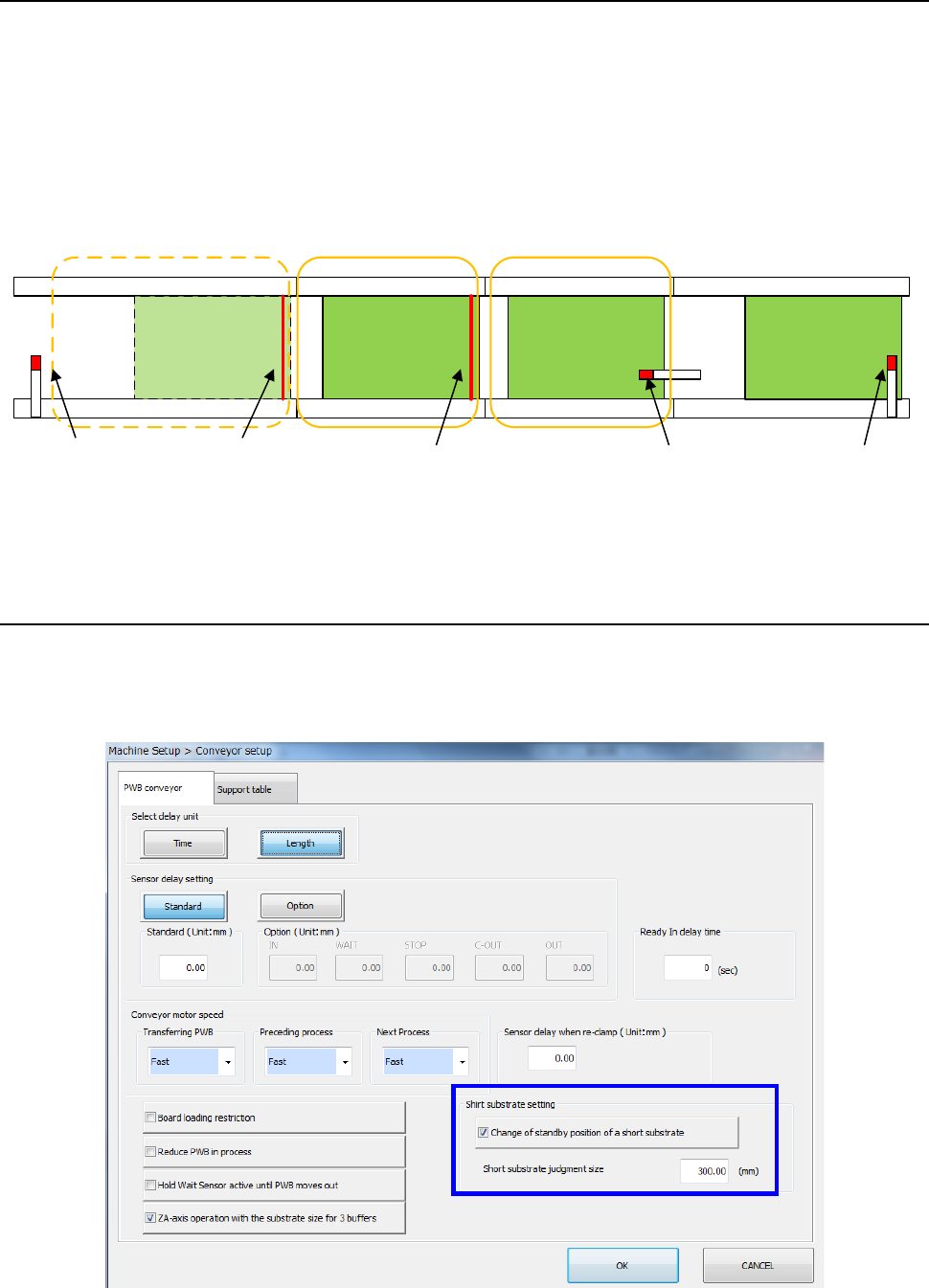
The RS-1/1R is equipped with two WAIT sensors for waiting for a board to be loaded to the
machine. When you change the standby position of a short-sized board (whose X-dimension is
300 mm or less), you can improve the board change cycle time.
When this function is disabled or when the X-dimension of a board exceeds the value set as the
“Short substrate judgment size” of the “Machine Setup” screen, the standby position is located
above the “WAIT sensor” as shown in the figure below.
* When a short-sized board waits above the WAIT2 sensor, the machine does not load the next
board onto the WAIT sensor.
12.7.3.1 How to set (on the “Machine Setup” screen)
Select the [Conveyor setup] command, and then the “PWB conveyor” tab from the “Machine Setup”
screen to check the “Short substrate setting.”
See Section 8.3.3.1 “Conveyor setup” for how to set this item.
IN sensor
WAIT sensor
WAIT2 sensor
OUT sensor
STOP sensor
Normal board
standby position
Short-sized board
standby position
Production position