RS-1_instruction manual.pdf - 第66页
Part 1 B asic O peration Chapter 1 Overv iew of the Machine 1- 48 Center ing s y s tem Instead o f using conv entional me chanical c entering system, this machi ne uses t ouchless centering system wher e LED align s enso…
Part 1 Basic Operation Chapter 1 Overview of the Machine
1-47
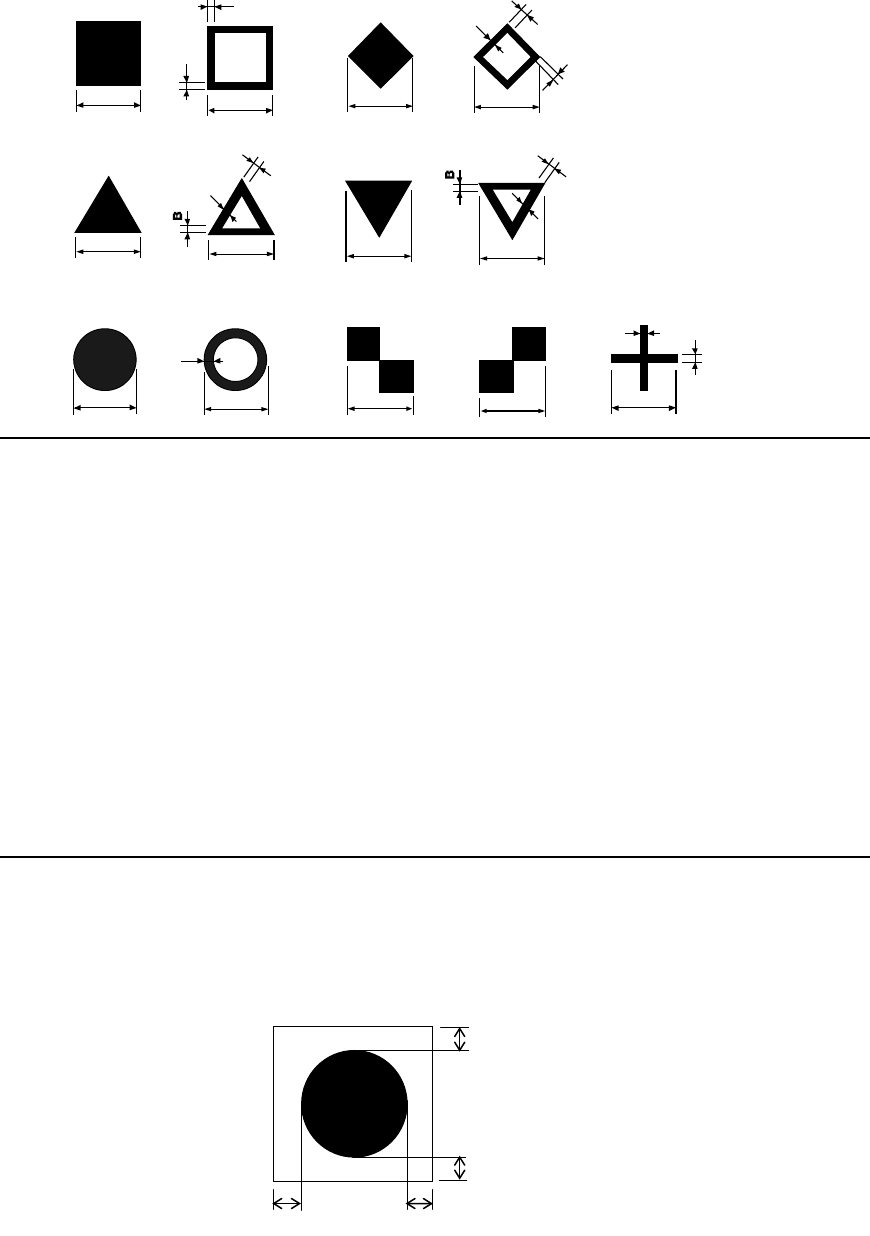
(3) Board Recognition Marks
1) Shape
Create the board recognition marks under the following conditions.
We recommend the filled circle for the mark.
A
C
C
A
B
A
B
B
A
B
A
B
C
C
B
B
B
B
A
C
B
A
C
B
B
Notes:
1. When recognition, the mark shall be placed in the angle shown above.
However, if you specify "Use of each circuit mark" for a non-matrix PWB, the mark can be
recognized only when all marks of the reference circuit are positioned in the angle
described and the circuit is positioned at 90, 180, 270 or 360 degrees.
2. The fiducials of the same shape and same size is preferable within a board.
3. When processing, copper foil or solder plating can be recognized
4. Maximum number of marks which can be registered
Board mark: 2 set (2 marks or 3 marks)
Component positioning mark: 100 sets (Pairs of 2 marks to 3 marks)
5. Items that can be registered
Mark number, Balance detection window, Normal/reverse rotation identification when
detected, Mark shape, Outer dimensions, Effective value of projection, Matching
6. If there is no recognition mark on a board, register a user designated template to allow
the machine to recognize marks
2) Clearance
In the area around each recognition mark, there shall be a space in which any other
component such as a conductor pattern, solder resist and marking is not located.
The dimensions of this space should be a square whose size is larger than the outer area of a
recognition mark by 0.5 mm or more in the X direction and 0.5 mm or more in the Y direction.
A and C sizes:
0.5 to 3.0 mm ± 10 % or
lower
B size:
0.2 mm or longer
Circle
Square
Diamond
Regular
triangle
Up-side-down
triangle
Checker
pattern (1)
Cross
Inside-blank
circle
Inside-blank
square
Inside-blank
diamond
Inside-blank
up-side-down triangle
Checker
pattern (2)
Inside-blank
Regular triangle
0.5 mm or more
0.5 mm or more
0.5 mm or more
0.5 mm or more
Part 1 Basic Operation Chapter 1 Overview of the Machine
1-48
Centering system
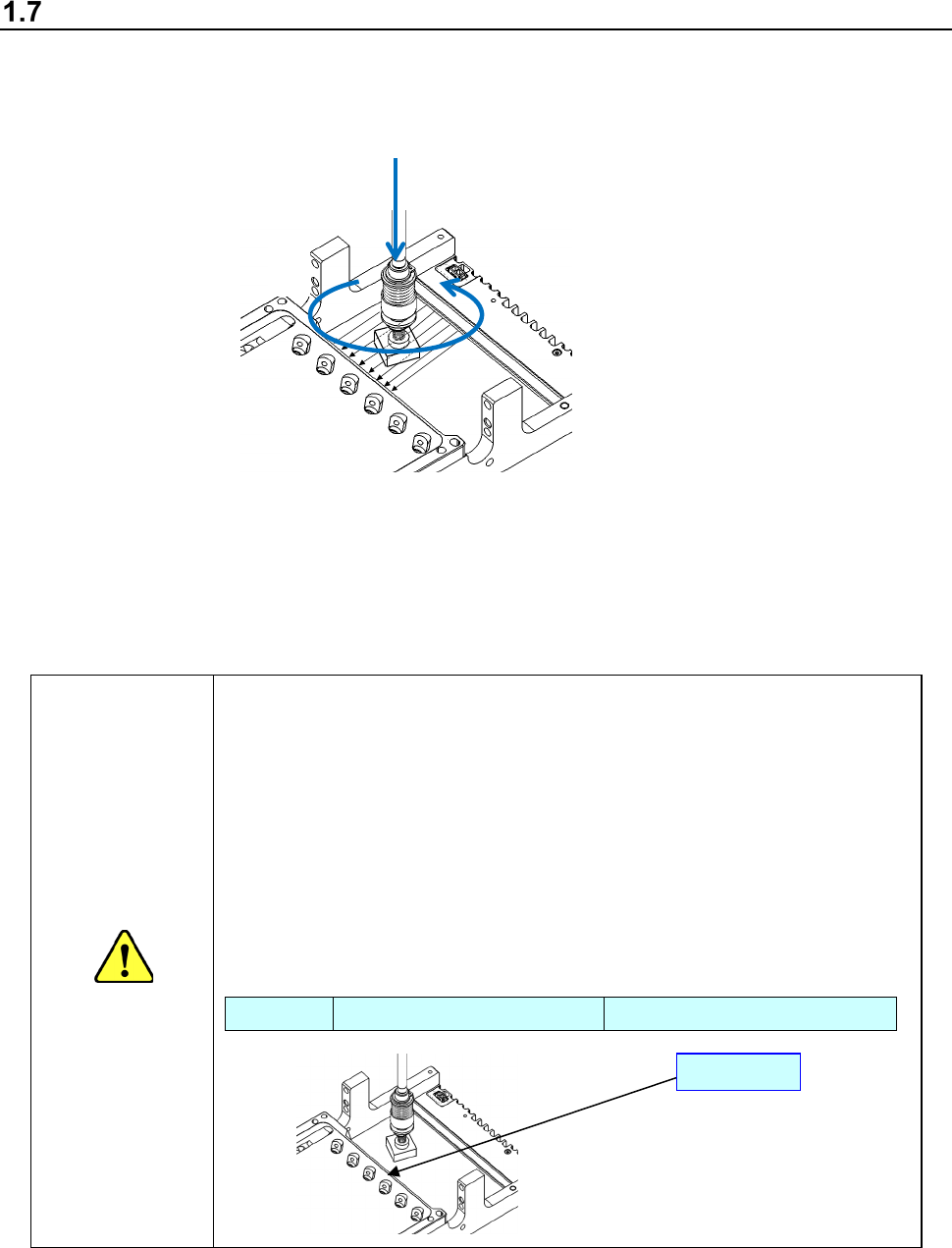
Instead of using conventional mechanical centering system, this machine uses touchless centering
system where LED align sensor is used to read the position and angle of components. This can be
achieved by detecting the shade of the components created by the laser rays applied horizontally to
the components.
LNC120-8
By moving Z-axis up and down, a component is picked with vacuum, and the LED is applied to the
component. A shade is made where the LED is obstructed by the component. By turning the
component along q-axis, the shade changes.
◇ According to the change of the shade, offsets of the position and angle of the picked component
are calculated. These offsets are corrected when mounting.
Caution
<Caution about protection of the laser unit glass>
If the surface of the glass that covers the component detecting section of the
laser unit is scratched, it causes a component recognition error with laser.
Note the following points to use the machine.
1. Do not use any component whose size exceeds the regulated maximum
component size.
2. Even though a component size is the regulated maximum component size
or smaller, the component may become in contact with the glass surface
when you change the component pick-up position.
Specifications (Maximum component size)
LNC120-8 Square component: □ 50 mm Length of a diagonal line: 70 mm
Glass
z
θ
Part 1 Basic Operation Chapter 1 Overview of the Machine
1-49
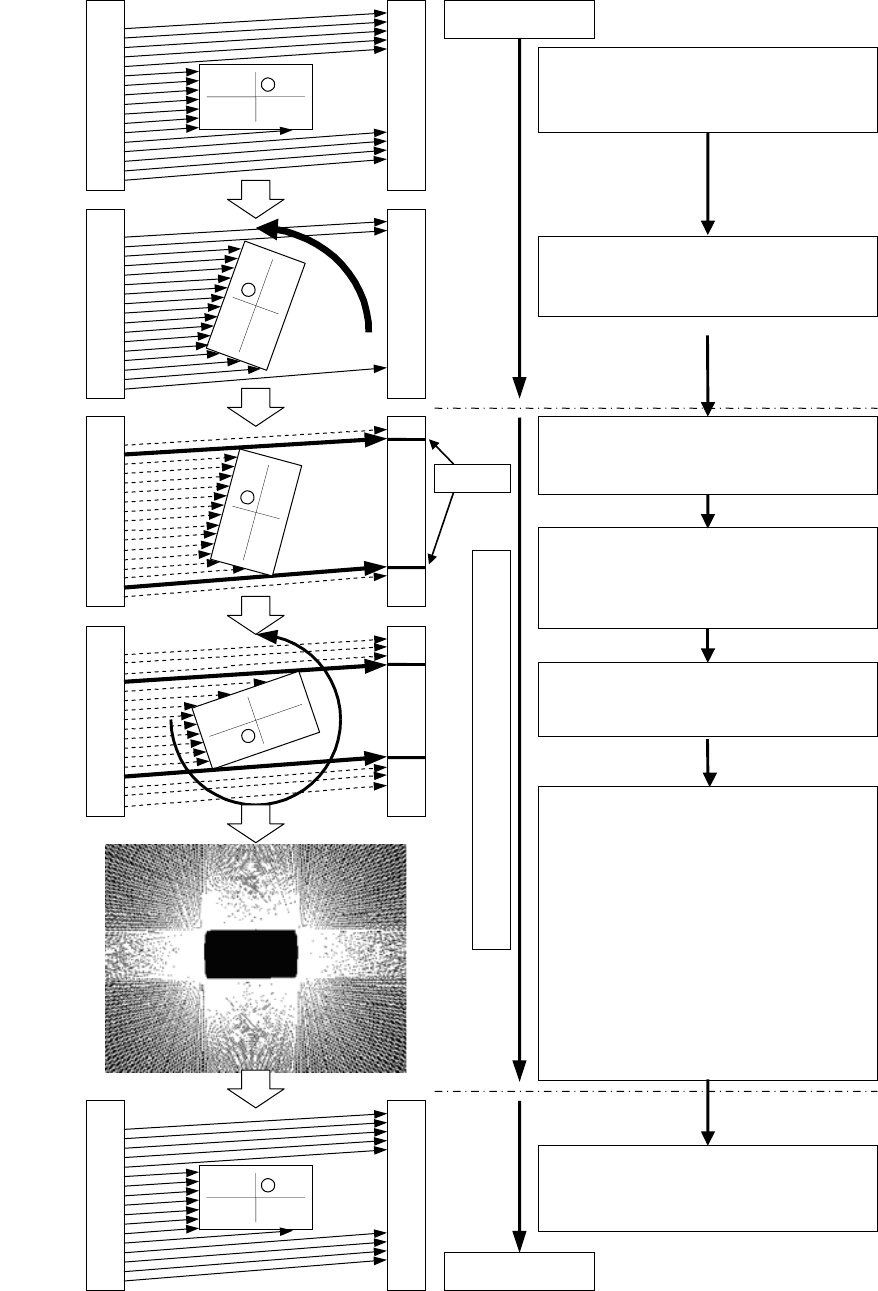
(1) Flow of laser align centering
1) For LNC120-8
①
②
③
④
⑤
⑥
Part attracting
Pick the component by driving
Z-axis, and adjust the
component at laser align height.
Rotation in θ direction starts.
While the θ-axis is accelerating, the system
does not start measuring a component.
Laser align measurement
Edge
When the speed of the rotation in θ direction
reaches the certain value, the system starts
laser align measurement.
Placement
The sensor obtains the edge position of the
area shadowed by a component.
The system saves a beam corresponding to
the edge position as a “tangent line” into the
sensor.
The system obtains the tangent line data on
each angle by rotating the θ axis 360
degrees.
When the θ axis finishes rotating by 360
degrees, the sensor generates and
analyzes the outer shape of a component
based on the tangent line data obtained at
each angle to return the measurement
result to the mounter.
- Component size
(X direction: wX Y direction: wY)
- Distance between the center of the
nozzle rotation and the center of a
component
(X direction: dX Y direction: dY)
- Angle (θ) error: dRz
The system corrects the following errors
and places a component on a board.
Positioning error (dX, dY)
Angle error (dRz)